Occupancy Permit in Slovakia: Why a Finished Hall Waits

An occupancy permit is the last item anyone puts time against in a delivery programme and the first one that stops a move-in. The Slovak rule is blunt: a completed building may be brought into permanent use only after the kolaudacia, the inspection that ends with a certificate. Since 1 April 2025 that inspection sits in a new Building Act, and because of the way its transitional rules are written, many halls being handed over in 2026 are still being completed under the old one. Two regimes, two documents, two sets of deadlines. Here is what each requires, how long it takes when nothing goes wrong, which two doors let an occupier in early, and what moving in too soon costs.

Why a completed hall is not a usable hall

One sentence governs everything. Section 66(1) of the new Building Act 25/2025 Z. z. reads, in the original: “Dokoncenu stavbu alebo jej cast sposobilu na samostatne uzivanie mozno uviest do trvaleho uzivania az po kolaudacii.” A completed building, or a part of it capable of separate use, may be brought into permanent use only after the kolaudacia. Not after practical completion, not after the handover protocol is signed, not after the keys change hands.

The document at the end is the kolaudacne osvedcenie, the occupancy certificate, and section 67(2) says what it certifies: the structural and technical fitness of the building for its designed purpose. Two limits sit next to it. Section 67(3) states that the certificate does not replace an operating permission under other legislation, so the hygiene, environmental and fire approvals a process needs sit on the same critical path. Section 68(1) states that a building may be used only for the purpose set out in the certificate, which is where a permitted use clause in the lease itself and the permit have to agree.

That is what catches conversions. A hall certified for storage is not certified for production, and a change in the prevailing use, or a change in the technical parameters that alters the fire safety of the building, needs its own decision under section 68(2). In a converted building the paper trail is usually older than the use somebody now has in mind. The same certificate comes back into view at the end of a lease, because the state the building has to be handed back in is the state the certificate describes.

Which act applies to your building
Which act applies to your building

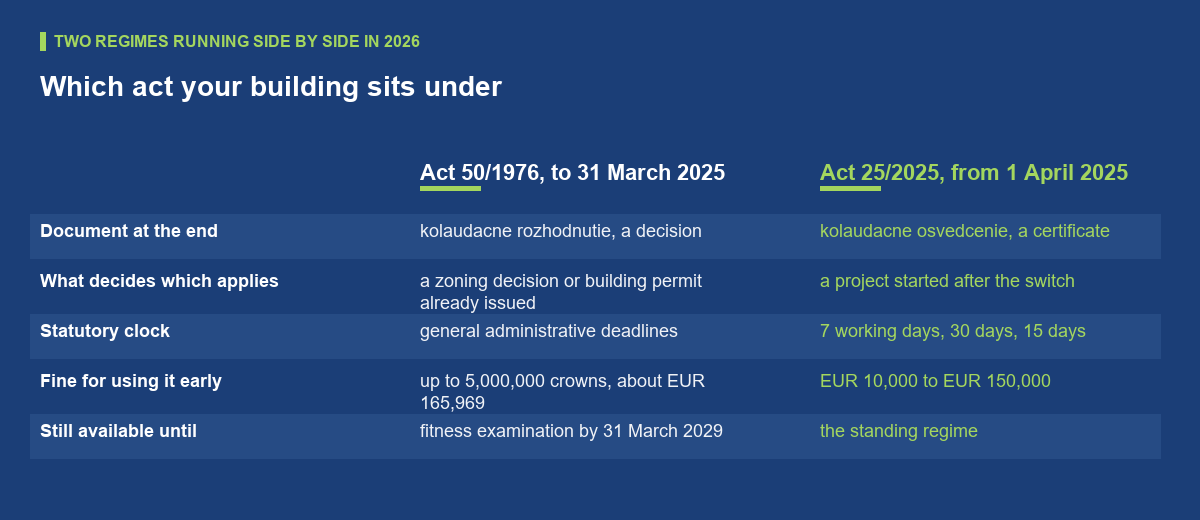
Here is the part that surprises even experienced occupiers. Act 50/1976, which had governed the kolaudacia since 1976, applied until 31 March 2025. The new act took over on 1 April 2025. But sections 84(4) to 84(6) keep the old rules alive: they apply to anything filed or started by 31 March 2025, and, more importantly, to any building that already held a zoning decision or a building permit under the old act, including applications made long after the switch.

For a hall completed in 2026 this is decisive, because the zoning decision behind it was typically issued in 2022 or 2023, back when land prices were the constraint everyone talked about. That building will be inspected under the old act and will receive a kolaudacne rozhodnutie, a decision under section 76(1) of the old law, not the certificate the new act describes. A speculative unit started after the switch will receive the certificate. Both are lawful, and English-language market guidance mostly still describes the older one.

The practical instruction is short: before signing, ask which regime the building sits in and get the answer in writing, ideally already at heads of terms stage. It changes the name of the document your start date depends on, the deadlines the authority has to meet, and the size of the fine if the building is used too early. On a build-to-suit it also decides which rules the design has to satisfy.

How long the occupancy permit takes when nothing goes wrong
How long the occupancy permit takes when nothing goes wrong

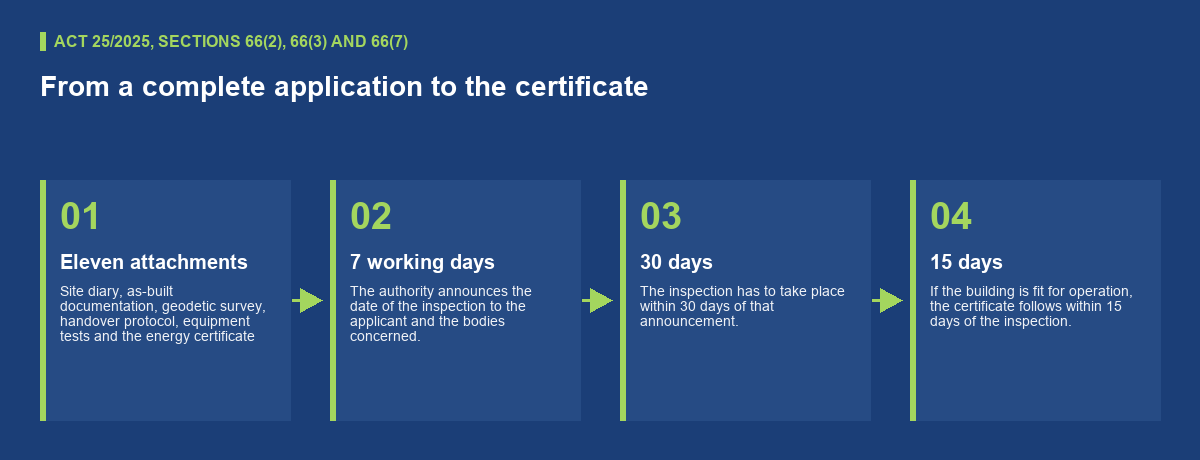
The new act puts the sequence on the clock. Under section 66(3) the authority has seven working days from a complete application to announce the date of the inspection, and the inspection has to take place within 30 days of that announcement. Under section 66(7) the certificate follows within 15 days if the building is found fit for operation.

Adding those periods is our own arithmetic rather than anything the act states: roughly 52 calendar days from a complete application to the certificate where no defect is found. The word carrying all the weight is “complete”. Section 66(2) lists eleven attachments, from the site diary and the as-built documentation to the handover protocol, the equipment tests and the energy certificate, which is the item that most often arrives last. The energy rules around it keep tightening, and it is also the first document that tells a tenant what the energy bill will look like.

The inspection is not a formality either. Section 66(4) lists what the authority checks on site, and two items regularly slip: whether the building is connected to the functioning technical networks of the area, and whether rainwater is captured or drained so that it does not burden the surroundings. A grid connection ordered late becomes visible at exactly this point, the same constraint that decides where a data centre can go.

Failure is handled just as plainly. Section 66(5) has the authority record the defects, set a period and interrupt the process, section 66(6) stops it if they are not removed in time, and section 66(8) stops it outright if the building was put up contrary to the verified project. A schedule of condition taken at handover earns its keep here, and the defects liability period runs on a timetable of its own. A fit-out contribution that funds work outside the verified project is the related risk: a change nobody re-verified can hold up the certificate for the whole building.

The two doors that open a building early
The two doors that open a building early

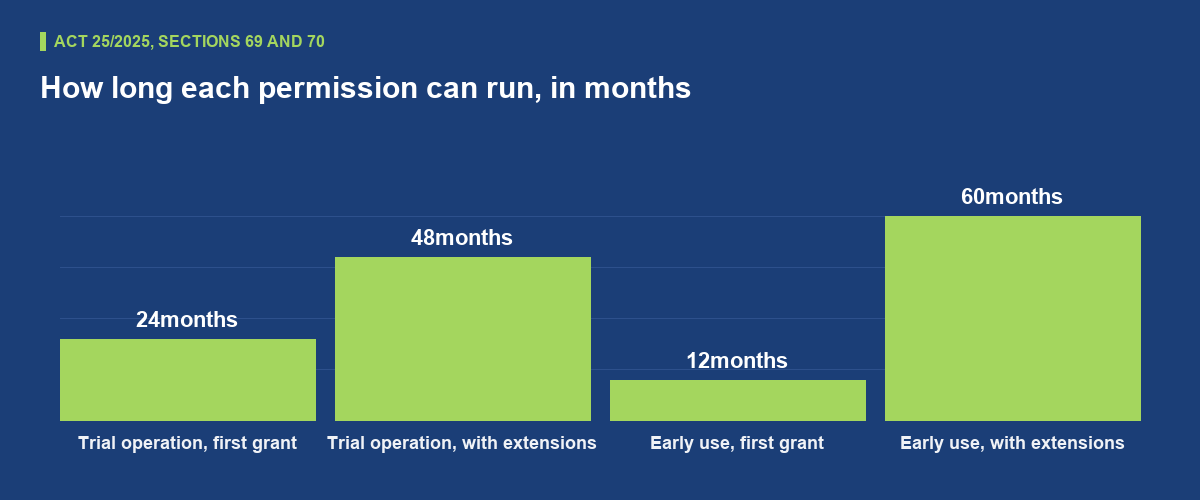
Slovak law provides two lawful ways into a building before the certificate exists, and they are not interchangeable. Trial operation under section 69 is for the case where fitness for use can only be verified by running the building. It is granted for at most 24 months, extendable for operational reasons but never beyond four years in total, and the authority decides within 30 days. The evaluation protocol it produces becomes an attachment to the kolaudacia.

Early use under section 70 is the other door: use of a building, or a part of it capable of separate use, before it is finished. It runs for at most 12 months, extensions are possible up to five years in total, and it needs the written agreement of the contractor and the designer to the conditions. Both permissions expire the moment the certificate is issued, under sections 69(6) and 70(5).

For a tenant this is a drafting question rather than a legal one. A lease that ties the start of the term or the rent commencement to “kolaudacia” names an event with three candidates: early use, trial operation and the certificate. Name the one you mean, say what happens to the rent-free period if it slips, and keep the fallback in the lease rather than in a side letter that a buyer of the building is not party to. Settle the running costs of the early period in the same place: heating, lighting and security during trial operation do not belong in the service charge by default. On a pre-let with a fixed handover date that clause is worth more than an argument about the prime rent, because it moves the effective rent without touching what occupiers actually pay on paper.

What using it too early costs

The new act prices early occupation seriously. Section 80(4)(c) requires the building inspectorate to impose a fine of between EUR 10,000 and EUR 150,000 on an entrepreneur or a legal person that uses a building without the occupancy certificate or contrary to it, or that, as owner, allows such use. Both ends of that sentence matter: the floor is mandatory, and the landlord who hands over the keys early is exposed alongside the tenant who walks in.

Under the old act the picture differs. Section 106(3)(d) of Act 50/1976 covers the same conduct with a fine of up to 5,000,000 Slovak crowns, an amount the text still carries in the old currency; at the statutory conversion rate of 30.1260 crowns to the euro that is EUR 165,969.59, and the conversion is ours. The old regime has the higher ceiling and no floor, the new one a lower ceiling and a hard minimum. Smaller failures are cheaper: under section 80(1)(a), not producing the energy certificate of a non-residential building within the period set at the kolaudacia carries EUR 100 to EUR 500.

One transitional door is still open for older stock. Section 84(7) lets an owner apply under the old rules for an examination of a building’s fitness for use, or for additional permission where it does not qualify, provided the application is filed by 31 March 2029. That is the window for a hall whose paperwork never caught up with its extensions. With 203,200 square metres under construction, pre-lease levels at just 35 per cent and the vacancy rate at 7.72 per cent in the first quarter of 2026, most of what is being built is speculative, so the certificate usually lands before the tenant does. It is the pre-let and the build-to-suit where the permit sits on somebody’s move-in date, and that is the pattern wherever a new anchor plant pulls its suppliers in, as in eastern Slovakia.

Conclusion

In Slovakia the building is finished twice: once by the contractor and once by the authority, and only the second one lets anybody in. Since 1 April 2025 two regimes have been running side by side, and which one applies to a given hall was settled years earlier by the decision that started it. Ask which act your building sits under, count the eleven attachments before counting the days, and make the lease name the exact event your start date hangs on. The occupancy permit is not paperwork at the end of a project. It is the last condition precedent nobody wrote down.
Send us the delivery programme for the unit you are about to sign, and we will tell you which permit regime it sits in, which document your start date actually depends on and what the fallback looks like if the certificate slips.

Warehouse Energy Costs in Slovakia: What a Hall Spends

Rent gets negotiated to the second decimal place and service charges are argued line by line, but warehouse energy costs usually arrive on a separate invoice from a separate company and nobody in the property team ever sees them. That is a mistake worth about fifteen per cent of the rent. Slovakia has quietly become one of the more expensive places in Central Europe to run an electric load, while its gas remains cheap, and that combination decides more about your next building than the headline rent does. Here is the arithmetic, from official price data, and what it changes.

Where warehouse energy costs actually land per square metre

Start with consumption, because nobody publishes it for Slovakia. The best public measurement of what a warehouse actually uses comes from the British statistics office: ND-NEED 2024 reports metered consumption for England and Wales in 2022, and puts the median warehouse at 26.59 kilowatt hours of electricity and 54.74 kilowatt hours of gas per square metre a year, across roughly 75,000 and 20,000 buildings respectively. Both figures have fallen by about a quarter since 2012, mostly through lighting. A cold store or a heavily automated hall sits well above those medians.

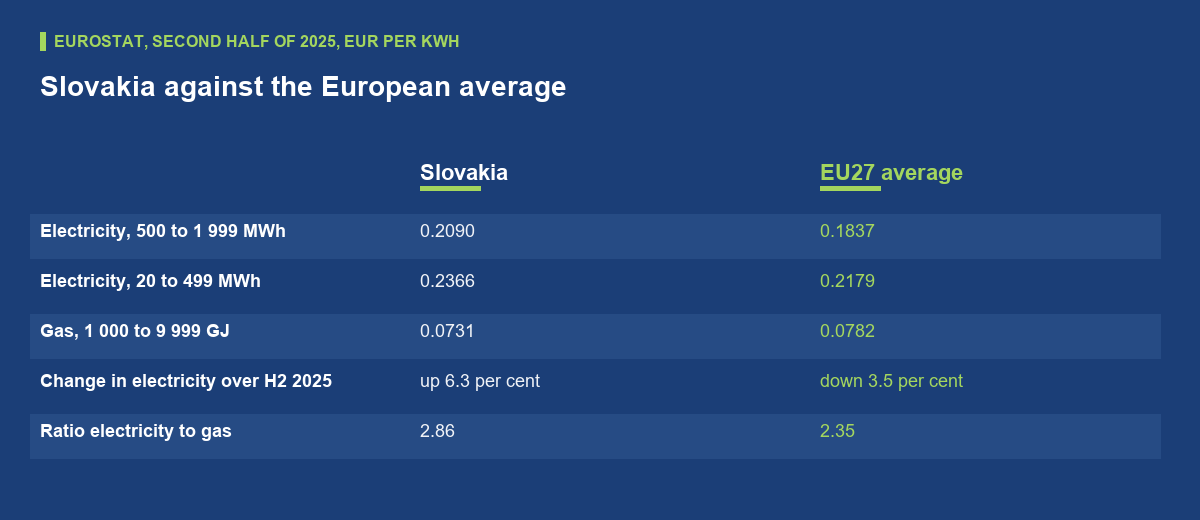
Now apply Slovak prices. In the second half of 2025, Eurostat puts industrial electricity for a mid-sized consumer, the band from 500 to 1,999 megawatt hours a year, at EUR 0.2090 per kilowatt hour excluding recoverable taxes, and gas for the comparable band at EUR 0.0731. Multiply through and a Slovak hall spends roughly EUR 5.56 per square metre a year on electricity and EUR 4.00 on gas. Together that is EUR 9.56 a year, or EUR 0.80 per square metre per month.

Set that against a prime rent of EUR 5.30 per square metre per month in the first quarter of 2026 and the energy bill is fifteen per cent of the rent line. It is not a rounding error and it is not in your rent review. The combination is ours: British medians on Slovak prices, offered as an order of magnitude rather than a measurement of your building.

Why the electricity side is the expensive one

Why the electricity side is the expensive one

The interesting part is not the total, it is the split. On the same Eurostat series, second half of 2025, Slovakia sits at EUR 0.2090 per kilowatt hour against Czechia at 0.1825, Poland at 0.1915, Austria at 0.1986 and an EU average of 0.1837. Only Hungary at 0.2132 and Germany at 0.2264 are dearer. Slovak industry pays about fourteen per cent more for a kilowatt hour than the European average and about the same premium over its Czech neighbour.

The direction matters more than the level. In the first half of 2025 Slovakia was at 0.1967 and the EU average at 0.1903, a gap of three per cent. Over the next six months the Slovak price rose 6.3 per cent while the EU average fell 3.5 per cent. The smaller consumption band, 20 to 499 megawatt hours, did the same thing: Slovakia up from 0.2200 to 0.2366 while the EU average fell from 0.2291 to 0.2179. Two bands, one direction, and it is the opposite of everyone else.

Part of that is regulated rather than traded. The regulator amended its decree in November 2025 and the regulated commodity price moves from 61 to 104 euros per megawatt hour for 2026, with a discounted rate of 72.70 for the protected segment, and distribution and system tariffs added on top in separate proceedings. A large industrial supply is bought on the market, not at that price, but the regulated components sit in every bill.

The gas side tells the opposite story

Gas is where Slovakia looks good. On the Eurostat gas series for the 1,000 to 9,999 gigajoule band, second half of 2025, Slovakia is at EUR 0.0731 per kilowatt hour against an EU average of 0.0782 and Austrian and Polish prices of 0.0793 and 0.0776. Only Czechia at 0.0715 and Hungary at 0.0626 are cheaper. A Slovak occupier heating a hall with gas is paying below the European average to do it.

Put the two together and you get the number that actually matters, which nobody quotes: the ratio. In Slovakia a kilowatt hour of electricity costs 2.86 times a kilowatt hour of gas. In Czechia the ratio is 2.55, in Poland 2.47, in Austria 2.50, and across the EU 2.35. Only Hungary, at 3.41, is more lopsided. Slovakia is not an expensive energy market. It is a market with an unusually wide spread between the two media.

That spread is why the same building costs different money in different countries even at identical consumption. Run the same hall in Czechia and the annual bill is EUR 8.77 per square metre against EUR 9.56 in Slovakia. On 10,000 square metres that is about EUR 7,900 a year, roughly what 125 square metres of prime space costs to rent. Small on its own, permanent over a ten-year term.

What the ratio does to every electrification project

What the ratio does to every electrification project

Now the part that turns a price table into a decision. Every regulatory push in front of you moves energy from the cheap medium to the expensive one. The European Commission defines a zero-emission building as one that “has no on-site carbon emissions from fossil fuels and a very high energy performance”, mandatory for new public buildings from 1 January 2028 and for all new buildings from 1 January 2030. Certificates are tightening on the same schedule, and automation adds electric load to a building that used to be mostly empty air.

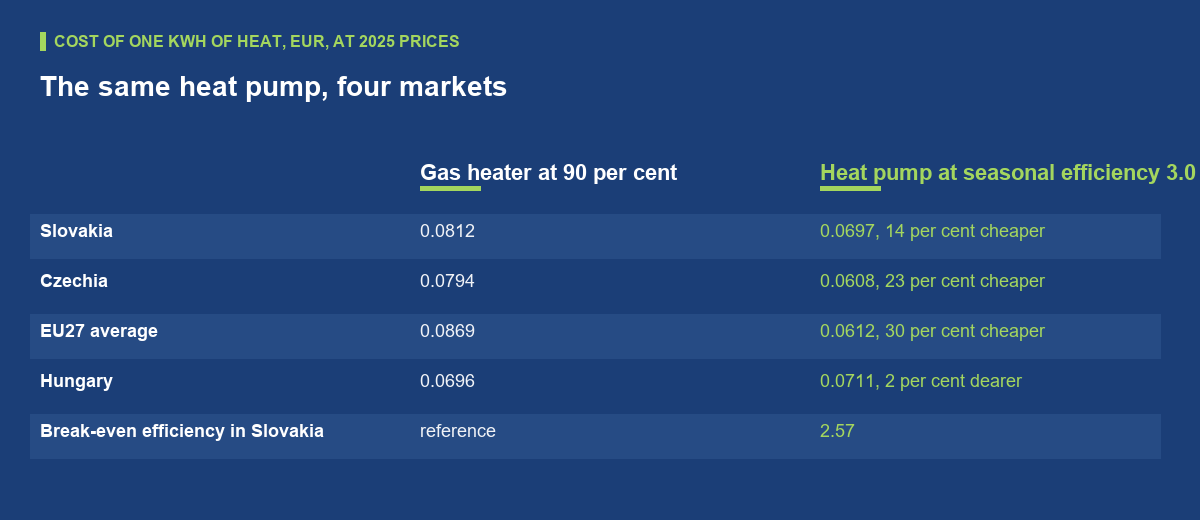
So price the swap. A gas heater at ninety per cent efficiency delivers a kilowatt hour of heat for EUR 0.0812 at Slovak prices. A heat pump at a seasonal efficiency of 3.0 delivers the same kilowatt hour for EUR 0.0697. The heat pump wins, by fourteen per cent. Run the identical machine on Czech prices and it wins by 23 per cent, on the EU average by 30 per cent, and on Hungarian prices it loses by two per cent. Same equipment, same physics, different answer, purely because of the ratio.

The practical form of that is a threshold. In Slovakia a heat pump has to beat a seasonal efficiency of 2.57 to be cheaper to run than the gas heater it replaces. At the EU average, 2.11 is enough. If the machine you are being offered is quoted at 2.8 on a test bench, a Slovak winter in a badly sealed hall will spend that margin. Ask for the seasonal figure at the design temperature, in writing, before the payback slide.

What to put in the lease before any of this matters

What to put in the lease before any of this matters

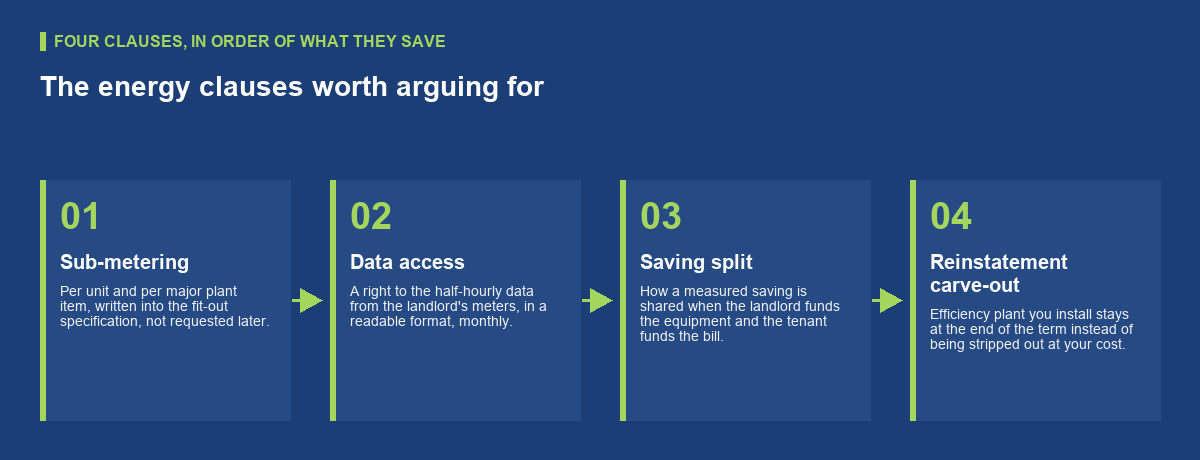
Most of this is decided by documents rather than by equipment. First, metering. If the hall is not separately metered for power and heat, the service charge becomes the only mechanism you have, and the full breakdown of that charge is a different argument with a different counterparty. Sub-metering per unit and per major plant item is cheap at fit-out and impossible to retrofit cheaply.

Second, who owns the improvement. If the landlord pays for the roof and you pay for the power, a rooftop array or a heat pump saves the tenant money and improves the landlord’s asset. That split is the classic reason nothing happens. A green lease clause that lets the landlord recover part of a measured saving is the usual fix, and it is far easier to write at heads of terms than at year four.

Third, the term. Retrofit economics need years, and a certified building carries its own value into the taxonomy tests that lenders apply. With vacancy at 7.72 per cent and renegotiations running at 54 per cent of demand, landlords are competing. Clauses that cost the landlord no cash today are the ones a tenant wins, and they change the effective rent more reliably than another ten cents off the headline.

Conclusion

Slovakia is not an expensive place to heat a warehouse. It is an expensive place to run one on electricity, and the gap widened in the same half-year in which the rest of Europe got cheaper. That matters because every rule now in front of occupiers moves load from gas to power. The projects still pay in Slovakia, but with roughly half the margin the European average would give you, so the assumptions have to be checked rather than accepted. Ask for the meter data before the payback model, and ask for the metering clause before the machine.

Send us the meter data and the lease for the hall you are in, and we will tell you which part of that bill is the building, which part is the tariff and which part is negotiable at the next renewal.

The Volvo Ripple: What Nitra Tells Us About Eastern Slovakia

Every conversation about eastern Slovakia now starts with the car plant at Valaliky. The expectation attached to it is simple: a factory that size arrives, suppliers follow, and the warehouse market around Kosice grows to meet them. The expectation is reasonable and largely untested, because Slovakia has run this experiment exactly once before. Jaguar Land Rover opened at Nitra in October 2018 with a comparable plant. Eight years of market data later, we can measure what that did to the leasable stock nearby. The answer is more useful than the forecast, and it points occupiers at a different set of decisions.

How tight is the Kosice market before the plant even starts?

How tight is the Kosice market before the plant even starts?

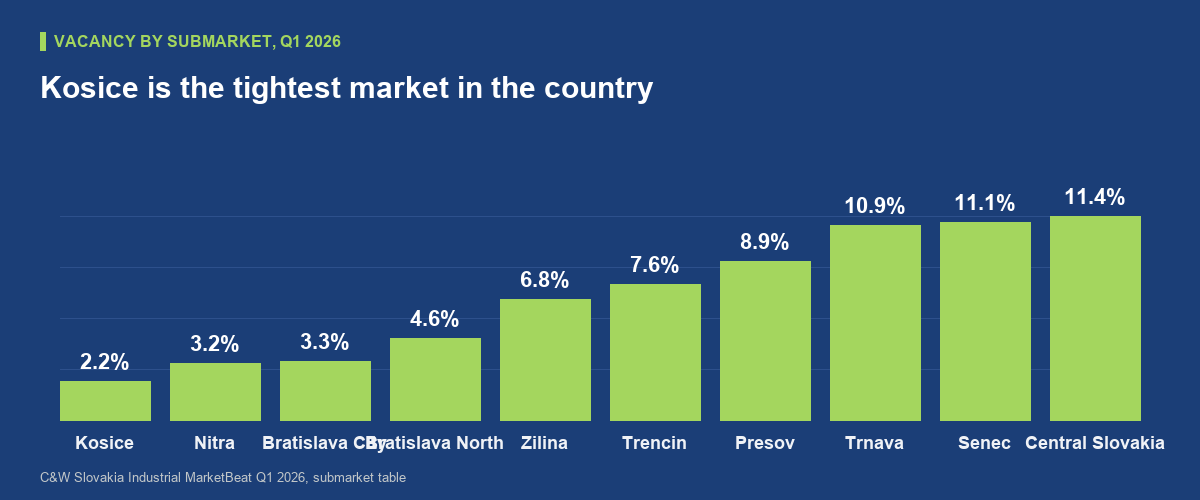
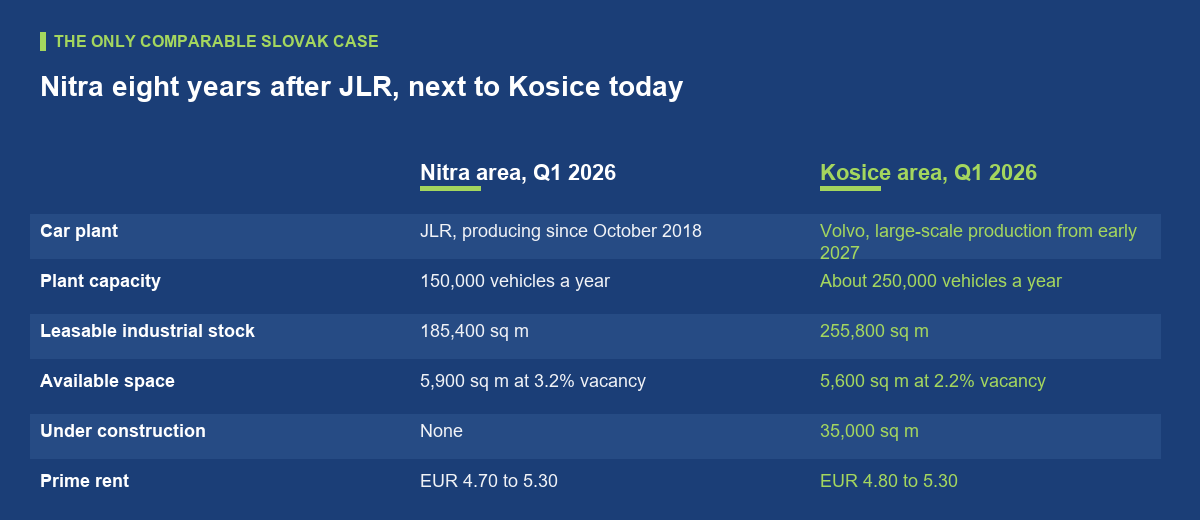
Tighter than anywhere else in the country. The submarket table in the Cushman and Wakefield Slovakia Industrial MarketBeat for Q1 2026 puts the Kosice area at 255,800 square metres of stock with 5,600 square metres standing available, a vacancy rate of 2.2 per cent against a national 7.72 per cent. No other Slovak submarket is that tight. Prime rents in the area run EUR 4.80 to 5.30 per square metre per month, and the report notes that “prime achievable rents held up better in lower-vacancy regions such as the Kosice, Zilina, and Nitra area” while rents softened almost everywhere else. Two numbers explain the paradox. Eastern Slovakia took roughly 42 per cent of all Q1 completions, 44,159 square metres, so the east is being built. But the demand side of the same quarter reads “Greater Bratislava remained the most attractive for leasing activity, capturing 91,110 sq m, followed by Western Slovakia with 29,400 sqm”, and the Kosice area records only 8,300 square metres of quarterly take-up. The new eastern space is not sitting empty, it is being spoken for before completion: the quarter’s largest eastern delivery, CTPark Kosice at 26,500 square metres, arrived 100 per cent pre-let. A market can look calm in the take-up column and still leave a newcomer with nothing to view, and the smaller units around the city already carried a premium before any of this, as we set out in our note on last-mile space in Bratislava and Kosice.

What did Nitra actually deliver after Jaguar Land Rover?

What did Nitra actually deliver after Jaguar Land Rover?

This is the part worth sitting with. Jaguar Land Rover opened its Nitra plant on 25 October 2018: a EUR 1.4 billion facility of 300,000 square metres, annual capacity 150,000 vehicles, one of the four carmakers along the Slovak automotive belt we mapped separately, around 1,500 people at opening with a further 850 recruited, and a supply chain effect the company described as having “sourced and localised a number of components, such as seats and wheels, to support production of the Land Rover Discovery in Nitra delivering several thousand additional jobs in the automotive supply chain in Slovakia”. By any measure the plant worked. Now look at the leasable market it sits in. Eight years on, the same C&W table gives the Nitra area 185,400 square metres of stock, the third smallest submarket in Slovakia, with 5,900 square metres available, 3.2 per cent vacancy, and nothing under construction. For comparison, the Trnava area alone holds 933,100 square metres. A plant that put several thousand supply chain jobs into a region did not produce a large rental warehouse market around it. The reason is structural rather than surprising: tier-one suppliers to a car plant build their own facilities on serviced land in the state industrial park, on built-to-suit terms or as owner-occupiers. Those buildings never enter the leasable stock a market report counts, which is why the land market we covered in what Slovak plots actually trade at moves before the rent table does.

So when does the ripple actually arrive?

So when does the ripple actually arrive?

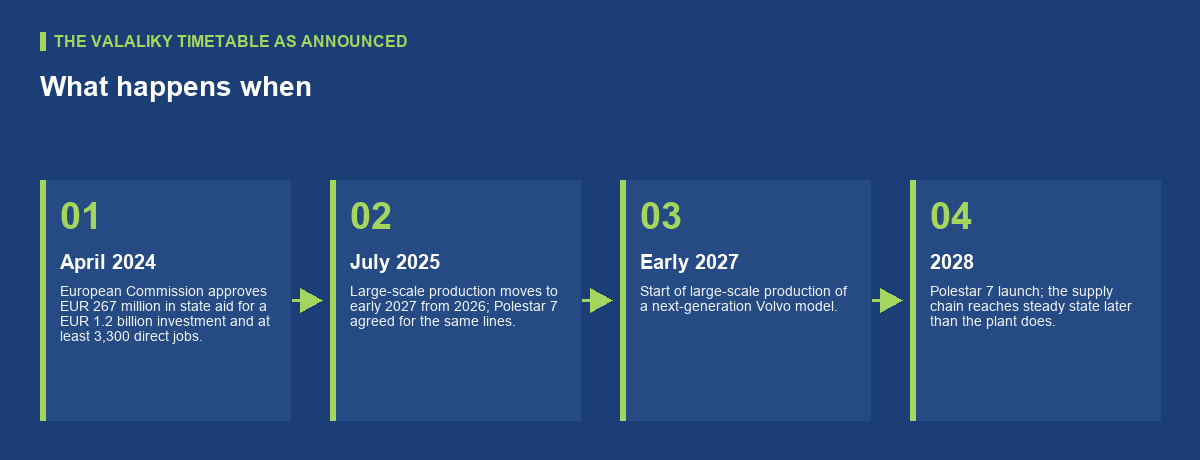
Later than the plan most occupiers are working from. The European Commission approved EUR 267 million of Slovak state aid on 8 April 2024 for a EUR 1.2 billion investment at Valaliky, at least 3,300 direct jobs and an initial capacity of about 250,000 electric vehicles a year, in an area eligible for regional aid under Article 107(3)(a) and identified as a Just Transition Fund territory. That aid framework is the same machinery we described in our note on incentives and state aid. The timetable then moved: large-scale production slipped to early 2027 from 2026, and the Polestar 7 agreed for the same plant is a 2028 launch, with Volvo’s chief executive putting the logic plainly, “Sharing the plant would be really good for us because, at the end, it’s a cost that has to be carried with production volume in the factory”. For a supplier that sequence matters more than the headline. Volume ramps after start of production, not at it, and a second model in 2028 means the supply chain reaches steady state later still. A five-year lease signed in mid-2026 spends its first year serving a plant that is commissioning, and expires roughly when the second programme matures. That is a timing mismatch, and it is fixable at the heads of terms stage rather than later.

Where will eastern Slovakia find the workforce?

Not in the city, on the current numbers. Registered unemployment by district from the Employment Institute for June 2026 puts the four Kosice city districts between 3.16 and 3.73 per cent, which is close to Bratislava’s 2.58 to 3.23 per cent and effectively means the urban labour pool is spoken for. The slack sits in the ring around it and further out: Kosice-okolie at 6.18 per cent, Michalovce 6.92, Trebisov 8.18, Sobrance 8.33, then Sabinov 9.45, Vranov nad Toplou 11.14, Kezmarok 11.99, and Rimavska Sobota at 13.85 per cent, the highest in the country. A plant recruiting at least 3,300 people plus its suppliers will draw across that whole map, which turns bus routes and shift patterns into a site selection criterion, exactly the argument we made in our note on labour availability as a site-selection factor. The practical consequence for an occupier choosing between two sites near Kosice is that the cheaper plot 30 kilometres out may sit closer to the available workforce than the expensive one at the gate, and that the competitor for those workers is no longer the warehouse next door. It is a car plant with an automotive wage structure.

What should an occupier do about it now?

Four things, in this order. First, treat pre-letting as the default, not the premium option: with 5,600 square metres available across the entire Kosice area and the quarter’s biggest delivery fully committed before handover, waiting to view standing space is not a strategy. Second, look at Presov. The neighbouring submarket holds 212,100 square metres of stock with 18,900 square metres available at 8.9 per cent vacancy and quoted rents of EUR 4.50 to 4.90, which is more than three times the space available around Kosice at a lower rent, roughly half an hour further from the plant. For anything that is not sequenced to the line, that trade is worth pricing, and it is the same corridor logic we set out in the D1 corridor versus the south. Third, price the whole deal rather than the headline: in a tight submarket the concessions that make up an effective rent are the first thing to disappear, so the quoted EUR 4.80 to 5.30 behaves differently here than the same number in a market at 11 per cent vacancy, as our breakdown of what occupiers actually pay sets out. Fourth, match the term to the ramp: a lease that starts in 2026 and ends before the second model programme matures asks you to renegotiate at the worst possible moment, in the tightest submarket in the country.

Conclusion

The plant at Valaliky will change eastern Slovakia. Nitra suggests how: more through land, owner-occupied supplier plants and wages than through a boom in leasable warehouse stock, and later than the announcement calendar implies. Meanwhile the Kosice area is already the tightest submarket in Slovakia at 2.2 per cent vacancy, for reasons that have nothing to do with a car that is not being built yet. Both facts point the same way for an occupier: secure space before it exists, and write the term around the ramp rather than around the ribbon-cutting.

Planning a footprint around the Kosice plant? Send us your space and timing requirement – in a submarket with 5,600 square metres standing free, the sequence matters more than the rent.

EPC and Energy Requirements in Slovakia: What Tightens Next

Slovak industrial leases are signed for five or ten years. The energy requirements those buildings must meet are being rewritten for the same period, and most of the change arrives mid-lease. The recast EU Energy Performance of Buildings Directive sets zero-emission standards for new buildings, renovation thresholds for the worst existing stock and hard deadlines for solar panels and vehicle chargers, and Slovakia is transposing it into the buildings act this year. This article sets out what the rules actually say, when they bite, where the Slovak amendment stands and what an occupier should fix in the lease before the obligations land.

Why is the market data silent on energy?

Why is the market data silent on energy?

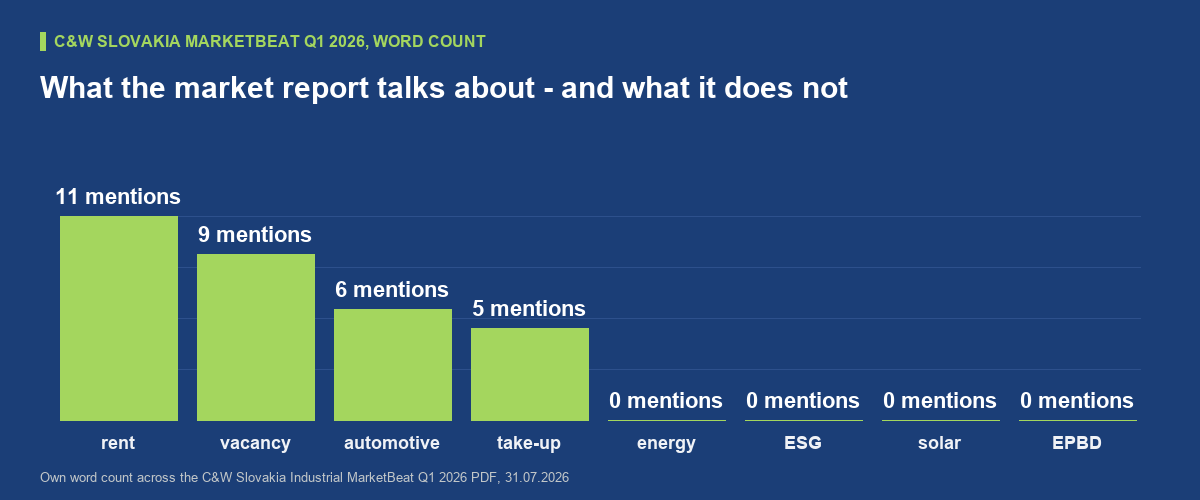
Read the Cushman and Wakefield Slovakia Industrial MarketBeat for Q1 2026 and you will learn that vacancy stands at 7.72 per cent, prime rent at EUR 5.30 per square metre per month and the prime yield at 6.00 per cent. We counted the words as well as the numbers: rent appears 11 times, vacancy 9 times, automotive 6 times, and the words energy, ESG, solar, emission, EPBD and EPC appear exactly zero times. That is not a criticism of the report, which measures the market. It is the point. The largest cost and compliance change now moving towards Slovak industrial buildings sits entirely outside the market data, in Brussels and in the buildings act, and it will not appear in a vacancy rate until it has already repriced buildings. An occupier signing a ten-year lease today will hold it through every deadline described below. The landlord’s investment case, described in our note on what trades in the Slovak industrial market, is being rewritten by the same rules.

What do the new EU energy requirements actually say?

What do the new EU energy requirements actually say?

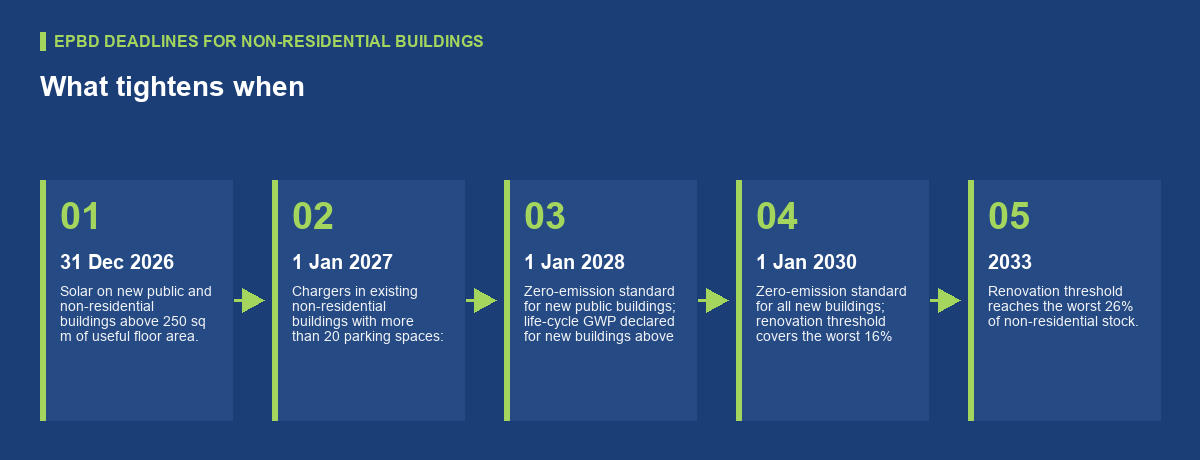
The recast directive, in force since May 2024, does three big things. First, it makes the zero-emission building the standard for new construction: very high energy performance and no on-site carbon emissions from fossil fuels, applying to new public buildings from 1 January 2028 and to all new buildings from 1 January 2030. Second, it forces the renovation of the worst existing stock. For non-residential buildings, member states must set thresholds so that, in the European Commission’s own words, the rules “will trigger the renovation of the 16% worst-performing buildings by 2030 and of the 26% worst-performing buildings by 2033”. Industrial stock is not exempt from the mechanism, and the oldest halls, the kind covered in our note on brownfield conversions, are exactly where the worst certificates sit. Third, it adds disclosure: the life-cycle global warming potential of new buildings above 1,000 square metres must be declared from January 2028, and for all new buildings from 2030. Financial incentives for stand-alone fossil fuel boilers ended in January 2025. None of this is certification. It is law.

When do solar panels and chargers stop being optional?

The dates are closer than most fit-out plans assume. The Commission’s guidance on Article 10 sets the solar timetable: suitable solar installations on new public and non-residential buildings with more than 250 square metres of useful floor area by 31 December 2026, and on existing non-residential buildings above 500 square metres by 31 December 2027 whenever the building undergoes a major renovation, roof works or the installation of a new technical building system that needs a permit. New roofed car parks adjacent to buildings follow by the end of 2029. Every obligation carries the same condition: technically, economically and functionally feasible. Who pays for the panels and who keeps the power is a lease question, and we set it out in our note on rooftop solar on Slovak warehouses. Vehicle charging runs on a parallel track: the guidance on Article 14 requires existing non-residential buildings with more than 20 car parking spaces to have, by 1 January 2027, at least one recharging point for every ten spaces or ducting for at least half of them, plus bicycle parking sized to the building’s users. For a distribution park with staff shift patterns, that is a real electrical design job, not a bollard.

Where does Slovakia stand on transposing the directive?

Behind the deadline, with the draft on the table. The transposition date was 29 May 2026. The government approved the amendment to Act 555/2005 on the energy performance of buildings at its session of 6 May 2026, as recorded by the association of municipalities, and parliament had not passed it at the time of writing, so the final wording can still move. The direction is fixed by the directive. The Slovak consultancy Novaco’s summary of the draft lists the building blocks: a zero-emission building definition requiring very high energy performance and no on-site emissions from fossil fuels, the zero-emission standard for new public buildings from 1 January 2028, renovation passports recorded in a central registry, minimum energy performance standards for the existing stock and energy certificates that state a building’s global warming potential and must be shown to prospective buyers and tenants. The municipalities objected to the budget impact, which tells you the state expects the obligations to cost real money. For occupiers the practical reading is simple: the Slovak EPC on the building you are about to lease is about to say more, and be worth more attention, than the one on file today.

What should occupiers and landlords agree before this lands?

What should occupiers and landlords agree before this lands?

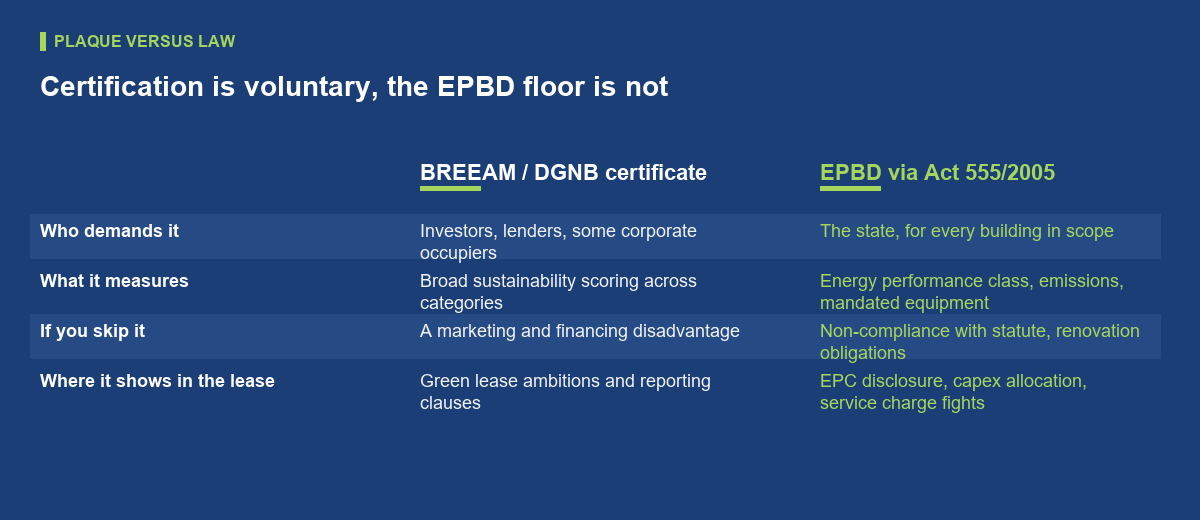
Four things, all cheaper before signature. First, put the certificate on the table: ask for the current EPC and its class in the heads of terms, not after exchange, and ask the landlord where the building sits relative to the national renovation thresholds once they are set. Second, allocate the mandated works. Solar by end-2027 on a renovating building, chargers by the start of 2027 on a big car park: someone pays, and if the lease is silent the argument arrives through the service charge, which we unpacked in our note on Slovak service charges. Improvements that cut the landlord’s regulatory exposure are not obviously a tenant cost. Third, model the rent effect: a building renovated to a better class carries a different effective rent than its headline suggests once energy and compliance are counted, and DGNB or BREEAM plaques, covered in our note on certification costs, do not substitute for statutory compliance. Check how the rent review machinery interacts with an energy renovation mid-term as well, because a landlord who has just spent capital on the roof will try to recover it, and a rent rebased after works is a different conversation from ordinary indexation. Fourth, use the window. With renegotiations at 54 per cent of Q1 demand, vacancy at 7.72 per cent and 203,200 square metres under construction at only 35 per cent pre-let, occupiers hold the pen, and energy clauses are exactly the kind of provision a tenant-favourable market lets you write.

Conclusion

The energy rules for Slovak industrial buildings only move in one direction. The zero-emission standard arrives for new public buildings in 2028 and for everything new in 2030, the worst 16 per cent of non-residential stock is due for renovation by 2030 and 26 per cent by 2033, and the solar and charger deadlines start biting as soon as next year. The Slovak amendment is late but coming, and the buildings it will reprice are the ones being leased right now. The occupiers who do best out of regulatory change are rarely the ones who fought it. They are the ones whose leases already said who pays.

Signing or renewing this year? Send us the EPC and the draft lease before you commit – the energy clauses are cheapest before signature.

What Happens at Lease Expiry: Dilapidations, Handback and the Final Account

Most occupiers plan the move and forget the exit. Then a schedule arrives six weeks before lease expiry, priced by a surveyor who has never met you, listing every mark on a floor slab you inherited. The money is real: on a large warehouse a handback claim can run into six figures, and it lands at the exact moment your cash is tied up in the new building. Slovakia has no statutory dilapidations code, so the size of that claim is decided almost entirely by wording agreed years earlier. This article sets out what the landlord can actually ask for, what your lease has probably imported from English practice, and the timetable that keeps the final account small.

What does Slovak law require at lease expiry?

Less than most tenants fear, and far less than most leases say. There is no Slovak equivalent of the English dilapidations regime, so the starting point is the ordinary law of lease plus whatever the parties wrote down. DLA Piper’s country guidance on repairs in Slovak commercial leases sets the default division: the landlord is obliged to maintain the property in good condition to enable its normal or agreed use, although in the case of commercial premises it is open to the parties to agree otherwise. The tenant covers the costs of normal maintenance and of minor repairs, and any other repairs are the responsibility of the landlord unless the contract says something different. There is also a duty that catches tenants out later: the tenant must notify the landlord without unreasonable delay when the need for a repair arises, otherwise the tenant may be liable for the resulting damage. Read those two sentences together and the shape of the exit becomes clear. Almost every phrase ends with unless the lease says otherwise, and in Slovak industrial leases it almost always does.

Reinstatement: the clause that decides the number

The single largest item in most handback accounts is not repair. It is putting the building back the way it was. The same guidance is blunt about alterations: the landlord’s consent is required before any changes are made to the property, otherwise the tenant will be required to restore the property to its original condition at the end of the lease. Where consent was given, the position is open: the parties must agree whether the premises need to be restored to their original condition and how the costs and benefits of the alterations and improvements are allocated. There is even an upside most occupiers never claim. Where the landlord approved works but did not pay for them, the tenant may be able to claim the amount by which the property has increased in value as a result. Three practical consequences follow. Undocumented fit-out is the expensive kind, because without a consent letter the default is restoration at your cost. A reinstatement clause that says all alterations is a blank cheque, so it should name what comes out and what stays. And racking anchors, mezzanines, dock equipment and slab penetrations belong on that list by name, because those are the items argued about in industrial buildings.

Why your lease speaks English dilapidations, and why that matters

Why your lease speaks English dilapidations, and why that matters

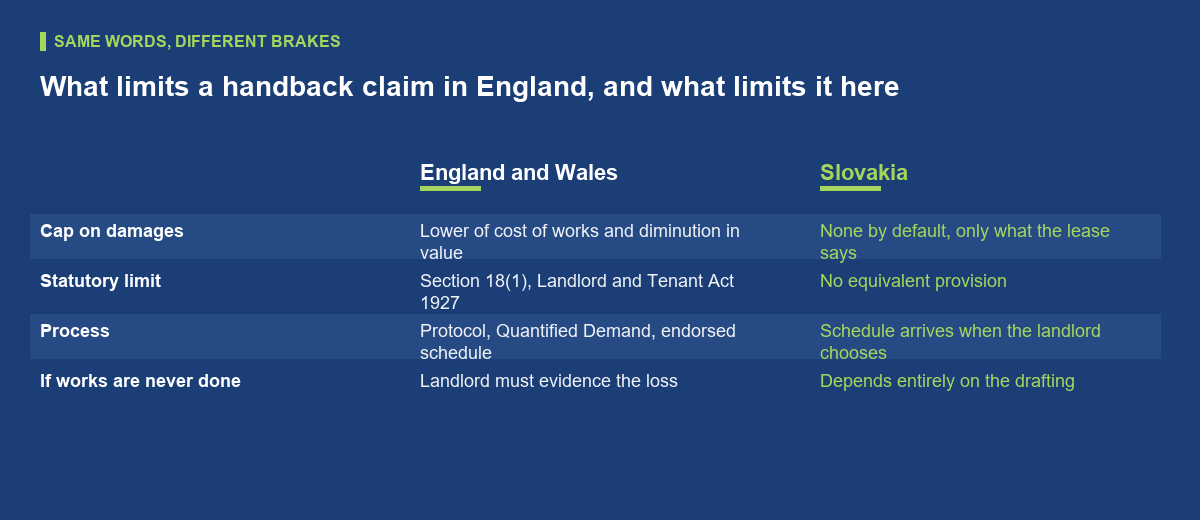
Slovak industrial leases are drafted for international landlords, so the vocabulary is imported wholesale: schedule of dilapidations, terminal schedule, quantified demand. It is worth knowing what that language does at home. Under the RICS professional standard Dilapidations (England and Wales, seventh edition, September 2016, effective from 1 December 2016), a claim runs through a defined process with two real brakes on it. The first is a cap: as a broad rule of thumb, the amount recoverable by a landlord will typically be the lower of the cost of the works and the diminution in value, that is the reduction in value of the landlord’s interest caused by the breaches. The second is statutory. Section 18(1) of the Landlord and Tenant Act 1927 limits the damages recoverable for breaches of the repairing covenant. Neither brake exists in Slovakia. On our reading, that is the asymmetry occupiers miss: the drafting travels, the limits do not, so a Slovak landlord who never intends to carry out the works can still hold you to the wording you signed. The protection has to be written into the lease itself, which is why a cap by reference to actual loss belongs in the heads of terms rather than in a later argument.

What the final account actually contains

What the final account actually contains

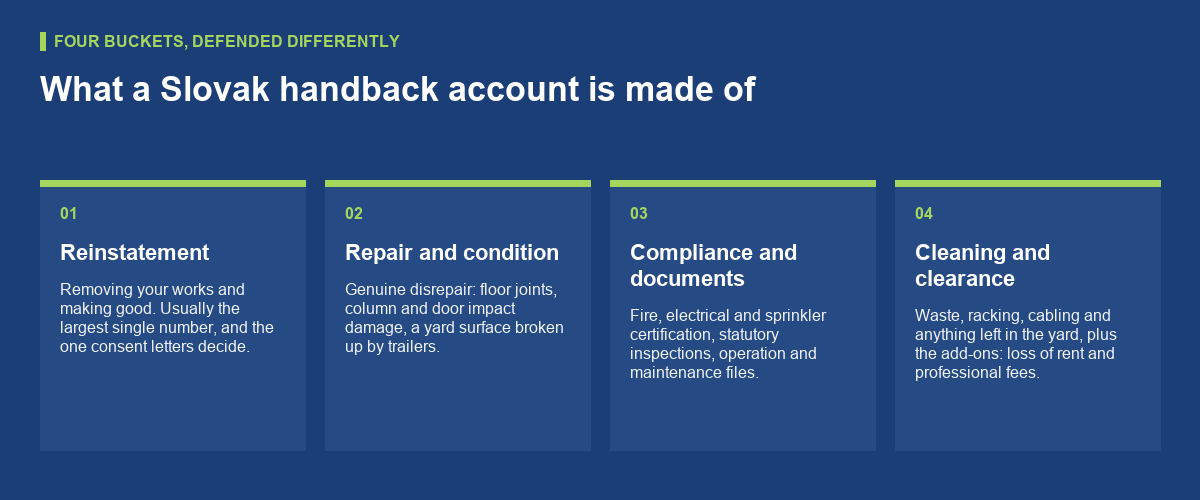
Four buckets, and they are worth separating because they are defended differently. Reinstatement is the removal of your works and the making good that follows. Repair and condition covers genuine disrepair: damaged floor joints, impact damage to columns and doors, a yard surface broken up by trailers. Compliance and documents is the quiet one: fire certification, electrical and sprinkler test records, statutory inspections for cranes or lifting equipment, and the operation and maintenance files. Cleaning and clearance closes it out, including waste, racking, IT cabling and anything left in the yard. Then come the add-ons that turn a schedule into a claim: loss of rent for the period the landlord says the works take, plus professional fees. Two items should not be there at all. Fair wear and tear is not disrepair, and items already recovered through the service charge cannot be charged twice, a point worth checking line by line against the last three years of statements. If the building was recently built, check the defects liability period too, because a fault the contractor should have remedied is not a tenant breach.

The exit timetable that keeps the account small

The exit timetable that keeps the account small

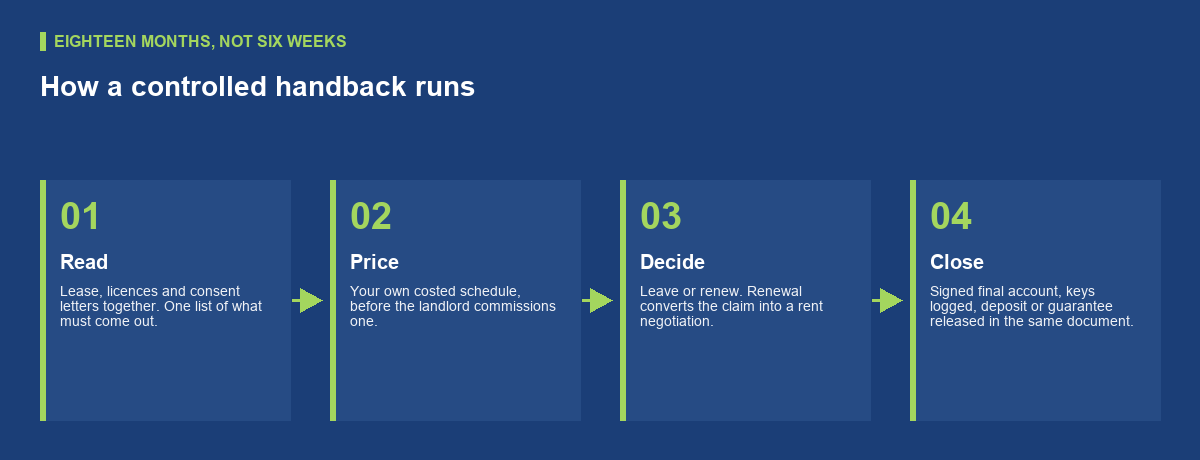
Start eighteen months out, not six weeks. First, read the lease with the licences and consent letters next to it, and build one list of what must come out. Second, commission your own priced schedule before the landlord commissions theirs. A tenant who arrives with a costed position negotiates. A tenant who arrives with nothing responds. If the exit date is driven by a break option rather than by expiry, deal with its conditions first, because an unsatisfied condition can invalidate the notice. Getting out before the end is a separate exercise with its own machinery. Third, decide early whether you are leaving at all, because the market answer is often no. In the first quarter of 2026 renegotiations accounted for 54 per cent of total demand in Slovakia, and Cushman and Wakefield note that this elevated trend is expected to persist through the year. A renewal converts the whole account into a negotiation about future rent, which is a far cheaper currency than cash for works. Fourth, use the market. Vacancy stood at 7.72 per cent and prime rent had declined to EUR 5.30 per square metre per month, with 203,200 square metres under construction at only 35 per cent pre-let. Fifth, close it properly: a signed final account, keys and access cards logged, and the release of the deposit or bank guarantee written into the same document.

Conclusion

Handback is not a building exercise, it is a documentation exercise that happens to involve builders. The lease decides what can be claimed, the consent letters decide what has to come out, and the condition evidence decides who wins the argument about the rest. Slovakia gives you none of the statutory protection the English wording implies, so the work has to be done twice: once when the clause is drafted and again eighteen months before the end. With more than half of Slovak demand now coming from renegotiation, the strongest exit position is usually the one that keeps a renewal on the table.

Coming up to the end of a Slovak industrial lease? Send us the reinstatement and repair clauses now, not when the schedule arrives.

Customs, Bonded Warehouses and Free Zones in Slovakia: What Importers Need

Importers arriving in Slovakia ask for a free zone, because that is what the brochures in neighbouring countries advertise. The honest answer is that Slovakia does not have one, and has not had one for years. What it has instead is the ordinary European toolkit: temporary storage, the customs warehousing procedure and a deferment of import VAT that most occupiers never apply for. A bonded warehouse in Slovakia is therefore not a place on a map, it is an authorisation attached to a building you lease. This article sets out what each instrument does to your cash, what 2026 changed, and which clauses in the lease decide whether any of it is possible at all.

Does Slovakia have a free zone, or only a bonded warehouse route?

Does Slovakia have a free zone, or only a bonded warehouse route?

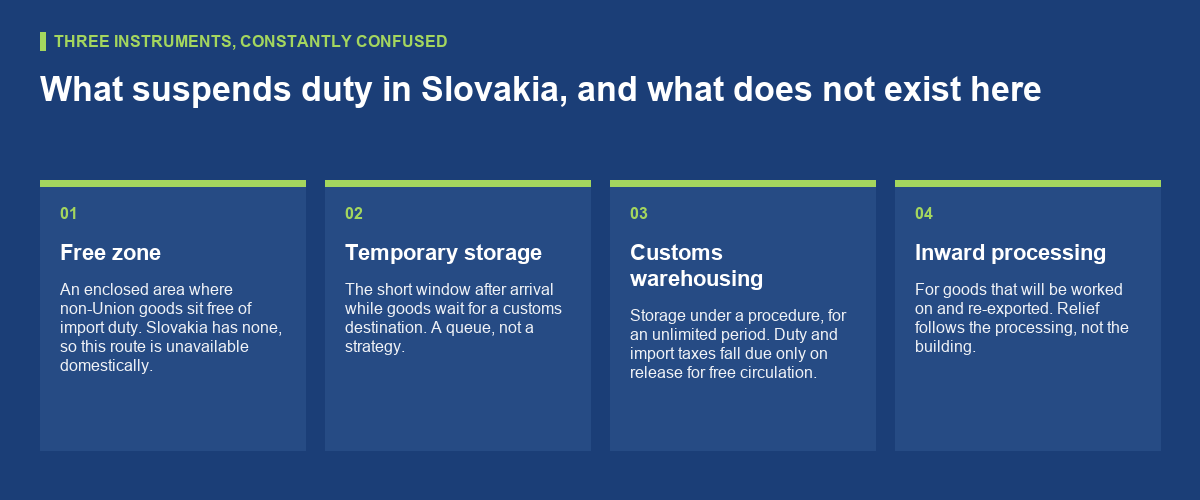
Only the second. The Commission publishes the definitive answer itself: its register of free zones in operation in the customs territory of the Union, compiled from what the member states report, lists the zone or zones for each country. We parsed the list. Twenty member states operate at least one. Seven report the single word None, and Slovakia is one of them, alongside Austria, Belgium, Finland, Ireland, the Netherlands and Sweden. Every neighbour with a port or a border terminal appears on the other side of that line: the Czech Republic through Ostrava, Hungary through Zahony, Poland through its port zone and Slovenia through Koper. That absence is less dramatic than it sounds. A free zone is an enclosed area where non-EU goods sit free of import duty and other charges until they are released, and the Commission describes it in exactly those terms. The customs warehousing procedure achieves the same suspension without the fence, because the suspension follows the goods and the authorisation rather than the postcode. The practical difference for a Slovak occupier is where the paperwork sits, not what it costs. What you cannot do is walk into an existing zone and rent a unit inside it. You build the arrangement yourself, inside a building you have chosen for ordinary reasons.

How customs warehousing works, and what it does to your cash

Three instruments sit in sequence and are constantly confused with one another. Temporary storage is the short window after arrival while the goods wait for a customs destination. Customs warehousing is the storage procedure proper. The Commission’s guidance on storage procedures is unusually generous about time. Storage may be for an unlimited period, unless the nature of the goods means they could pose a threat to health or to the environment if stored for a long time. Inward processing is the third, for goods that will be worked on and re-exported. The cash effect of the middle one is the reason importers care. Duty and import taxes do not fall due while the goods sit under the procedure. They fall due when the goods are released for free circulation, and if the goods are re-exported instead, they never fall due in the Union at all. For a distributor holding regional stock for several markets, that is the difference between financing duty on the whole consignment at arrival and financing it pallet by pallet as orders leave. The conditions are not onerous, but they are real. The holder must be established in the customs territory of the Union. It must give the authorities assurance that the facility will be properly run, and provide a guarantee where a customs debt is incurred. That guarantee is the number to model before anything else.

What 2026 changed at the border, and why it lands in the warehouse

What 2026 changed at the border, and why it lands in the warehouse

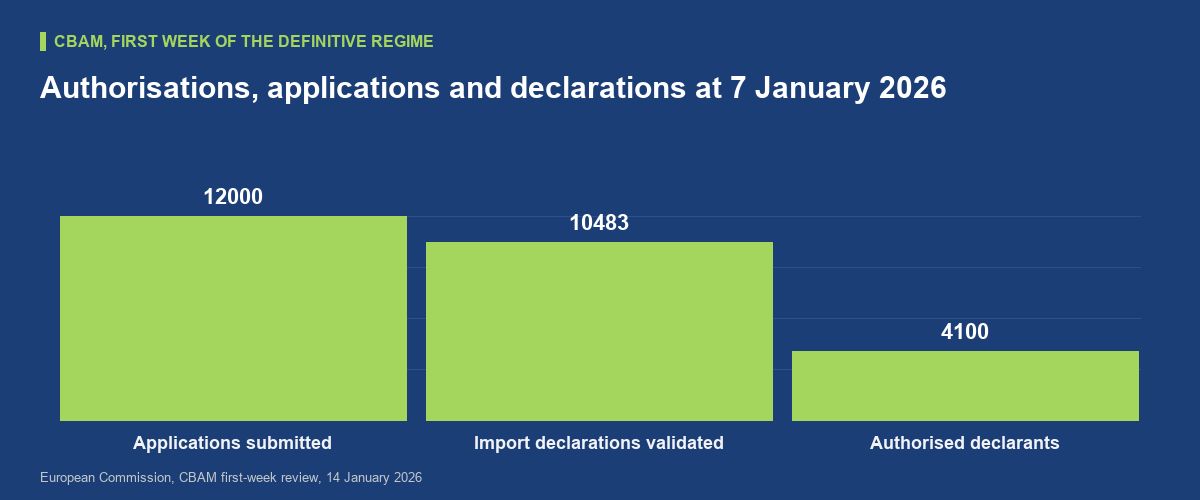
Two changes, both live now, both with consequences for stock that arrives from outside the Union. The first is the end of the low-value exemption. The Commission’s own guidance of 8 June 2026 sets out Council Regulation (EU) 2026/382. It brings a temporary customs duty of EUR 3 per item, from 1 July 2026 until 1 July 2028. It replaces the duty relief for consignments under EUR 150, which ran until the end of June. The Commission had already announced the political agreement in November 2025, and describes the flat fee as an interim measure until the EU Customs Data Hub is operational in the middle of 2028. The second is the carbon border mechanism. According to the Commission’s own first-week review, CBAM entered into force on 1 January 2026, and the authorisation is now validated by customs before goods are released for free circulation. More than 4,100 operators had obtained authorised declarant status. Over 12,000 applications had been submitted by 7 January. In the first week customs validated 10,483 import declarations containing CBAM goods, covering roughly 1.66 million tonnes. Iron and steel made up 98 per cent of that volume. Read those two together and the warehousing question changes shape. A customs warehouse buys you time before release. It does not buy you the authorisation you need at the moment of release, and in Slovakia, where steel and automotive components dominate third-country inflows, that distinction is the one that strands pallets.

Import VAT: the Slovak rule that quietly decides your working capital

Duty is usually the smaller number. Import VAT is the one that ties up cash for weeks between payment at the border and recovery through the return, and Slovakia changed the mechanics recently. As DLA Piper set out when the rule was introduced, from 1 July 2025 a deferment scheme applies to imports of goods into Slovakia from third countries. Under it the customs office does not levy the tax. The importer accounts for it in its own VAT return instead. The catch is in the eligibility. The firm’s summary is blunt: the mechanism is available only to VAT payers who hold an authorised economic operator permit and have their registered seat, place of business or establishment in Slovakia. No separate consent from the customs or tax office is needed, the regime simply applies to the declaration once the conditions are met and the importer opts in. From 1 January 2026 the scope widened to taxable persons established in another member state, with the AEO licence, the Slovak VAT identification and the taxable-use condition all still in place. The consequence for a mid-sized importer is worth stating plainly. Without AEO status, the deferment is closed to you, and the customs warehousing procedure becomes the main lever you have left for delaying the same payment. The two instruments are usually presented as separate topics. In a cash-flow model they are alternatives.

What this means when you sign the lease

What this means when you sign the lease

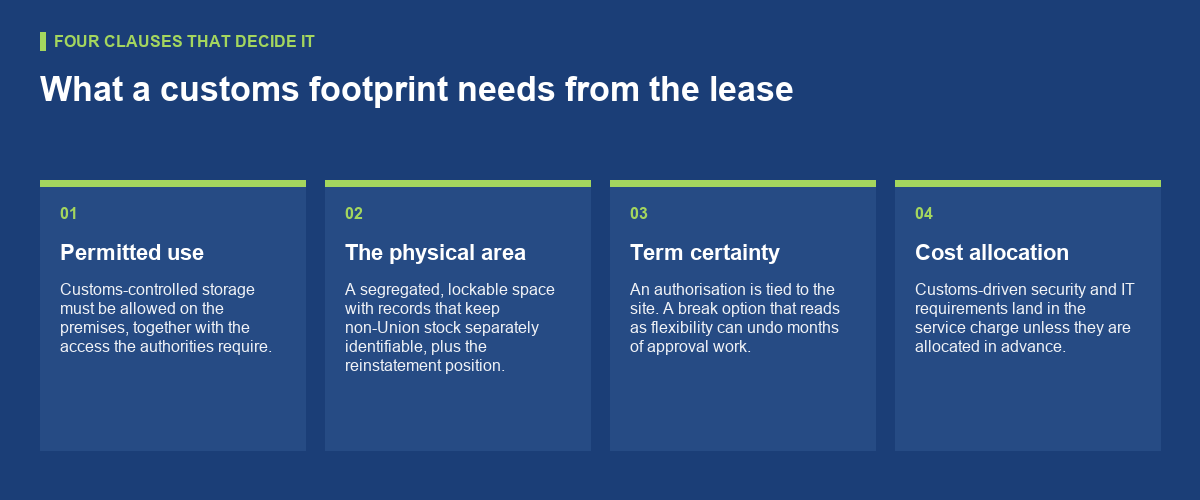
This is where the customs question stops being a tax question. An authorisation for customs warehousing attaches to the storage facility named in it. That is our own summary of how the approval works in practice. It produces four clauses that belong in the heads of terms rather than in a later side letter. First, permitted use: the lease must allow customs-controlled storage on the premises and allow the authorities the access they require, which many standard Slovak leases simply do not address. Second, the physical arrangement: a segregated, lockable area with records that keep non-Union stock separately identifiable, plus whatever the landlord must consent to in order to create it, and the reinstatement position at the end. Third, term. An authorisation you spend months obtaining is worth little in a building you can be asked to leave, so the break option that looks like flexibility on the tenant side can be the item that undermines the whole structure. Fourth, cost allocation, because customs-driven security and IT requirements will show up in the service charge unless they are allocated in advance. Ask now rather than later. Slovak vacancy stands at 7.72 per cent and is rising. Prime rent is down to EUR 5.30 per square metre per month, and 203,200 square metres is under construction at only 35 per cent pre-let. A landlord has more reason to write these clauses your way than at any point in the last three years.

Conclusion

Slovakia’s missing free zone is not the problem it looks like. The suspension of duty and import taxes travels with the procedure and the authorisation, not with a fenced site, so the same cash-flow effect is available inside an ordinary leased warehouse. What has changed is the cost of getting the paperwork wrong: CBAM authorisation is now checked before release, the low-value exemption is gone, and the Slovak import VAT deferment is closed to anyone without an AEO permit. Decide which instrument you are relying on before you choose the building, because the authorisation is tied to the site and the site is tied to a lease term you are about to fix.

Planning to hold third-country stock in Slovakia? Send us the site requirement and the customs footprint together, before the lease is drafted.

Data Centres in Slovakia: Power, Land and What They Compete For

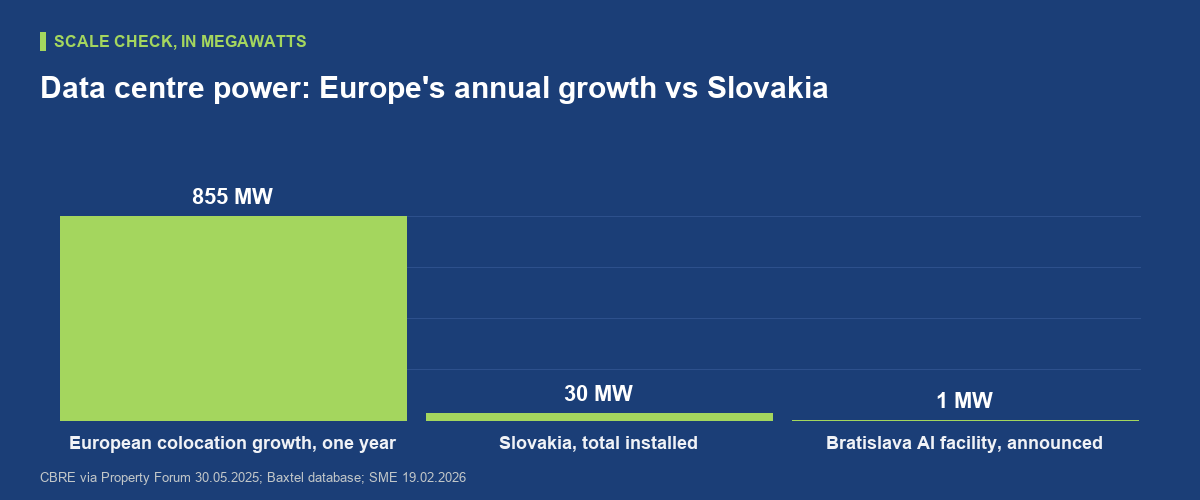
Every industrial market in Europe is now telling itself a data centre story, and Slovakia has started telling one too: sovereign compute, nuclear baseload, an AI facility for Bratislava. It is worth checking the numbers behind the narrative before it reprices anybody’s land. Data centres in Slovakia today amount to 30 megawatts across 13 facilities – less than Europe’s colocation market adds in a fortnight. This article sets out what actually exists, what is announced, what power really costs here, and the one thing a compute campus genuinely takes away from a warehouse occupier: a place in the grid queue.

How big are data centres in Slovakia today?

How big are data centres in Slovakia today?

Start with the installed base, because it is smaller than the discussion suggests. The Baxtel facility database lists 13 data centres in Slovakia from five providers, totalling 139,073 square feet and 30 megawatts of power. Datacube’s Bratislava site accounts for 10 megawatts of that on its own; Deutsche Telekom operates six facilities adding up to 9.6 megawatts, including sites in Kosice and Tajov; VNET holds 5.0 megawatts across three sites and CNC a further 3.5. Now the comparison. Property Forum, reporting CBRE research in May 2025, put European colocation capacity growth at 22 per cent year on year to 855 megawatts, the fastest rate in four years, with nearly half of all annual take-up concentrated in London and Frankfurt. Divide one figure by the other – our own arithmetic – and Europe adds roughly 28 times Slovakia’s entire installed base in a single year. Colliers counts 12.5 gigawatts operational across EMEA, with Frankfurt, London, Amsterdam, Paris and Dublin held back by grid access, planning complexity and land scarcity. The same Colliers reading notes where the industry is heading as a result: towards self-generation and microgrids in the markets where the grid says no, already visible in Ireland, Germany and the United Kingdom. Slovakia is not a data centre market yet. It is a rounding error with an option on one – and the option is worth watching precisely because the established hubs are full.

What is actually being built here?

The announcements are real but modest. On 19 February 2026, speaking from New Delhi, President Peter Pellegrini said Slovakia’s first modern AI data centre would be built in Bratislava, running on chips not yet deployed in Europe, with a consumption of one megawatt. No investor, sum or completion date was named. The rationale was sovereignty rather than economics: sensitive national data should not sit in clouds on the other side of the world. Set that single megawatt against the 30 already installed – our own comparison – and the flagship project represents about one thirtieth of existing national capacity. It is a computer room with a strategic purpose, not a campus. The private-sector proposal is more ambitious in shape if not in disclosed scale: the Tatra Supercompute AI factory concept presented in December 2025 describes high-density GPU racks with liquid cooling, waste heat routed into district heating, a modular build-out and a mix of private capital, state coordination and energy partners. No megawatt figure, cost or timeline has been published. For an occupier reading the market, that absence is the story: nothing announced so far is large enough to move land values, and nothing published is firm enough to plan around. The test to apply to the next announcement is simple: how many megawatts, contracted with which operator, and energised in which year. Until those three answers exist in writing, a compute project is a press release competing for the same grid headroom as everybody else’s.

Does cheap nuclear power really make the case?

Does cheap nuclear power really make the case?

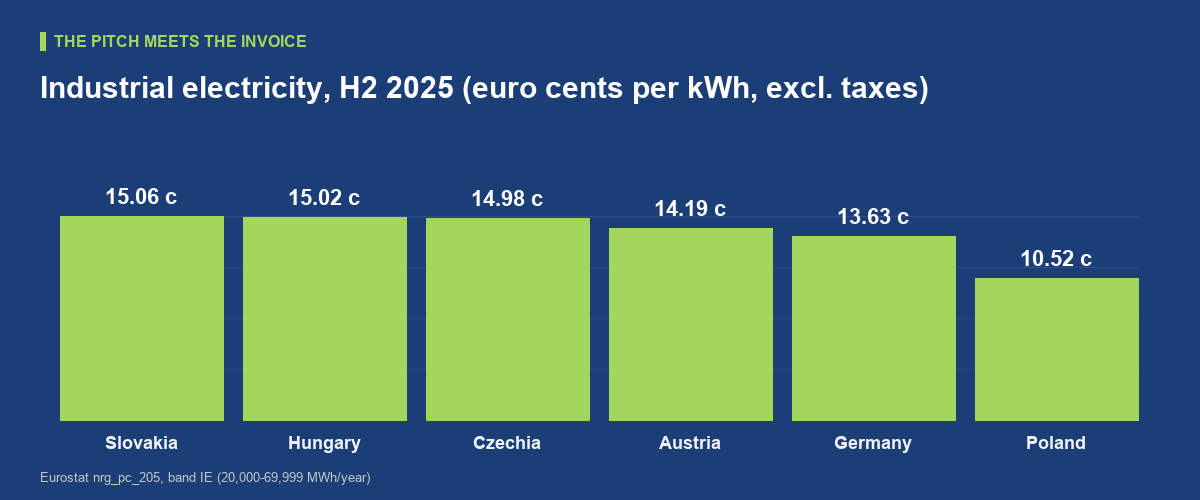
This is where the pitch meets the invoice. Slovakia’s generation mix is genuinely low-carbon and heavily nuclear, as our own industrial power capacity piece set out – and the president named nuclear and hydro as the country’s competitive advantage. Low carbon, however, is not the same as low cost. Eurostat’s price series for industrial consumers in the band that covers a mid-sized compute load – annual consumption of 20,000 to 69,999 megawatt hours – puts Slovak electricity at EUR 0.1506 per kilowatt hour in the second half of 2025, excluding taxes and levies. Hungary sits at EUR 0.1502, Czechia at EUR 0.1498, Austria at EUR 0.1419, Germany at EUR 0.1363 and Poland at EUR 0.1052. Slovakia is the dearest of the six. On our own arithmetic, the same kilowatt hour costs 43 per cent more here than in Poland – and for a workload where electricity is the dominant operating cost, that difference outweighs any rent advantage the region can offer. Two caveats belong with the table. The published band excludes taxes and levies, so the delivered bill depends on network charges and any relief a specific consumer negotiates – and very large consumers buy on bilateral contracts that no public series captures. Neither caveat rescues the pitch: the ranking is stable across the band, and nothing in it puts Slovakia ahead of Poland. The honest case for Slovak compute is carbon content, grid stability and jurisdiction, not the price per kilowatt hour.

Will data centres outbid warehouses for land?

Will data centres outbid warehouses for land?

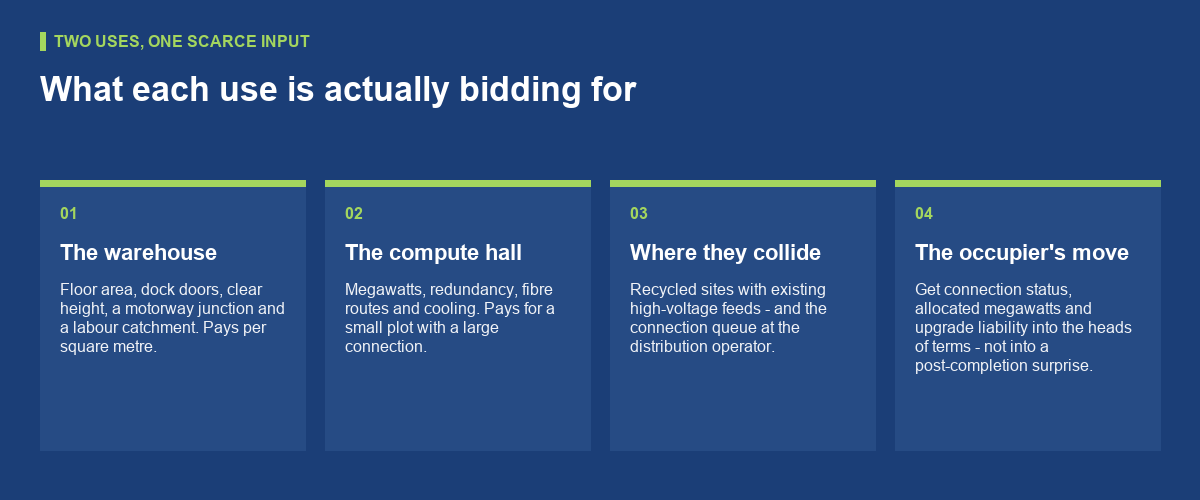
Not on square metres. A shed monetises floor area, dock doors and a motorway junction; a compute hall monetises megawatts, redundancy and fibre routes, and it will pay for a small plot with a large connection rather than a large plot with a good access road. As our land prices analysis showed, what moves Slovak plot values is servicing and consented capacity, and that is exactly the currency the two uses share. The collision point is therefore narrow but real: recycled industrial sites with existing high-voltage feeds, the same assets our brownfield analysis identified as the cheapest route to a connected site. Meanwhile the warehouse market has no shortage problem to blame on compute demand: the Cushman & Wakefield MarketBeat for the first quarter of 2026 counts 4.86 million square metres of stock with 375,700 square metres available at a vacancy rate of 7.72 per cent, prime rent at EUR 5.30 and a pipeline of 203,200 square metres only 35 per cent pre-leased. If Slovak prime rent softens or firms this year, data centres will not be the reason.

What should occupiers do about the queue?

Treat grid capacity as the contested asset, because that is what it is. Four practical moves. First, ask the developer what capacity the site holds and in what form – an indicative letter from the distribution operator is not a reservation, and the difference is years. Second, put the answer in writing at heads of terms stage: connection status, the megawatts allocated to your unit, who pays for an upgrade if your process load grows, and what happens if energisation slips. Third, ask who else feeds from the same substation. A neighbouring compute load, a battery plant or a charging hub can absorb the headroom you assumed was yours, and a park’s shared connection is a queue inside a queue. Fourth, if you already hold reserved capacity you are not using, treat it as an asset on the balance sheet rather than a line in a forgotten contract – in a market where new connections take years, spare megawatts have become negotiable currency. The data centre story may or may not arrive at scale in Slovakia. The competition for connections is already here.

Conclusion

Three findings survive the research. The installed base is tiny – 30 megawatts nationally, against 855 megawatts of colocation capacity added across Europe in a single year. The flagship announcement is one megawatt, which makes it a statement of intent rather than a market event. And the cheap-power argument does not hold: at EUR 0.1506 per kilowatt hour, Slovak industrial electricity is the dearest among six neighbouring markets. What follows for occupiers is not a land story but a queue story. Compute demand competes for connection capacity, for brownfield sites that already have a feed, and for the attention of the same distribution operators that decide when your extension energises. Price that risk into the lease, not into the hope that the grid will keep up.

Screening a Slovak site where power matters more than rent? Talk to our team before the connection application, not after.

Slovakia vs Poland vs Czechia: What CEE Occupiers Get per Euro

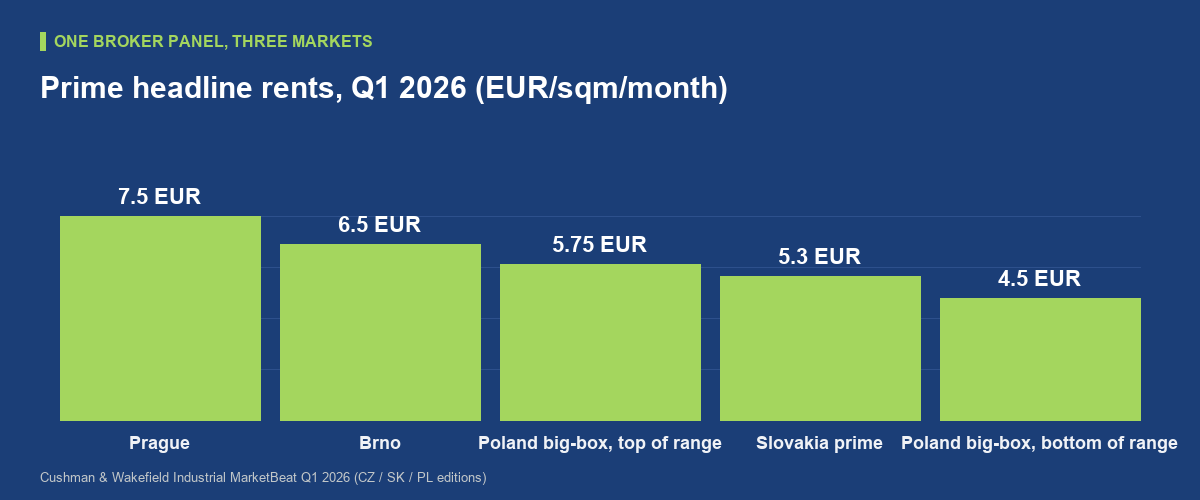
Three neighbouring markets quote three very different prices for a modern warehouse. In the first quarter of 2026, prime industrial space cost EUR 7.50 per square metre per month in Prague, EUR 5.30 in Slovakia and as little as EUR 4.50 at the bottom of Poland’s big-box range. For CEE occupiers comparing sites across borders, that spread looks like an answer – and it is mostly a trap. This article puts the three markets side by side on one broker panel and one Eurostat dataset: headline rents, what is actually available, what labour now costs, and which costs move after signing. The cheapest number wins fewer of those rounds than you would expect.

The rent ladder: three price tags, one region

The rent ladder: three price tags, one region

On paper the ladder is simple. Cushman & Wakefield’s Czech MarketBeat quotes prime headline rents for a 10,000 square metre unit at EUR 7.50 in Prague and EUR 6.50 in Brno, easing to EUR 5.75 in Pilsen and EUR 5.45 in Ostrava. The Slovak panel puts national prime rent at EUR 5.30 a month after a soft quarter – with Bratislava City stretching to EUR 6.50 and the regions sitting lower. Poland’s big-box range runs EUR 4.50 to EUR 5.75. Do the subtraction – our own arithmetic on the report figures – and the Prague premium over Slovak prime space is EUR 2.20 per square metre per month, roughly 42 per cent more for the same modern shell. On a 20,000 square metre unit that gap compounds into serious money every year. But a headline rent is the price of the space, not the cost of the operation – and the next three sections are where the ladder starts to reorder itself.

Availability: where CEE occupiers can actually choose

Scale is the first correction. Poland’s stock stands at 37.44 million square metres with 2.72 million vacant; gross leasing reached 1.58 million square metres in the first quarter alone, up 47 per cent on the year. Czechia holds 13.6 million square metres with 4.7 per cent vacant – a tight 639,100 square metres. Slovakia is the small market of the three: 4.86 million square metres of stock and 375,700 square metres available, at a vacancy rate of 7.72 per cent. Put one number against another – our own comparison – and Poland leases more space in a quarter than Slovakia has vacant in total. For CEE occupiers that cuts both ways. In Poland you shortlist between competing parks and landlords fight for the requirement; the Polish report itself notes that pressure to offer incentives keeps pushing effective rents below stable headlines. In Czechia the shortage sits on the other side of the table: at 4.7 per cent vacancy the landlord can wait. Slovakia currently offers a rare middle setting – elevated vacancy, softening prime rent, and a pipeline of 203,200 square metres that is only 35 per cent pre-leased, which means real choice without Polish-scale competition for the best units.

Labour: the arbitrage has moved inside the borders

Labour: the arbitrage has moved inside the borders

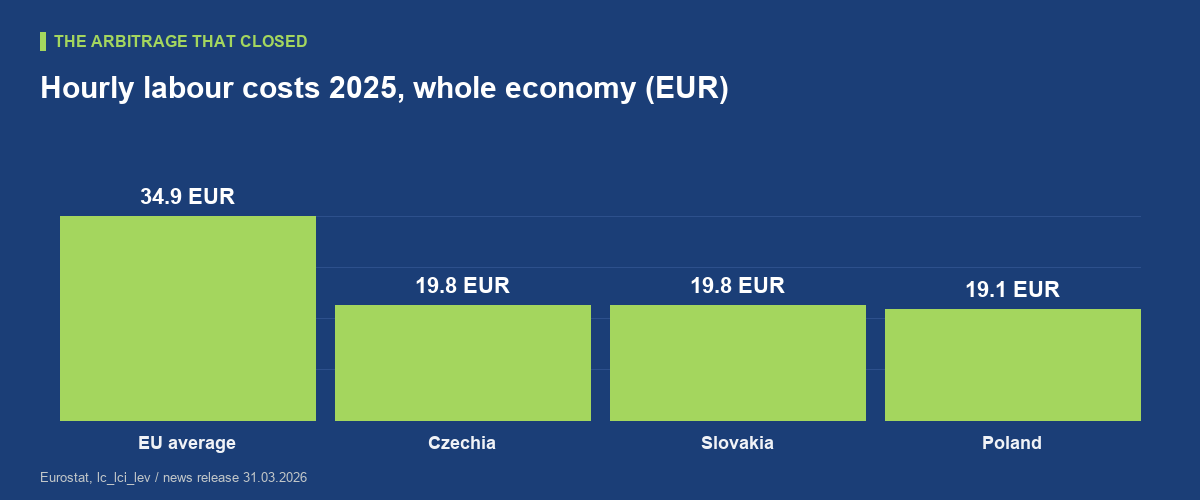
The old shortcut said: go east for cheap labour. Eurostat’s 2025 labour cost levels have quietly retired it. At whole-economy level, an hour of labour costs EUR 19.80 in both Czechia and Slovakia and EUR 19.10 in Poland – against an EU average of EUR 34.90. The three markets have converged to within seventy cents of each other; the real gap is with the West, not between the neighbours. In industry specifically, Poland is cheapest at EUR 18.20, Slovakia sits at EUR 19.70 and Czechia at EUR 20.60. Two footnotes matter more than the averages. Poland recorded one of the sharpest labour cost increases in the EU at 8.8 per cent year on year in national currency – today’s saving is on a steep escalator. And Slovakia carries the EU’s highest non-wage share of labour costs at 28.6 per cent, so the payslip understates the employer’s bill. The durable arbitrage is now regional, not national: as our labour availability piece set out, eastern Slovak unemployment runs at several times the Bratislava rate, and the Kosice Area pairs that workforce with 2.2 per cent vacancy and rents of EUR 4.80 to 5.30 – Polish-level pricing inside the eurozone.

The bill behind the rent: currency, indexation and incentives

The rent line is signed once; three other lines move every year. Currency is the quiet one. Slovakia is the only market of the three inside the euro: leases, wages, energy and service charges all clear in the same currency as the rent. In Poland and Czechia the lease is typically euro-denominated while payroll runs in zloty or koruna – a structural mismatch that sits on the occupier’s P&L and has just shown its teeth in Poland’s 8.8 per cent wage-cost jump. Indexation is the second line: a euro-area lease indexes off euro-area inflation, while the headline you negotiated in Warsaw or Prague compounds off whatever the local basis clause says – worth reading before celebrating a low starting rent. Incentives are the third. The Polish market’s own report describes landlords under growing pressure to give them; Slovakia’s soft quarter creates the same dynamic, with renegotiations at 54 per cent of gross demand as sitting tenants re-cut terms; Czechia, at sub-five vacancy, concedes the least. The effective rent – after rent-free months, fit-out money and the indexation base – is the number the three markets should be compared on, and it is never the one on the brochure.

The per-euro answer: match the market to the mission

The per-euro answer: match the market to the mission

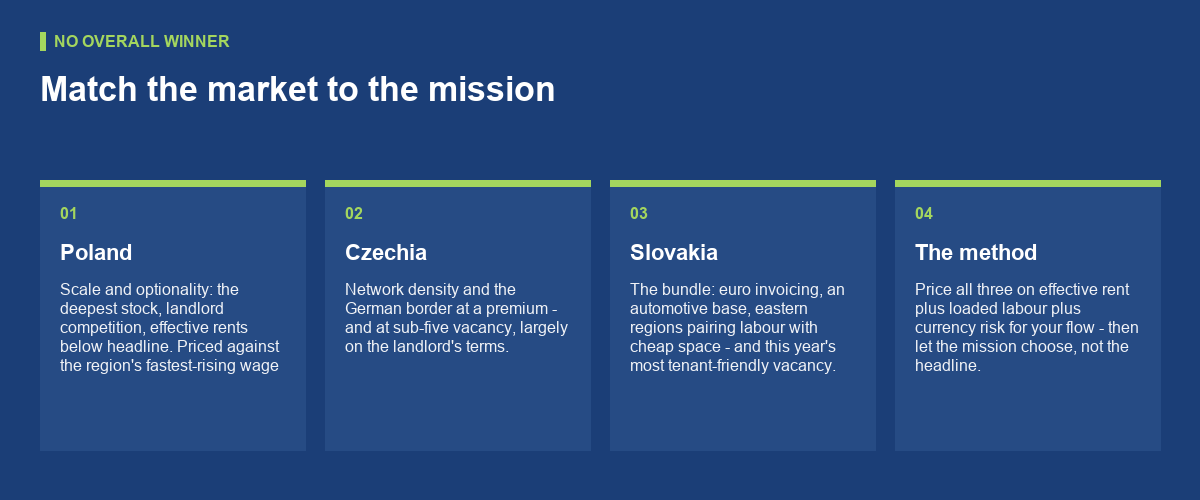
There is no overall winner – there is a right market per requirement. If the mission is scale, optionality and the lowest entry rent, Poland is hard to beat: the deepest stock, the most landlord competition, and effective rents drifting below headline. The price is the fastest-rising wage bill in the region and a currency mismatch to manage. If the mission is serving Germany and Czech-plus-Bavarian networks at maximum density, Czechia justifies its premium – but at 4.7 per cent vacancy you pay it on the landlord’s terms. Slovakia earns its place when the bundle matters: euro invoicing with no currency risk, an automotive-industrial base that took roughly 71 per cent of gross leasing in the first quarter, eastern regions where labour and 2.2 per cent-vacancy space coexist, and a tenant-favourable window – 7.72 per cent vacancy and softening prime rents – that the other two markets are not offering this year. The honest method: price all three on effective rent plus loaded labour plus currency risk for your specific flow, then let the mission, not the headline, choose the market.

Conclusion

The rent ladder says Poland is cheap, Czechia is dear and Slovakia sits in between. The operating reality is less tidy: labour costs have converged to within cents, the cheapest market carries the steepest wage escalator, the dearest is the tightest, and the one in the middle is the only one that invoices in euros – currently with the most tenant-friendly vacancy of the three. Per euro of rent, the best buy depends on what the operation needs the euro to do. Compare effective rents, not headlines; loaded labour, not payslips; and the market’s direction, not its snapshot.

Weighing a Slovak site against a Polish or Czech alternative? Talk to our team about what the euro of rent buys here.

Slovak Industrial Investment 2026: Yields, Buyers and What Trades

Slovak industrial investment enters the second half of 2026 with a puzzle on the tape. The first quarter printed one of the thinnest readings in years – yet brokers call industrial the market’s most liquid asset class and expect the year’s big trades to close in the months ahead. Both statements are true, and the space between them is where pricing, buyer behaviour and sale decisions are being made right now. This article reads the numbers behind the market: what 2025 actually delivered, who is buying in 2026, what kind of asset changes hands, and what the yield ladder says to occupiers and owners.

A thin quarter for Slovak industrial investment – after a near-record year

Start with the two numbers that frame the year. In the first quarter of 2026, Cushman & Wakefield counted EUR 89 million of transactions across five deals – a quiet opening by any recent standard. Yet the year it follows was anything but quiet: 2025 closed at EUR 967 million, the second-highest annual volume on record, and industrial led the market with a 46 per cent share – roughly EUR 446 million of sheds, plants and portfolios. The contradiction is smaller than it looks. Slovakia is a small, lumpy market: a handful of large trades decides any quarter, and the broker outlook for 2026 expects sizeable single-asset and portfolio transactions to complete later in the year, with industrial property remaining, in Cushman & Wakefield’s words, the most liquid asset class. Small markets breathe in deal-sized gulps, and annual rather than quarterly volume is the honest unit of measurement. A thin quarter is noise. The buyer pool, the yield ladder and the type of asset that trades are the signal – and each is worth reading separately.

Who buys: capital has come home

The most striking line in the Q1 2026 report is not the volume – it is the origin of the money: all transactional capital in the quarter was of Slovak origin. That is an extreme reading of a real trend. Across 2025, Czech investors led the Slovak market with roughly 30 per cent of volume, Slovak and wider European capital took about a quarter each, and US and Asian money made up the rest. Region-wide the pattern is the same: CEE investment reached EUR 11.8 billion in 2025, up 34 per cent, with CEE-based investors at a record 65 per cent of volume. The names behind the Slovak numbers are increasingly domestic retail funds: Erste Realitna Renta bought the Amazon hall in Sered (62,300 square metres), ZFP Investments took Bory Mall, 365 Invest bought Green Point Offices, Supernova Invest the MAX portfolio, Wia Slovakia a former Ecco warehouse. One nuance matters for owners of industrial stock, though: in 2025 industrial was the one Slovak sector driven by capital from outside CEE – the asset class international money still crosses borders to buy. Sell a good shed and you are marketing to two pools at once – and the domestic one now reads the fine print of a lease as fluently as any London fund.

What trades: leases, not buildings

What trades: leases, not buildings

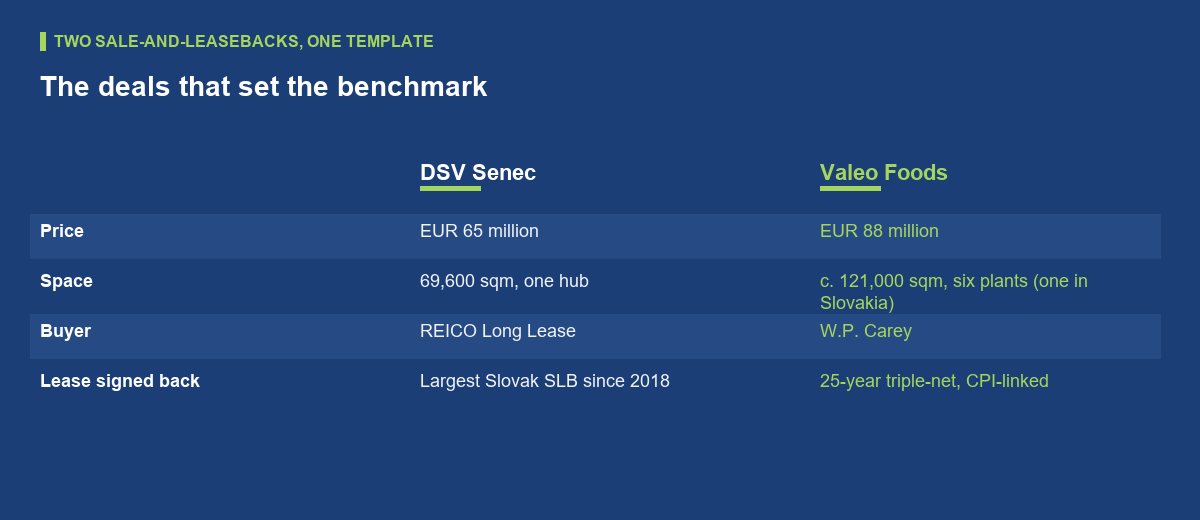
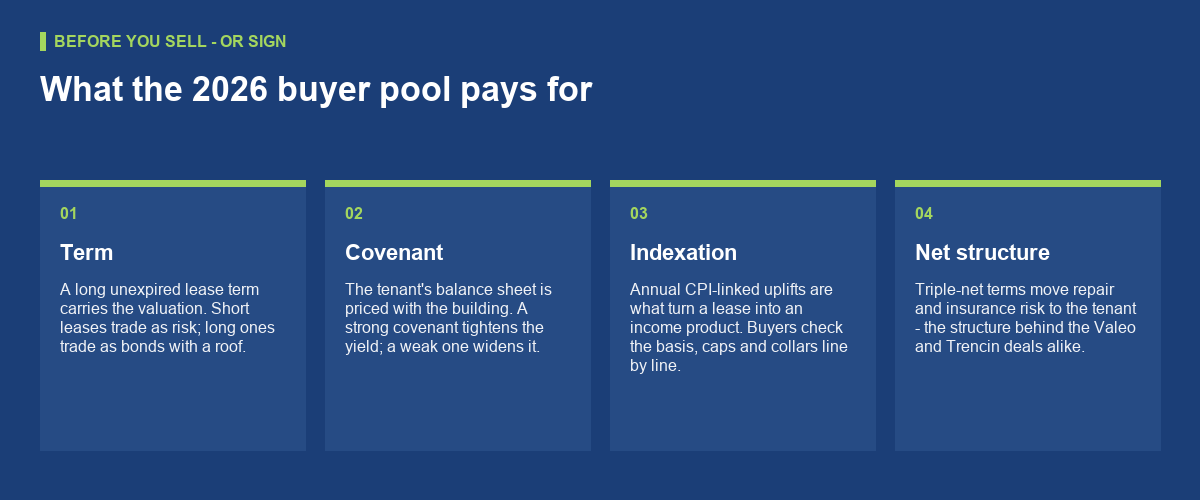
Look at what actually changed hands and a pattern emerges: buyers are not purchasing steel and concrete, they are purchasing income. The largest industrial trade of the last twelve months was a portfolio – P3 took the Stoneweg industrial portfolio of 99,300 square metres across several cities. The benchmark single-asset deal was a lease in disguise: REICO Long Lease paid EUR 65 million for DSV’s 69,600 square metre hub in Senec, the largest sale-and-leaseback in Slovakia since 2018, as our sale-and-leaseback review set out. W.P. Carey’s EUR 88 million deal with Valeo Foods – six food plants across the UK, Czechia and Slovakia, circa 121,000 square metres – was signed on 25-year master leases with annual CPI-linked increases. Even the small trades follow the template: Arete sold its circa 5,600 square metre Trencin park, fully let to Linde Material Handling on a triple-net frame, to Erste Realitna Renta in April 2026. In every case the product is the same: a long weighted average unexpired lease term, a strong covenant, and rent that indexes. The building is the wrapper.

The yield ladder – and the arithmetic beneath it

The yield ladder - and the arithmetic beneath it

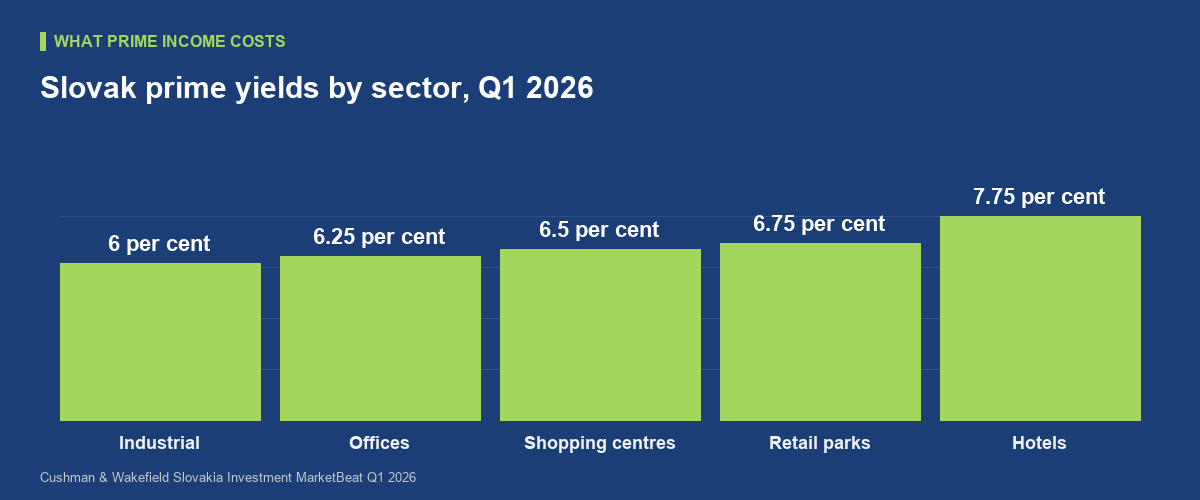
Pricing has held remarkably still through all of this. Prime Slovak industrial assets – the strongest space in the strongest locations, let long – are quoted at a 6.00 per cent prime yield, firm on the quarter and the top of the national ladder: offices at 6.25, shopping centres at 6.50, retail parks at 6.75, hotels at 7.75 per cent. The spread maths – our own arithmetic on the report’s figures – explains the appetite: against a 10-year Slovak government bond at 3.4 per cent, prime sheds offer roughly 260 basis points of excess income; against the 5-year euro swap at 2.4 per cent, roughly 360. That cushion survived a monetary turn: the ECB raised all three key rates by a quarter point effective 17 June 2026 – its first hike since 2023 – and held them steady on 23 July. The regional comparison sharpens the picture: Czech prime industrial has compressed to 4.75 per cent, the European prime logistics average sits at 5.23 per cent, and Poland trades at a level similar to Slovakia’s. For income buyers, Slovakia is the yield pickup within the region; for owners, that same gap is the discount at which their asset sells.

What it means for occupiers and owners

What it means for occupiers and owners

For tenants, the shift in ownership is not abstract. Your next landlord is increasingly a domestic fund answerable to retail savers – a buyer that, at current prime yield arithmetic, pays roughly 17 euros of capital value for each euro of provable annual rent (the yield entry’s rule of thumb). Expect covenant checks, indexation discipline and professional asset management, because your lease is the product being financed. For owner-occupiers, the window the DSV and Valeo deals opened is real but priced in decades: capital released today is exchanged for 25 years of CPI-linked, triple-net obligations – the terms of the leaseback, not the sale price, decide whether the trade was cheap. And the occupational backdrop still favours the tenant side of any negotiation: the Industrial Research Forum panel puts Q1 gross take-up at 128,800 square metres, up 110 per cent year on year, vacancy at 7.72 per cent heading towards about 8, prime rent softened to EUR 5.30 per square metre per month, and renegotiations at 54 per cent of demand. Investors are buying income streams in a market where occupiers currently have room to negotiate the very leases that back them – both sides should notice the asymmetry.

Conclusion

The Slovak investment story of 2026 is not the quiet quarter – it is the structure underneath it. A near-record 2025, a buyer pool that has gone local while industrial still imports capital, pricing that held through the first rate hike in three years, and a deal template that values the lease over the building. For owners, that template is a checklist: term, covenant, indexation, net structure. For occupiers, it is negotiating power – the market is paying for exactly what you sign. Whichever side of the lease you sit on, it pays to know what the other side’s spreadsheet rewards.

Weighing a sale of your facility – or wondering what your new fund landlord will care about? Talk to our team.

Brownfield vs Greenfield in Slovakia: Converting Old Industry into Modern Space

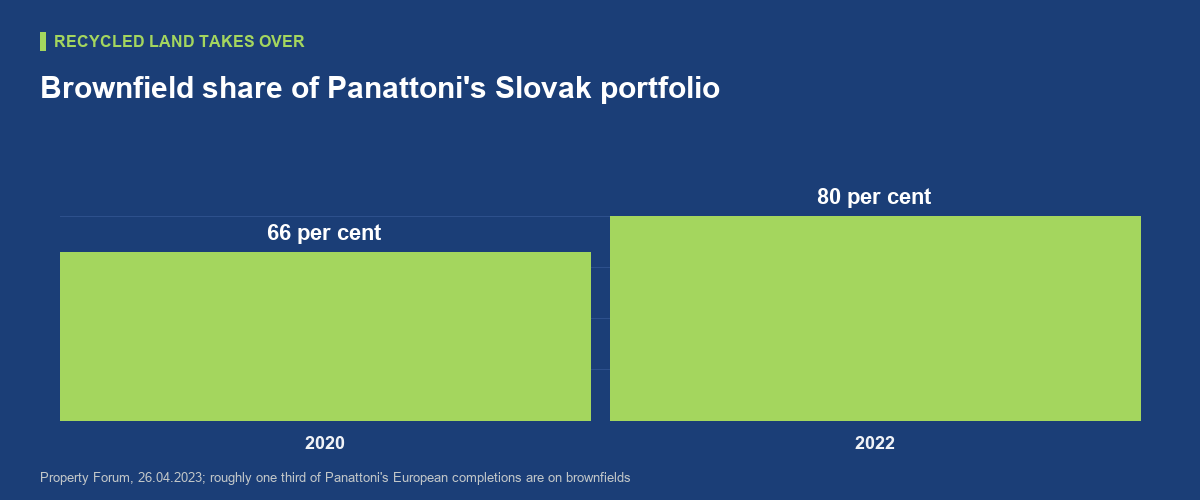
Slovakia industrialised early and in concrete: chemical works, machine plants, textile mills – many of them silent for decades. Every one of those sites is a brownfield, and every investor weighing one faces the same alternative: convert old industry, or pour fresh foundations into a field at the edge of town. For years the field won, and the arithmetic explains why. But the balance is shifting – the country’s busiest logistics developer now builds mostly on recycled land, Brussels has put a legal frame around soil consumption, and the state has finally begun counting its abandoned sites. This article sets out the real numbers on both routes and what they mean for occupiers and investors in 2026.

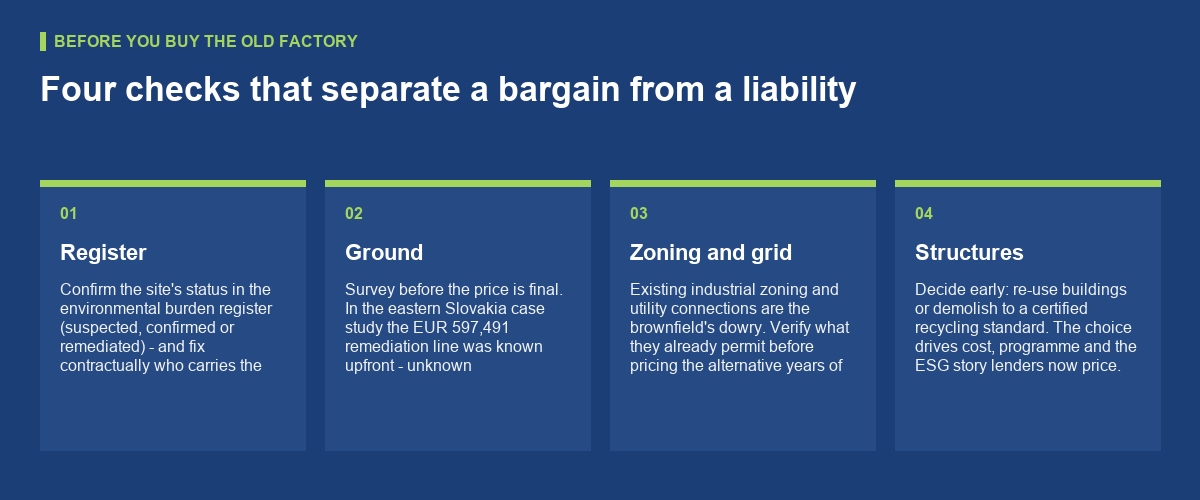
Nobody knows how many brownfields Slovakia has – that is finally changing

Start with the uncomfortable fact: there is no national brownfield inventory. The best-counted city is Bratislava, where the metropolitan institute’s 2022 update mapped 113 such sites larger than 0.5 hectares covering 580 hectares – sites derelict or unused for at least two years – of which 15 carry registered contamination across 193 hectares. Nationally, the closest proxy is the state register of environmental burdens, which lists 1,783 sites across its suspected, confirmed and remediated parts – a proxy, not a count, since a contaminated site is not automatically abandoned and many abandoned sites are clean. That gap is now being closed: in August 2025 the investment ministry MIRRI launched the first systematic national mapping of these sites – an EU-funded project of EUR 1,998,326 over 24 months that will produce the country’s first public database and map portal of its kind, with field mapping under way since May 2026. A market that cannot count its supply cannot price it. When the database goes public, an asset class that has traded on local knowledge gets a national price list – which is precisely why the homework is worth doing before it arrives.

The arithmetic that kept greenfield in front

The arithmetic that kept greenfield in front

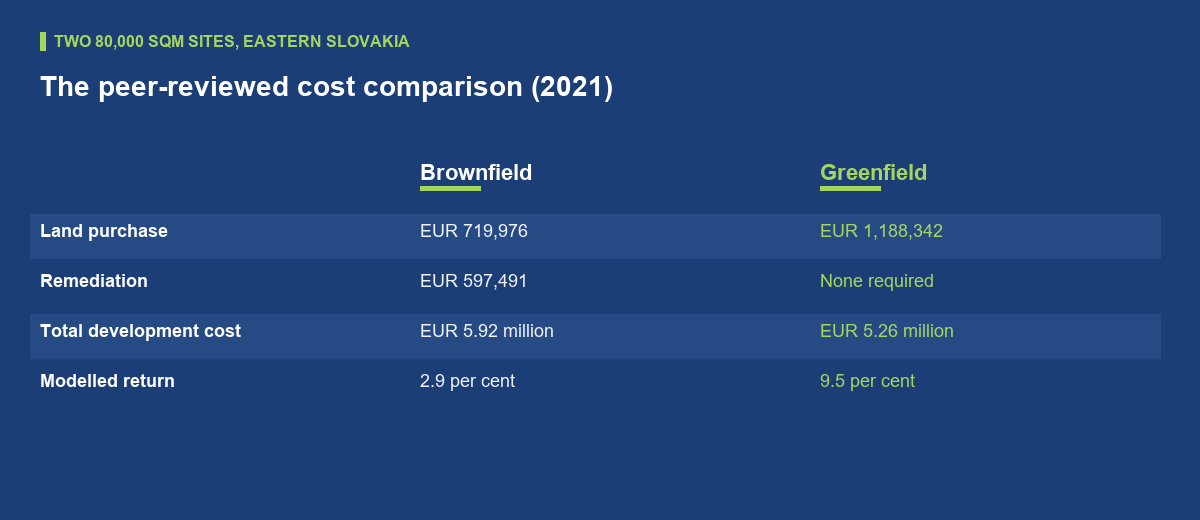
The cost case has been studied on Slovak ground. A peer-reviewed 2021 case study compared two 80,000 square metre sites in eastern Slovakia, one brownfield, one greenfield. The recycled plot was far cheaper to buy – EUR 719,976 against EUR 1,188,342 – but remediation added EUR 597,491 and heavier groundworks the rest, flipping the totals: EUR 5.92 million for the conversion against EUR 5.26 million for the fresh field, and a modelled return of 2.9 per cent against 9.5 per cent. Consistently, only 32 per cent of the 16 subsidised industrial park projects the authors examined were conversions rather than fresh fields. The state then amplifies the tilt. At Valaliky the state is investing EUR 733.54 million including VAT to 2029 – EUR 584.30 million into the circa 679-hectare park and EUR 149.24 million into surrounding municipalities – and sold 281 serviced hectares to Volvo for EUR 57 million, roughly EUR 20 per square metre serviced, our division. A private buyer in Bratislava, by contrast, is asked EUR 170 per square metre plus VAT at Majerska, as we set out in our land-prices review. Greenfield looks cheap to its buyer because much of the bill is public.

The developers have already switched sides

The developers have already switched sides

While the subsidy arithmetic favoured fields, the biggest industrial developers quietly moved the other way. Panattoni grew the brownfield share of its Slovak portfolio from 66 per cent in 2020 to 80 per cent in 2022, with roughly a third of its European completions on recycled land. Its Czech reference project, Panattoni Park Ostrov North, recycled 98.7 per cent of demolition materials and saved circa 10,300 lorry journeys – a Czech example, but the same playbook now applied west of Kosice and around Bratislava. The commercial logic is set out plainly by CBRE Investment Management: recycled land costs less, arrives with utility connections and transport infrastructure already in the ground, and re-using structures and materials cuts embodied carbon – which certification schemes and lenders increasingly price. And location does the rest: old industry stands where the workers and the customers already are. In a market where national vacancy runs at 8.12 per cent and the average rent has softened 6 per cent year on year to EUR 4.55 per square metre per month (CBRE data via Property Forum), the developer who skips the rezoning years and inherits the grid connection wins on time – and time is the scarcest input of all.

The twist in the cities: housing outbids the shed

There is a catch for industrial occupiers eyeing urban brownfields: housing wants them more. Bratislava’s flagship conversions are all going residential or mixed-use. Istrochem – the Dynamitka chemical works founded by Alfred Nobel – is the capital’s largest such site at circa 1.6 million square metres, and Penta Real Estate is steering it towards a new city district, with an urban design competition from 2027 and remediation named an essential part of the project. Corwin’s Palma project is turning a former mill into 798 apartments with four industrial buildings preserved, and the former Matador rubber works in Petrzalka is becoming 267 homes, under construction since spring 2025 with a first stage due in 2028. Each of those projects removes well-located land from the industrial market for good. The consequence is a ring structure: inner-city conversions go residential, while the industrial opportunity concentrates on edge-of-city sites and regional towns, where former plants already live second lives as multi-tenant parks. For an occupier the question is no longer whether old industry converts – it is which ring of the city you can still afford.

Policy now pushes the same way – and what to check before you buy

Policy now pushes the same way - and what to check before you buy

The regulatory direction is one-way. Directive (EU) 2025/2360 on soil monitoring and resilience, published in November 2025, obliges member states to monitor soil sealing and land take – the measuring instrument for the EU’s older ambition of no net land take by 2050, against cities and commuting zones that consumed circa 450 square kilometres per year between 2012 and 2018 (CBRE IM). Slovak money is already flowing: the environment ministry’s third call under Program Slovensko put EUR 186.67 million into remediating environmental burdens, and regional investment aid remains available in weaker regions, as we set out in our state-aid review – though with no explicit brownfield bonus yet. For a buyer, four checks separate a bargain from a liability. Confirm the site’s status in the environmental burden register and fix in the contract who carries the historical liability. Survey the ground before the price is final – in the case study above the EUR 597,491 remediation line was known upfront, and unknown contamination is what actually sinks conversions. Verify what the zoning and the grid connection already permit, because they are the old site’s dowry. And decide early whether structures are re-used or demolished to a certified recycling standard, because that choice drives both cost and the ESG story.

Conclusion

The question is no longer whether Slovakia converts its old industry – the developers have switched, Brussels has legislated, and the state is counting and funding. The question is who captures the value: housing already takes the prime urban plots, logistics takes the ring, and the coming national database will put a price on everything else. For an occupier the decision stays built-to-suit arithmetic plus honesty about ground risk: greenfield sells simplicity at a largely public price, brownfield sells location with homework attached. Do the homework while the supply is still uncounted – that is when the discount is largest.

Weighing a converted site against a fresh plot – or trying to price the ground risk between them? Talk to our team before you commit.