
Slovak industrial leases are signed for five or ten years. The energy requirements those buildings must meet are being rewritten for the same period, and most of the change arrives mid-lease. The recast EU Energy Performance of Buildings Directive sets zero-emission standards for new buildings, renovation thresholds for the worst existing stock and hard deadlines for solar panels and vehicle chargers, and Slovakia is transposing it into the buildings act this year. This article sets out what the rules actually say, when they bite, where the Slovak amendment stands and what an occupier should fix in the lease before the obligations land.
Why is the market data silent on energy?
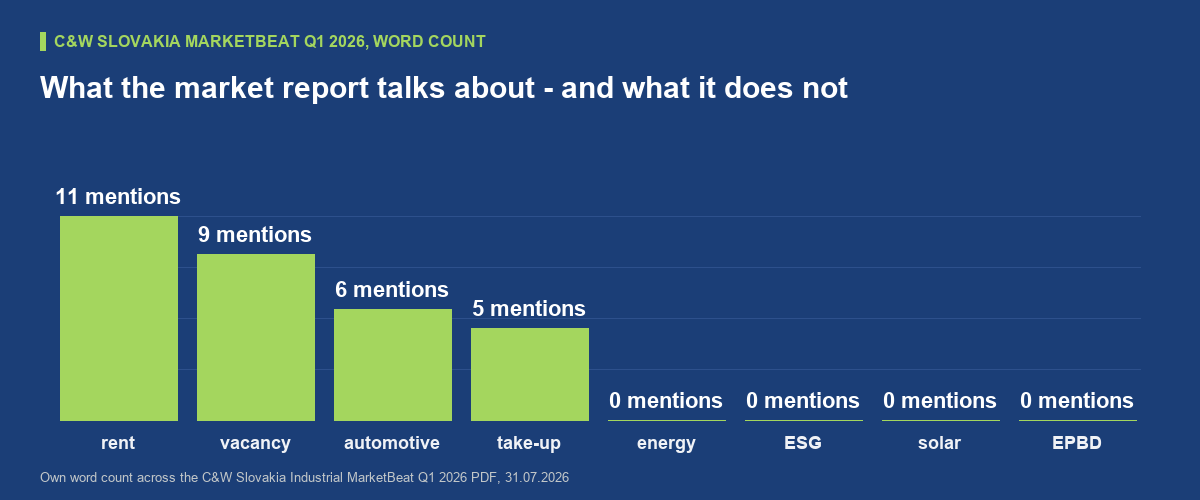
Read the Cushman and Wakefield Slovakia Industrial MarketBeat for Q1 2026 and you will learn that vacancy stands at 7.72 per cent, prime rent at EUR 5.30 per square metre per month and the prime yield at 6.00 per cent. We counted the words as well as the numbers: rent appears 11 times, vacancy 9 times, automotive 6 times, and the words energy, ESG, solar, emission, EPBD and EPC appear exactly zero times. That is not a criticism of the report, which measures the market. It is the point. The largest cost and compliance change now moving towards Slovak industrial buildings sits entirely outside the market data, in Brussels and in the buildings act, and it will not appear in a vacancy rate until it has already repriced buildings. An occupier signing a ten-year lease today will hold it through every deadline described below. The landlord’s investment case, described in our note on what trades in the Slovak industrial market, is being rewritten by the same rules.
What do the new EU energy requirements actually say?
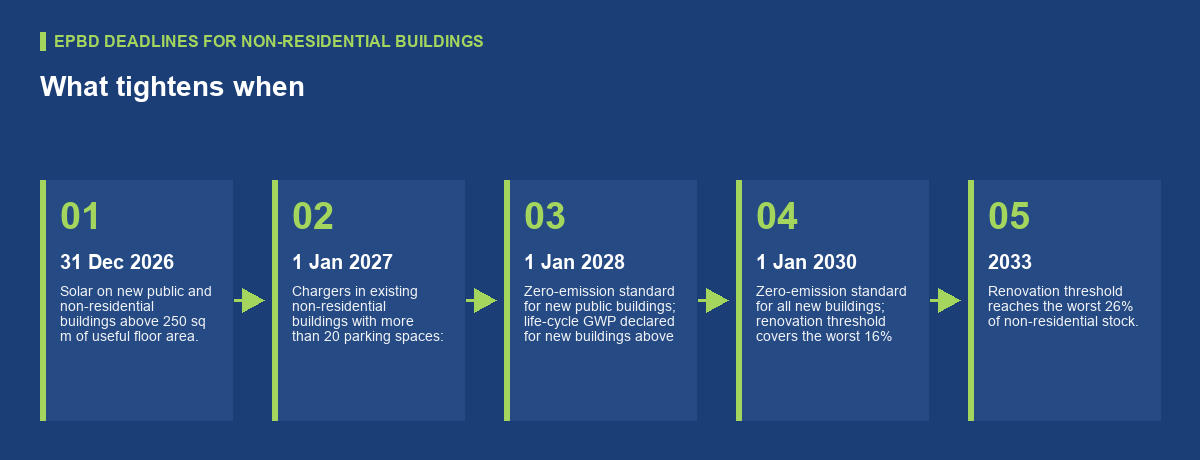
The recast directive, in force since May 2024, does three big things. First, it makes the zero-emission building the standard for new construction: very high energy performance and no on-site carbon emissions from fossil fuels, applying to new public buildings from 1 January 2028 and to all new buildings from 1 January 2030. Second, it forces the renovation of the worst existing stock. For non-residential buildings, member states must set thresholds so that, in the European Commission’s own words, the rules “will trigger the renovation of the 16% worst-performing buildings by 2030 and of the 26% worst-performing buildings by 2033”. Industrial stock is not exempt from the mechanism, and the oldest halls, the kind covered in our note on brownfield conversions, are exactly where the worst certificates sit. Third, it adds disclosure: the life-cycle global warming potential of new buildings above 1,000 square metres must be declared from January 2028, and for all new buildings from 2030. Financial incentives for stand-alone fossil fuel boilers ended in January 2025. None of this is certification. It is law.
When do solar panels and chargers stop being optional?
The dates are closer than most fit-out plans assume. The Commission’s guidance on Article 10 sets the solar timetable: suitable solar installations on new public and non-residential buildings with more than 250 square metres of useful floor area by 31 December 2026, and on existing non-residential buildings above 500 square metres by 31 December 2027 whenever the building undergoes a major renovation, roof works or the installation of a new technical building system that needs a permit. New roofed car parks adjacent to buildings follow by the end of 2029. Every obligation carries the same condition: technically, economically and functionally feasible. Who pays for the panels and who keeps the power is a lease question, and we set it out in our note on rooftop solar on Slovak warehouses. Vehicle charging runs on a parallel track: the guidance on Article 14 requires existing non-residential buildings with more than 20 car parking spaces to have, by 1 January 2027, at least one recharging point for every ten spaces or ducting for at least half of them, plus bicycle parking sized to the building’s users. For a distribution park with staff shift patterns, that is a real electrical design job, not a bollard.
Where does Slovakia stand on transposing the directive?
Behind the deadline, with the draft on the table. The transposition date was 29 May 2026. The government approved the amendment to Act 555/2005 on the energy performance of buildings at its session of 6 May 2026, as recorded by the association of municipalities, and parliament had not passed it at the time of writing, so the final wording can still move. The direction is fixed by the directive. The Slovak consultancy Novaco’s summary of the draft lists the building blocks: a zero-emission building definition requiring very high energy performance and no on-site emissions from fossil fuels, the zero-emission standard for new public buildings from 1 January 2028, renovation passports recorded in a central registry, minimum energy performance standards for the existing stock and energy certificates that state a building’s global warming potential and must be shown to prospective buyers and tenants. The municipalities objected to the budget impact, which tells you the state expects the obligations to cost real money. For occupiers the practical reading is simple: the Slovak EPC on the building you are about to lease is about to say more, and be worth more attention, than the one on file today.
What should occupiers and landlords agree before this lands?
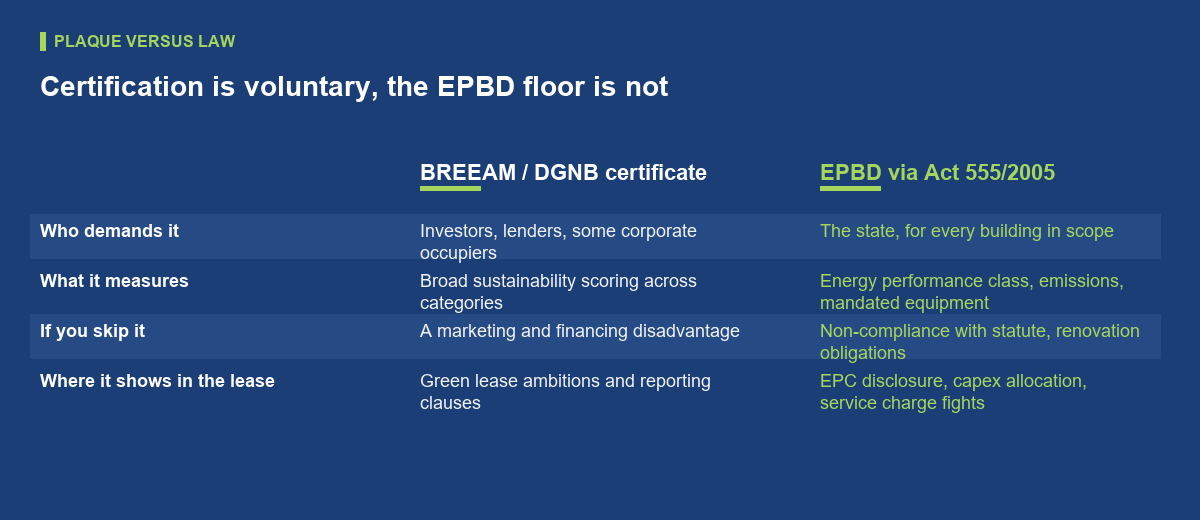
Four things, all cheaper before signature. First, put the certificate on the table: ask for the current EPC and its class in the heads of terms, not after exchange, and ask the landlord where the building sits relative to the national renovation thresholds once they are set. Second, allocate the mandated works. Solar by end-2027 on a renovating building, chargers by the start of 2027 on a big car park: someone pays, and if the lease is silent the argument arrives through the service charge, which we unpacked in our note on Slovak service charges. Improvements that cut the landlord’s regulatory exposure are not obviously a tenant cost. Third, model the rent effect: a building renovated to a better class carries a different effective rent than its headline suggests once energy and compliance are counted, and DGNB or BREEAM plaques, covered in our note on certification costs, do not substitute for statutory compliance. Check how the rent review machinery interacts with an energy renovation mid-term as well, because a landlord who has just spent capital on the roof will try to recover it, and a rent rebased after works is a different conversation from ordinary indexation. Fourth, use the window. With renegotiations at 54 per cent of Q1 demand, vacancy at 7.72 per cent and 203,200 square metres under construction at only 35 per cent pre-let, occupiers hold the pen, and energy clauses are exactly the kind of provision a tenant-favourable market lets you write.
Conclusion
The energy rules for Slovak industrial buildings only move in one direction. The zero-emission standard arrives for new public buildings in 2028 and for everything new in 2030, the worst 16 per cent of non-residential stock is due for renovation by 2030 and 26 per cent by 2033, and the solar and charger deadlines start biting as soon as next year. The Slovak amendment is late but coming, and the buildings it will reprice are the ones being leased right now. The occupiers who do best out of regulatory change are rarely the ones who fought it. They are the ones whose leases already said who pays.