
On a national dashboard, Slovakia looks like one industrial market with one headline rent. Walk the geography and it splits in two. The D1 corridor – the motorway spine running from Bratislava through Senec, Trnava and Zilina towards Kosice – carries most of the country’s institutional stock and nearly all of its leasing liquidity. South of it, along the R1 and the Danube belt from Nitra to Dunajska Streda, Nove Zamky and Komarno, sits a second market: thinner, cheaper and priced deal by deal. This article walks through where the rents actually diverge, why the gap exists, and when paying the corridor premium is worth it.
One motorway, most of the market
The concentration is starker than most occupiers assume. In the first quarter of 2026 the wider Bratislava area alone accounted for 72 per cent of all leasing activity, western Slovakia for another 22 per cent, and eastern Slovakia for the remaining 6 per cent (CBRE figures reported by Property Forum). Modern stock stands at 4.87 million square metres, and the bulk of it lines the D1 between the capital and Zilina, clustered around the A-cities where developers, lenders and investment buyers all feel at home. The south is a different landscape. Nitra anchors it with automotive volume, and the Danube belt towns – Dunajska Streda, Nove Zamky, Komarno, Sturovo – host terminals, plants and owner-built sheds, but institutional multi-let parks are scarce. Where the corridor has a leasing market with quoted terms and comparables, the south often has a negotiation: one landlord, one building, one tenant requirement, and a price discovered rather than quoted. The far east of the corridor tells the same story from the other side: eastern Slovakia took just 6 per cent of first-quarter leasing, yet runs the country’s lowest vacancy rate at 2.66 per cent – not because demand is booming, but because hardly anything speculative gets built there. That structural difference, more than construction cost or land value, is where the rent divergence begins – liquidity itself is priced.
What the rent stack actually shows
Start with the paradox in the national numbers. CBRE puts Slovakia’s prime rent at EUR 5.95 per square metre per month in the first quarter of 2026, up 3 per cent year on year – while the average rent fell 6 per cent to EUR 4.55 (Property Forum). The top of the market and the middle of the market are moving in opposite directions, which is exactly what a two-speed geography produces: scarce prime space on the corridor holds its price, while everything secondary competes harder. The stack deepens the further you look. 108 REAL ESTATE reported a fourth-quarter 2025 prime of EUR 5.40 and an average headline of EUR 5.07, with entry rents around Senec starting from EUR 3.90 (warehouserentinfo.sk), and Cushman & Wakefield’s MarketBeat puts prime at EUR 5.30 for the same quarter CBRE calls EUR 5.95 (Cushman & Wakefield). Three houses, three definitions of prime rent – each tracks a different basket of buildings. The lesson for occupiers is not that one broker is wrong; it is that a Slovak headline rent without a location attached is close to meaningless. And every one of these figures is a headline, not an effective rent: once incentives are netted off, the regional spread widens further, because concession packages are exactly where landlords in oversupplied submarkets compete first.
Why the D1 corridor prices at a premium
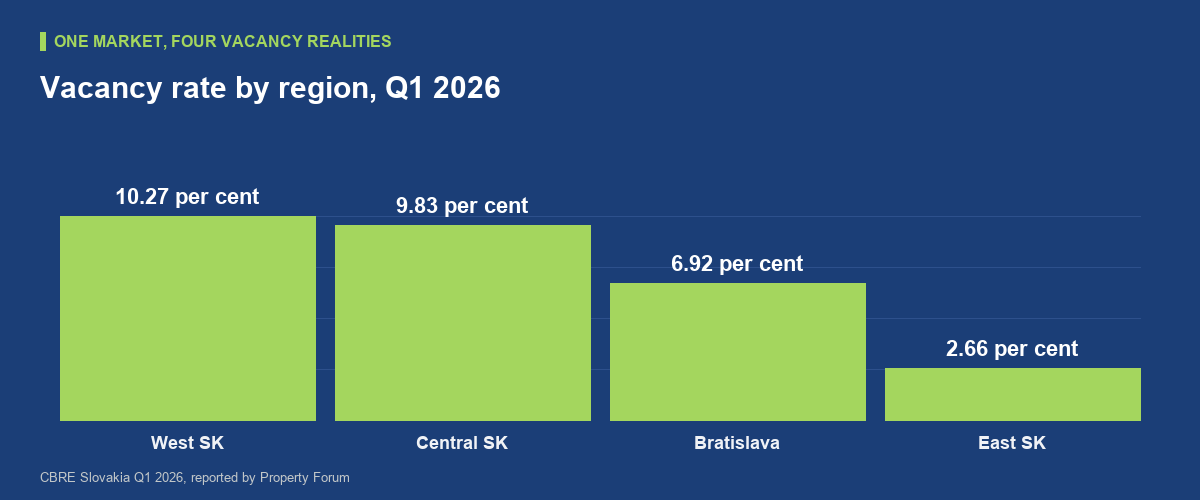
The corridor premium is a network effect, not a landlord conspiracy. Demand on the D1 is distribution demand: third-party logistics took 30 per cent of first-quarter leasing, e-commerce 17 per cent and retail 11 per cent (Property Forum) – operators whose business case is reach, and whose trucks need the motorway junction more than they need the cheapest slab. Because those occupiers cluster, the corridor also concentrates the behaviour that keeps rents firm: renegotiations made up 53 per cent of all first-quarter transactions and pre-leases another 26 per cent, meaning tenants overwhelmingly stay put or commit before buildings exist. Yet the premium coexists with the country’s highest vacancy rate – 10.27 per cent in western Slovakia and 9.83 per cent in the centre, against 6.92 per cent around Bratislava and just 2.66 per cent in the east – because that is where the speculative pipeline lands: 83,000 square metres delivered in the first quarter and 178,000 under construction. Empty new space on the corridor does not drag prime pricing down; it widens the gap between the best buildings and the rest, which is precisely the divergence the averages reveal.
Why the south trades at a discount – and why the gap narrows
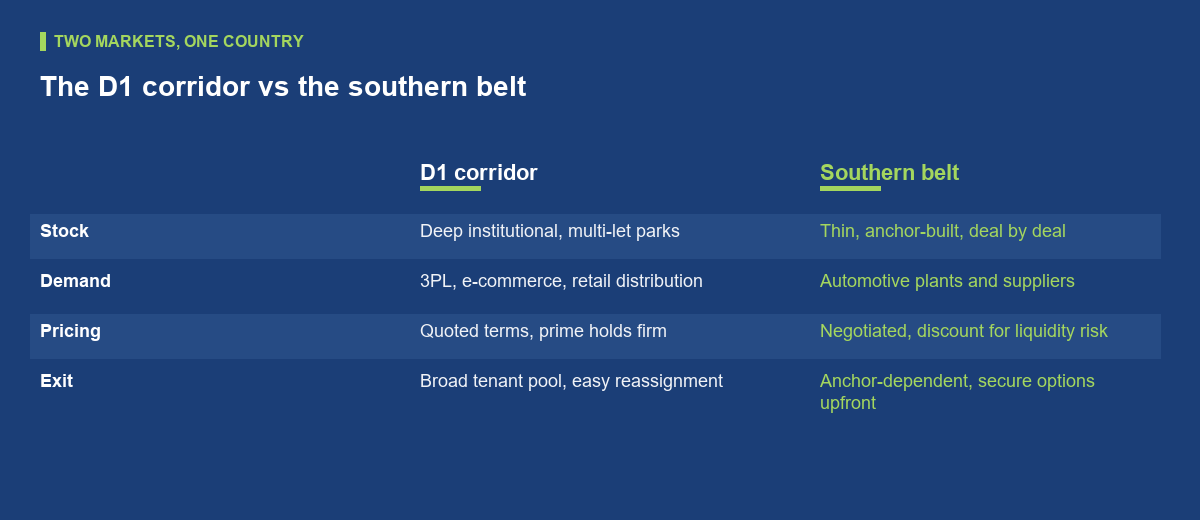
The south’s discount is real, but so are its anchors. Jaguar Land Rover’s Nitra plant – a site of roughly 300,000 square metres opened in October 2018, with a planned capacity of 150,000 vehicles a year building the Discovery and the Defender (Wikipedia) – pulls a supplier ecosystem deep into the Nitra region, and automotive was the single largest demand sector in the country in the first quarter at 31 per cent of leasing (Property Forum). Dunajska Streda has grown into a rail-connected logistics hub in its own right, and the R1 and R7 expressways have shortened the distance argument that once justified much of the corridor premium. What keeps southern rents lower is the thinness of the market rather than the quality of the buildings: fewer institutional owners, fewer comparable lettings, and an exit that depends on one anchor industry. Investors price that liquidity risk into yields, lenders into terms, and both flow through to what a landlord must charge. For an occupier whose network tolerates it, that risk premium is a genuine saving – manufacturing tied to a plant does not care about a broad tenant pool. For a distribution operator who may need to exit or expand quickly, the discount can cost more than it saves.
Choosing a corridor in 2026: the occupier’s arithmetic
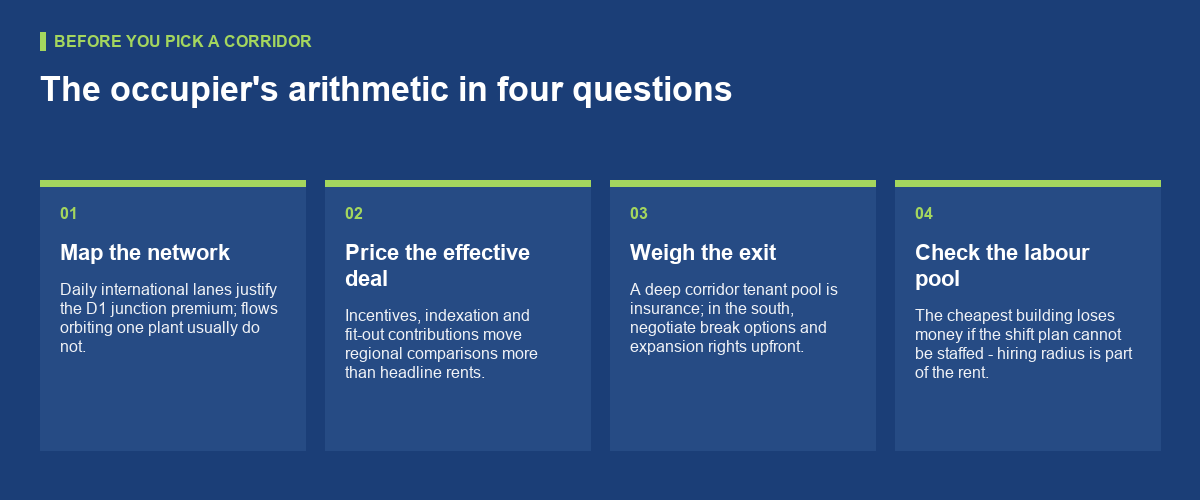
The current market hands occupiers an unusual amount of room to run this arithmetic properly. National vacancy stands at 8.12 per cent, leasing activity rose 47 per cent year on year to 136,000 square metres, and net demand 35 per cent to 59,000 (Property Forum) – a live market in which landlords still compete hard for signatures, as we argued in our review of a tenant’s market on the D1. The decision framework is straightforward. First, map the network: if your trucks run international lanes daily, the D1 junction premium usually pays for itself; if your flows orbit one plant or one border crossing, the south’s discount is money on the table. Second, price the effective deal, not the headline – incentives, indexation and fit-out contributions move regional comparisons more than quoted rents do, a gap our analysis of industrial rent levels quantifies. Third, weigh the exit: on the corridor you can reassign or sublet into a deep pool; in the south, negotiate break options and expansion rights upfront, because the building next door may not exist. Landlords face the mirror image – on the D1 the fight is specification against new supply; in the south it is proving liquidity to tenants who doubt it.
Conclusion
Slovakia’s rent map diverges because markets price more than concrete: they price liquidity, anchors and infrastructure. The D1 corridor charges for a deep tenant pool and motorway reach; the south discounts for thinness and single-industry exposure. Neither number is wrong, and neither is universally better – the right rent is the one attached to the corridor your network actually uses. In a year when vacancy sits above eight per cent and averages are falling, occupiers who do the geography homework will sign the best Slovak industrial deals in a decade.