
Service charges in Slovak industrial leases are the quiet second rent. The headline figure a tenant compares between two parks is the base rent, but that is only part of what leaves the account each month. On top of the rent sits a service charge that funds the running of the estate, and on top of that come metered utilities. In a market where prime rent has settled at €5.30 per square metre per month, the service charge is where two apparently identical deals quietly diverge. This article breaks the charge down in full: what it pays for, how it is billed, what it costs, and how occupiers keep it under control.
What a service charge is in a Slovak industrial lease
A Slovak industrial lease is almost always structured as a triple net lease, which means the tenant carries three separate costs rather than one. First the base rent, the headline figure that sat at about €5.30 per square metre per month for prime space in early 2026 (Cushman & Wakefield Slovakia MarketBeat). Second the service charge, the subject of this article. Third the tenant’s own utilities, metered and billed separately. The service charge is not the landlord’s profit and not a second margin dressed up as a fee. It is a recovery of the real cost of running the shared parts of the estate – the roads, the yards, the security, the insurance – passed through to the tenants who use them, usually in proportion to the floor area each one occupies. Understood properly, it is the mechanism that keeps a multi-let logistics park functioning while spreading the cost fairly across its occupiers. Understood loosely, it is the line on the invoice where a tenant can quietly overpay for years without ever renegotiating the rent.
What the service charge actually pays for
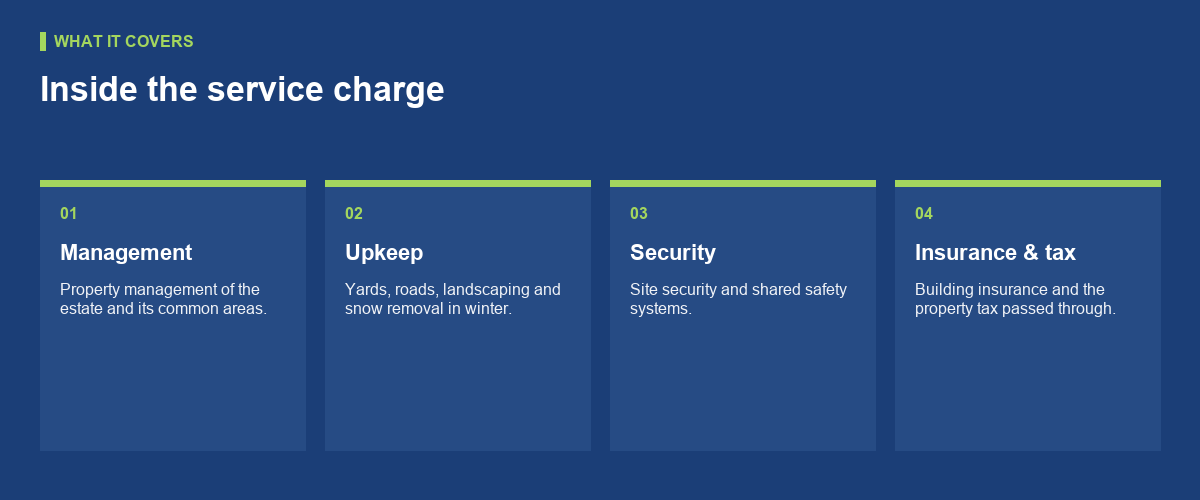
The service charge funds the operation and upkeep of everything a tenant shares with its neighbours rather than occupies alone. In a modern Slovak park that typically means property management, the maintenance of common areas and yards, snow removal in winter, landscaping, security, building insurance, and the property tax the landlord passes through. Each of these is a running cost of the estate as a whole, which is why it is shared rather than billed to one unit. What the service charge does not cover is just as important. A tenant’s own electricity and gas are metered and billed separately, so they sit outside the charge entirely and rise or fall with the tenant’s own consumption. The line between the two matters at reconciliation time, because a landlord that folds unit-level consumption or its own structural repairs into the shared charge is recovering costs that do not belong there. The tenant’s defence is a lease that lists, explicitly, which categories the charge includes and which it excludes, so the annual bill can be checked against the wording rather than taken on trust.
How a service charge is billed: advance and reconciliation
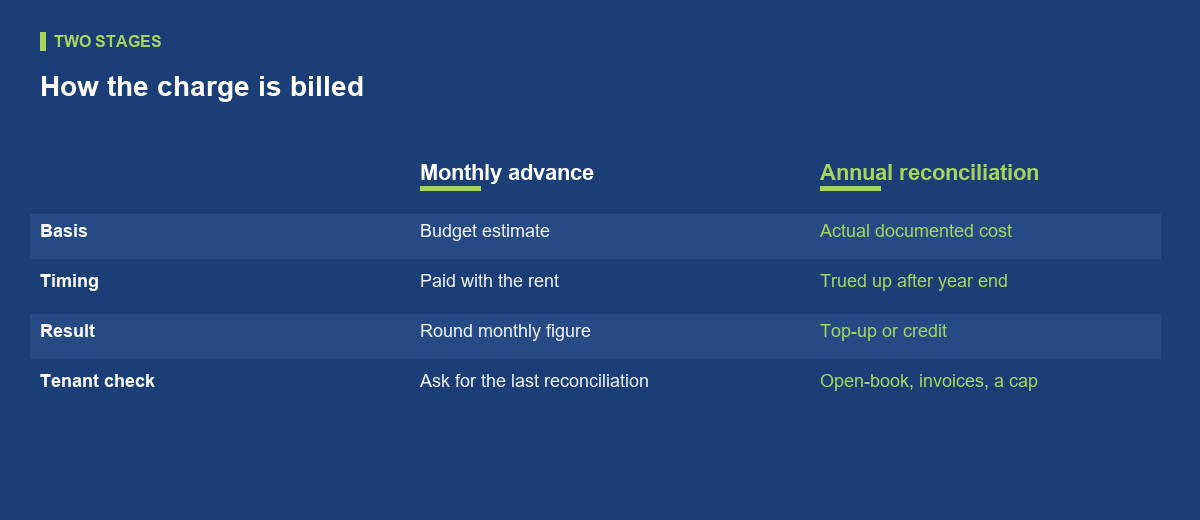
A service charge is not a fixed number but an estimate that is trued up after the fact. The landlord sets an annual budget, divides it across the tenants and bills it as a monthly advance, a round figure paid alongside the rent through the year. Once the year closes, the landlord reconciles that advance against what the estate actually spent. If the real costs came in above the budget, the tenant tops up the difference; if they came in below, the tenant receives a credit. This is the moment where a service charge is either transparent or opaque. The occupier’s protection is to insist on an open-book regime with an annual reconciliation against documented actual costs, or at the very least a cap on the amount that can be charged in any year. A charge billed as a smooth monthly advance with no reconciliation, no invoices behind it and no cap is a charge a tenant cannot audit, and one that tends to drift upward. Before signing, the single most useful document to request is the last full-year reconciliation for the building, because it shows what the charge really was rather than what the current advance suggests.
What service charges cost, and why two identical rents differ
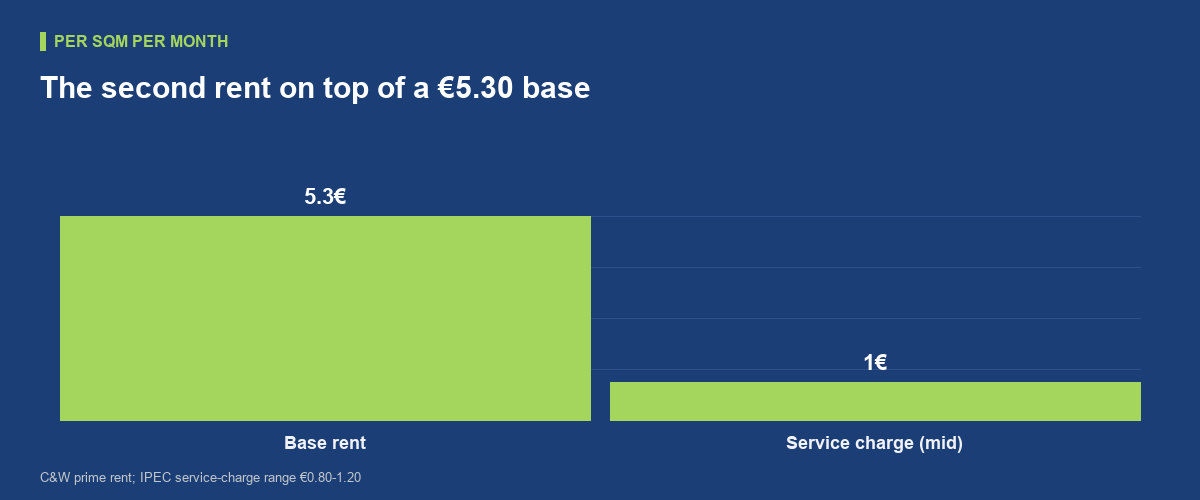
In a modern Slovak logistics park the service charge typically runs between about €0.80 and €1.20 per square metre per month, which on top of a €5.30 base rent adds materially to the real cost of occupation. The scale is not trivial at portfolio level: across the CEE region, taxes and service charges account on average for about 19 per cent of a warehouse’s total property costs (Savills, via Property Forum). This is why two leases signed at an identical €5.30 headline can end up ten per cent or more apart in real cost once service charges, indexation, rent-free periods and reinstatement obligations are counted, a gap we set out in Industrial Rent Levels in Slovakia 2026. Indexation compounds the effect, because the service charge, like the rent, is usually linked to the harmonised index of consumer prices: Slovak HICP ran at 8.4 per cent in 2022 before easing to 2.1 per cent in 2025, so a charge agreed in a high-inflation year keeps a higher base long after inflation falls (Eurostat). The lesson is that the headline rent is a poor guide to what a building actually costs. The service charge decides the rest.
How occupiers should negotiate and control the service charge
A service charge is negotiable, and the work is done before signing rather than after. The first move is to cap the amount that can be charged in any year, or at least to cap the annual uplift, so a bad year for the estate does not become an open-ended bill for the tenant. The second is to fix the scope in writing: the lease should list what the charge includes and, just as firmly, exclude the landlord’s own capital works, structural repairs and the cost of fixing initial construction defects, none of which a tenant should fund through a running charge. The third is to demand transparency – an open-book regime, documented reconciliation and the right to inspect the invoices behind the figure. Benchmarking helps too, because a charge that sits well above the €0.80 to €1.20 range for comparable space is worth questioning before it is accepted. These are the same disciplines that protect a tenant elsewhere in the deal, set out in Warehouse Lease Terms in Slovakia, and they matter most in the current market. With vacancy at about 7.72 per cent across roughly 4.67 million square metres of grade-A stock, the balance in 2026 sits with occupiers, and a tenant with options has real room to fix the service charge on fair terms. For the standalone definition, see our glossary entry on service charges.
Conclusion
Service charges are the part of a Slovak industrial lease that hides in plain sight. They are not profit and not a trick, but a genuine recovery of the cost of running a shared estate – and precisely because they are legitimate, they go unexamined. The occupier who treats the charge as seriously as the rent asks what it covers, how it is reconciled, what it costs against the €0.80 to €1.20 benchmark, and where it can be capped. In a tenant’s market that scrutiny is not just prudent, it pays. Compare the total occupancy cost, not the headline rent, and the second rent stops being the place where good deals quietly turn into ordinary ones.