
Slovakia industrialised early and in concrete: chemical works, machine plants, textile mills – many of them silent for decades. Every one of those sites is a brownfield, and every investor weighing one faces the same alternative: convert old industry, or pour fresh foundations into a field at the edge of town. For years the field won, and the arithmetic explains why. But the balance is shifting – the country’s busiest logistics developer now builds mostly on recycled land, Brussels has put a legal frame around soil consumption, and the state has finally begun counting its abandoned sites. This article sets out the real numbers on both routes and what they mean for occupiers and investors in 2026.
Nobody knows how many brownfields Slovakia has – that is finally changing
Start with the uncomfortable fact: there is no national brownfield inventory. The best-counted city is Bratislava, where the metropolitan institute’s 2022 update mapped 113 such sites larger than 0.5 hectares covering 580 hectares – sites derelict or unused for at least two years – of which 15 carry registered contamination across 193 hectares. Nationally, the closest proxy is the state register of environmental burdens, which lists 1,783 sites across its suspected, confirmed and remediated parts – a proxy, not a count, since a contaminated site is not automatically abandoned and many abandoned sites are clean. That gap is now being closed: in August 2025 the investment ministry MIRRI launched the first systematic national mapping of these sites – an EU-funded project of EUR 1,998,326 over 24 months that will produce the country’s first public database and map portal of its kind, with field mapping under way since May 2026. A market that cannot count its supply cannot price it. When the database goes public, an asset class that has traded on local knowledge gets a national price list – which is precisely why the homework is worth doing before it arrives.
The arithmetic that kept greenfield in front
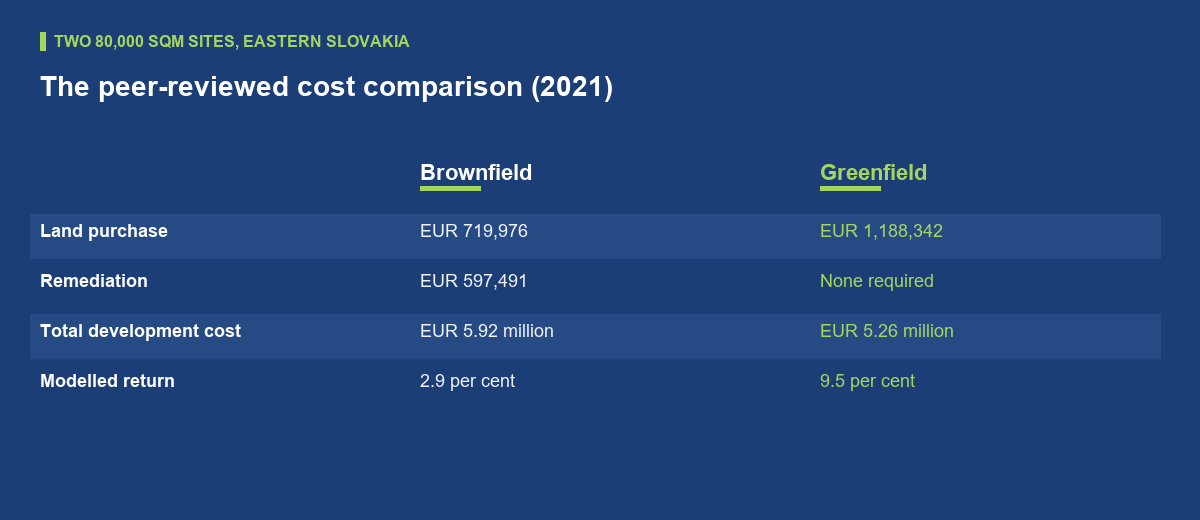
The cost case has been studied on Slovak ground. A peer-reviewed 2021 case study compared two 80,000 square metre sites in eastern Slovakia, one brownfield, one greenfield. The recycled plot was far cheaper to buy – EUR 719,976 against EUR 1,188,342 – but remediation added EUR 597,491 and heavier groundworks the rest, flipping the totals: EUR 5.92 million for the conversion against EUR 5.26 million for the fresh field, and a modelled return of 2.9 per cent against 9.5 per cent. Consistently, only 32 per cent of the 16 subsidised industrial park projects the authors examined were conversions rather than fresh fields. The state then amplifies the tilt. At Valaliky the state is investing EUR 733.54 million including VAT to 2029 – EUR 584.30 million into the circa 679-hectare park and EUR 149.24 million into surrounding municipalities – and sold 281 serviced hectares to Volvo for EUR 57 million, roughly EUR 20 per square metre serviced, our division. A private buyer in Bratislava, by contrast, is asked EUR 170 per square metre plus VAT at Majerska, as we set out in our land-prices review. Greenfield looks cheap to its buyer because much of the bill is public.
The developers have already switched sides
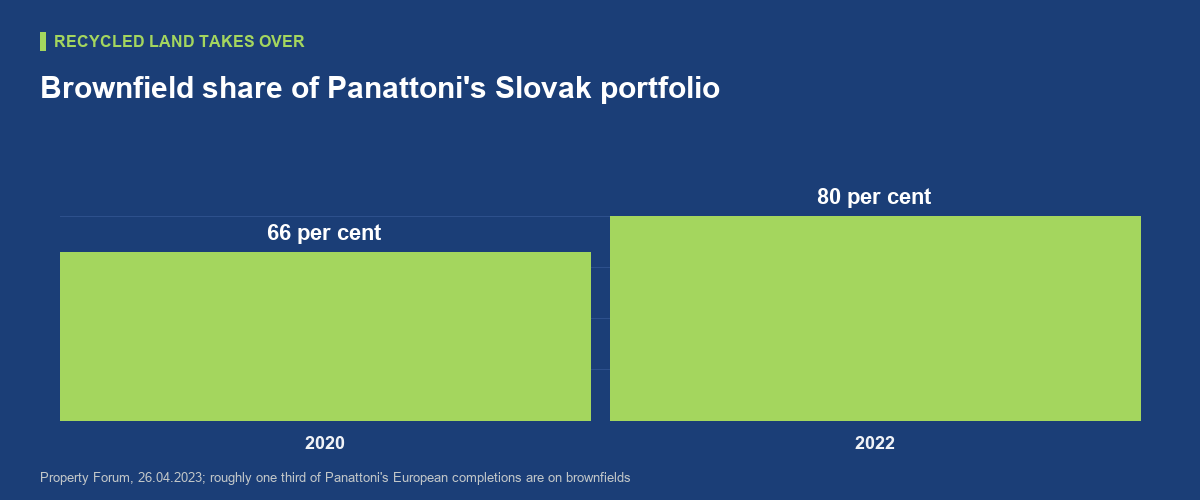
While the subsidy arithmetic favoured fields, the biggest industrial developers quietly moved the other way. Panattoni grew the brownfield share of its Slovak portfolio from 66 per cent in 2020 to 80 per cent in 2022, with roughly a third of its European completions on recycled land. Its Czech reference project, Panattoni Park Ostrov North, recycled 98.7 per cent of demolition materials and saved circa 10,300 lorry journeys – a Czech example, but the same playbook now applied west of Kosice and around Bratislava. The commercial logic is set out plainly by CBRE Investment Management: recycled land costs less, arrives with utility connections and transport infrastructure already in the ground, and re-using structures and materials cuts embodied carbon – which certification schemes and lenders increasingly price. And location does the rest: old industry stands where the workers and the customers already are. In a market where national vacancy runs at 8.12 per cent and the average rent has softened 6 per cent year on year to EUR 4.55 per square metre per month (CBRE data via Property Forum), the developer who skips the rezoning years and inherits the grid connection wins on time – and time is the scarcest input of all.
The twist in the cities: housing outbids the shed
There is a catch for industrial occupiers eyeing urban brownfields: housing wants them more. Bratislava’s flagship conversions are all going residential or mixed-use. Istrochem – the Dynamitka chemical works founded by Alfred Nobel – is the capital’s largest such site at circa 1.6 million square metres, and Penta Real Estate is steering it towards a new city district, with an urban design competition from 2027 and remediation named an essential part of the project. Corwin’s Palma project is turning a former mill into 798 apartments with four industrial buildings preserved, and the former Matador rubber works in Petrzalka is becoming 267 homes, under construction since spring 2025 with a first stage due in 2028. Each of those projects removes well-located land from the industrial market for good. The consequence is a ring structure: inner-city conversions go residential, while the industrial opportunity concentrates on edge-of-city sites and regional towns, where former plants already live second lives as multi-tenant parks. For an occupier the question is no longer whether old industry converts – it is which ring of the city you can still afford.
Policy now pushes the same way – and what to check before you buy
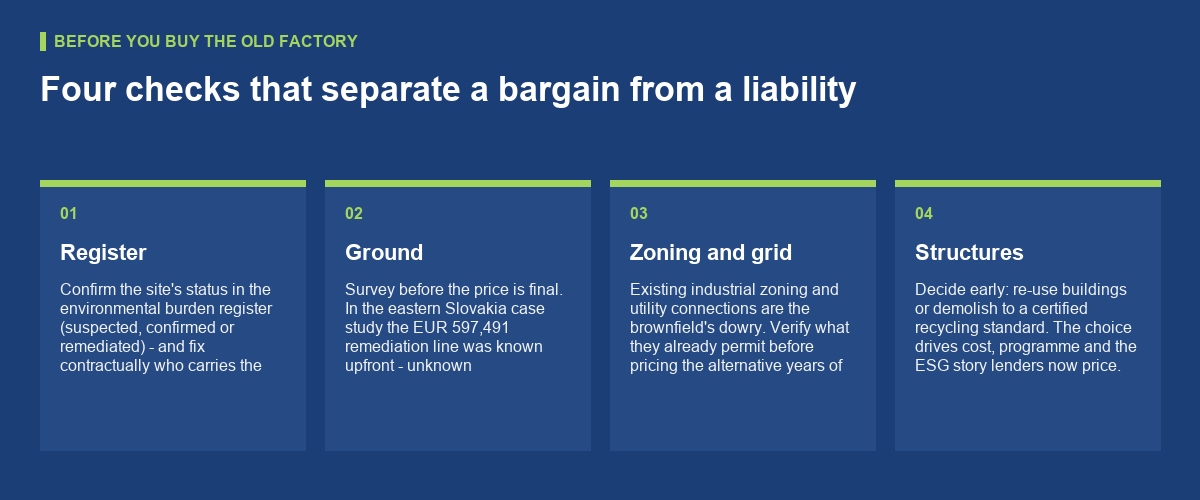
The regulatory direction is one-way. Directive (EU) 2025/2360 on soil monitoring and resilience, published in November 2025, obliges member states to monitor soil sealing and land take – the measuring instrument for the EU’s older ambition of no net land take by 2050, against cities and commuting zones that consumed circa 450 square kilometres per year between 2012 and 2018 (CBRE IM). Slovak money is already flowing: the environment ministry’s third call under Program Slovensko put EUR 186.67 million into remediating environmental burdens, and regional investment aid remains available in weaker regions, as we set out in our state-aid review – though with no explicit brownfield bonus yet. For a buyer, four checks separate a bargain from a liability. Confirm the site’s status in the environmental burden register and fix in the contract who carries the historical liability. Survey the ground before the price is final – in the case study above the EUR 597,491 remediation line was known upfront, and unknown contamination is what actually sinks conversions. Verify what the zoning and the grid connection already permit, because they are the old site’s dowry. And decide early whether structures are re-used or demolished to a certified recycling standard, because that choice drives both cost and the ESG story.
Conclusion
The question is no longer whether Slovakia converts its old industry – the developers have switched, Brussels has legislated, and the state is counting and funding. The question is who captures the value: housing already takes the prime urban plots, logistics takes the ring, and the coming national database will put a price on everything else. For an occupier the decision stays built-to-suit arithmetic plus honesty about ground risk: greenfield sells simplicity at a largely public price, brownfield sells location with homework attached. Do the homework while the supply is still uncounted – that is when the discount is largest.