
Slovakia’s industrial statistics describe a market of big boxes on motorway junctions – and miss the segment where the queue is. Last-mile logistics, the final leg between a depot and the customer’s door, runs on a different product: compact units inside the city, served by vans rather than articulated trucks, leased short and priced high. While standard warehouse space in Slovakia reprices in the tenant’s favour, urban small units remain scarce in Bratislava and close to unobtainable in Kosice. This article maps what that space actually is, what it costs across the region, and when the premium is worth paying.
Two markets in one country: big boxes soften, small units queue
On paper the Slovak industrial market has swung the tenant’s way. The national vacancy rate climbed to 8.12 per cent in the first quarter of 2026, and the average rent slipped 6 per cent year on year to EUR 4.55 per square metre per month even as total leasing jumped 47 per cent to 136,000 sqm (CBRE figures reported by Property Forum). Landlords of standard big-box space are working to keep income in place – renegotiations made up 53 per cent of all transactions. Small urban units sit at the opposite end of that cycle. Alto Real Estate, whose STORE.TO scheme is one of the few modern small-business-unit projects in the capital, describes the segment as undersupplied, with many companies still operating from outdated facilities (interview with warehouserentinfo.sk). The capital’s weight makes that mismatch matter: the wider Bratislava area took 72 per cent of national leasing in the first quarter, and e-commerce contributed 17 per cent of demand. When most of the country’s requirements point at one city, and the product those requirements increasingly need – compact, close-in, van-served – barely exists in modern form, the usual cycle logic stops applying. Big boxes reprice; small units queue.
What a small unit in Bratislava actually is
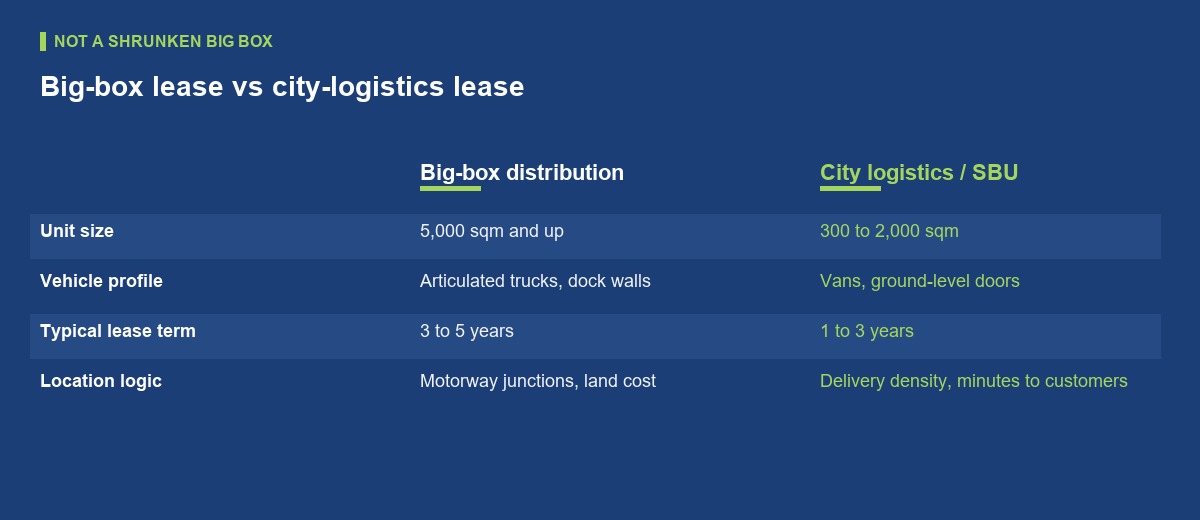
The product has its own grammar, and it is not a shrunken big box. City-logistics units in Bratislava typically run from 300 to 2,000 square metres, with development concentrated in urban districts such as Petrzalka and Raca (warehouserentinfo.sk market guide). At STORE.TO, standard units range between 500 and 1,000 sqm, and the developer is explicit that this is not a traditional logistics park designed for heavy truck traffic – the scheme is optimised for van logistics and fast access (Alto Real Estate). The specification differs in kind: ground-level doors instead of full dock walls, parking and charging for van fleets instead of trailer yards, and a visibly higher office and showroom share – integrated office space within industrial buildings rented for EUR 9.00 to 11.00 per square metre per month in mid-2025, roughly double the big-box warehouse rate (Industrial Research Forum data summarised by warehouserentinfo.sk). Lease terms are shorter too: city-logistics deals commonly run one to three years against three to five for distribution space. The tenant mix explains the design – e-commerce operators, service businesses, parcel carriers and showroom-plus-storage concepts value proximity and flexibility over cubic volume.
The premium, quantified: what small space costs across CEE
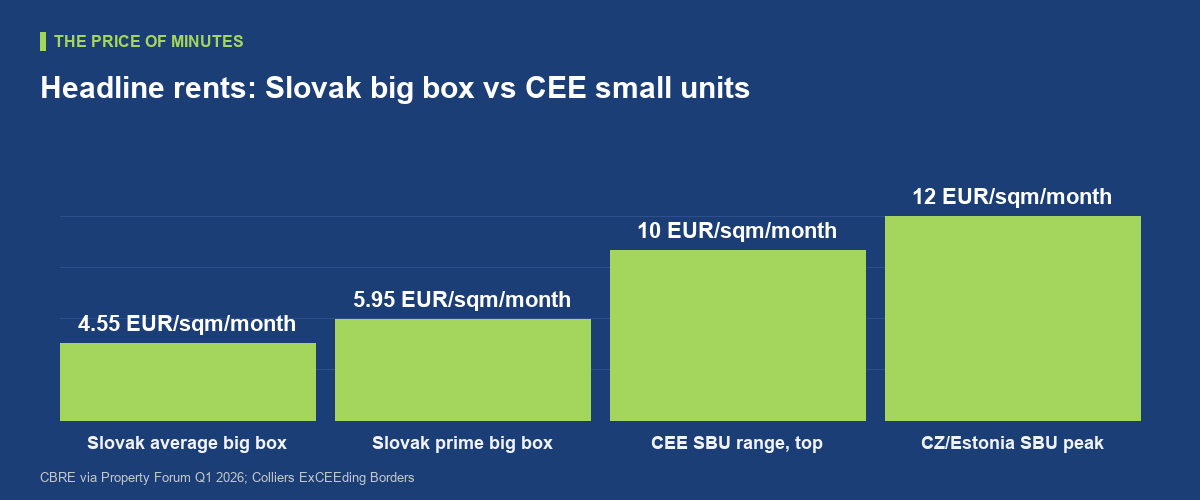
There is no published Bratislava SBU rent series yet – the segment is too young and too thin – so the honest benchmark is regional. Colliers’ CEE-15 analysis of the small-business-unit and last-mile segment, published in 2022, put headline rents for this type of space at EUR 4.00 to EUR 10.00 per square metre per month, reaching EUR 12.00 in the Czech Republic and Estonia, and noted that rents and service charges run significantly higher than in standard buildings (Colliers, ExCEEding Borders). Stock across the fifteen markets exceeded 3 million square metres, roughly 2 million of it in Poland – Slovakia’s share was marginal then and remains thin now. Set the top of that range against what occupiers actually pay for Slovak big boxes – a prime of EUR 5.95 and an average of EUR 4.55 in the first quarter of 2026 (Property Forum) – and the scale of the premium comes into focus. The reasons are structural rather than cyclical: urban land competes with residential and retail uses; small floorplates carry more walls, doors and management per square metre; shorter leases price the tenant’s flexibility into the rent; and the office share is higher. The premium is not an inefficiency waiting to correct. It is the price of minutes.
Kosice: the tightest market nobody builds in
Eastern Slovakia is the small-unit story at its most extreme. The east runs the country’s tightest vacancy rate at 2.66 per cent, yet it took just 6 per cent of national leasing in the first quarter (CBRE via Property Forum) – not because nobody wants the space, but because almost nothing modern gets built there speculatively. The demand side is not standing still. The expected Volvo plant near Kosice is anticipated to pull suppliers and services east (warehouserentinfo.sk), the city anchors Slovakia’s rail-connected logistics for Ukraine-facing flows, and the parcel networks that carry Slovak e-commerce need eastern depots regardless of where developers prefer to build – DPD alone maintained almost 3,700 pickup points across Slovakia as of May 2026 (E-commerce Germany News). The national online market those networks serve turned over EUR 1.84 billion in 2024, still below the 2021 record of EUR 2.08 billion but growing again (Trade.gov). For occupiers the practical reading is uncomfortable: in Kosice the constraint is not the rent, it is the option set. Units of the right size surface rarely, lease fast, and reward tenants who have scoped requirements before the space appears rather than after.
Pricing the premium: four questions and the investor angle
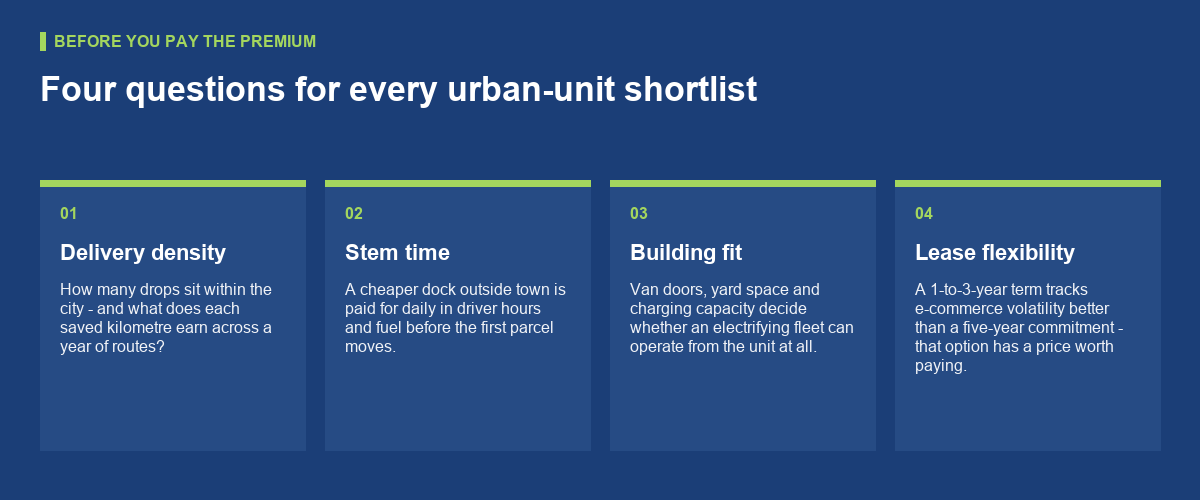
Whether the urban premium pays is arithmetic, not taste. First, delivery density: how many drops sit within the city, and what does each saved kilometre earn across a year of routes? Second, stem time: a cheaper dock in Senec is paid for daily in driver hours and fuel before the first parcel moves – the rent saving has to beat that recurring bill. Third, building fit: van doors, yard space and charging capacity decide whether an electrifying fleet can actually operate from the unit, and EV charging infrastructure is now a standard tenant requirement (warehouserentinfo.sk). Fourth, lease flexibility: a one-to-three-year term tracks e-commerce volatility far better than a five-year commitment, and that option has a value worth paying for. The investor side explains why landlords rarely blink first. Slovak investment volume reached EUR 536 million in the first half of 2025, up 315 per cent year on year, with industrial assets taking 58 per cent of it, and the Bratislava prime industrial yield stood at 6.00 per cent (Cushman & Wakefield CEE investment report). Scarce urban logistics is exactly the profile buyers underwrite hardest for rental growth – which means owners of small-unit schemes can afford patience that big-box landlords currently cannot.
Conclusion
Slovakia’s headline statistics describe a softening big-box market and quietly omit the segment moving the other way. Small urban units in Bratislava are scarce, specified differently, leased shorter and priced above the big-box prime; in Kosice they are close to unobtainable. Occupiers who run the density and stem-time arithmetic will know precisely when the premium pays – and occupiers who wait for the tenant’s market to reach the city centre are likely to find that it never arrives.