
Ask three people what industrial land prices in Slovakia look like and you will get three confident, incompatible answers – because unlike rents, land has no broker index, no quarterly MarketBeat line and no official statistic worth the name. Prices are set plot by plot, and the printed number is routinely the smallest part of the story. This article assembles what can actually be evidenced in 2026: regional asking prices, a concrete Bratislava benchmark, the hidden second price of utilities and zoning, what full servicing costs when the state does it at scale – and how all of it flows into the rent occupiers end up paying.
Why quoted industrial land prices tell you so little
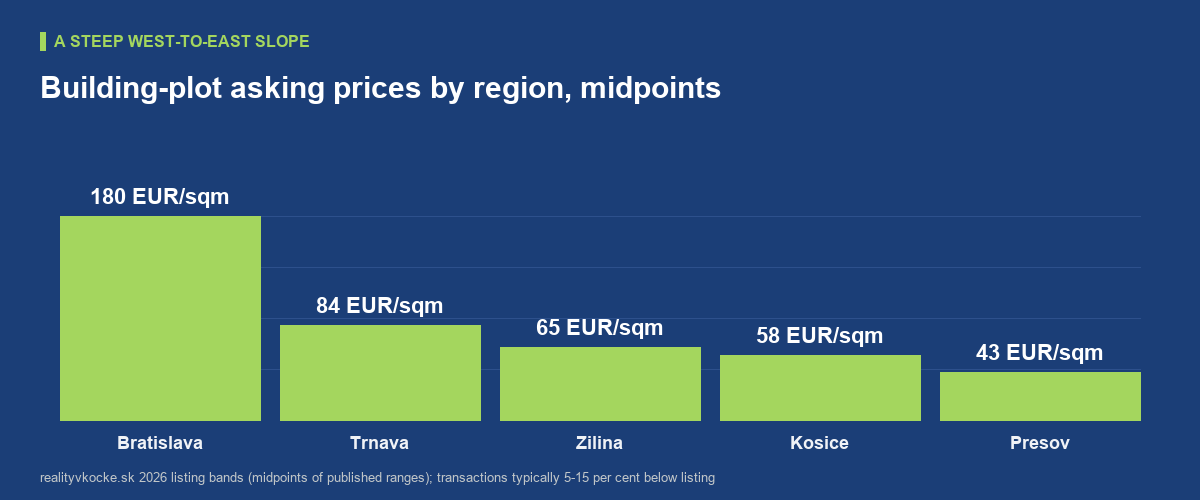
Slovakia publishes no industrial land price index. What exists is listing data – and listings are an opening position, not a result. Portal analysis compiled by realityvkocke.sk puts typical building-plot asking prices at EUR 150 to 210 per square metre around Bratislava, EUR 60 to 107 in the Trnava region, EUR 40 to 90 around Zilina, EUR 45 to 70 around Kosice and EUR 25 to 60 in the Presov region – with actual transactions typically closing 5 to 15 per cent below the listed number (realityvkocke.sk market overview). Those figures skew towards residential-grade plots, so treat them as a gradient rather than a tariff: what they reliably show is the shape of the market – a steep west-to-east slope, and a Bratislava premium of roughly three to five times the eastern regions. Industrial plots follow the same slope but price on different variables: zoning status, utility capacity at the boundary, geometry and access. Two neighbouring fields can differ in value by an order of magnitude because one is zoned and serviced and the other is, legally speaking, still a meadow. That is why the only honest answer to the price question is a range – and why the second half of this article is about everything the headline number hides.
The Bratislava benchmark: what a real plot asks in 2026
Concrete asking prices are rare in public, which makes the exceptions valuable. A live listing on Majerska Street in Bratislava-Ruzinov offers 30,000 square metres of industrial land at EUR 170 per square metre plus VAT, with electricity and water available on site (warehouserentinfo.sk listing) – EUR 5.1 million for the plot, our multiplication. That sits exactly inside the EUR 150 to 210 Bratislava listing band above, and it illustrates what the top of the market buys: city-fringe location, utilities at hand, scale suitable for a mid-size distribution or production building. The corridor logic familiar from rents applies to land with more force: proximity to the D1, to labour and to power capacity has become a site-selection constraint in its own right, and plots that combine all three trade at multiples of the regional average. The same 30,000 square metres in a Presov-region village might list below EUR 60 per square metre – but the saving is only real if the cheaper plot can actually be built on, powered and reached, which is precisely what the asking price does not tell you.
The hidden second price: utilities and zoning
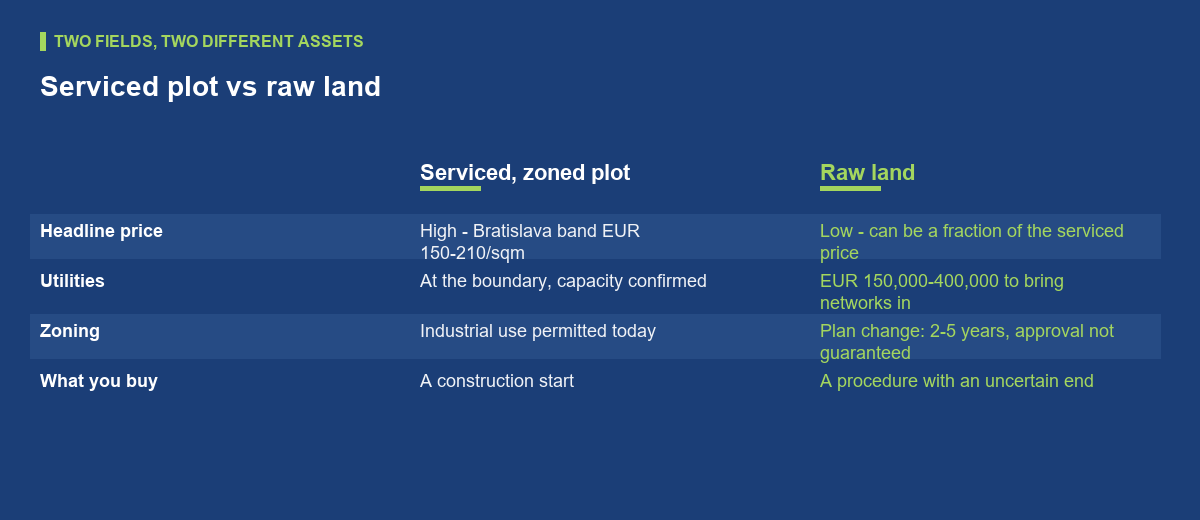
The number on the listing is the first price. The second one is buried in the ground. Slovak agency Atte Reality, which specialises in plot acquisitions, puts the cost of bringing all utility networks to an unserviced plot at EUR 150,000 to 400,000, with a new transformer station and high-voltage connection alone running EUR 50,000 to 200,000 and more (Atte Reality, the hidden price of a plot). Spread over a 30,000 square metre site, that adds up to EUR 13 per square metre to the real entry cost – our arithmetic – before a single foundation is poured. Time is the harsher currency: where the municipal zoning plan does not permit industrial use, a zoning-plan change takes two years in the ideal case and three to five years normally, involves public consultation where neighbours can object, and approval is not guaranteed – the municipality can simply decline (Atte Reality, same guide). This is what the price gap between raw and ready land actually buys: not convenience but risk transfer. A plug-and-play plot at EUR 170 can be the cheaper purchase than a EUR 40 field that spends four years in procedure and still needs a transformer.
The Valaliky yardstick: what full servicing costs at scale
For a sense of what industrial readiness is worth when priced honestly, look at the largest land project in the country. The strategic park at Valaliky near Kosice spans over 700 hectares including infrastructure land, and the state’s planned investment is EUR 731 million (Valaliky Industrial Park) – with over EUR 280 million already committed at the 2023 construction launch for transport links, water supply, sewage and park infrastructure (DRIVEN report). Divide the planned total by the area and the state is spending the equivalent of roughly EUR 100 per square metre to turn eastern Slovak fields into a site an investor like Volvo – approximately EUR 1 billion, 12,000 expected jobs – will actually build on. That is our arithmetic, and the spend covers more than bare servicing; but the order of magnitude is the lesson. Readiness costs as much as, or more than, raw land – which is why regional investment aid exists to close the gap, and why privately quoted prices for genuinely ready plots in strong locations are not the anomaly they may seem. Someone always pays for the pipes; the only question is whether it is visible in the price or hidden in the project.
Rent or buy: how land prices reach the occupier
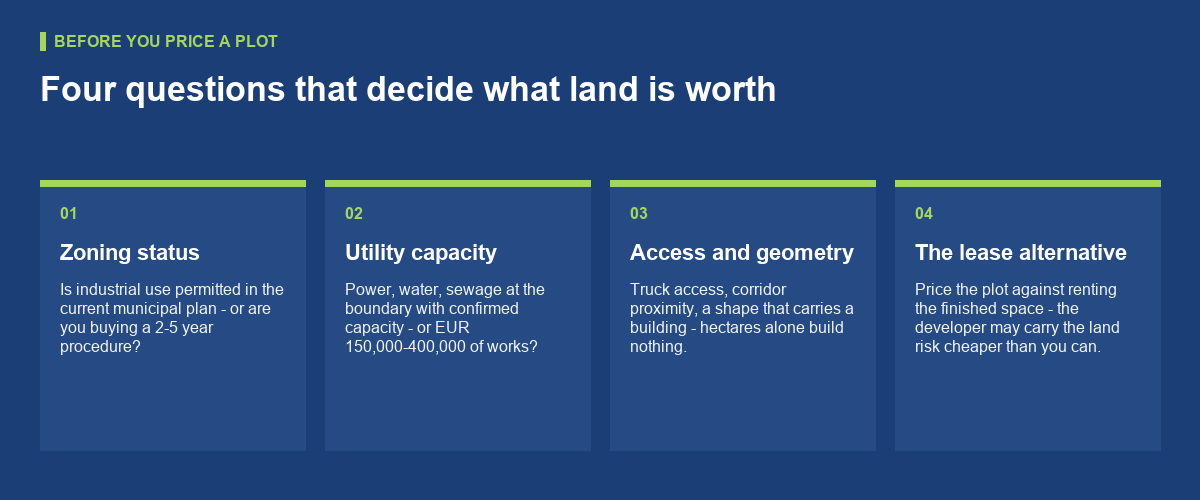
Most occupiers never buy a square metre of land – and the land market reaches them anyway, through the developer’s spreadsheet. Slovakia’s modern industrial stock stands at 4.87 million square metres with vacancy at 8.12 per cent and a prime rent of EUR 5.95 per square metre per month (CBRE figures via Property Forum); Cushman & Wakefield’s Q1 2026 read has prime rent at EUR 5.30, vacancy at 7.72 per cent and more than 105,000 square metres newly delivered (C&W Slovakia MarketBeat). Land is one of the few development inputs still rising while rents flatten, and developers underwrite it years ahead through land banks – one reason speculative supply concentrates where plots were secured cheaply. For an occupier, the buy case is narrow but real: owner-occupiers with long horizons, specialised facilities that no landlord would fund, or a built to suit where controlling the plot strengthens the negotiation. For everyone else, leasing means renting the land risk along with the building – the developer absorbed the zoning procedure, the utility connections and the price of being wrong. Seen that way, the gap between a prime rent and a secondary one is partly just land price in monthly instalments.
Conclusion
Industrial land in Slovakia has no price list, and anyone quoting one number is quoting the wrong one. What the evidence supports in 2026: a steep west-to-east gradient in asking prices, a Bratislava benchmark around EUR 170 per square metre for serviced city-fringe land, a hidden second price of up to several hundred thousand euros in utilities and years in zoning procedure – and a state yardstick at Valaliky showing that readiness itself costs on the order of EUR 100 per square metre. Whether buying or leasing, the discipline is the same: price the plot’s status, not its surface.