
Slovak warehouses sit under some of the country’s most valuable unused land – their own roofs. Rooftop solar has moved from sustainability brochure to lease negotiation: commercial and industrial installations are the fastest-growing segment of Slovakia’s photovoltaic market, grid connections for new capacity are scarce, and the question of who installs, owns and profits from the panels is landing in heads of terms. This article covers what a logistics roof actually yields, the three ownership models and what each does to the lease, the Slovak permitting rulebook, and the questions occupiers should settle before they sign.
The fastest-growing segment of a small market
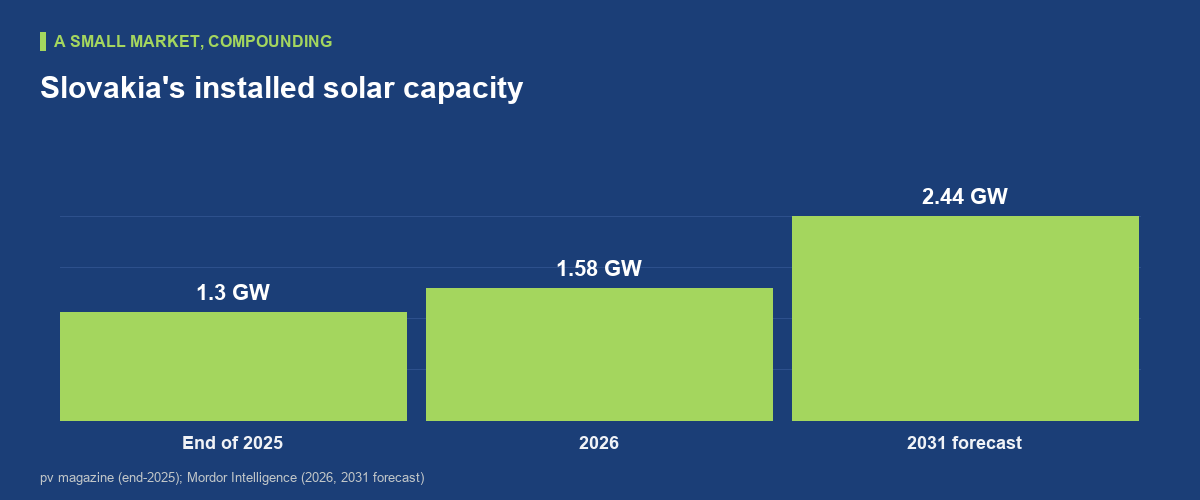
Slovakia’s solar base is modest but compounding quickly. Cumulative capacity passed 1.3 GW by the end of 2025, with almost 16,000 new installations connected in that year alone (pv magazine). Mordor Intelligence expects the market to grow from 1.58 GW in 2026 to 2.44 GW by 2031, a 9.06 per cent annual rate – and within that, commercial and industrial rooftops are the fastest segment at 17.92 per cent a year (Mordor Intelligence). Logistics parks are the natural carrier of that growth: flat roofs measured in hectares, daytime consumption underneath, and a modern stock of 4.87 million square metres (CBRE figures via Property Forum). Apply the standard sizing rule – roughly 8 to 10 square metres of usable roof per kilowatt-peak, with 70 to 80 per cent of a roof usable (Evo Energy) – and the national warehouse stock is, in order-of-magnitude terms, a 300 to 500 MWp roof bank. That is our arithmetic, not a broker forecast, but it frames the prize: the sector could carry a meaningful share of the country’s entire solar build-out without touching a field. The grid is the catch: new connection capacity is scarce and slowly allocated, which is exactly why generation that never leaves the building has become the segment to watch. A roof does not stand in the connection queue.
What rooftop solar actually yields on a logistics roof
The sizing physics are well established: a standard 10,000 square metre warehouse roof accommodates a 700 to 900 kWp system, enough to offset 40 to 70 per cent of annual electricity consumption for a high-energy-use facility (Evo Energy commercial solar guide – UK figures, and Slovak irradiation is no worse). Slovakia already has a reference case. Photon Energy built rooftop plants on three CTParks – 407.68 kWp in Bratislava, 354.90 kWp in Trnava and 499.59 kWp in Zilina, a combined 1.26 MWp, commissioned between May and September 2022. The buildings had been constructed solar-ready, and CTP handled the AC connections itself (Photon Energy case study). CTP runs these under energy-service contracts that bundle solar with storage and EV charging (Mordor Intelligence). The economics rest on self-consumption: power used where it is generated avoids the substantial non-commodity costs a licensed supplier adds, so the benefit is greatest where the building itself is the customer (CMS). For occupiers, solar-ready matters more than it sounds: structural reserve, cable routes and inverter space planned at construction are what separate a weekend installation from a year of retrofit engineering. And in a market where power capacity has become a site-selection constraint, behind-the-meter generation is one of the few hedges an occupier can actually buy.
Who owns the panels: three models, three different leases
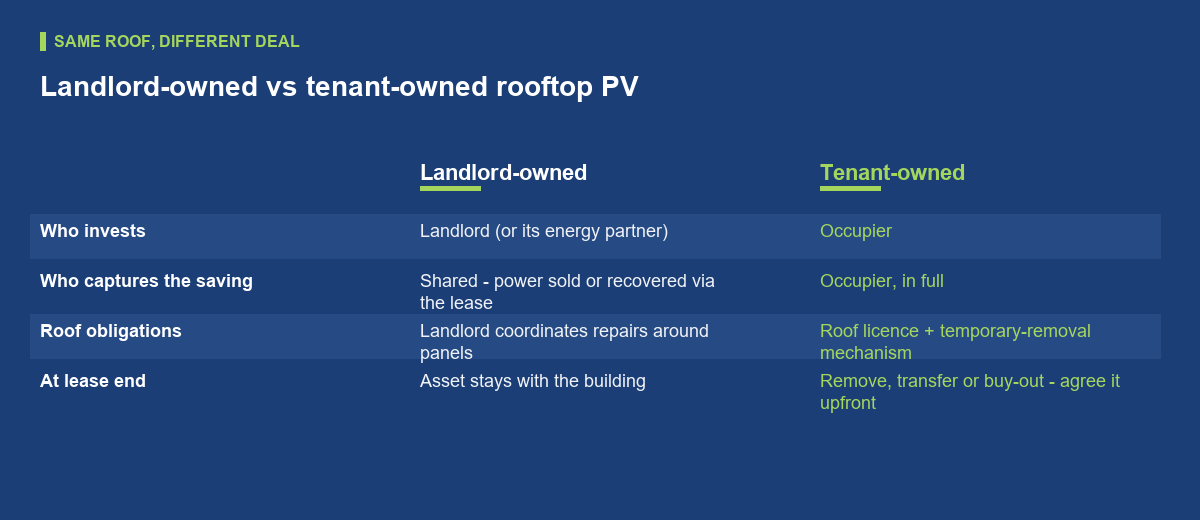
The core structuring decision is who procures the installation, operation and ownership of the panels (CMS, The roof space race). Landlord ownership is the cleanest for multi-let parks: the landlord invests, sells the power to tenants or recovers costs through the lease, and keeps the asset at expiry – the CTP schemes follow this logic. Tenant ownership suits single-let buildings with long terms: the occupier captures the full saving but needs a roof licence, and must agree what happens to the equipment at lease end. The third-party model – an energy company owns the plant and sells power under a power purchase agreement – moves the capital cost off both balance sheets and prices the electricity instead. Whichever model applies, the agreements have to dovetail with the lease rather than fight it. If the tenant holds roof-repair obligations, a mechanism for the temporary removal of the solar apparatus is needed; and panels installed on a completed building can risk invalidating subsisting roof warranties (CMS). On a triple net lease the insurance and maintenance split needs explicit words – and where costs are recovered, the service charge schedule is where the solar clause either pays the tenant back or quietly does not. The clean test is cash flow: follow who pays the capital cost, who bills the kilowatt-hour and who books the asset at expiry, and the real model reveals itself.
The Slovak rulebook: notification, not licence
Slovak permitting is friendlier to rooftop projects than its reputation. Installations up to 1 MW – which covers essentially every single-building warehouse system – are subject to a notification obligation rather than a full production licence; the licence for constructing an energy installation only applies above 5 MW. Statutory permitting timeframes run 30 days for standard cases and 60 for complex ones, though in practice they are often exceeded (CMS CEE Expert Guide). The fiscal side has been moving in the producer’s favour: the excise-duty exemption threshold rose to 50 kW from 2025, prosumers may export up to 1,000 MWh a year, and legislation effective January 2026 introduces contract-for-difference payments, flexible grid-connection deals and electricity sharing (Mordor Intelligence). That last item matters most for parks: Slovakia is preparing an energy-community framework built mainly around rooftop PV combined with battery storage, local consumption and electricity sharing (pv magazine) – which would let one big roof serve several tenants, or several buildings, without each needing its own plant. One caution: exporting power still needs a connection agreement with the distribution operator, and the statutory priority access for renewable producers is, in CMS’s words, rather a theoretical right – one more argument for sizing a system to the building’s own load. The regulatory direction of travel is clear even where the detail is not yet law.
Four questions before you sign
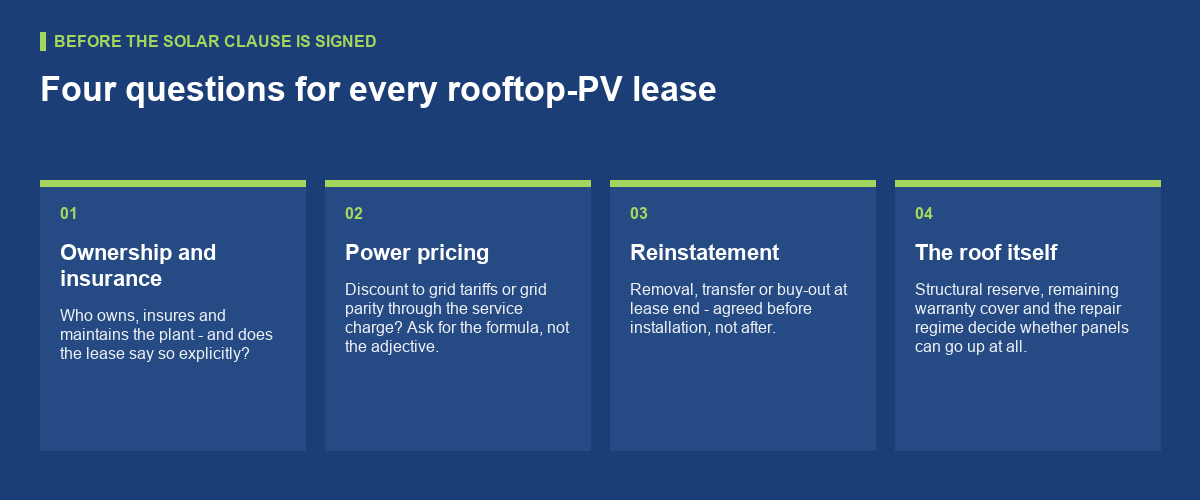
First: who owns, insures and maintains the plant – and does the lease say so in those words? Ownership decides who claims the savings, who carries the replacement risk and who benefits from subsidy schemes. Second: how is the power priced? A landlord selling roof power at a discount to grid tariffs is sharing the gain; one charging grid-parity rates through the service charge is keeping it. Ask for the formula, not the adjective. Third: what happens at reinstatement? A tenant-owned plant needs an agreed end-of-lease treatment – removal, transfer or buy-out – before installation, not after. Fourth: does the roof itself cooperate? Structural reserve, remaining warranty cover and the repair regime determine whether panels can go up at all without creating a liability (CMS). Occupiers already pay attention to what BREEAM and DGNB certification costs them – the same discipline belongs on the solar clause, because it moves real money every month. A building whose roof cuts 40 to 70 per cent off the power bill at a fair price is a different economic proposition from an identical building next door whose roof only shades the racking. And put the answers in the lease itself, not in a side letter that quietly dies at assignment or sale.
Conclusion
Slovakia’s warehouse roofs are becoming the cheapest new power plant in a grid-constrained market, and the growth numbers say the build-out has started. But the panels themselves decide nothing: the lease decides who invests, who saves and who owns the asset when the term ends. Occupiers who negotiate the solar clause with the same care as the rent clause will capture a share of the roof’s value – the rest will watch it flow, kilowatt by kilowatt, to the other side of the table.