
The second quarter of 2026 looks, on the headline row, like the quietest quarter the Slovak industrial market has had in two years. Prime rent held at EUR 5.30 per square metre per month, no submarket moved its band, and gross leasing fell by 28 per cent against a strong first quarter. Read one level deeper and the quarter changed two things that will outlast it: the map split into a tight, building east and an empty, static west, and the market’s own statistics changed shape, because finished halls without fit-out are now counted as a category of their own. Both changes decide how every number below should be read.
The quarter in numbers, and the contradiction inside them
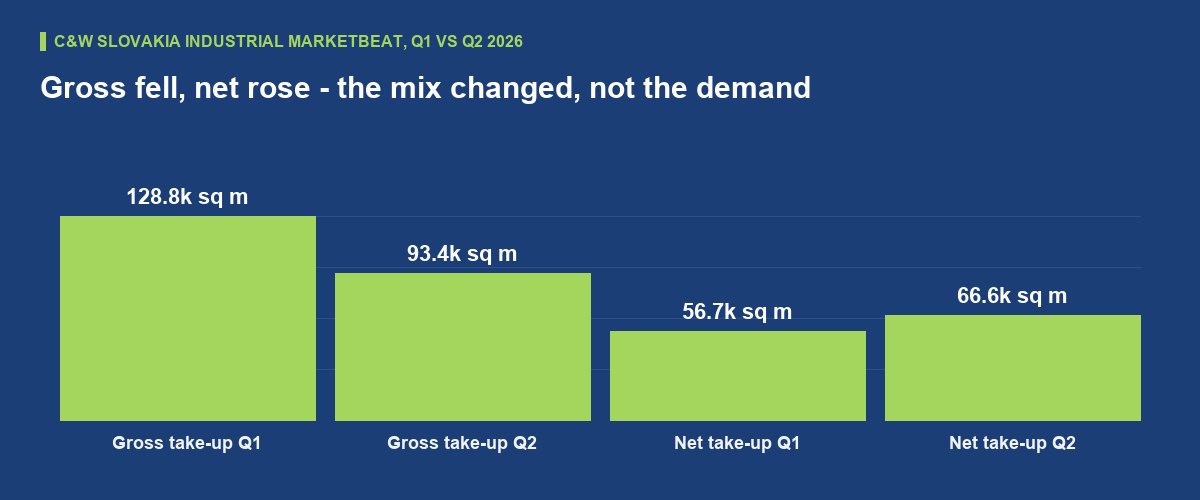
The raw figures first. Gross take-up reached 93,400 sq m across 18 transactions in Q2 2026, down 28 per cent quarter on quarter, according to the Cushman & Wakefield Slovakia Industrial MarketBeat published on 4 August. Net take-up, which strips out renegotiations, went the other way: 66,600 sq m, up 17 per cent on the first quarter. Those two arrows pointing in opposite directions are the story. The first quarter was carried by renegotiations, which made up 54 per cent of all demand; the second quarter was carried by commitments to space that does not exist yet. Pre-leases accounted for 50 per cent of everything signed.
New completions were thin: 25,800 sq m across two buildings, Mountpark Bratislava Triblavina at 21,300 sq m and CTPark Trnava North at 4,500 sq m, both fully let on delivery, per the Industrial Research Forum figures. The pipeline moved up to 265,800 sq m under construction, 37 per cent of it already pre-leased. Total stock stands at 4.89 million sq m. None of these numbers is dramatic on its own. The drama is in where they sit on the map, and that is the next section.
A five-year vacancy high that the prime rent ignores
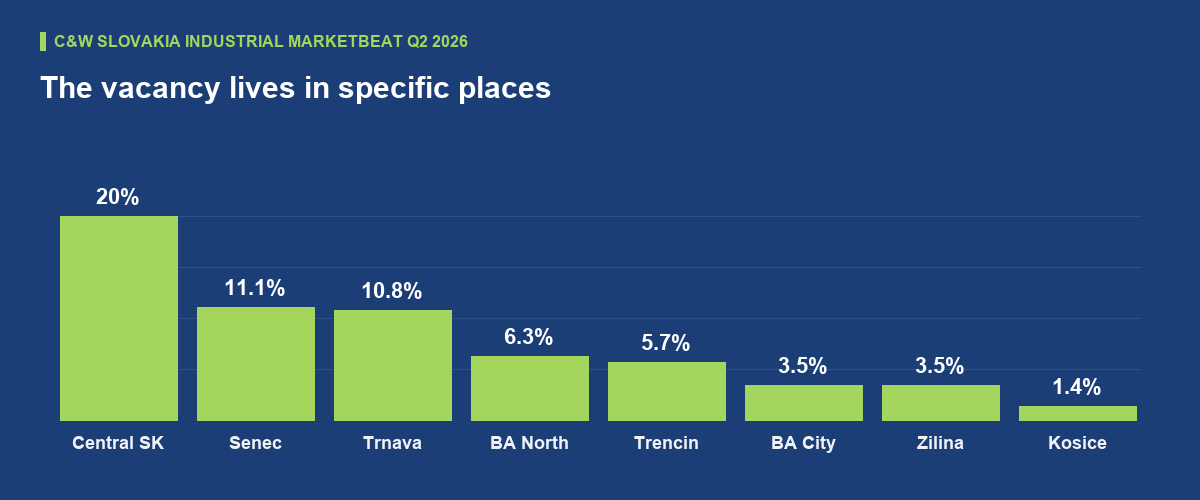
The national vacancy rate ticked up to 7.8 per cent, which Cushman & Wakefield calls the highest in the last five years. In the same report, prime rent is unchanged at EUR 5.30. In the first quarter the same source still recorded rental decreases across most submarkets; in the second, “rental levels remained stable”. The decline of early 2026 stopped at EUR 5.30 even as more space stood empty, and both facts are true because they describe different buildings.
Prime rent is measured on the best space in the strongest locations, and the empty square metres are mostly somewhere else: older stock and the south-western logistics belt. The submarket bands tell it plainly. Bratislava City lets at EUR 5.30 to 6.50, while Senec, twenty minutes east and the largest submarket in the country, lets at EUR 3.80 to 4.70 with 11.1 per cent vacancy. Trnava sits at EUR 3.80 to 4.40 with 10.8 per cent empty. For an occupier the practical number was never the headline anyway: it is the effective rent after incentives, and incentives are exactly what a landlord with a double-digit vacancy rate trades with. How wide that gap already ran in 2026 is documented in what occupiers actually pay.
The map split in two
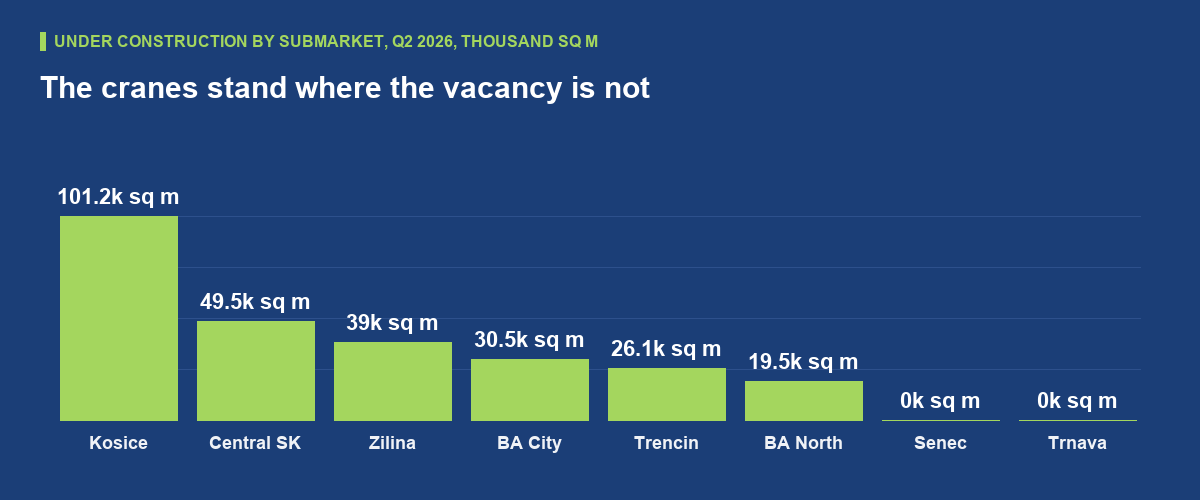
Here is the quarter’s real event. The Kosice area holds 255,800 sq m of stock, 5.2 per cent of the national total, and its vacancy rate is 1.4 per cent – effectively nothing is available. Yet 42,000 sq m of the quarter’s 93,400 sq m of gross take-up landed there, 45 per cent of the national figure, and 101,200 sq m is under construction, 38 per cent of the entire Slovak pipeline. All three shares are our own arithmetic from the MarketBeat table. The two largest deals of the quarter were both pre-leases at Logis One Park Kosice, one automotive in the 20,000 to 35,000 sq m bracket, one 3PL behind it. The Industrial Research Forum names the cause directly: suppliers gathering around Volvo’s plant, the ripple we mapped when the plant was announced.
Now the other half. Senec and Trnava together hold 201,000 sq m of available space, 53 per cent of the national total, and their under-construction column reads zero. The west has the empty halls and no cranes; the east has the cranes and no empty halls. The divide we once described as the D1 corridor against the south has rotated ninety degrees: in 2026 it runs west against east.
Shell and core enters the statistics
The quarter also changed the ruler. The Industrial Research Forum adopted an updated methodology and now reports shell and core space – buildings structurally complete but handed over without fit-out – as a category of its own. There is currently 76,400 sq m of it, and counting it lifts total stock to 4.97 million sq m. Until this quarter that space was statistically invisible: not in the stock, not in the vacancy rate, a finished hall that existed only in the developer’s accounts.
The category matters because it is the developer’s answer to a market that will not commit. Finishing a building to shell and leaving the fit-out open keeps the capital expenditure low and the specification flexible, and shortens the wait for a tenant who needs space in months rather than years. Czechia showed the pattern first: Colliers counted roughly 360,000 sq m of shell and core space there already at the end of Q1 2024. For occupiers reading Slovak reports, the practical consequence is a new question to ask about any availability figure: does it include the shell and core layer or not? A building in that state is real supply, but it is not space you can occupy next month – the fit-out and its approvals still sit between you and the racking, as anyone who has read why a finished Slovak hall waits will recognise.
What the split Slovak industrial market means for H2
The split market gives the two halves opposite playbooks. In the west, time is on your side. With Senec above 11 per cent vacancy, zero speculative development underway and landlords competing against each other’s standing space, the negotiation belongs to the tenant: push on the rent-free period and the fit-out contribution rather than the headline figure, and get the result written into the heads of terms early. Sublease stock – the grey space layer – adds further quiet competition on the landlord’s side of the table.
In the east the same tactics fail, because 1.4 per cent vacancy is not a negotiation, it is a queue. There the realistic route is the pre-lease with its long lead time, or paying the premium for the little that stands. Watch the second half for two things: whether the several pending deals the Industrial Research Forum expects to close actually land, and whether weakening industry – production fell 2.0 per cent year on year in May – starts feeding the renegotiation wave that already dominates Slovak leasing. Investors, for their part, kept buying: the investment market saw EUR 224 million trade in H1, all of it Slovak and Czech capital, at a prime yield of 6.00 per cent quoted for class A stock only. The tenant’s market we described in January is still here – but as of this quarter, only west of Zilina.