
The Slovak industrial property market enters 2026 tilted firmly towards the occupier. After a decade in which warehouses were scarce and rents only rose, vacancy has climbed to its highest level in years, new supply keeps arriving, and landlords in the busiest sub-markets are quietly reducing rents and adding incentives. For a business planning warehouse or production space along the D1 corridor, that shift changes the maths of when to move and what to ask for. This article sets out where the market actually stands in early 2026, with the numbers behind it, and what a tenant-side market means in practice.
How big is the Slovak industrial property market in 2026?
Slovakia has quietly built one of Central Europe’s more substantial logistics bases. By the third quarter of 2025 the country held roughly 4.67 million square metres of modern A-class warehouse and production space, and completions through the rest of the year pushed the total past 4.8 million (Property Forum, Cushman & Wakefield MarketBeat). The stock is heavily concentrated in the west, along the D1 motorway that links Bratislava to Trnava, Nitra and onward to the Czech border. The Bratislava region and the Senec node in particular sit at the centre of the map, close to the capital, the airport and the Austrian and Hungarian borders. Demand has long been anchored by the automotive sector, whose plants and suppliers cluster around Trnava, Nitra and Zilina. For an occupier the practical point is that the useful market is smaller than the national figure suggests: most grade-A space a distribution or light-production tenant would actually consider lies within an hour of Bratislava, which is exactly where the current swing in conditions is most visible. Within that core, the A-cities of the west, Bratislava, Trnava and Nitra, hold the bulk of institutional-grade stock, and the D1 acts as the spine that connects them to the Czech and Austrian markets in a single day’s drive.
Vacancy at a multi-year high
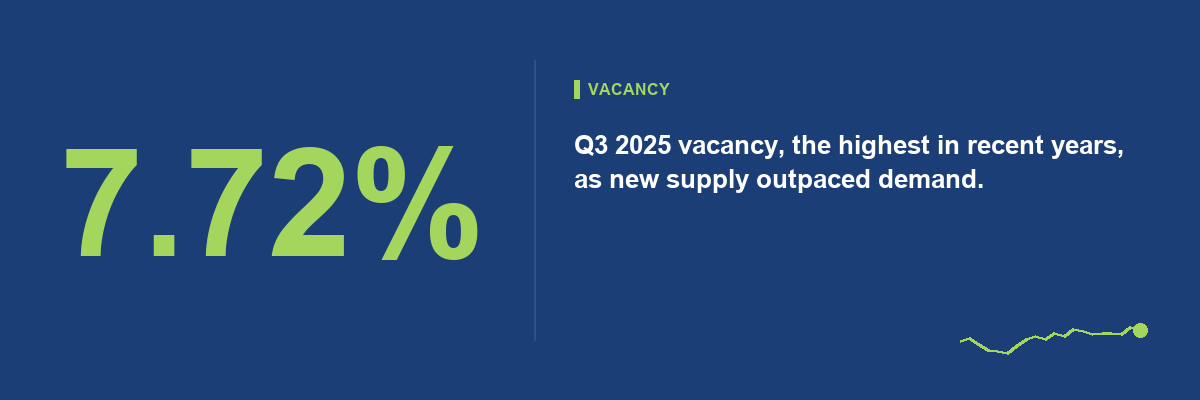
The clearest signal of the shift is vacancy. In the third quarter of 2025 the national industrial vacancy rate reached 7.72 per cent, described by market analysts as the highest level in recent years (Property Forum). Only a few years ago the same market ran below two per cent, tight enough that tenants took whatever came available. The rise is supply-led rather than a collapse in occupancy: developers kept building into a slowing economy. Around 28,000 square metres were completed in the third quarter alone, and roughly 311,000 square metres were under construction at that point, close to half of it speculative, meaning built without a signed tenant (108 Real Estate). As that speculative space completes into soft demand, vacancy is widely expected to edge higher before it stabilises. For occupiers this is the difference between a market where you accept what exists and one where several landlords compete for your signature. Empty modern units, ready to occupy, are now a normal feature of the western sub-markets rather than a rarity, and that is a structural change in how the market behaves, not a one-quarter blip. It also changes pricing psychology: when a tenant can view three comparable units in a single week, the landlord who holds out for the last euro of rent is the one left with an empty building.
Rents look stable, but effective deals are softening
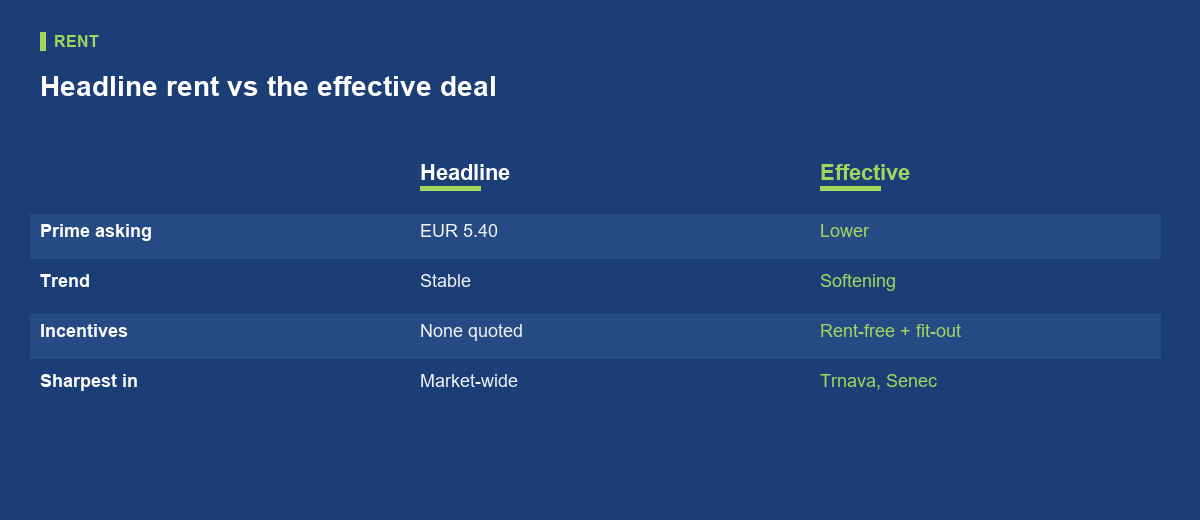
Headline rents have not fallen far, which can mislead. Prime asking rent held at about 5.40 euros per square metre per month through 2025, with the market-wide average nearer 5.07 euros (Cushman & Wakefield). The real movement is in what tenants actually pay. Facing weak demand, landlords in the most active locations, particularly Trnava and Senec, have started to offer incentives and reduce rents to keep units filled (Property Forum). Those incentives take familiar forms: rent-free months at the start of a term, a contribution towards fit-out, or a cap on annual indexation. The gap between the headline number and the effective rent, the all-in cost averaged across the lease, has widened accordingly. Two tenants can sign at the same 5.40 euros and pay very different real rates once free months and contributions are counted. For anyone negotiating in 2026 the lesson is to ignore the sticker price and model the effective rent over the full term. That Senec appears by name in the analysts’ commentary matters for the D1 corridor specifically, because it is one of the sub-markets where the balance of power has moved furthest towards the tenant.
Demand is thinner, and automotive-led
Underneath the supply story sits softer demand. Net take-up in the third quarter of 2025 was about 50,615 square metres, from total leasing activity of 64,365, and the second quarter had already recorded the weakest leasing since 2018 (Property Forum). What activity there was leaned heavily on automotive occupiers and stayed concentrated in the Bratislava region. That concentration is a double-edged sword: it keeps the western sub-markets liquid, but it ties the whole market’s fortunes to one cyclical industry at a time when European car production is under pressure. The longer-term supports are still in place. Nearshoring continues to pull supply chains back towards Central Europe, and Slovakia’s position on the regional trade routes remains an asset, a theme we set out in Cross-Border Logistics Slovakia: CEE’s Pivot Point. But those are structural tailwinds measured in years, not the near-term demand that fills a speculative hall this quarter. For 2026 the realistic base case is thin, selective take-up, with occupiers moving when the numbers are compelling rather than because space is scarce. Occupiers with automotive exposure of their own should stress-test their footprint against a slower production schedule, because space that is easy to take in a soft market is equally easy to be left holding when volumes turn.
What a tenant-side market means for occupiers in 2026
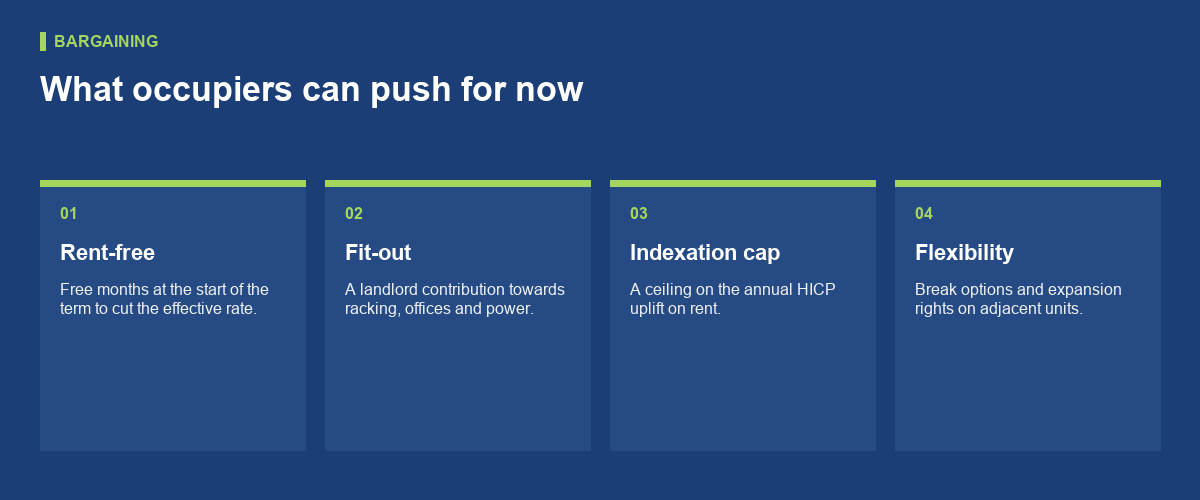
A tenant-side market rewards occupiers who negotiate the whole lease, not just the rent. With vacancy high and landlords competing, the concessions described above, rent-free periods, fit-out contributions, indexation caps and expansion rights, are genuinely on the table for a credible covenant. Two structural points are worth watching. First, on the investment side, buyers value logistics assets partly on their Weighted Average Lease Term (WALT), so a landlord may trade a rent concession for a longer commitment that lengthens income security; an occupier can use that appetite to win incentives in exchange for term. Second, build-to-suit remains a commitment game even in a soft market, because bespoke space is financed against a signed tenant, and one further constraint has grown sharper: grid capacity for power-hungry automation, a point we cover in Industrial Power Capacity in Slovakia. The timing signal for 2026 is simple. Renewals and relocations carry unusual bargaining power right now, and that advantage is strongest exactly where vacancy is highest, including the D1 sub-markets around Senec. Occupiers who prepare, benchmark the effective rent and come with a clear brief will find landlords more willing to move than at any point in the past five years.
Conclusion
Slovakia’s warehouse market has swung from landlord-led to tenant-led faster than most expected. Vacancy sits near a multi-year high, headline rents look stable but effective deals are softening, and demand is thin and automotive-dependent. For occupiers that adds up to bargaining power, the most they have had in years. For developers it is a reminder that in a fuller market, location and building quality decide who fills space and who carries the void. On the D1 at Senec, well-specified, well-managed units still let. The rest of the market is negotiating.