
An occupancy permit is the last item anyone puts time against in a delivery programme and the first one that stops a move-in. The Slovak rule is blunt: a completed building may be brought into permanent use only after the kolaudacia, the inspection that ends with a certificate. Since 1 April 2025 that inspection sits in a new Building Act, and because of the way its transitional rules are written, many halls being handed over in 2026 are still being completed under the old one. Two regimes, two documents, two sets of deadlines. Here is what each requires, how long it takes when nothing goes wrong, which two doors let an occupier in early, and what moving in too soon costs.
Why a completed hall is not a usable hall
One sentence governs everything. Section 66(1) of the new Building Act 25/2025 Z. z. reads, in the original: “Dokoncenu stavbu alebo jej cast sposobilu na samostatne uzivanie mozno uviest do trvaleho uzivania az po kolaudacii.” A completed building, or a part of it capable of separate use, may be brought into permanent use only after the kolaudacia. Not after practical completion, not after the handover protocol is signed, not after the keys change hands.
The document at the end is the kolaudacne osvedcenie, the occupancy certificate, and section 67(2) says what it certifies: the structural and technical fitness of the building for its designed purpose. Two limits sit next to it. Section 67(3) states that the certificate does not replace an operating permission under other legislation, so the hygiene, environmental and fire approvals a process needs sit on the same critical path. Section 68(1) states that a building may be used only for the purpose set out in the certificate, which is where a permitted use clause in the lease itself and the permit have to agree.
That is what catches conversions. A hall certified for storage is not certified for production, and a change in the prevailing use, or a change in the technical parameters that alters the fire safety of the building, needs its own decision under section 68(2). In a converted building the paper trail is usually older than the use somebody now has in mind. The same certificate comes back into view at the end of a lease, because the state the building has to be handed back in is the state the certificate describes.
Which act applies to your building
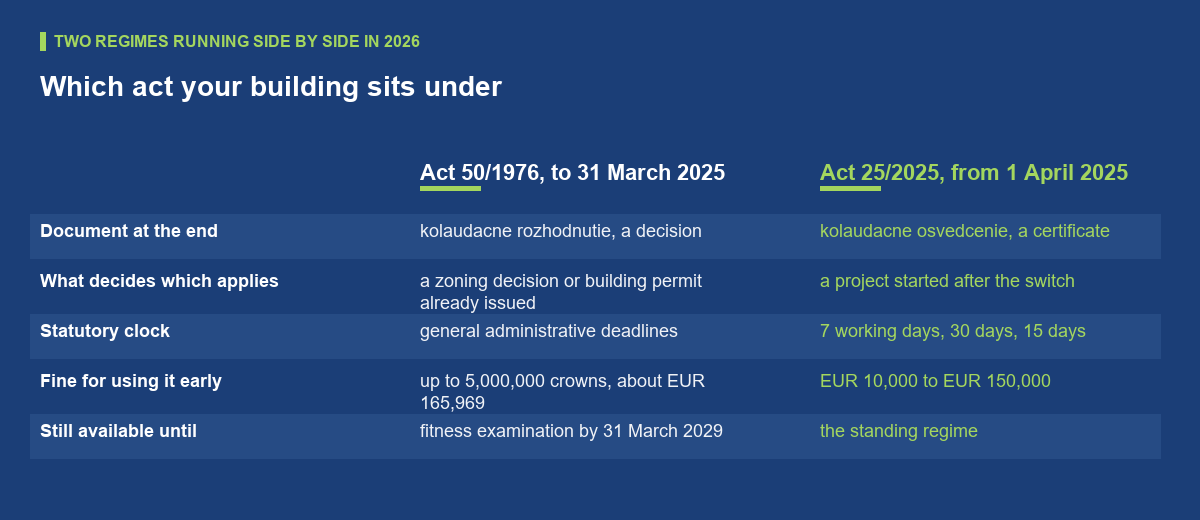
Here is the part that surprises even experienced occupiers. Act 50/1976, which had governed the kolaudacia since 1976, applied until 31 March 2025. The new act took over on 1 April 2025. But sections 84(4) to 84(6) keep the old rules alive: they apply to anything filed or started by 31 March 2025, and, more importantly, to any building that already held a zoning decision or a building permit under the old act, including applications made long after the switch.
For a hall completed in 2026 this is decisive, because the zoning decision behind it was typically issued in 2022 or 2023, back when land prices were the constraint everyone talked about. That building will be inspected under the old act and will receive a kolaudacne rozhodnutie, a decision under section 76(1) of the old law, not the certificate the new act describes. A speculative unit started after the switch will receive the certificate. Both are lawful, and English-language market guidance mostly still describes the older one.
The practical instruction is short: before signing, ask which regime the building sits in and get the answer in writing, ideally already at heads of terms stage. It changes the name of the document your start date depends on, the deadlines the authority has to meet, and the size of the fine if the building is used too early. On a build-to-suit it also decides which rules the design has to satisfy.
How long the occupancy permit takes when nothing goes wrong
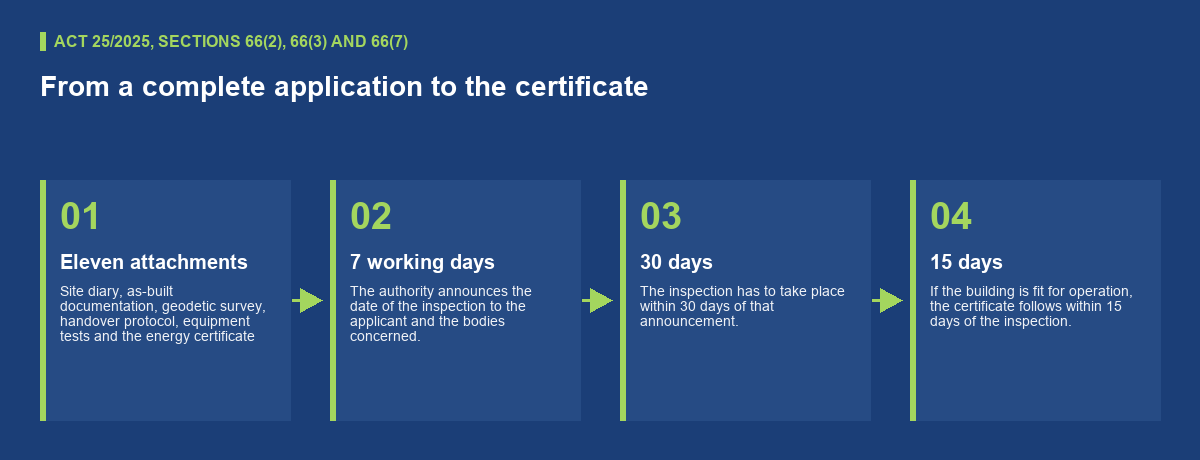
The new act puts the sequence on the clock. Under section 66(3) the authority has seven working days from a complete application to announce the date of the inspection, and the inspection has to take place within 30 days of that announcement. Under section 66(7) the certificate follows within 15 days if the building is found fit for operation.
Adding those periods is our own arithmetic rather than anything the act states: roughly 52 calendar days from a complete application to the certificate where no defect is found. The word carrying all the weight is “complete”. Section 66(2) lists eleven attachments, from the site diary and the as-built documentation to the handover protocol, the equipment tests and the energy certificate, which is the item that most often arrives last. The energy rules around it keep tightening, and it is also the first document that tells a tenant what the energy bill will look like.
The inspection is not a formality either. Section 66(4) lists what the authority checks on site, and two items regularly slip: whether the building is connected to the functioning technical networks of the area, and whether rainwater is captured or drained so that it does not burden the surroundings. A grid connection ordered late becomes visible at exactly this point, the same constraint that decides where a data centre can go.
Failure is handled just as plainly. Section 66(5) has the authority record the defects, set a period and interrupt the process, section 66(6) stops it if they are not removed in time, and section 66(8) stops it outright if the building was put up contrary to the verified project. A schedule of condition taken at handover earns its keep here, and the defects liability period runs on a timetable of its own. A fit-out contribution that funds work outside the verified project is the related risk: a change nobody re-verified can hold up the certificate for the whole building.
The two doors that open a building early
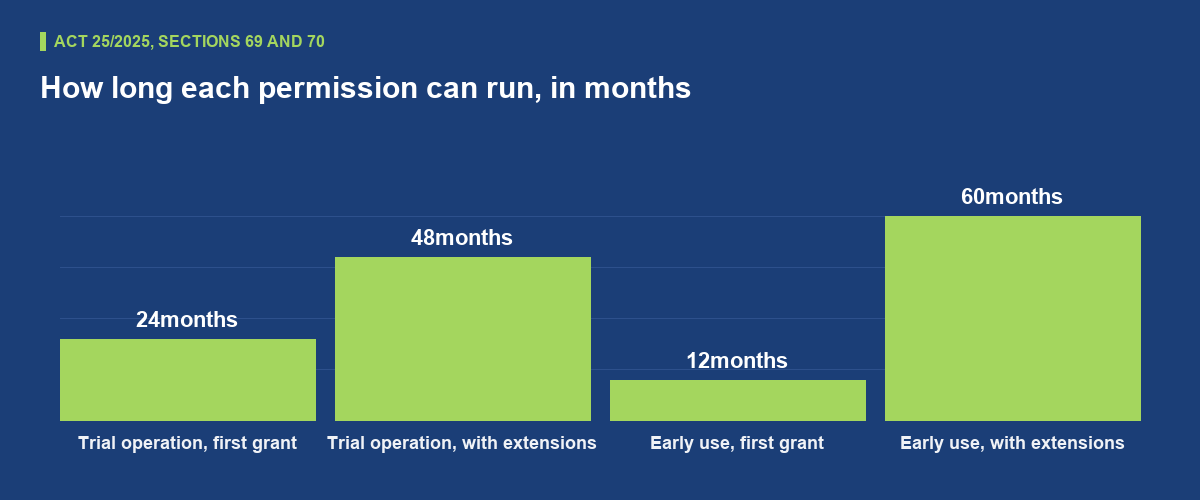
Slovak law provides two lawful ways into a building before the certificate exists, and they are not interchangeable. Trial operation under section 69 is for the case where fitness for use can only be verified by running the building. It is granted for at most 24 months, extendable for operational reasons but never beyond four years in total, and the authority decides within 30 days. The evaluation protocol it produces becomes an attachment to the kolaudacia.
Early use under section 70 is the other door: use of a building, or a part of it capable of separate use, before it is finished. It runs for at most 12 months, extensions are possible up to five years in total, and it needs the written agreement of the contractor and the designer to the conditions. Both permissions expire the moment the certificate is issued, under sections 69(6) and 70(5).
For a tenant this is a drafting question rather than a legal one. A lease that ties the start of the term or the rent commencement to “kolaudacia” names an event with three candidates: early use, trial operation and the certificate. Name the one you mean, say what happens to the rent-free period if it slips, and keep the fallback in the lease rather than in a side letter that a buyer of the building is not party to. Settle the running costs of the early period in the same place: heating, lighting and security during trial operation do not belong in the service charge by default. On a pre-let with a fixed handover date that clause is worth more than an argument about the prime rent, because it moves the effective rent without touching what occupiers actually pay on paper.
What using it too early costs
The new act prices early occupation seriously. Section 80(4)(c) requires the building inspectorate to impose a fine of between EUR 10,000 and EUR 150,000 on an entrepreneur or a legal person that uses a building without the occupancy certificate or contrary to it, or that, as owner, allows such use. Both ends of that sentence matter: the floor is mandatory, and the landlord who hands over the keys early is exposed alongside the tenant who walks in.
Under the old act the picture differs. Section 106(3)(d) of Act 50/1976 covers the same conduct with a fine of up to 5,000,000 Slovak crowns, an amount the text still carries in the old currency; at the statutory conversion rate of 30.1260 crowns to the euro that is EUR 165,969.59, and the conversion is ours. The old regime has the higher ceiling and no floor, the new one a lower ceiling and a hard minimum. Smaller failures are cheaper: under section 80(1)(a), not producing the energy certificate of a non-residential building within the period set at the kolaudacia carries EUR 100 to EUR 500.
One transitional door is still open for older stock. Section 84(7) lets an owner apply under the old rules for an examination of a building’s fitness for use, or for additional permission where it does not qualify, provided the application is filed by 31 March 2029. That is the window for a hall whose paperwork never caught up with its extensions. With 203,200 square metres under construction, pre-lease levels at just 35 per cent and the vacancy rate at 7.72 per cent in the first quarter of 2026, most of what is being built is speculative, so the certificate usually lands before the tenant does. It is the pre-let and the build-to-suit where the permit sits on somebody’s move-in date, and that is the pattern wherever a new anchor plant pulls its suppliers in, as in eastern Slovakia.
Conclusion
In Slovakia the building is finished twice: once by the contractor and once by the authority, and only the second one lets anybody in. Since 1 April 2025 two regimes have been running side by side, and which one applies to a given hall was settled years earlier by the decision that started it. Ask which act your building sits under, count the eleven attachments before counting the days, and make the lease name the exact event your start date hangs on. The occupancy permit is not paperwork at the end of a project. It is the last condition precedent nobody wrote down.