
Warehouse lease terms in Slovakia are being written in a market that has quietly turned in the tenant’s favour. Prime industrial rents eased to €5.30 per square metre per month in early 2026 while vacancy climbed to 7.72 percent, the highest level in years, and nearly half of the construction pipeline is speculative. In that environment the lease structure, not the headline rent, decides what a building really costs over five or ten years. In this article we walk through term lengths, HICP indexation, service charges, deposits and break options as they are typically agreed in 2026, and show where an occupier has genuine room to negotiate. Written from the perspective of a developer that structures these leases along the D1 corridor every day.
A tenant’s window: where the Slovak market stands in 2026
Slovakia’s industrial market has handed occupiers a rare negotiating window. According to Cushman & Wakefield’s Slovakia MarketBeat, prime industrial rents stood at €5.30 per square metre per month in the first quarter of 2026, down from €5.50 a year earlier, after roughly 105,000 square metres of new space was delivered and vacancy rose to 7.72 percent.
Data from 108 Real Estate fills in the rest of the picture: total grade-A stock of about 4.67 million square metres, average asking rents of €4.63 to €5.22 per square metre, and some 311,000 square metres under construction, almost half of it speculative. More competing space means landlords compete on lease structure before they move the headline rent. Two leases signed at €5.30 can differ by ten percent or more in real cost once indexation, service charges, rent-free periods and reinstatement obligations are counted. The number on the brochure is where the conversation starts; the structure is where the money is.
How long do warehouse leases in Slovakia run?
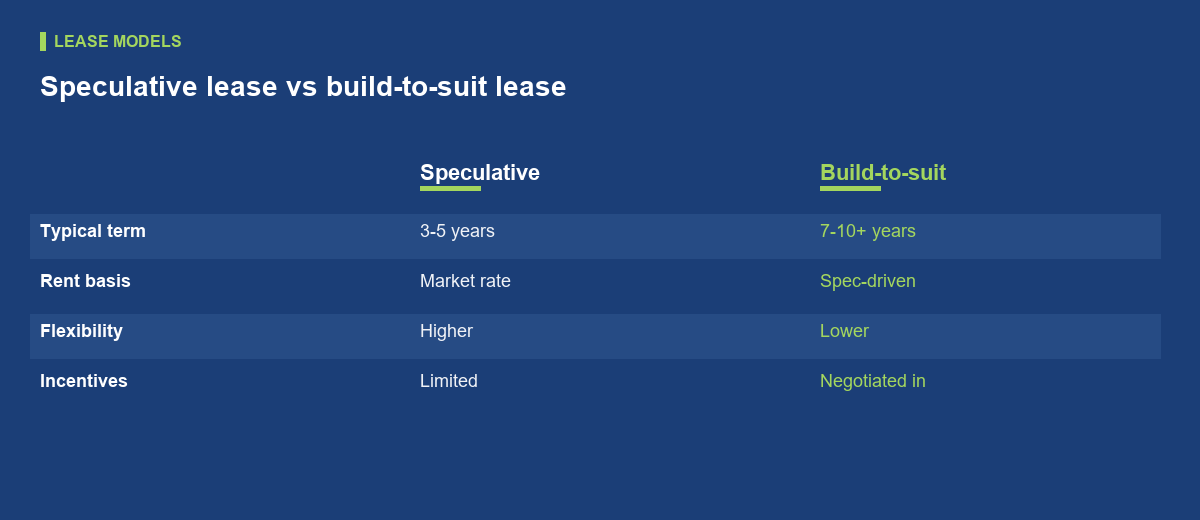
For speculative grade-A space, five years remains the institutional standard, with three-year terms achievable on smaller units and five to seven years common on newly delivered stock, a pattern documented across the neighbouring Czech market and mirrored in Slovak parks. Build-to-suit is different: because the landlord finances a bespoke design, terms of seven to ten years or more are needed to underwrite the investment.
Demand composition explains who signs what. Leasing activity reached 128,800 square metres in the first quarter of 2026, concentrated in the automotive sector around Bratislava, and 108 Real Estate attributes 69.7 percent of demand to producers rather than distributors. Manufacturers bolt equipment to the floor, so they trade flexibility for term, incentives and certainty; distribution operations keep terms shorter and options open. Occupiers planning around power-hungry automation should also check grid capacity early, a constraint we examined in Industrial Power Capacity in Slovakia.
Indexation: how euro-zone inflation flows into Slovak rents
Slovak logistics leases are euro-denominated and indexed once a year, almost always to the harmonised index of consumer prices (HICP) published by Eurostat. Cushman & Wakefield’s guidance on indexation clauses is blunt: the lease should name the exact index and state whether the annual rate or the twelve-month average applies, because vague drafting is what ends up in court.
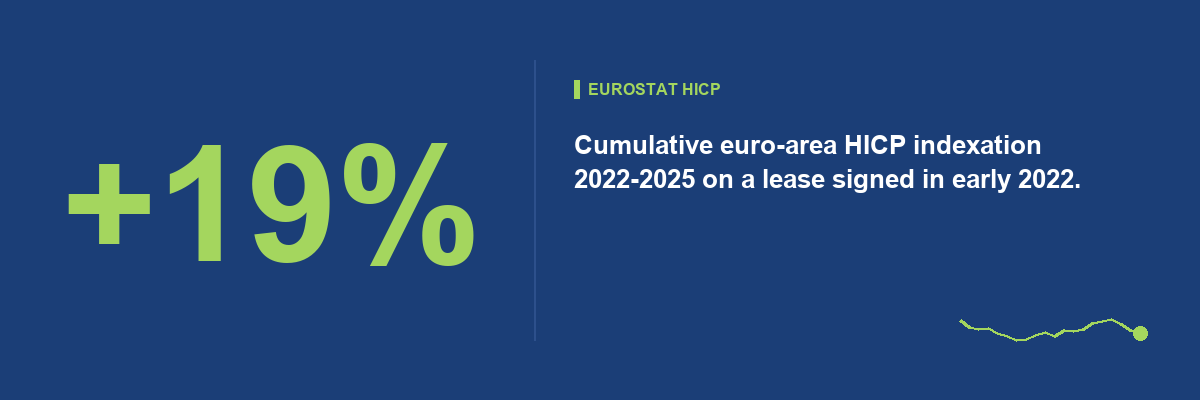
The recent cycle shows why the clause deserves attention. Euro-area HICP averaged 8.4 percent in 2022, 5.4 percent in 2023, 2.4 percent in 2024 and 2.1 percent in 2025. Compounded, a lease signed at the start of 2022 carries roughly 19 percent more rent in 2026 through indexation alone, on an unchanged building. By default the mechanism is uncapped and one-directional: rent follows the index upward and stays flat when inflation falls. The negotiable levers are a cap on the annual uplift, a collar defining both floor and ceiling, or a fixed annual step-up that replaces the index entirely and makes the cash flow fully predictable for both sides.
Service charges and the second line on the invoice
Beside the rent sits the service charge, typically in the range of €0.80 to €1.20 per square metre per month in modern Slovak parks. It usually covers property management, maintenance of common areas and yards, snow removal, landscaping, security, building insurance and the property tax passed through from the landlord. Electricity and gas are metered and billed separately, so an occupier should model them independently, especially for energy-intensive operations.
The detail worth negotiating is transparency. An open-book regime with annual reconciliation against actual costs, or at minimum a cap on the annually chargeable amount, keeps the second line on the invoice predictable. In a market where the headline rent is publicly benchmarked at €5.30, an unmanaged service charge can move total occupancy cost by more than the last round of rent negotiation did.
Break options, deposits and what 7.72 percent vacancy buys you
Security is standard and rarely moves: a bank guarantee or cash deposit covering roughly three months of rent plus service charge, occasionally more for weaker covenants. Break options in short speculative leases remain rare, since the landlord has priced the term into the deal; where they appear, they are paired with a longer overall term and a break penalty.
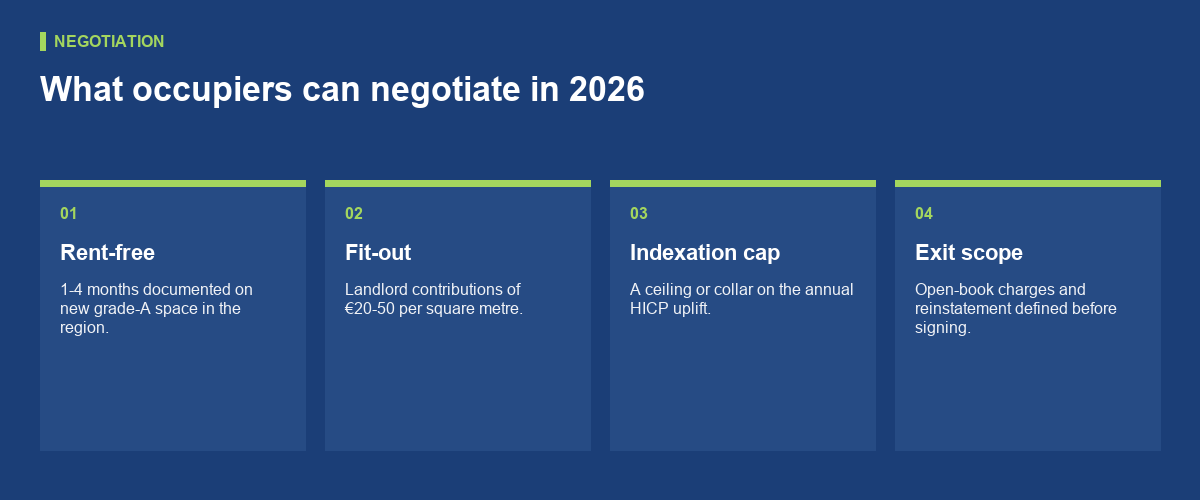
The genuine negotiating space is in incentives, and the current market has widened it. On new grade-A space in the region, one to four months rent-free and fit-out contributions of €20 to €50 per square metre are documented practice, and with vacancy at 7.72 percent and a construction pipeline that is nearly half speculative, Slovak landlords compete on exactly these terms before touching the headline rent. On a five-year lease an occupier can reasonably discuss rent-free months, a fit-out contribution, a cap on indexation, expansion or first-refusal rights on adjacent units, and a clearly defined reinstatement scope at exit. Each of these moves the effective rent; none of them shows up in the brochure.
Conclusion
A warehouse lease is a system, not a price. Term length sets your flexibility, indexation sets the trajectory, service charges set the second line on the invoice, and incentives decide what you actually pay per square metre over the term. The 2026 market, with prime rents easing to €5.30 and vacancy at its highest level in years, gives occupiers more leverage than they have had in this cycle, but windows like this close as speculative space is absorbed. As we argued in Cross-Border Logistics Slovakia: CEE’s Pivot Point, the location decides your operating cost; the lease decides what you pay for it. Negotiate the structure while the market is listening.
Looking for the right industrial space on the D1 in Slovakia? Talk to our team.