
Every Slovak industrial lease asks the tenant to put something behind the rent: cash on deposit, a guarantee from the parent company, a bank guarantee, sometimes a notarial deed on top. The negotiation usually circles around how many months, as if the number were the substance. It is not. Slovak law regulates commercial lease security nowhere at all, which means the wording of your instrument is the only rule that applies to it, and the only honest test of that wording is the day the tenant stops paying for good. Under that test the usual instruments do not merely differ in cost. Two of them get stronger, one gets weaker, and the landlord’s favourite shortcut stops working altogether.
Slovak law says nothing about the deposit
Start with the gap. The lease of non-residential premises is governed by Act 116/1990 Zb., and that act contains no provision on security of any kind. There is no cap, no rule on where the money must be held, no interest rule, no deadline for its return. We searched the full text for kaucia, zabezpeka, depozit and istina and found none of them, which is our own check rather than a cited authority, but it is easy to repeat. The three-months and six-months ceilings that circulate in conversation are real enough, they simply belong to state-supported rental housing and have nothing to do with a warehouse.
One security does arise automatically. Section 672(1) of the Civil Code, Act 40/1964 Zb. gives the landlord a lien over the tenant’s movable property on the premises for unpaid rent. It is the only protection nobody has to negotiate, and its practical value depends entirely on whether the racking, the machines and the stock are owned by the tenant or leased and financed by somebody else, which in logistics they usually are. Everything beyond that lien is a matter of drafting, so the quality of the drafting is the whole subject. That is why the customary level of around three months of rent plus the service charge, which we described in what occupiers sign in 2026, is our own market observation and not a published benchmark. We looked for an independent one for Slovak industrial property and there is none.
Three instruments, three different legal machines
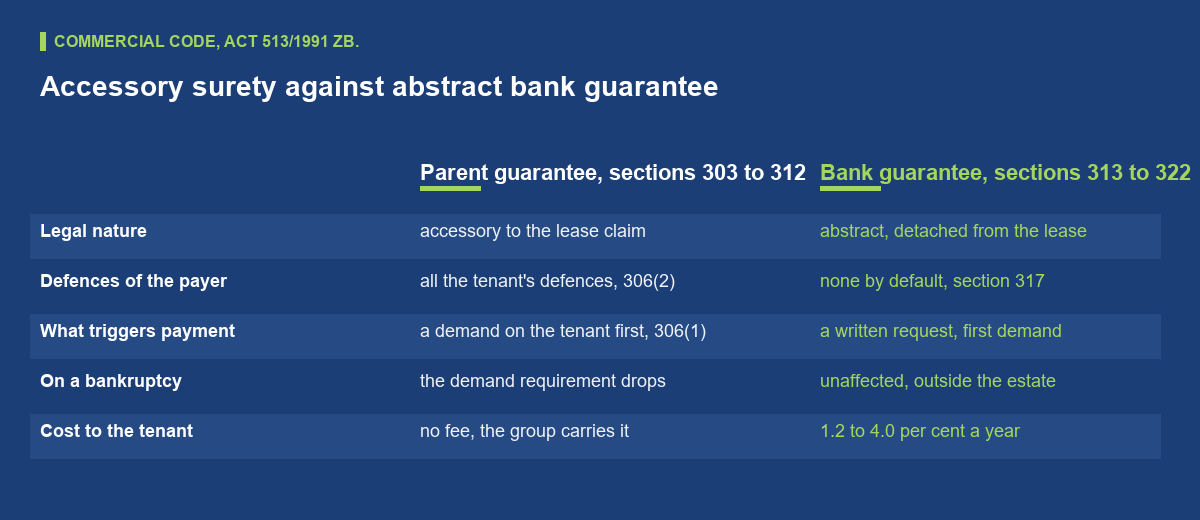
The cash rent deposit is the simplest and the least defined. The landlord holds the money, and unless the lease agreement says otherwise there is no segregated account, no interest and no fixed return date. A parent company guarantee is a surety under sections 303 to 312 of the Commercial Code, Act 513/1991 Zb. Section 303 defines it: whoever declares in writing to the creditor that he will satisfy him if the debtor fails to perform a particular obligation becomes the debtor’s surety. The decisive feature sits in section 306(2): the surety may raise all the defences the debtor could raise. A surety is accessory, so it carries the underlying dispute with it. Argue about a service charge reconciliation and you will be arguing with the parent about the same reconciliation.
A bank guarantee under sections 313 to 322 of the same code is built the opposite way. Section 317 is explicit: unless the guarantee instrument provides otherwise, the bank may not raise the objections which the debtor would be entitled to raise against the creditor, and the bank must perform when the creditor asks it to do so in writing. That is a first-demand instrument, abstract and detached from the lease. Section 322(1) then applies the surety rules only subsidiarily. Fourth on the list is not a security at all but an enforcement shortcut: a notarial deed in which the tenant consents to enforceability is an enforcement title under section 45(2)(c) of the Enforcement Code, Act 233/1995 Zb., which as Noerr sets out lets a landlord collect and evict without first litigating the claim. Section 53(3)(h) is its limit: formal defects or a conflict with good morals get the enforcement refused.
The test is insolvency, not the missed invoice
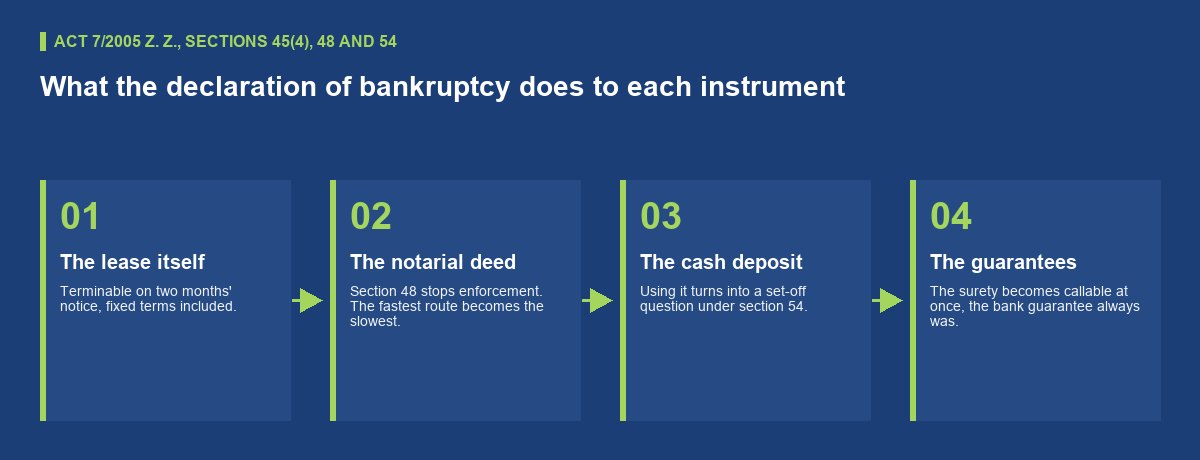
A missed invoice is not what security is for; two months of arrears get sorted out with a phone call. Security exists for the day a bankruptcy is declared over the tenant, and Slovak insolvency law, Act 7/2005 Z. z., rearranges every instrument on that day. Section 45(4) sets the scene: the administrator may terminate the lease on two months’ notice, and the provision says expressly that this applies even to a lease agreed for a fixed term. Only residential premises are carved out. The weighted average lease term in a landlord’s portfolio is, for any tenant in difficulty, a number with an asterisk.
Now the instruments. The cash deposit is money the landlord already holds, so using it becomes a set-off question, and section 54 restricts set-off in bankruptcy: it is barred against claims that arose in favour of the estate after the declaration, a claim that was not filed cannot be set off at all, and other set-offs remain admissible. Reading those limits onto a rent deposit is our own analysis rather than a decided point, and it is the reason the deposit is the instrument with the most homework attached. The parent guarantee moves the other way. Section 306(1) normally requires the creditor to demand performance from the debtor first, but that requirement falls away, in the words of the provision, particularly on the declaration of bankruptcy. The accessory instrument becomes immediately callable at exactly the moment you need it. The bank guarantee never depended on the tenant at all: it sits outside the estate, the bank pays on demand, and the bank’s recourse under section 321(2) is the bank’s problem. And the notarial deed, the fastest route of all up to that day, goes blunt: section 48 stops individual enforcement from the declaration of bankruptcy.
What each option actually costs
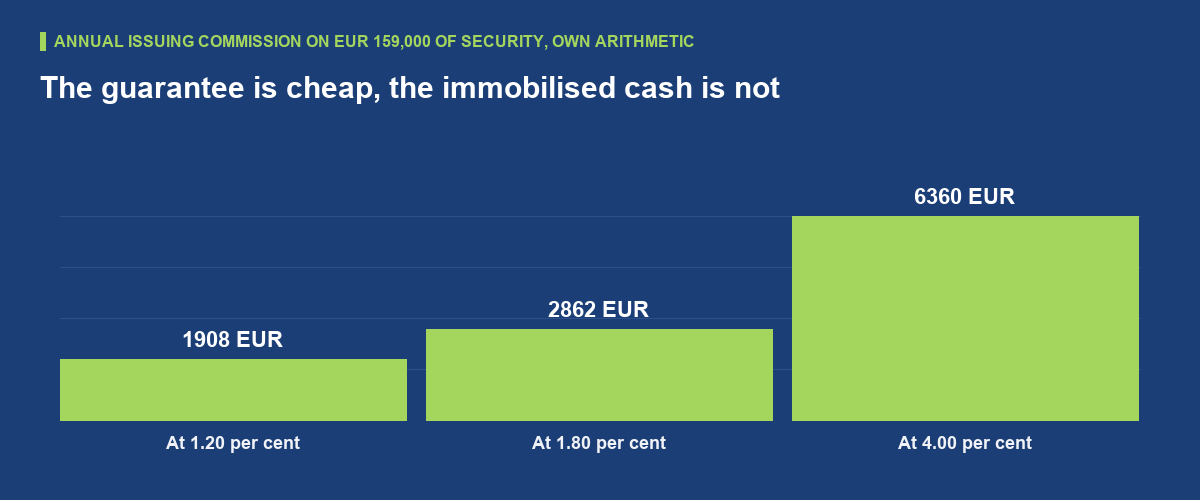
Bank guarantees are usually described as expensive and deposits as free. Both halves of that sentence are wrong. The published Slovak tariffs put the issuing commission for a bank guarantee at a minimum of 1.80 per cent per annum with a floor of EUR 400 at Tatra banka, valid from 31 May 2024, plus a handling fee from EUR 100 and, if the guarantee is ever called, 0.25 per cent of the amount with a floor of EUR 200 and a ceiling of EUR 800. Prima banka’s tariff sits between 1.20 and 4.00 per cent per annum with a floor of EUR 120. The realistic band is therefore 1.2 to 4 per cent, not the 0.5 to 2 per cent quoted in general European material.
Put that against a hall. Ten thousand square metres at the Q2 2026 prime rent of EUR 5.30 per square metre per month is EUR 53,000 of rent a month, so three months of security is EUR 159,000. A guarantee over that amount at 1.80 per cent costs about EUR 2,862 a year plus fees, which is our own arithmetic. The deposit costs nothing in fees and EUR 159,000 in working capital that stops working for the whole term. The honest qualification is that the bank will normally want the guarantee collateralised or counted against the credit line, so the cash is not always released, and the choice between the two is a treasury decision rather than a legal one. What it is not is a rounding error, and it belongs in the same conversation as the effective rent rather than in the small print after it.
Negotiating lease security in a market that split in two
Which instrument you can actually negotiate depends on where the hall stands, because Slovakia no longer has one bargaining climate. As we set out in the Q2 2026 market split in two, Senec sits above 11 per cent vacancy with nothing under construction while the Kosice area runs at 1.4 per cent. In the west the security package is the lever that moves most easily, because conceding it costs the landlord nothing on the rent line that his own investors read. In the east it will not move at all, and the sensible trade is to accept the instrument and buy back flexibility elsewhere, in the break option or in the indexation floor.
Four things belong in the heads of terms rather than in the lease draft, because by the draft stage they cost goodwill. First, the trigger: what the landlord must show before calling, and how long the tenant has to cure. Second, a reduction ladder, so the security steps down after a defined run of clean payments rather than sitting at its opening level for ten years. Third, the return mechanism, with a deadline and a rule for the interest, since the act supplies neither. Fourth, the expiry date of a bank guarantee, which must outlast the lease and the handback period, because the dilapidations argument arrives after the keys do, as anyone who has been through a Slovak final account knows. Record the agreed structure where it survives the drafting, in the heads of terms or a side letter, and take the schedule of condition at the start, because the security is only ever as good as the evidence of what you were handed.
Conclusion
Lease security in Slovakia is a drafting subject rather than a legal one, because there is no statute to fall back on. That cuts both ways. A landlord who relies on a cash deposit and a notarial deed holds the two instruments that weaken most on the day they are needed, while a tenant who concedes a first-demand bank guarantee has handed over a payment that no dispute about the service charge can slow down. Neither side should be arguing about the number of months before it has agreed what the instrument does, when it can be called, how it steps down and when it comes back. Those four sentences are worth more than the difference between three months and six.