
Fire safety compliance is the part of a Slovak industrial lease that gets read once, at handover, and then filed. That is unfortunate, because the statutory starting point is the opposite of what most occupiers assume: the law puts the duties on the owner who lets the building, and it is the lease that moves them. The second surprise is the clock. A storage or production floor is not on an annual inspection cycle in Slovakia, it is on a quarterly one. Here is what the two instruments actually say, what the intervals are, what the fines look like and what belongs in the contract.
Who the law makes responsible
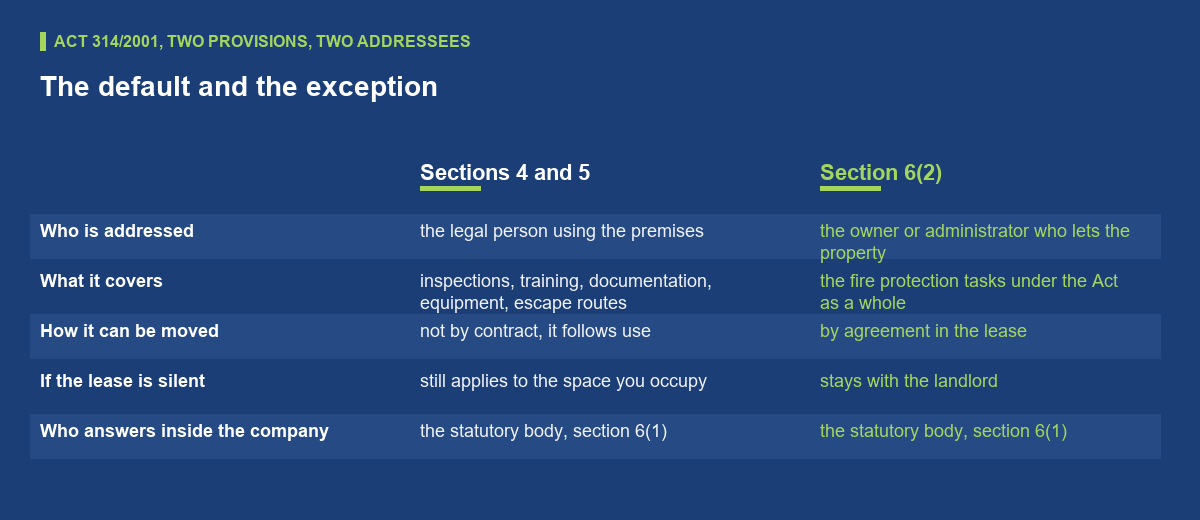
Two provisions of Act 314/2001 on fire protection point in different directions, and the gap between them is where most disputes start. Sections 4 and 5 address the legal person and the entrepreneur, listing what has to happen in the premises they use: preventive inspections and the removal of the defects found, staff training, fire protection documentation kept in line with the actual state of the building, fire equipment in working order, escape and access routes kept permanently clear.
Section 6 then adds the sentence that changes the picture for a leased building. In the original: “Vlastnik (spravca) nehnutelnosti, ktory prenajima nehnutelnost, je povinny zabezpecit ulohy ochrany pred poziarmi podla ustanoveni tohto zakona, ak sa v najomnej zmluve nedohodne s najomcom o zabezpeceni tychto uloh inak.” The owner or administrator who lets a property has to ensure the fire protection tasks under the Act, unless the lease agrees otherwise with the tenant.
Read together, the default sits with the landlord and the lease is the instrument that moves it. Section 6(1) adds a second addressee inside the company that ends up carrying the duty: responsibility for performance rests with the statutory body, so it is a director who answers for it, not the facilities manager. A lease that says nothing about fire protection has not left the question open. It has answered it, in the landlord’s disfavour, because the contract itself is what section 6(2) points at. That matters most in a converted building, where the fire solution on file is often older than the use the space now serves.
The three-month clock nobody budgets for
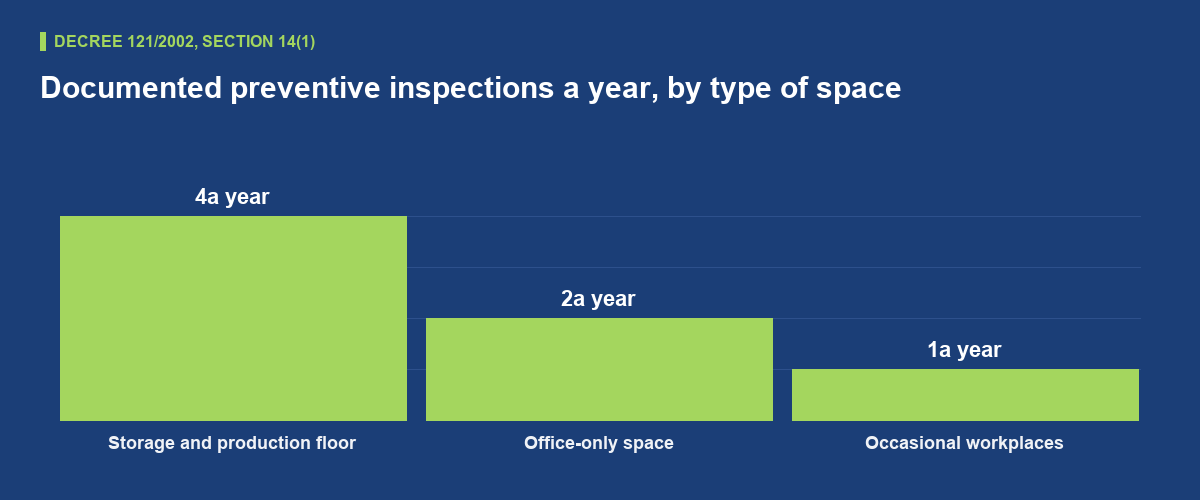
The interval comes from the implementing decree, not the Act. Section 14(1) of decree 121/2002 on fire prevention sets three periods for the preventive fire inspection. Every twelve months in residential buildings and in premises with only occasional workplaces, where nobody is regularly stationed and someone appears at intervals of several days for checks, maintenance or repair. Every six months in premises used only for administrative work. And every three months in all other premises of a legal person, unless its statutory body sets a shorter period.
A warehouse floor is neither an office nor an occasional workplace, so it falls into the residual third category. That is the quarterly cycle, and it is the single most commonly missed obligation in the sector, because the annual visit that most occupiers budget for is the interval for the space they are not in.
The practical consequence is that one building can run three clocks at once. On our own reading of that provision, a typical unit with a storage and production floor, an office block and an unstaffed technical room generates four documented inspections a year for the floor and two for the offices, so six visits and six records rather than one. None of that is discretionary and none of it is expensive; it only becomes expensive when three years of it are missing at once.
What else runs on its own clock
Fire equipment has a separate cycle. Section 5(a) of the Act requires the occupier of the duty to keep it in working order and have it checked and maintained by a qualified person, and section 13(1) of the decree fixes the floor at one check every twelve months, with the result written into the fire book. Where the manufacturer specifies more, the manufacturer wins. A sprinkler installation, a smoke extraction system and a set of hydrants each carry their own regime under that rule, which is why the suppression system is worth naming individually in the lease rather than covering it with the word equipment.
Technical and technological equipment is a third category again. Section 13a(1)(b) of the decree requires a fire-safety check by designated persons at the manufacturer’s intervals and at least once every twelve months, with written documentation. In a modern hall that catches the charging room, the conveyors and the racking-mounted electrics, which is exactly the equipment an automation project adds after the lease was signed. It happens without any automation too: a rooftop installation, the electric plant that arrives with the new-build standard and the plant room of a cold store all land on the same register.
Two more obligations are easy to forget because they involve people rather than plant. Section 5(e) requires an evacuation drill at least once every twelve months in premises where evacuation conditions are not simple, and section 9(2) requires that the inspections, the training, the documentation and the drills are carried out through a qualified fire protection technician. That is a named external appointment with a cost attached, and the lease should say who makes it.
Where fire safety compliance gets expensive
The sanctions sit in section 59. A regional or district directorate can impose a fine of up to EUR 8,298 for breaches that include failing to carry out the regular preventive fire inspection, and up to EUR 16,596 for breaches that include failing to ensure the regular check of fire equipment and of technical and technological equipment. A repeat of a breach already fined in the previous three years can be fined up to double, so the ceiling for a second offence is EUR 33,192.
Two features matter more than the headline numbers. Section 59(7) states that the fine leaves liability for the damage caused untouched. The penalty is therefore the smaller half of the exposure. Section 60 then gives the authority one year from learning of the breach, and three years from the breach itself. A gap in the fire book survives well past the quarter it happened in. It usually comes to light after an incident, or during a state fire inspection.
The national picture is not reassuring. The fire and rescue corps recorded 8,956 fires in Slovakia in 2025, 1,262 more than in 2024 and an increase of 16.4 per cent, with direct damage of EUR 57,426,265 and 55 people killed. The corps does not publish an accessible breakdown by type of building, so nobody should quote a warehouse share from it, including us. What the figure does establish is that the trend is going the wrong way while the inspection duties stay where they are.
What to write into the lease
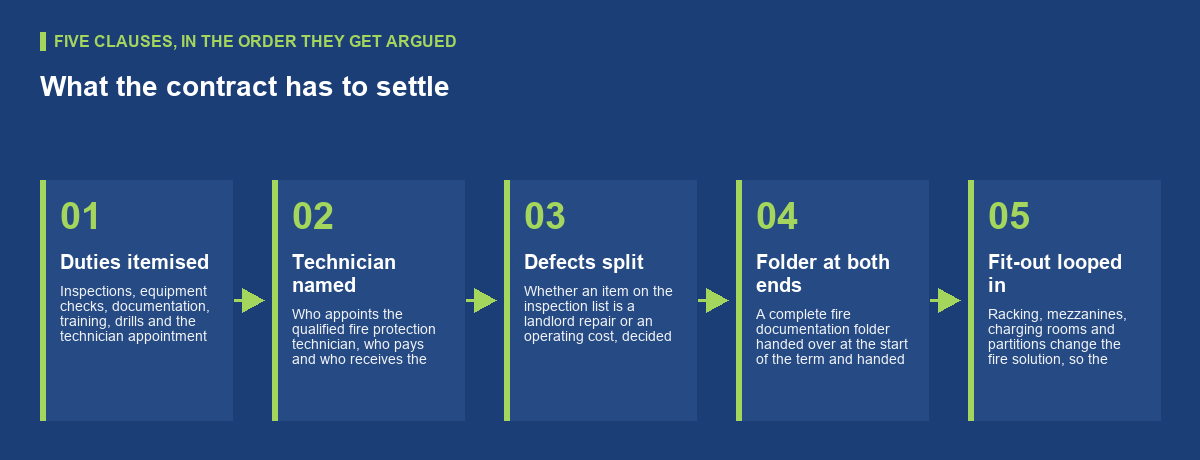
Because section 6(2) makes the split contractual, the drafting is the whole game. Five points are worth the argument. First, name the duties individually rather than allocating “fire safety” as a block: preventive inspections, equipment checks, documentation, training, drills and the technician appointment are six separate cost lines with three different intervals. Second, put the technician appointment in writing, including who pays and who receives the reports.
Third, deal with the defects the inspection finds. An inspection produces a list, and the argument that follows is whether an item is a repair the landlord owes on the structure or an operating item that lands in the service charge. Deciding that in advance is cheaper than deciding it in front of a deadline. It belongs in the same folder as the energy bill: a running cost with a document trail. Fourth, secure the folder at both ends. A complete set is handed over at the start, recorded like a schedule of condition, and a complete set goes back at the end of the term. A tenant planning an early exit meets that problem sooner. And anything agreed outside the lease, in a separate agreement, has to survive a change of owner.
Fifth, keep the fit-out in the loop. Racking, a mezzanine floor, a charging room or a fire-rated partition all change the fire solution of the building, and the party that installs them is not always the party the register lists as responsible; a fit-out contribution that funds the work does not move the duty by itself, and the reinstatement obligation decides who takes it all out again. With the prime rent at EUR 5.30 per square metre per month and vacancy at 7.72 per cent in the first quarter of 2026, a tenant negotiating today has the room to ask for all five, and the cost of asking is a paragraph rather than anything on the rent line.
Conclusion
Fire protection in Slovakia is not a single duty with a single annual appointment. It is a set of obligations on three clocks, resting by default on the owner who lets the building and moved only by the words of the lease. The occupier who assumes the landlord has it covered and the landlord who assumes the occupier has it covered are describing the same building, and one of them is wrong. Read section 6(2) against your own contract, count the intervals your spaces actually attract, and settle the defect question before an inspector settles it for you.