
Plot assembly in Slovakia is rarely a price problem. The land is there, the asking price per square metre is known, and the seller is willing. The obstacle sits in the register. Ten hectares outside a town is almost never one parcel with one owner. On the national averages it is around twenty parcels, and each of them carries close to twelve co-owners. Every one of them has to sign. Each signature can trigger the pre-emption right of the others. That is where the years go, and none of it appears in the asking price.
What the register holds under ten hectares
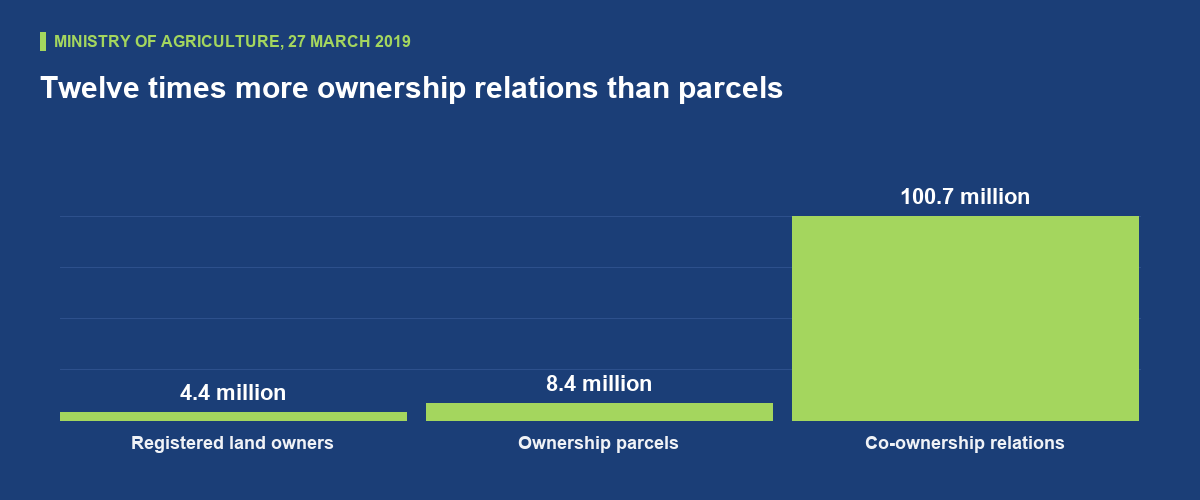
The scale of the problem is official. When the Ministry of Agriculture and Rural Development launched its consolidation programme on 27 March 2019, it put the numbers on the record: 8.4 million ownership parcels, 4.4 million registered land owners and 100.7 million co-ownership relations. The average parcel has 11.93 co-owners. The average owner holds shares in 22.74 parcels. The roots are Hungarian inheritance law and then collectivisation, and neither has been undone.
The second figure comes from the Institute for Strategies and Analyses at the Government Office. In its assessment of the programme, updated on 12 September 2023, the average Slovak agricultural parcel measures 0.5 hectares. Put the two averages together and a ten hectare site is about twenty parcels. At 11.93 co-owners each, that is roughly 240 ownership relations before a single square metre changes hands. That is our own arithmetic on the two official averages, not a survey of any particular site. A specific site can be far better or far worse, and the only place to find out is the title sheet. It is also why an asking price per square metre, of the kind we set out for industrial land in 2026, says nothing about how long the site takes.
Why every share is its own negotiation
Slovak co-ownership is not a company. There is no board and no majority that can sell. Section 139(1) of the Civil Code makes all co-owners jointly and severally entitled and obliged from legal acts concerning the common thing. Section 139(2) lets a majority counted by the size of the shares decide on the management of the thing, and sends the matter to court where no majority is reached. Management is not sale. You do not buy the parcel. You buy shares, one at a time, from people who never met each other.
Then comes section 140. Where a co-ownership share is transferred, the other co-owners have a pre-emption right, unless the transfer is to a close person. If they cannot agree on exercising it, they may buy the share in proportion to their own shares. Every purchase in the sequence therefore has to be offered around first. The buyer of the first share becomes a co-owner and gains the same right against everyone else, which is why the first share is worth more than its area suggests. The practical answer is not speed but simultaneity: option contracts with every owner, conditional on each other, so that nothing completes until everything completes. The heads of terms for a site of this kind are a timetable of conditions, not a price. Land is the harder case here. On a standing asset the register is short and the surprises sit in the lease, which is what a buyer inherits on a tenanted warehouse.
The owner nobody can find, and the fund that stands in
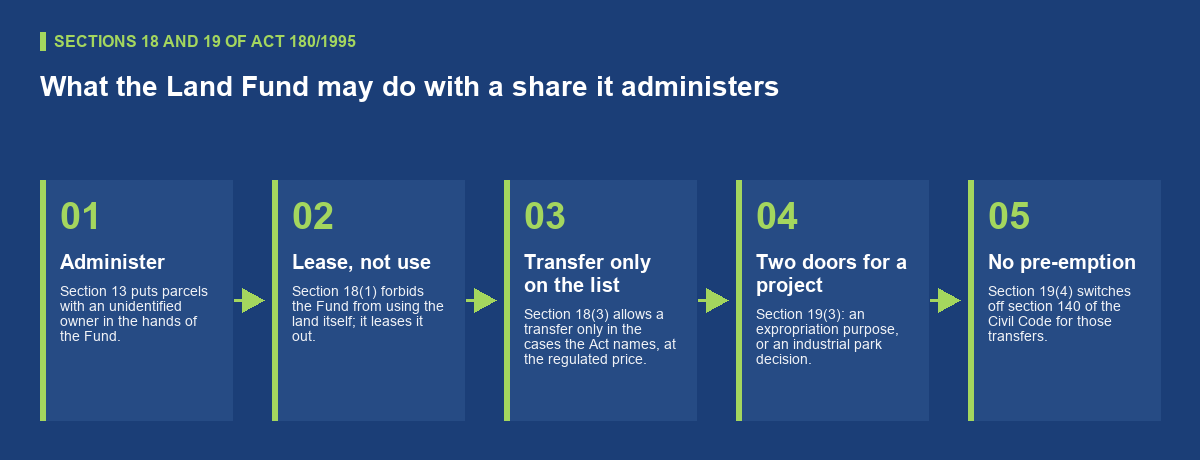
A share of those relations belongs to people who cannot be traced. Slovak law does not leave that land ownerless. Under section 13 of Act 180/1995 the Slovak Land Fund administers parcels with an unidentified owner, and section 16(1) puts them alongside state land and land whose ownership is not evidenced in the cadastre. Section 17(1) lets the Fund act in its own name, including before courts and public authorities. Section 16(2) makes it the representative of those owners.
What the Fund may do with the land is deliberately narrow. Section 18(1) forbids it from using the land itself; it leases it for agriculture or forestry. Section 18(3) lets it transfer ownership only in the cases the Act lays down, and section 18(4) sets a floor at the price under the price regulation. The list is in section 19(3). Two entries matter to an industrial project: a purpose for which the land could be expropriated, and a decision on the establishment of an industrial park. Section 19(4) then removes section 140 of the Civil Code from those transfers, so the pre-emption right of the remaining co-owners does not stand in the way. The untraceable owner is not a dead end. The route to that share simply runs through a public decision instead of a purchase contract. What the institution may and may not do with such a share, including the easement route where no transfer reason fits, is set out in our glossary entry on the Slovak Land Fund.
What plot assembly in Slovakia is allowed to divide
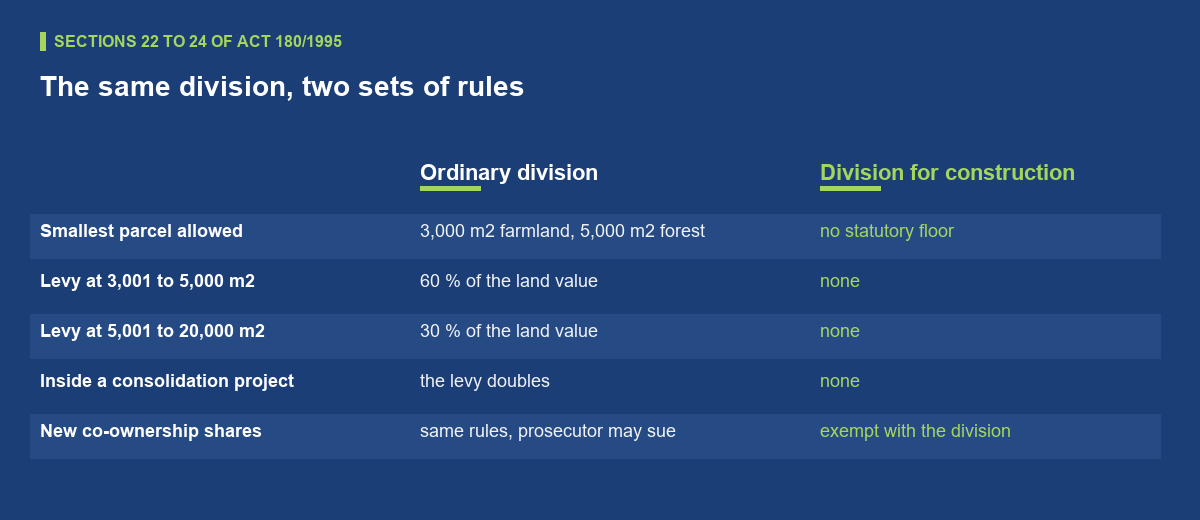
The second surprise is friendlier. Slovak law protects farmland from being cut into ribbons, and the rules are strict. Section 23(1) of Act 180/1995, in the version in force from 1 April 2025, forbids a division that would create an agricultural parcel below 3,000 square metres or a forest parcel below 5,000. Section 22(1) puts a levy on the acquirer wherever a division creates a parcel between that floor and 20,000 square metres: 60 per cent of the value of the agricultural land between 3,001 and 5,000 square metres, 30 per cent between 5,001 and 20,000. Section 22(5) doubles it inside the area of a registered consolidation project. Section 24(1) applies the same rules to the creation of co-ownership shares, and section 24(2) lets the prosecutor sue to invalidate a share created against them.
Then section 24(3)(a) steps aside. None of it applies where the parcel is divided for the purposes of construction, or for a purpose for which it could be expropriated, or under a consolidation project. The rule that binds a farmer does not bind a building project. The exemption attaches to the purpose, which means the purpose has to exist on paper before the division, not after it. That is the same sequencing discipline that decides whether a building permit arrives on time.
Why waiting for the state to sort it out is not a plan
Slovakia has a systemic answer to fragmentation, and it is called land consolidation. It works. It is also slow. The Institute for Strategies and Analyses put a figure on the pace: at the current rate consolidation will take 30 years and cost an estimated 1.1 billion euros, covering 4 million hectares in 3,103 cadastral areas. The programme stalled in 2021, then restarted with 120 cadastral areas for 2021 and another 120 for 2022. The 2019 tender covered 168 cadastral areas for 44.6 million euros excluding VAT and was the first state-commissioned consolidation since 2010. No site programme can wait for that.
The practical order is the opposite of the usual one. Read the register before you agree a price, because the number of owners, not the area, sets the timetable. Take options from every private co-owner at once. Establish the public position that opens the Fund route: an industrial park under Act 193/2001 is an area delimited by the spatial plan of the municipality, so the zoning comes first and the park decision follows it. Only then divide, and divide for construction. A brownfield can shorten some of this, which is one of the arguments in our brownfield against greenfield comparison. What it cannot shorten is the register. Programmes are lost on this order of operations, in the same way that a finished hall waits for a document nobody sequenced.
Conclusion
Ten hectares in Slovakia is not one asset. It is a register entry with, on the national averages, about twenty parcels and a few hundred ownership relations behind it. The price per square metre is the smallest variable in the programme. Three provisions decide the rest: section 140 of the Civil Code on every private share, the closed list in section 19(3) of Act 180/1995 for every share the Land Fund holds, and section 24(3)(a) of the same act, under which a division for construction escapes the levy that binds a farmer. All three are settled long before the first excavator arrives, and none of them can be repaired afterwards.