
Buying a tenanted warehouse in Slovakia is not the purchase of a building with a lease attached to it. The building is the smaller half of the transaction. What carries the price is the income, and the income sits in a contract the buyer did not write, cannot see in any public register, and cannot get out of. The Civil Code settles the transfer in a single sentence, hands the buyer every obligation the seller had, and gives one new right to the tenant. Everything that follows in a due diligence exercise is an attempt to find out what that sentence actually bought.
What buying a tenanted warehouse in Slovakia actually transfers
Section 680(2) of the Civil Code, Act 40/1964 Zb., is the whole mechanism: where ownership of a leased thing changes, the acquirer enters the legal position of the landlord. There is no assignment to negotiate, no tenant consent to collect, no novation to draft. The lease continues on its own terms with a different name at the top.
The same sentence contains the one administrative step that matters on completion day. The tenant is entitled to discharge its obligations towards the previous owner until the change has been notified to it or proven by the acquirer. Rent paid to the seller before that moment is validly paid. On a quarterly rent cycle that is a full quarter of income sitting in the wrong account, recoverable from the seller under the sale agreement rather than from the tenant.
What passes is the position, not the paperwork. Everything the seller agreed sits in the buyer’s hands the same morning: the repair obligations, the indexation clause with its floor and its cap, the service charge mechanism with whatever cap the seller conceded, the outstanding fit-out contribution, and any rent free still to run. A triple net heading on the term sheet does not change any of that, because the nets are a matter of what the lease says, not of what the market calls the structure.
The only termination right belongs to the tenant
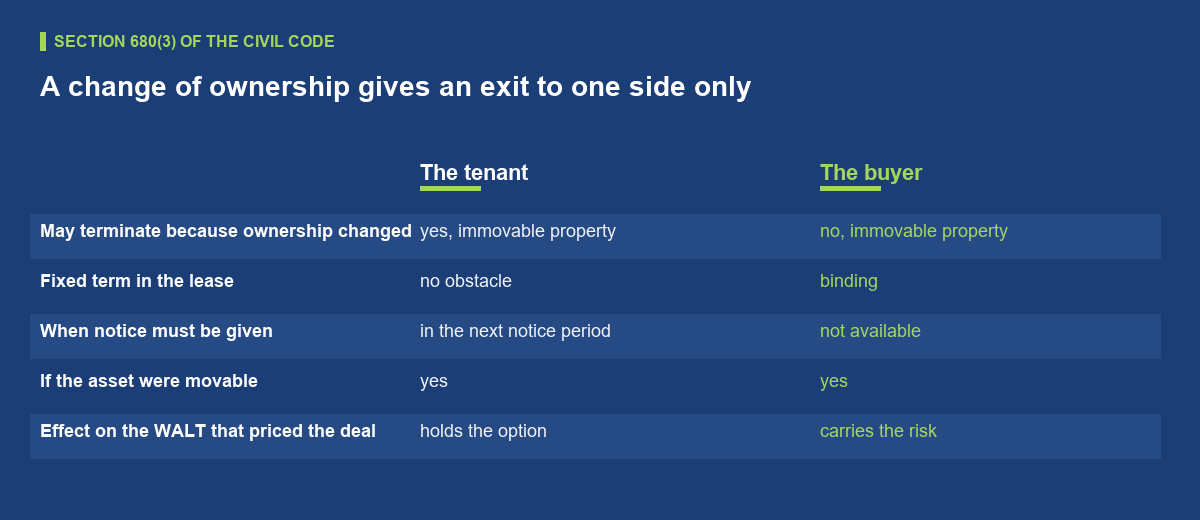
Section 680(3) is the part that surprises buyers, and it is worth quoting in effect rather than in summary. Where ownership of immovable property changes, only the tenant may terminate the lease on that ground, and it may do so even where the lease was concluded for a fixed term. The notice must be given in the next notice period where one is set by statute or by agreement. For movable property the acquirer may terminate as well. For a warehouse it cannot.
Read that against the way the asset was priced. A weighted average lease term of six years is the reason the yield was accepted, and on the day of completion those six years become an option in the hands of the party that did not pay for them. The building is bought at a cap rate on stabilised net operating income, and the statute has just made the stabilised part conditional on a decision somebody else gets to take.
This is why the confirmation letter from the tenant is not a formality in a Slovak transaction. It is where the buyer asks the occupier to state the term, the rent, the security held, the arrears position and any side agreements, and where the parties deal with the statutory notice right. Whether and how far that right can be waived in advance is a question for Slovak counsel on the specific lease, not a point to assume from a term sheet. What is certain is that the question has to be asked before the price is fixed, not after.
The cadastre does not show you a warehouse lease
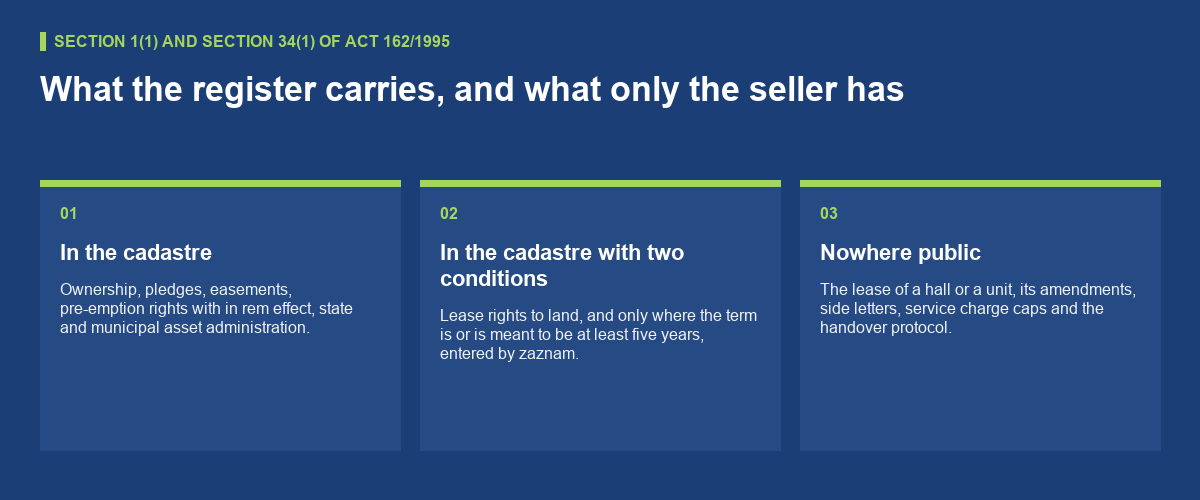
A buyer used to registers that publish occupational interests will look in the wrong place. Section 1(1) of Act 162/1995 Z. z. on the cadastre lists what the cadastre records: ownership, pledges, easements, pre-emption rights where they are meant to have in rem effect, the administration of state and municipal assets, and lease rights to land where they last or are intended to last at least five years.
Land, and five years. A lease of a hall, of a unit inside it, or of any class A building is not in that list at any length of term. Where a land lease does appear, section 34(1) enters it by zaznam, the recording route used for rights that arise outside the register, which means the entry follows the right rather than creating it. The register is a mirror here, and a partial one.
The practical consequence is that the rent roll is a disclosure exercise and never a search. Four documents carry the weight, and each of them exists in exactly one copy until somebody hands it over: the lease with every amendment and side letter, the handover protocol that fixes the condition the unit was taken in, the service charge reconciliations for the last three years, and the correspondence file where the concessions live. A missing side letter is not a gap in the data room, it is a term of the contract the buyer is about to be bound by.
The security does not travel with the title
The landlord position transfers by law. The instruments that secure it do not necessarily follow, because they are separate contracts with their own parties. A bank guarantee is issued by a bank in favour of a named beneficiary, and the named beneficiary is the seller. Unless the instrument is drafted to be transferable or the tenant procures a replacement in favour of the buyer, the buyer completes on Monday holding a lease and no guarantee behind it. One piece of security does travel, and it is the one nobody negotiated: the landlord’s lien under section 672 of the Civil Code secures the rent under the letting rather than a claim personal to the seller, so it passes with the landlord position. It is also worth no more than the movables in the unit that the tenant actually owns.
A cash deposit raises the mirror problem. The money is in the seller’s account, the obligation to repay it at the end of the term is part of the landlord position the buyer has just inherited, and the two only meet if the deposit is transferred or credited in the completion statement. A parent company guarantee sits in the same category as the bank instrument, and a corporate guarantor that consented to secure one landlord has not consented to secure another.
None of this is exotic drafting, but it is the item most often left to the last week. Our post on what survives an insolvency sets out how thin the difference between these instruments becomes when the tenant fails. A buyer who discovers the gap after completion is negotiating with a tenant that has no reason to help and a bank that has no relationship with it.
Two tax clocks start on completion
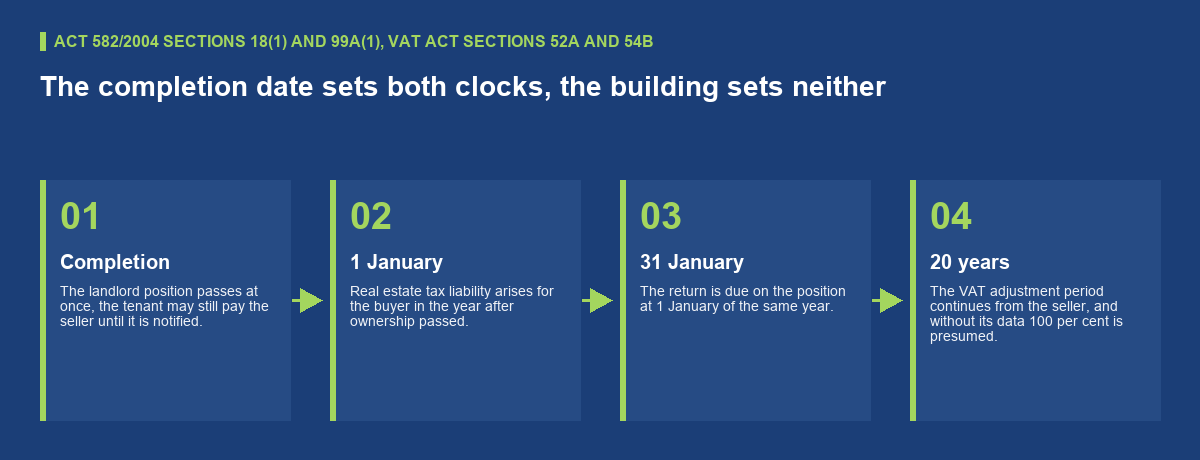
The first is annual and simple. Under section 18(1) of Act 582/2004 Z. z. liability for real estate tax arises on 1 January of the year following the one in which the taxpayer became owner, and section 99a(1) puts the return in by 31 January of that year, assessed on the position at 1 January. A deal that completes in December moves the whole of the following year to the buyer, and a deal that completes in January leaves it with the seller. On the rates set out in our post on real estate tax, that timing is worth up to five euro per square metre a year in the wrong direction.
The second runs for two decades. Under section 52a(2)(b) of the VAT Act 222/2004 Z. z. the period for adjusting deducted VAT on buildings, building land, flats and non-residential premises is 20 calendar years, including the year of first use. Where a building is sold as an enterprise or part of one under section 10(1), so outside VAT, the clock does not restart: section 54b(2) requires the seller to hand over the figures for the tax deducted and the adjustments already made, and the buyer continues them.
Section 54b(3) supplies the sanction, and it is the reason the VAT history belongs in the first disclosure request rather than the last. Where the buyer of the enterprise does not have those figures, the law presumes that the tax was deducted in the year of acquisition at 100 per cent of a base equal to the fair value of the asset. A missing schedule therefore does not produce an unknown, it produces the worst assumption the statute allows, and it interacts directly with the option to tax the rent that the seller may or may not have exercised.
Conclusion
The Slovak position is unusually clean to state and unusually easy to underestimate. The lease transfers automatically, the buyer has no exit and the tenant acquires one, the public register is silent on everything that matters, the security has to be re-papered, and two tax clocks are set running by the completion date rather than by anything in the building. Three requests cover most of it, and all three belong in the first week rather than the last: the complete lease file including side letters, the tenant’s written confirmation of the term and the security, and the seller’s VAT deduction and adjustment schedule for the asset. A building can be inspected in an afternoon. The thing being bought cannot.