
Automated high-bay warehouses in Slovakia are usually bought as equipment and built as a structure, and the gap between those two sentences is where the money sits. A shuttle store or a stacker-crane store is ordered from a materials handling supplier, arrives on lorries and is bolted to a slab. Whether the result is a machine standing inside a hall or a hall made of racking is not a question of vocabulary. Two Slovak acts answer it with two different tests, and the answers decide the permit route, the handover date, the depreciation period and the annual tax assessment.
Where automated high-bay warehouses in Slovakia stop being equipment
The starting point is section 2(1) of the Building Act, Act 25/2025 Z. z., in force since 1 April 2025. A stavba is a building construction erected by construction works that is firmly connected with the ground or whose placement requires preparation of the substrate. The same subsection then lists what counts as a firm connection, and the second item is the one that matters here: fastening by machine parts or by weld to a firm foundation in the ground or to another structure. Anchoring by piles or by ground screws is the third. Bolting is not a way around the definition, it is inside it.
Section 2(2) closes the other door. Part of a free-standing structure are the related underground spaces, above-ground constructions and the technical, technological and operational equipment without which the structure would not be complete and fit for operation. In a rack-clad store, where the racking carries the roof and the cladding, the second test needs no argument at all: remove the racking and there is no building left to be fit for anything.
That gives two cases with very different answers. Free-standing racking inside a conventional hall is equipment placed in a building. A rack-clad silo store is a building made of racking. The engineering consequences of that choice are the subject of our post on what robotics change about the building spec. The legal consequences start here.
Two acts, two different tests
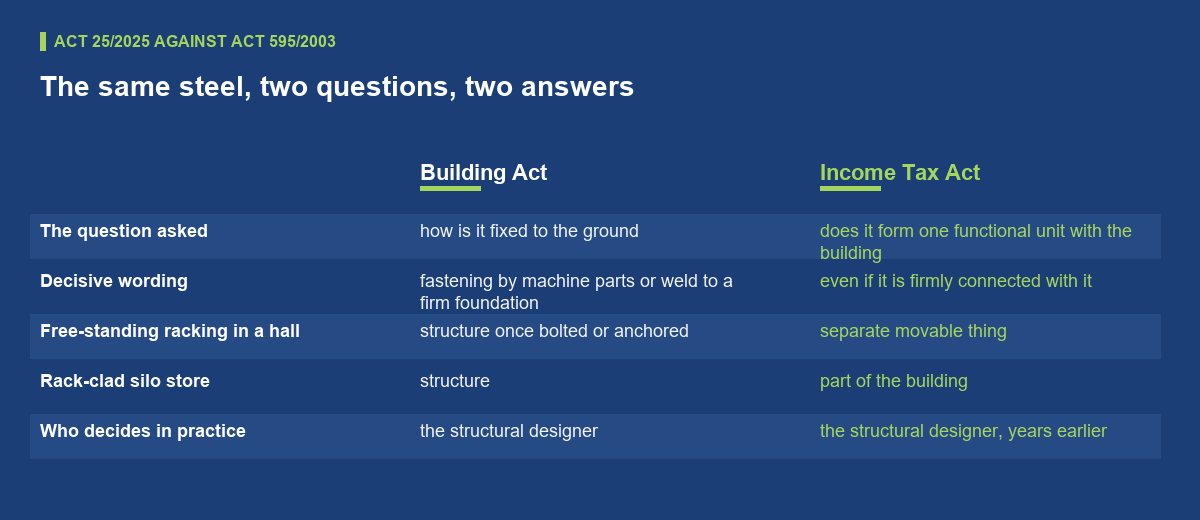
The trap is assuming that one classification travels across all the desks. It does not. The Building Act asks how the thing is fixed. The Income Tax Act, Act 595/2003 Z. z., says in section 22(3) that fixing is expressly not the test: a production device, an object serving the provision of services, a purpose-built object and other equipment is a separate movable thing if it does not form one functional unit with the building, even where it is firmly connected with it.
Read the two together and the pattern is clean. For the building authority the question is the anchor. For the tax authority the question is the functional unit. Free-standing racking, shuttles and conveyors in a leased hall are firmly bolted down and still form no functional unit with the building, so they stay movable property. In a rack-clad store the same equipment is the load-bearing structure, which is a functional unit by construction, and the tax classification follows the building.
The practical warning is that the choice is made by the designer, months before anyone in finance sees a fixed asset register. Once the envelope hangs off the racking, no accounting policy takes it back off. This is a point for the heads of terms of a built-to-suit project and for the developer briefing, not for the year-end close.
What the classification does to the clock
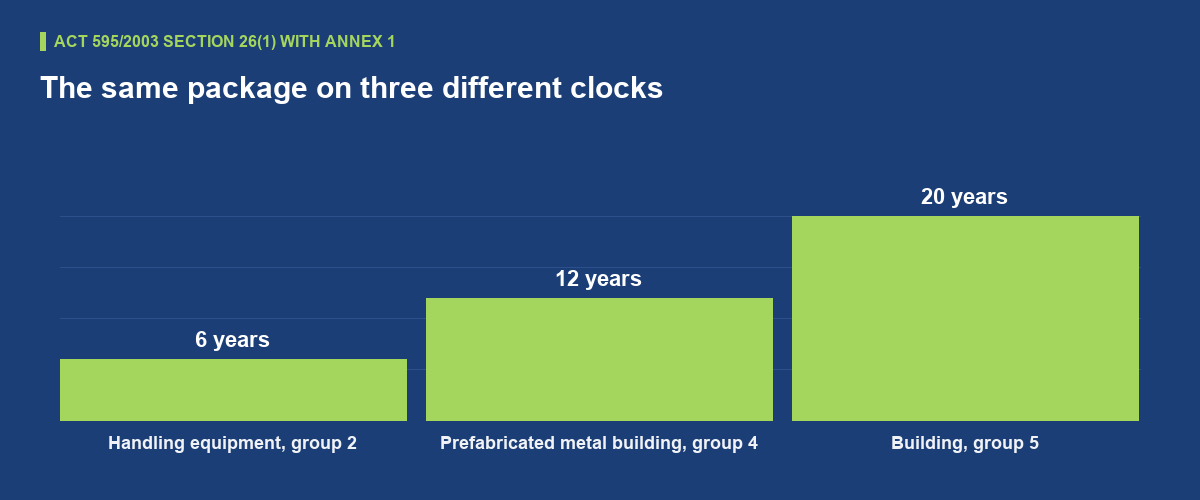
Section 26(1) of the Income Tax Act sorts tangible property into groups whose periods are 2, 4, 6, 8, 12, 20 and 40 years, and Annex 1 assigns the codes. Three items decide the outcome for an automated store. Item 2-20, code 28.22, covers lifting and handling equipment: a stacker crane or a shuttle sits in group 2 at six years. Item 4-2, code 25.11.10, covers prefabricated metal buildings where they are not separate construction objects connected to utility networks, which is group 4 at twelve years. A building that is a separate construction object falls in group 5 at twenty years. Section 27(1) then gives one sixth, one twelfth and one twentieth a year on a straight line.
Section 22(15) is the sentence that removes the escape route. Out of a building, only those separable components listed in Annex 1 may be carved out for separate depreciation, and that list is closed: air conditioning, passenger and goods lifts, escalators and moving walkways. Racking is not on it, and neither is a shuttle system once it has become part of the structure.
On a EUR 12 million steel and automation package the difference is not academic. At one sixth the annual deduction is EUR 2 million, at one twentieth it is EUR 600,000, and the gap runs for the whole life of the asset. These are worked examples on round numbers. The tenant-side variant of the same question, where the occupier pays for works in someone else’s building, is covered in our post on who writes off the tenant’s installations.
Why the automation cannot be commissioned like a machine
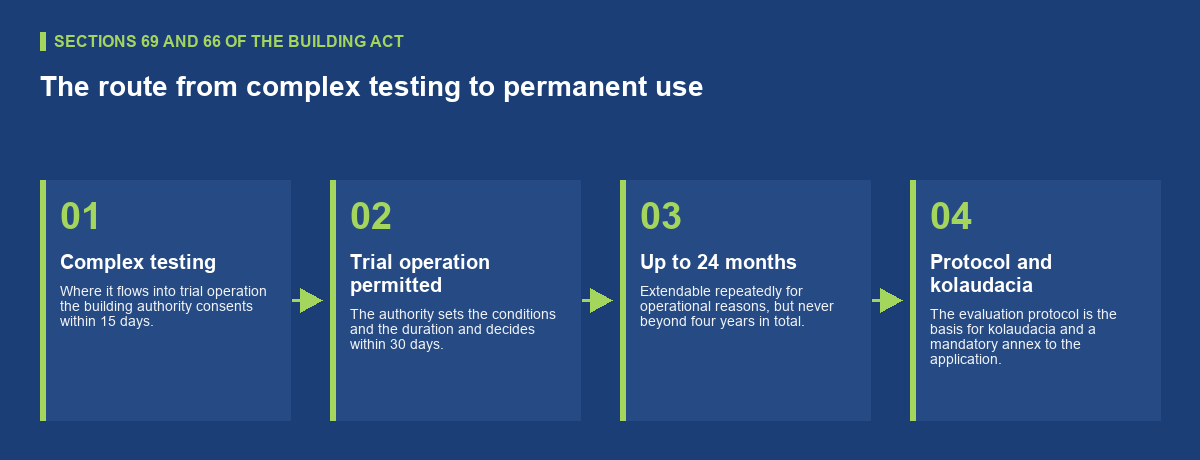
A machine is commissioned, signed off and used. A structure has to be put into permanent use through kolaudacia under section 66(1) of the Building Act, and our post on why a finished hall waits follows that procedure in detail. The complication in an automated store is that section 66(4)(c) and (f) require the inspection to establish that the technical and operational equipment is functional and that the reserved technical equipment runs smoothly and safely, which in a store of this kind cannot be judged from a drawing.
Section 69 is the answer the Act provides. Trial operation is temporary use of the structure to carry out tests and measurements of the functional parameters of the structure and its technical or technological equipment, where fitness for use can only be verified by operating it. The authority sets the conditions and the duration and decides within 30 days. It may be permitted for at most 24 months and, with repeated extensions, never beyond four years. The protocol on its course and evaluation is the basis for kolaudacia under section 69(5), and it is a mandatory annex to the application under section 66(2)(f). The instrument itself, including the extension rules and the delimitation against early use, is set out in our glossary entry on trial operation.
Section 70 is the other instrument and it is not interchangeable. Early use of a structure that is not finished at all runs for at most 12 months and, with extensions, five years. Trial operation assumes a finished building whose function is unproven; early use assumes an unfinished building whose usable part is safe. Fire safety runs on its own track alongside both, and that is the subject of a separate post, along with the sprinkler question that height creates.
What the municipal tax desk does with height
Here the direction reverses. Under section 11 of Act 582/2004 Z. z. the base of the tax on buildings is the built-up area in square metres, measured as the footprint at the level of the largest above-ground part, with the roof overhang excluded. Section 12(1) sets the annual rate at EUR 0.033 per square metre, which the municipality may raise or lower, capped at ten times the lowest rate it sets itself. Height is not in the formula.
The surcharge is where a tall building would normally be caught. Section 12(3) lets the municipality set up to EUR 0.33 for each further floor of a multi-storey building, and section 12a(2) excludes the first above-ground floor from the count. Section 12(4) then defines a floor as the part of the interior space bounded by a floor structure and a ceiling structure, and where the building has no ceiling structure, as the part bounded by the floor and the roof structure. Rack levels are not ceilings. A 40 metre automated store with no intermediate slabs therefore has one above-ground floor.
On a 6,000 square metre footprint at the statutory base rate that is EUR 198 a year, and the fourteen extra levels of storage add nothing to it, while a mezzanine with a proper deck would add a floor to the count. Municipal rates differ from the statutory base and the assessment turns on the position on 1 January, both of which we set out in the post on real estate tax on industrial property. The design decision that costs fourteen extra years of depreciation costs nothing at all at the municipal desk.
Conclusion
An automated store is one asset with two legal identities. Under Act 25/2025 the anchor decides: bolted or welded to a foundation is a firm connection with the ground, and equipment without which the building is not fit for operation is part of it. Under Act 595/2003 the functional unit decides, and firm attachment is expressly not enough. Where the two answers converge, as they do in a rack-clad store, the whole package runs twenty years instead of six, cannot be carved out under the closed list in section 22(15), and reaches permanent use only through a trial operation that the Act caps at 24 months. Where they diverge, the difference is worth more than the racking. Both outcomes are decided on the structural drawing, and neither can be repaired later by an accounting policy.