Rail-Connected Logistics in Slovakia: Terminals, Corridors, and Who Benefits

Rail-connected logistics in Slovakia is a story most site searches skip. An occupier shortlisting halls along the D1 compares rents, currently around €5.30 per square metre per month for prime space, checks the motorway junction and never asks where the nearest intermodal terminal loads. Yet Slovakia moves almost a third of its inland freight by rail, one of the highest shares in the European Union, and the terminals and corridors behind that figure quietly decide which parks stay competitive. This article maps the network – the western hub, the eastern broad-gauge gateway, the TEN-T corridors – and asks the practical question: which occupiers actually benefit from paying for rail access?

Why rail-connected logistics in Slovakia still matters
Why rail-connected logistics in Slovakia still matters

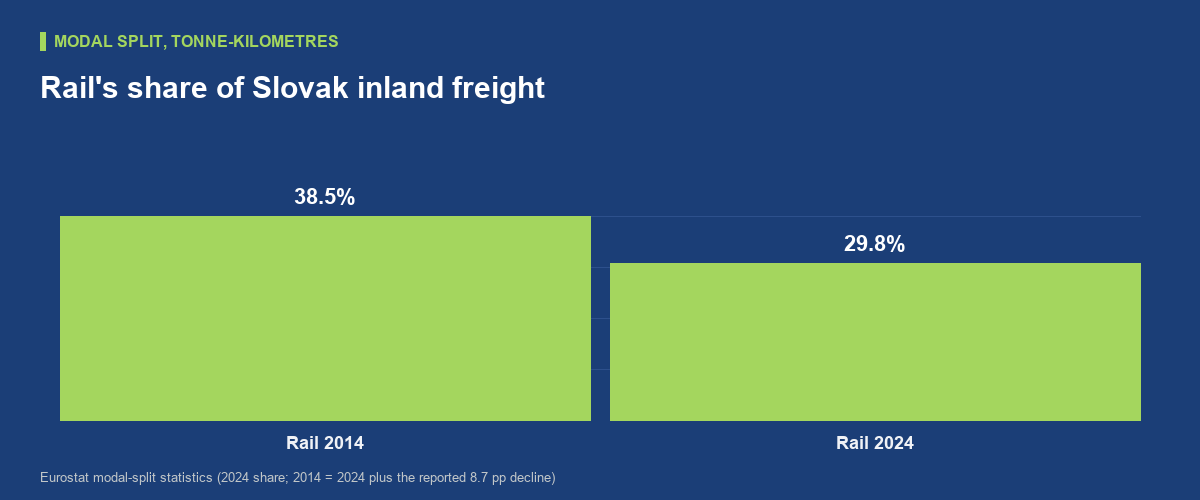
Slovakia is one of the few EU countries where rail remains a first-class freight mode rather than a rounding error. Eurostat’s modal-split statistics put rail at 29.8 per cent of Slovak inland freight tonne-kilometres in 2024 (Eurostat), a share most western European markets can only envy. The trend line, however, points the other way: between 2014 and 2024 the Slovak rail share fell by 8.7 percentage points while road’s share rose by 9.9 percentage points, so the country is drifting towards the European norm of truck-first logistics. Both facts matter to an occupier. The high share means the infrastructure, the operators and the working know-how are all in place; a company that wants to move volume by rail in Slovakia is not pioneering anything. The decline means capacity is available and terminal operators are hungry for new flows, which keeps intermodal pricing honest. It also means the occupiers who do commit to rail tend to be the ones with structural reasons – heavy inputs, fixed corridors, sustainability targets written into customer contracts – rather than opportunists chasing a subsidy. Reading the modal numbers first frames the real question: not whether rail works in Slovakia, but whether it works for a specific set of flows.

The western hub: what Dunajska Streda actually offers
The western hub: what Dunajska Streda actually offers

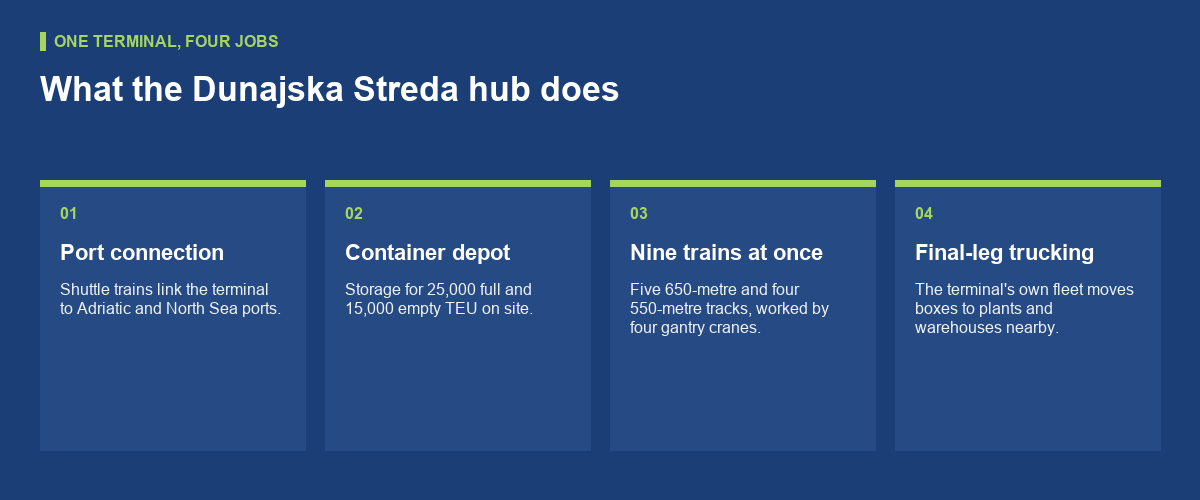
The centre of gravity of Slovak intermodal traffic sits south-east of Bratislava, in Dunajska Streda. The METRANS hub there is the largest inland container terminal in the country: a total site of 326,000 square metres with a 296,000 square metre stacking area, rail capacity for nine trains at once on five 650-metre and four 550-metre tracks, four rail-mounted gantry cranes, and a depot holding 25,000 TEU of full and 15,000 TEU of empty containers (METRANS). Rail operations run around the clock, including public holidays. In practice the hub works as Slovakia’s connection to the deep-sea ports: regular shuttle trains link it to the Adriatic and the North Sea range, and containers are trucked the final leg to plants and warehouses across western Slovakia. For an occupier this changes the geography of a site search. A hall within a short drayage of Dunajska Streda effectively has a port connection without a port, and the terminal’s own trucking fleet handles the last kilometres. Cross-docking volumes between rail and road is routine here rather than exotic, which is why container-heavy retailers and automotive suppliers cluster in the surrounding districts instead of paying Bratislava rents.

The eastern gateway: broad gauge and the Ukraine question
The eastern gateway: broad gauge and the Ukraine question

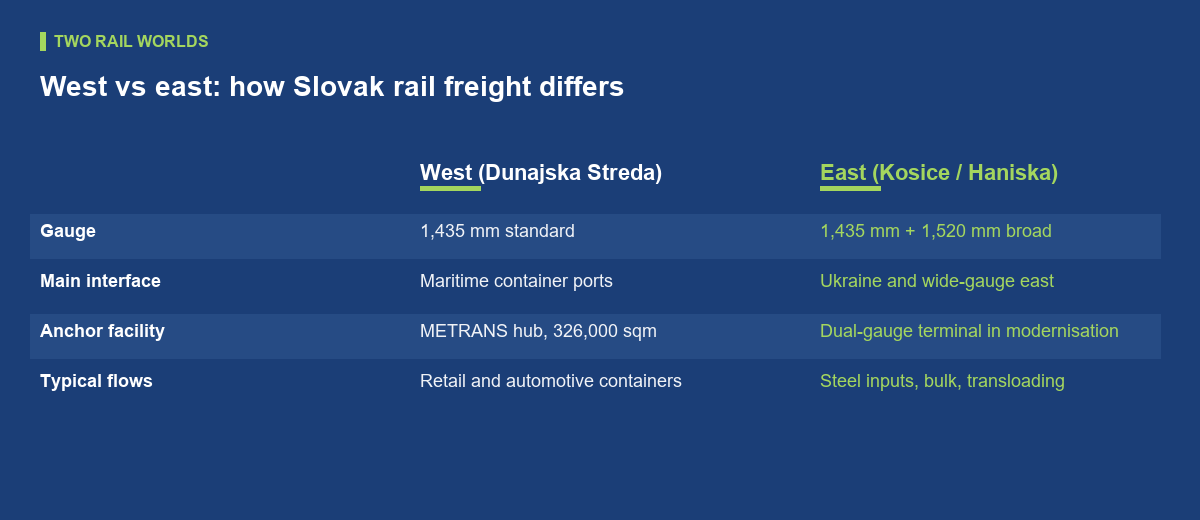
Eastern Slovakia plays a different rail game, built on a gauge break. The Uzhhorod-Kosice broad-gauge track, a single-track 1,520 mm line running from the Ukrainian border to Haniska just south of Kosice, was built to feed iron ore from the east to the steelworks near Kosice (Uzhhorod-Kosice line), and it still defines the region’s freight identity. Where western Slovakia interfaces with maritime containers, the east interfaces with the wide-gauge world: cargo arriving on Ukrainian and further-east railways can run deep into Slovak territory before it has to change systems. That break-of-gauge is friction, and friction is precisely what creates logistics work – transloading, storage, consolidation. The strategic bet on this corridor is now visible in private capital: Metrans and Interport Servis are modernising a terminal near Kosice to handle both broad and standard gauge, explicitly to ease rail freight to and from Ukraine (RailFreight.com). Whatever shape Ukraine’s reconstruction takes, the flows will need a staging ground inside the EU, and eastern Slovakia holds the shortest rail-served route. Occupiers positioning for that traffic are choosing the east now, while land near the gauge break remains cheap relative to what the corridor could carry.

The corridors that decide which parks win

Terminals are the nodes; the corridors decide how well they are fed. Slovakia sits on the crossing of two of the EU’s core TEN-T freight arteries. The Baltic Sea – Adriatic Sea corridor runs north-south through the country, entering from Poland near Zilina and leaving past Bratislava towards Vienna and the Adriatic ports (European Commission). The Rhine – Danube corridor crosses east-west, with a northern branch running via Zilina towards the Ukrainian border and a southern branch through Bratislava along the Danube (European Commission). Corridor status is not a diploma on a wall: it steers EU infrastructure co-funding, electrification and signalling upgrades, and the timetable priorities that decide whether a freight train crosses the country in hours or days. For industrial property the consequence is blunt. Parks that sit where a corridor meets a terminal – the Bratislava-Dunajska Streda pocket, the Zilina crossroads, the Kosice basin – enjoy a structural advantage that survives any single market cycle, because public money keeps flowing into the rails beneath them. A tenant’s market comes and goes; a corridor does not move.

Who benefits: matching occupier profiles to rail access

Rail access is worth real money to some occupiers and almost nothing to others, and honesty about which profile you are saves years of mispriced logistics. The clearest winners are heavy and steady flows: steel, automotive components, white goods, packaging – anything that moves in trainload rhythms on fixed lanes. Container importers with Adriatic or North Sea routings benefit through Dunajska Streda’s shuttles, particularly when sustainability clauses in customer contracts start pricing road kilometres. Businesses eyeing eastern flows – reconstruction materials, agricultural volumes, anything crossing the gauge break – gain from siting near Kosice ahead of the dual-gauge upgrade. Who does not benefit? Parcel networks and e-commerce fulfilment tuned to next-day promises, where the truck’s flexibility wins, and any operation whose volumes are too irregular to fill scheduled capacity. The warehouse lease terms an occupier signs should follow the same logic: a rail-served site commands its premium only if the siding, the terminal slots and the handling equipment are actually written into the deal. Rail access on a marketing brochure loads no trains.

Conclusion

Rail-connected logistics in Slovakia rewards the occupier who reads the map before the rent list. The country still moves almost a third of its freight by rail, the western hub at Dunajska Streda provides a genuine port connection without a coastline, and the eastern gauge break is turning into a strategic gateway as private terminals re-equip for Ukraine traffic. None of this shows up in a standard hall comparison, and that is exactly the opportunity: two buildings at the same rent can carry very different freight economics once the nearest terminal, the corridor beneath it and the shape of your own flows are priced in. The occupiers who benefit are the ones who ask early – and who make rail access a term of the lease, not a line in the brochure.
Comparing a rail-served park with a cheaper hall two junctions from the motorway? Talk to our team about what rail access is actually worth for your flows.

Incentives and State Aid for Industrial Occupiers in Slovakia

State aid for industrial occupiers in Slovakia is one of the most under-read lines in a site-selection budget. A manufacturer comparing halls on the D1 tends to fixate on the headline rent, currently around €5.30 per square metre per month for prime space, and forgets that the Slovak state will co-fund the move itself. Regional investment aid can cover up to half of a project’s eligible costs, yet many occupiers treat it as paperwork for someone else. This article sets out what the scheme funds, where the aid map pays most, the thresholds a company must clear, and how the numbers reshape a site decision.

What state aid for industrial occupiers actually covers

What state aid for industrial occupiers actually covers

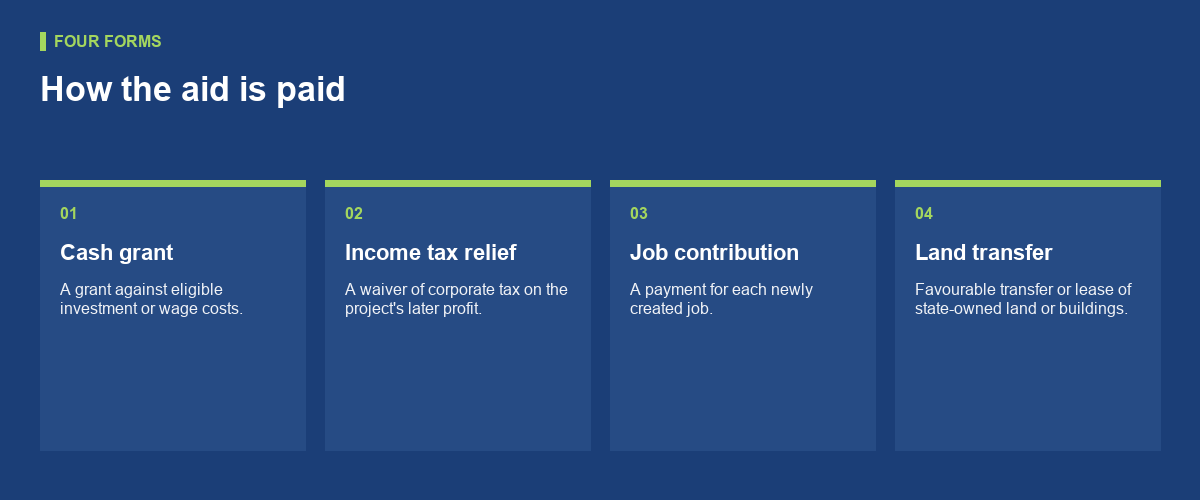
Slovakia runs a formal regional investment aid scheme under the Act on Regional Investment Aid, administered by the Ministry of Economy with the investment agency SARIO as the first point of contact (SARIO). It is open to small, medium and large companies, domestic or foreign, that invest in new capacity in industrial production, technology centres or shared-service centres. For an occupier this matters because the aid attaches to the operating company that will run the plant, not to the developer that builds the shell. The scheme pays out through four channels rather than one. The first is a cash grant against eligible investment or wage costs. The second is income tax relief, a waiver of corporate tax on the profit the project later generates. The third is a contribution for each newly created job. The fourth is a favourable transfer of state-owned land or buildings, priced at up to 100 per cent of a discount, or a favourable lease at up to 90 per cent. One project can combine several of these, and the Bratislava region is the single exclusion, so a site anywhere else in the country is in scope. The headline point is simple: the building is only half the decision, and the state funds the other half.

Where the aid map pays most across Slovakia

Where the aid map pays most across Slovakia

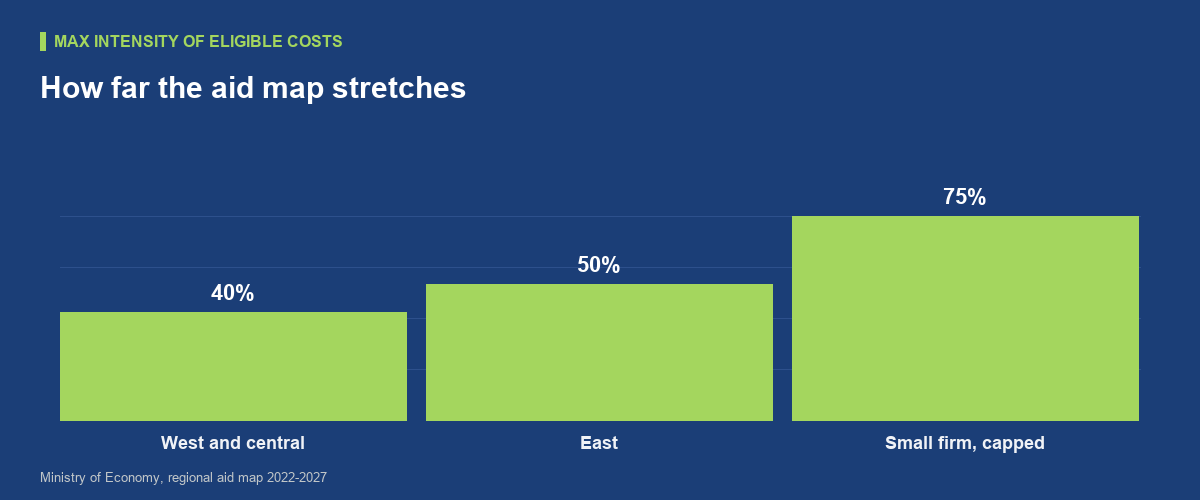
How much a project can claim depends on where it lands. Slovakia’s regional aid map, in force from 2022 to 31 December 2027, caps the intensity of aid at 40 per cent of eligible costs across most of the country and 50 per cent in the least-developed eastern districts (Ministry of Economy). From January 2024 the government lifted the ceilings in western Slovakia, raising several districts to the higher band and sharpening the incentive to build outside the saturated Bratislava hinterland (UNCTAD). Smaller companies do better still. The maximum intensity rises by 20 percentage points for micro and small enterprises and by 10 percentage points for medium-sized ones, though the combined figure can never exceed 75 per cent of total eligible costs. The map is blunt but predictable. In practice it becomes a genuine lever: an identical project that clears the same thresholds is worth materially more in Prešov or Košice than in Trnava, purely because the eastern districts carry the higher intensity. For an occupier with any freedom over location, the aid map is a reason to look east before signing in the west.

The thresholds an occupier must clear

The thresholds an occupier must clear

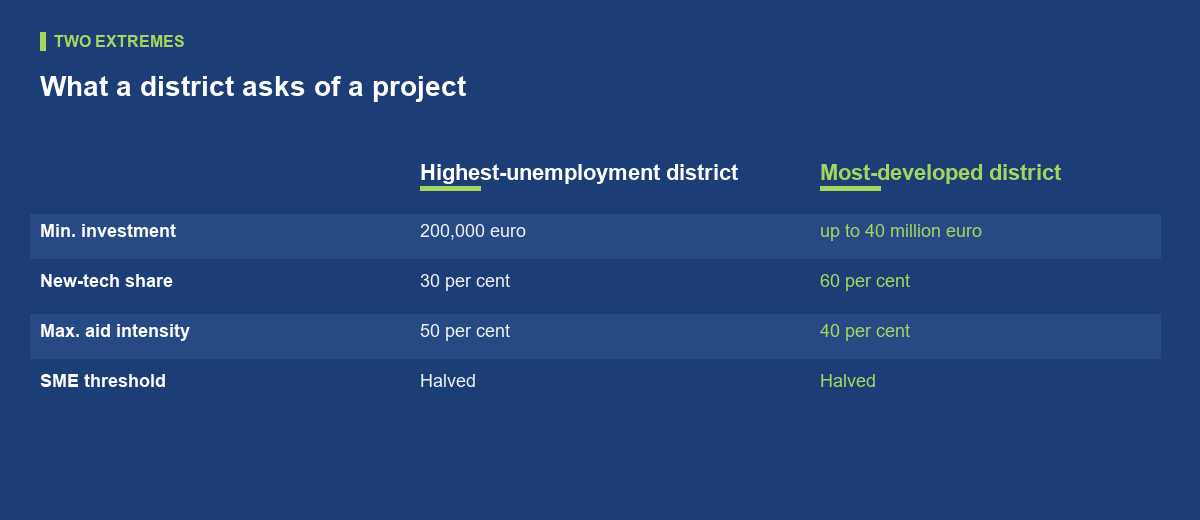
Aid is not automatic; a project has to clear minimum values that scale with how developed the district is. For industrial production the minimum qualifying investment ranges from 200,000 euro in the highest-unemployment districts to as much as 40 million euro in the most developed ones, and the thresholds are halved for small and medium-sized enterprises (Ministry of Economy). A second test governs modernity: the share of the investment spent on new technological equipment must reach between 30 per cent and 60 per cent of eligible costs, again rising with the wealth of the region. Where the aid takes the form of a job-creation contribution, the project must also create a minimum number of new posts, from around 20 in the weakest labour markets to 200 in the strongest. The logic is deliberate. Slovakia wants modern plant and real employment in the places that need them, so it asks least of a project in a struggling eastern district and most of one in a prosperous western one. An occupier reading these numbers should map its own capital plan against them early, because a site that misses a threshold by a small margin forfeits the aid entirely.

Beyond the grant: tax relief and the R&D super-deduction

The cash grant is the visible incentive, but the tax side often carries more value over the life of a plant. Income tax relief lets a beneficiary shelter the profit its new capacity generates, which is worth more the higher the tax rate. From January 2025 Slovakia charges corporate tax at 10 per cent on taxable income up to 100,000 euro, 21 per cent between 100,000 euro and 5 million euro, and 24 per cent above 5 million euro (PwC). A profitable project therefore shields income at the top band, so the relief compounds as the operation scales. The saving is real money, not a rounding error. Stacked on that is the research and development super-deduction: a company can deduct an additional 100 per cent of qualifying R&D costs from its tax base, on top of the normal expense, and carry any unused amount forward for up to five years (SARIO). For an occupier running any process engineering, testing or product development on site, that turns routine costs into a second, standing subsidy. The favourable transfer or lease of state land rounds out the package, cutting the cost of the plot beneath the building. Read together, the incentives are less a one-off cheque than a structural discount on operating in Slovakia.

How incentives should shape a site decision

The practical mistake is to treat aid as an afterthought once the building is chosen. It belongs at the front of the process, because it can reorder the site ranking outright. A hall that looks dearer on rent can be the cheaper total commitment once a 50 per cent intensity, income tax relief and a discounted plot are counted, so the comparison has to run on landed project cost rather than the rent line alone. Timing is the other trap: aid must be applied for before work on the project begins, so an occupier that breaks ground first can disqualify itself. The cleanest route is to align the incentive application with the lease or build-to-suit structure from the outset, so the developer’s delivery and the state’s aid decision move together. This is the same discipline that governs the rest of the deal, from the warehouse lease terms an occupier signs to the way rent indexation quietly compounds over the term, and it rewards the tenant that reads the whole cost, not the headline. In today’s tenant’s market, with the balance already tilted toward occupiers, incentives are the lever that decides which Slovak site actually wins.

Conclusion

Incentives are the part of a Slovak industrial decision that sits outside the lease and therefore outside most occupiers’ attention. Yet regional investment aid can fund up to half of a project’s eligible costs, income tax relief shelters the profit that follows, and the R&D super-deduction quietly discounts the work done inside the building. None of it is automatic, and all of it turns on where the project lands and how early the application starts. The occupier who prices the aid into the site decision from the beginning, rather than discovering it afterwards, is the one who signs the genuinely cheaper deal – and often in a better location than the rent line alone would have suggested.

Weighing two Slovak sites and unsure which one the state will co-fund? Talk to our team about aligning a building on the D1 with the regional aid your project can actually claim.

Service Charges in Slovak Industrial Leases: The Full Breakdown

Service charges in Slovak industrial leases are the quiet second rent. The headline figure a tenant compares between two parks is the base rent, but that is only part of what leaves the account each month. On top of the rent sits a service charge that funds the running of the estate, and on top of that come metered utilities. In a market where prime rent has settled at €5.30 per square metre per month, the service charge is where two apparently identical deals quietly diverge. This article breaks the charge down in full: what it pays for, how it is billed, what it costs, and how occupiers keep it under control.

What a service charge is in a Slovak industrial lease

A Slovak industrial lease is almost always structured as a triple net lease, which means the tenant carries three separate costs rather than one. First the base rent, the headline figure that sat at about €5.30 per square metre per month for prime space in early 2026 (Cushman & Wakefield Slovakia MarketBeat). Second the service charge, the subject of this article. Third the tenant’s own utilities, metered and billed separately. The service charge is not the landlord’s profit and not a second margin dressed up as a fee. It is a recovery of the real cost of running the shared parts of the estate – the roads, the yards, the security, the insurance – passed through to the tenants who use them, usually in proportion to the floor area each one occupies. Understood properly, it is the mechanism that keeps a multi-let logistics park functioning while spreading the cost fairly across its occupiers. Understood loosely, it is the line on the invoice where a tenant can quietly overpay for years without ever renegotiating the rent.

What the service charge actually pays for

What the service charge actually pays for

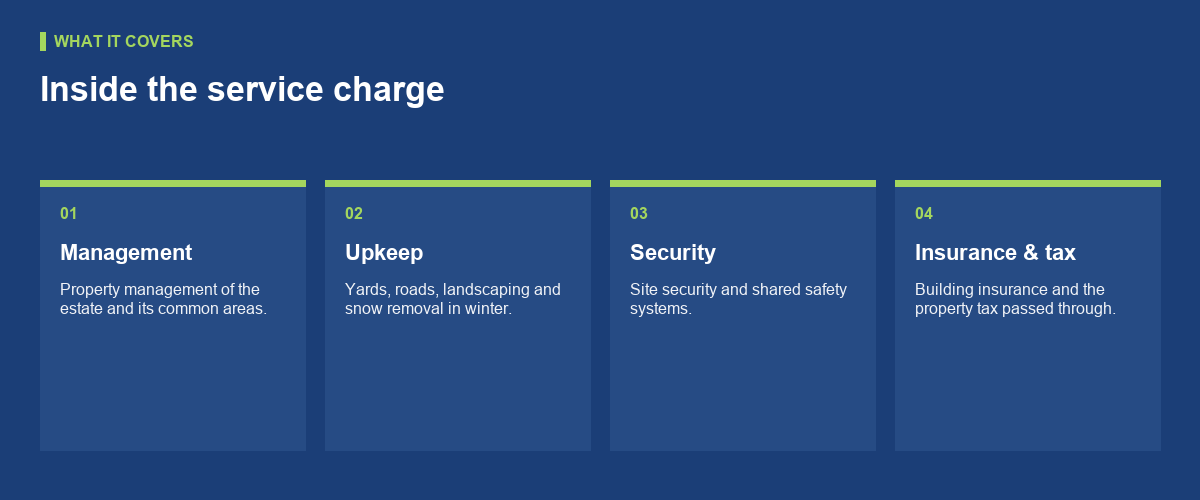
The service charge funds the operation and upkeep of everything a tenant shares with its neighbours rather than occupies alone. In a modern Slovak park that typically means property management, the maintenance of common areas and yards, snow removal in winter, landscaping, security, building insurance, and the property tax the landlord passes through. Each of these is a running cost of the estate as a whole, which is why it is shared rather than billed to one unit. What the service charge does not cover is just as important. A tenant’s own electricity and gas are metered and billed separately, so they sit outside the charge entirely and rise or fall with the tenant’s own consumption. The line between the two matters at reconciliation time, because a landlord that folds unit-level consumption or its own structural repairs into the shared charge is recovering costs that do not belong there. The tenant’s defence is a lease that lists, explicitly, which categories the charge includes and which it excludes, so the annual bill can be checked against the wording rather than taken on trust.

How a service charge is billed: advance and reconciliation

How a service charge is billed: advance and reconciliation

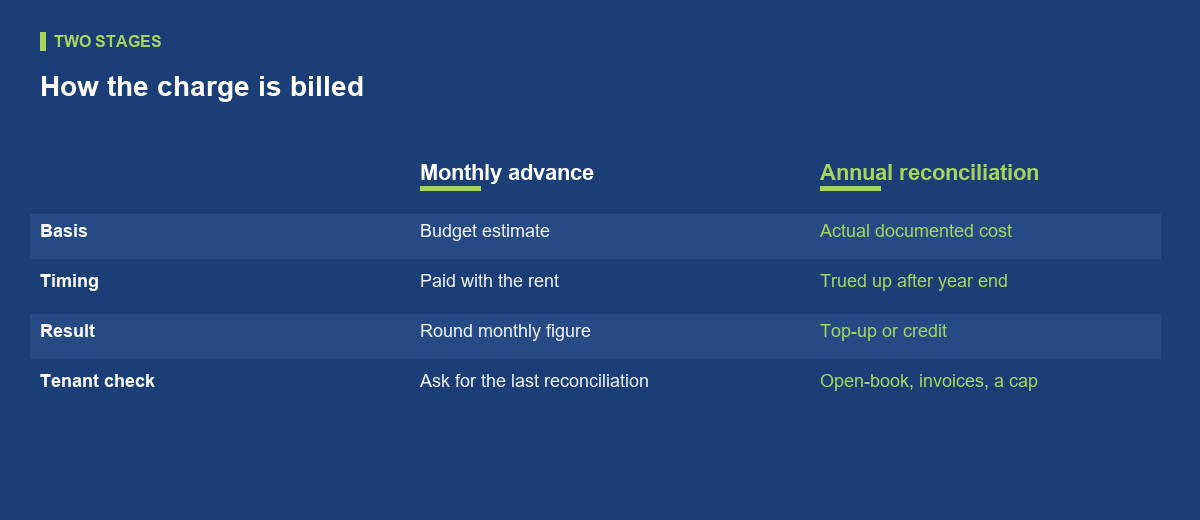
A service charge is not a fixed number but an estimate that is trued up after the fact. The landlord sets an annual budget, divides it across the tenants and bills it as a monthly advance, a round figure paid alongside the rent through the year. Once the year closes, the landlord reconciles that advance against what the estate actually spent. If the real costs came in above the budget, the tenant tops up the difference; if they came in below, the tenant receives a credit. This is the moment where a service charge is either transparent or opaque. The occupier’s protection is to insist on an open-book regime with an annual reconciliation against documented actual costs, or at the very least a cap on the amount that can be charged in any year. A charge billed as a smooth monthly advance with no reconciliation, no invoices behind it and no cap is a charge a tenant cannot audit, and one that tends to drift upward. Before signing, the single most useful document to request is the last full-year reconciliation for the building, because it shows what the charge really was rather than what the current advance suggests.

What service charges cost, and why two identical rents differ

What service charges cost, and why two identical rents differ

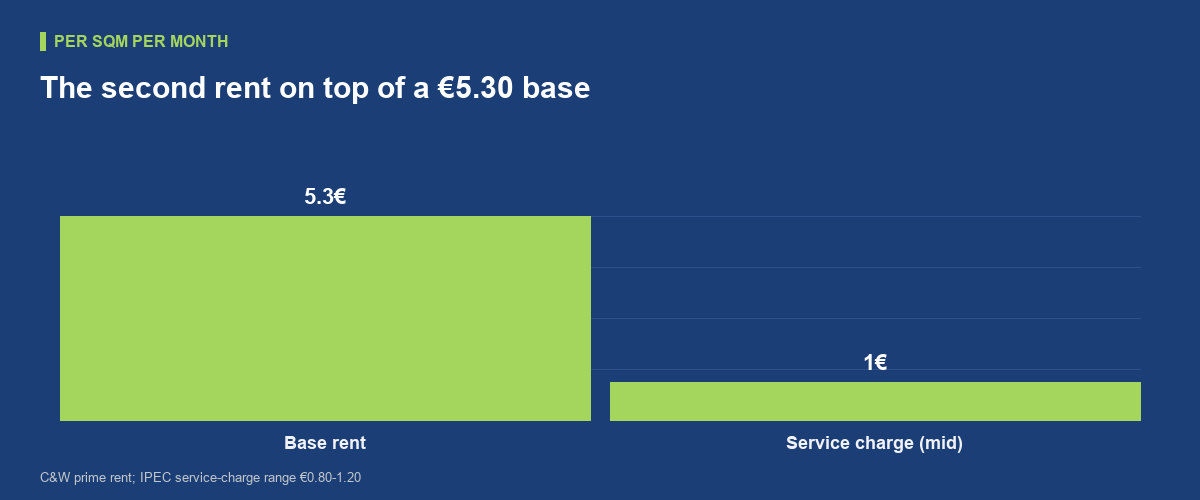
In a modern Slovak logistics park the service charge typically runs between about €0.80 and €1.20 per square metre per month, which on top of a €5.30 base rent adds materially to the real cost of occupation. The scale is not trivial at portfolio level: across the CEE region, taxes and service charges account on average for about 19 per cent of a warehouse’s total property costs (Savills, via Property Forum). This is why two leases signed at an identical €5.30 headline can end up ten per cent or more apart in real cost once service charges, indexation, rent-free periods and reinstatement obligations are counted, a gap we set out in Industrial Rent Levels in Slovakia 2026. Indexation compounds the effect, because the service charge, like the rent, is usually linked to the harmonised index of consumer prices: Slovak HICP ran at 8.4 per cent in 2022 before easing to 2.1 per cent in 2025, so a charge agreed in a high-inflation year keeps a higher base long after inflation falls (Eurostat). The lesson is that the headline rent is a poor guide to what a building actually costs. The service charge decides the rest.

How occupiers should negotiate and control the service charge

A service charge is negotiable, and the work is done before signing rather than after. The first move is to cap the amount that can be charged in any year, or at least to cap the annual uplift, so a bad year for the estate does not become an open-ended bill for the tenant. The second is to fix the scope in writing: the lease should list what the charge includes and, just as firmly, exclude the landlord’s own capital works, structural repairs and the cost of fixing initial construction defects, none of which a tenant should fund through a running charge. The third is to demand transparency – an open-book regime, documented reconciliation and the right to inspect the invoices behind the figure. Benchmarking helps too, because a charge that sits well above the €0.80 to €1.20 range for comparable space is worth questioning before it is accepted. These are the same disciplines that protect a tenant elsewhere in the deal, set out in Warehouse Lease Terms in Slovakia, and they matter most in the current market. With vacancy at about 7.72 per cent across roughly 4.67 million square metres of grade-A stock, the balance in 2026 sits with occupiers, and a tenant with options has real room to fix the service charge on fair terms. For the standalone definition, see our glossary entry on service charges.

Conclusion

Service charges are the part of a Slovak industrial lease that hides in plain sight. They are not profit and not a trick, but a genuine recovery of the cost of running a shared estate – and precisely because they are legitimate, they go unexamined. The occupier who treats the charge as seriously as the rent asks what it covers, how it is reconciled, what it costs against the €0.80 to €1.20 benchmark, and where it can be capped. In a tenant’s market that scrutiny is not just prudent, it pays. Compare the total occupancy cost, not the headline rent, and the second rent stops being the place where good deals quietly turn into ordinary ones.

Comparing offers on the D1 and unsure how the service charges stack up? Talk to our team about the total occupancy cost behind the headline rent, not just the rent itself.

Nearshoring and the Slovak Automotive Belt: Where Manufacturing Capacity Is Moving

The Slovak automotive belt is the reason nearshoring is more than a slogan in Central Europe. It is the chain of car plants and suppliers that runs across the country, and in 2024 it built about 993,000 vehicles – the highest output per head of any nation on earth. Now that belt is shifting: a decade of production weighted to the west is extending east toward Kosice, pulled by a €1.2 billion Volvo plant and the broader move to bring supply chains closer to the markets they serve. This article maps where the capacity is going, and what it means for occupiers.

What the Slovak automotive belt actually is

What the Slovak automotive belt actually is

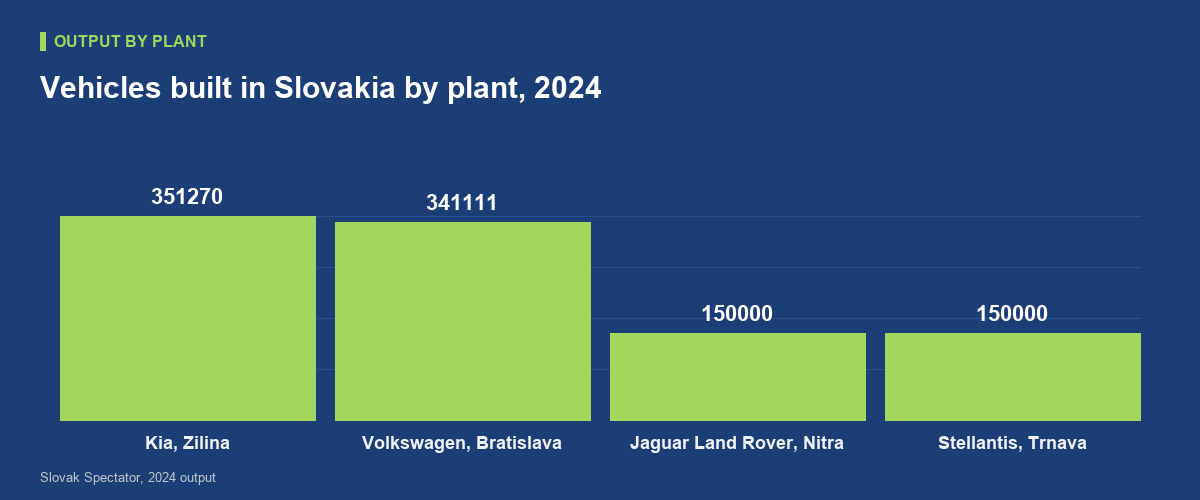
The Slovak automotive belt is the chain of car plants and their supplier networks that runs across the country, from Bratislava in the west toward Kosice in the east. Four carmakers anchor it today: Volkswagen in Bratislava, Stellantis in Trnava, Kia in Zilina and Jaguar Land Rover in Nitra. Together they built about 993,000 vehicles in 2024, which on a population of roughly five million works out at 182 cars per 1,000 inhabitants – the highest per-capita output of any country in the world, a position Slovakia has held since 2007 (Slovak Spectator; Wikipedia). This is not a side industry. Car and component manufacturing accounted for 49.5 per cent of total industrial revenues in 2023 and about 9.2 per cent of GDP, and the sector employs more than 165,000 people directly, or around 244,000 once the supply chain is counted (Slovak Spectator). The weight sits in a handful of plants: Kia in Zilina made 351,270 vehicles in 2024 and Volkswagen in Bratislava 341,111. When people say nearshoring is reshaping Central Europe, this belt is the physical thing the investment lands on.

Why nearshoring is redrawing the map

Nearshoring is the decision to move production closer to the market it serves, and after a decade of stretched, far-flung supply chains it has turned Central and Eastern Europe into Europe’s preferred factory floor. The drivers are practical: shorter transport routes, lower lead times, labour that still costs less than in Western Europe, and free movement of goods inside the EU (Cushman & Wakefield). For the car industry the pull is sharpened by the electric transition, which pushes carmakers to localise battery and component production rather than ship it across continents. Slovakia sits in the middle of this shift. It already has the plants, the trained workforce and the road and rail links along the D1, so new supplier investment tends to land where assembly capacity already is rather than starting from scratch elsewhere. That is the quiet logic of nearshoring: it concentrates, it does not scatter. Demand for space follows the same rule, which is why occupier interest in Slovak industrial property has stayed firm even though output dipped by about 90,000 units in 2024, from roughly 1,083,000 the year before. The belt is where the supply chain wants to be.

The eastward shift: Volvo and the Kosice axis

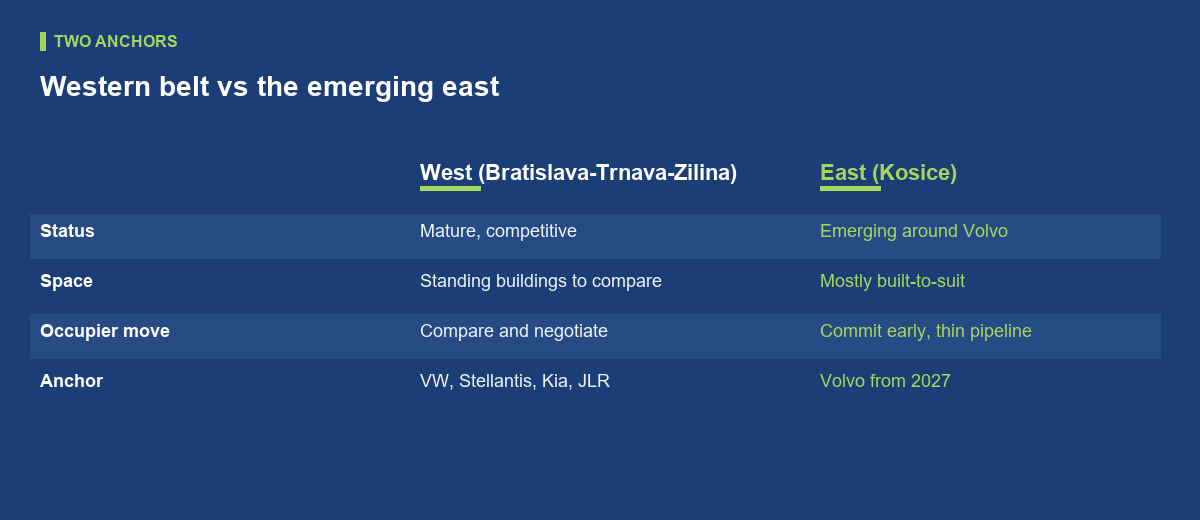
For most of its history the belt has been weighted to the west, around Bratislava and Trnava. That is changing. Volvo Cars is building a €1.2 billion assembly plant at Valaliky near Kosice, in the far east of the country, designed for 250,000 electric cars a year and at least 3,300 direct jobs, backed by €267 million of approved EU state aid (bne IntelliNews; electrive). Large-scale production has slipped to early 2027 (Mobility Portal), but the effect on the map is already visible. A plant of that size does not arrive alone: it pulls a ring of suppliers, logistics operators and service firms into a region that until now had little heavy automotive presence. For the first time the belt has a serious eastern anchor to match its western one, and the corridor between them – the spine we map in Cross-Border Logistics Slovakia: CEE’s Pivot Point – becomes the axis along which capacity, and property demand, will spread. Kosice is no longer the edge of the belt. It is becoming its second centre.

What the shift means for industrial occupiers

What the shift means for industrial occupiers

For anyone taking space in Slovakia, the nearshoring story is not an abstraction – it decides where the good buildings will be and what they will cost. Supplier operations that feed an assembly line need to sit close to it, so demand clusters tightly around the plants rather than spreading evenly. Around Bratislava, Trnava and Zilina that means a mature, competitive market where a tenant can compare standing buildings, a point we set out in The Slovak Industrial Property Market in 2026. Around Kosice it means something different: much of the specialised supplier space does not exist yet and will be built to order, the built-to-suit route we compare in Built-to-Suit vs Speculative Space in Slovakia. The practical read is to match your location to the plant you serve, and to move early in the east, where the pipeline is thin and the best sites near the Volvo plant will be committed well before production starts. Rent still matters, and we break down what occupiers actually pay in Industrial Rent Levels in Slovakia 2026, but in a belt this concentrated, position comes first.

The risks that could stall the belt

The risks that could stall the belt

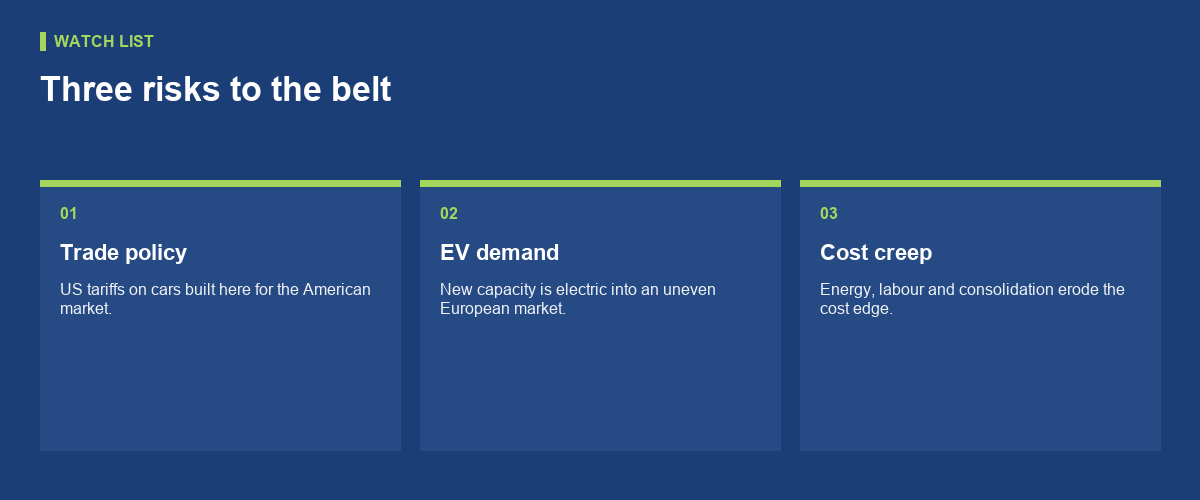
None of this is guaranteed, and honest planning means naming what could go wrong. The clearest risk is trade policy. A large share of Slovak output is exported, and cars built here for the American market – notably at Volkswagen and Jaguar Land Rover – are exposed to US tariffs, which would hit the plants and their suppliers together (Slovak Spectator). The second risk is the electric transition itself: Slovakia’s new capacity, Volvo included, is being built around electric vehicles at a time when European EV demand has been uneven, so a slower switch would leave expensive new lines underused. The third is closer to home. Rising energy and labour costs, sharpened by government consolidation measures, are eroding the cost advantage that drew the industry here in the first place (Slovak Spectator). None of these cancels the nearshoring case – the plants, the skills and the location are real and hard to replicate – but they do mean the belt will grow in fits rather than a straight line. Occupiers should plan for a strong long-term trend carried on a bumpy road.

Conclusion

The Slovak automotive belt is the clearest example in Central Europe of nearshoring turning into concrete and steel. It already produces more cars per head than anywhere on earth, it anchors close to half of the country’s industrial revenue, and it is now extending east toward Kosice on the back of Volvo’s €1.2 billion plant. For occupiers the message is simple: capacity is moving, it is moving in a predictable direction, and the best positions – especially in the east – will be taken by those who read the map early. The output dip of 2024 and the tariff and EV risks are real, but they change the pace of the story, not its direction. Match your location to the plant you serve, move ahead of the pipeline in the east, and the belt works for you rather than around you.

Planning a supplier or logistics footprint along the Slovak automotive belt in 2026? Talk to our team about the right location, route and terms for the plant you serve.

ESG in Slovak Logistics: What BREEAM and DGNB Really Cost Tenants

ESG in Slovak logistics has moved from a marketing badge to a condition of doing business. Industrial and logistics assets now draw up to 58 per cent of all commercial property investment in Slovakia, the highest sectoral share in Central and Eastern Europe. Almost every new hall is now handed over with a green certificate attached. For a tenant that raises a practical question the brochure skips: what does the BREEAM or DGNB label actually cost you, and what does it give back? This article breaks down the build cost, the running savings and the rent premium that sits behind the certificate on the wall.

ESG in Slovak logistics: how the green certificate became standard

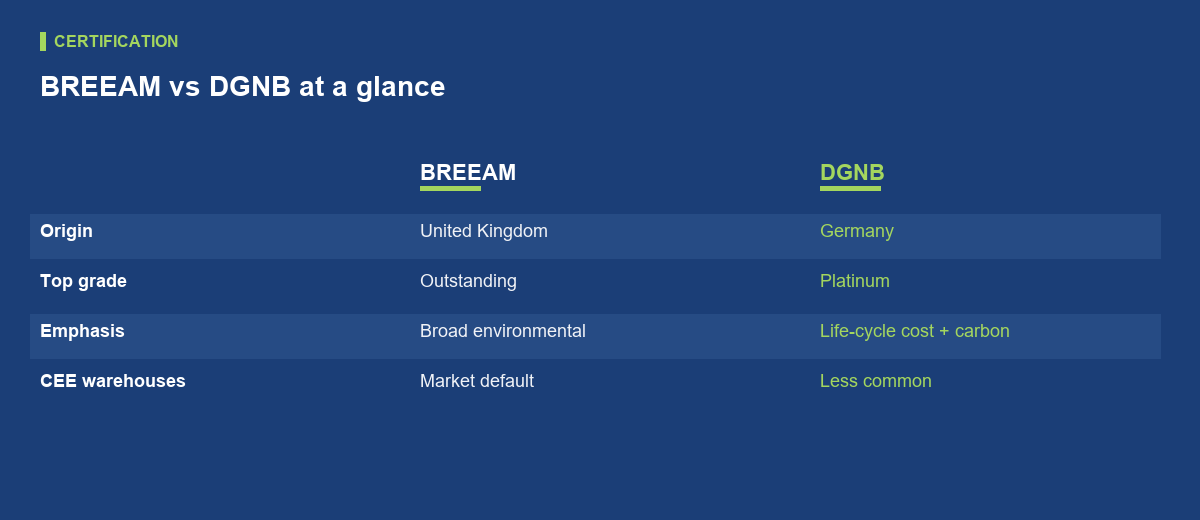
Two forces turned certification from optional to obligatory. The first is money. Investment into Slovak industrial and logistics property jumped by around 315 per cent year on year in the first half of 2025. The sector now commands the largest share of commercial investment in the country (Cushman & Wakefield). Institutional buyers price ESG risk directly: a building without a recognised certificate is harder to finance, harder to insure and harder to sell to a fund with its own disclosure obligations. The second force is the occupier. Third-party logistics operators and manufacturers increasingly carry their own decarbonisation targets, pushed down from the retailers and brands they serve. A warehouse is one of the largest line items in a company’s reported carbon, so a certified building is no longer a nice extra but a reporting necessity. The result is visible on the ground. Across the region BREEAM has become the default specification for new warehouse stock rather than a premium option (EurobuildCEE). The recent Slovak openings tell the same story: CEVA Logistics and Jungheinrich moved into a BREEAM Excellent building at Plavecky Stvrtok near Bratislava (CEVA Logistics), on the cross-border spine we map in Cross-Border Logistics Slovakia: CEE’s Pivot Point. For a tenant the question is no longer whether to take certified space, but how to read what the certificate is worth.

BREEAM and DGNB: what the two certificates measure

BREEAM and DGNB: what the two certificates measure

BREEAM and DGNB answer the same question with different accents. BREEAM, the British system that dominates the CEE warehouse market, scores a building across categories such as energy, water, materials, health, land use and pollution, then awards a single rating: Pass, Good, Very Good, Excellent or Outstanding (BREEAM rating guide). Most institutional-grade logistics stock now targets Very Good or Excellent, because anything lower reads as a compliance floor rather than a selling point. DGNB, the German system, works on a different logic. It scores economic, ecological and socio-cultural performance over the whole life cycle and awards Bronze, Silver, Gold or Platinum, with a heavier weighting on life-cycle cost and carbon than BREEAM applies. For a tenant the practical distinction is narrow. Both certificates confirm that the shell, the services and the site were designed to a measured environmental standard, and both feed the same corporate ESG reports. What matters is the level, not the logo: an Excellent or a Gold building carries real specification behind it, while a bare Pass or Bronze certificate may signal little more than that the developer wanted a badge. The tenant’s job is to read the scorecard, not the sticker. Ask which credits were actually achieved on energy and on-site renewables, because those are the ones that show up later in the service charge.

What certification actually costs to build

The certificate itself is not where the money goes. The assessment, modelling and administration for a BREEAM rating typically run at well under one per cent of total construction cost, and can be held close to zero when the design targets the credits from the outset rather than retrofitting them (Salvis BREEAM consulting). The real cost sits in the specification the certificate demands: a better-insulated envelope, LED lighting, water-saving fittings, a roof structure ready for solar, electric-vehicle charging bays and metering that actually reports consumption. Those items add to the developer’s build budget, and in a market where the landlord finances construction against a lease, they arrive on the tenant’s side as rent. This is the point occupiers miss. You do not pay for certification as a separate line, and you cannot decline it to save money, because in Slovakia the certified building is now the product on offer. What you can do is understand which parts of the green specification serve you and which serve the landlord’s exit. Solar-ready roofs and generous power capacity lower your running costs. A higher headline rating that adds cost without cutting your bills mainly protects the asset’s resale value. Knowing the difference is what lets a tenant argue about where the premium lands.

What the certificate saves a tenant

What the certificate saves a tenant

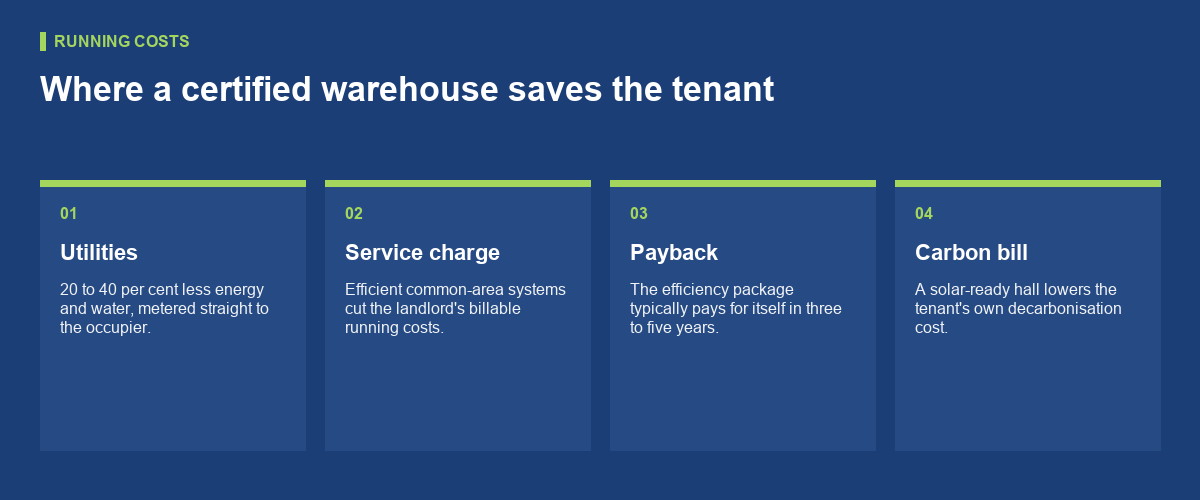
Against that cost sits a running saving that most rent comparisons ignore. A well-designed certified warehouse cuts energy and water consumption by roughly 20 to 40 per cent against an older uncertified shed, with the efficiency package typically paying for itself within three to five years of occupation (Salvis). For a tenant those savings land in two places. The first is the utility bill, which sits outside the rent and the service charge and is metered straight to the occupier, so every kilowatt the building does not waste is money kept. The second is the service charge itself: efficient lighting, heating and water systems lower the common-area running costs that the landlord bills back, the line we break down in Industrial Rent Levels in Slovakia 2026. A certified building also cuts a cost that appears on no invoice yet. Because the warehouse is a large part of a company’s reported carbon, a certified, efficient, solar-ready hall reduces the tenant’s own decarbonisation bill, the price of hitting the targets its customers now demand. That is why certified space increasingly wins the deal over a marginally cheaper uncertified unit. The saving is real, but it is not automatic. A certificate proves the building can perform; it does not guarantee the tenant runs it well. The lease should give the occupier the right to install rooftop solar and to read its own meters, or the efficiency stays on paper.

The green premium: what tenants really pay

The green premium: what tenants really pay

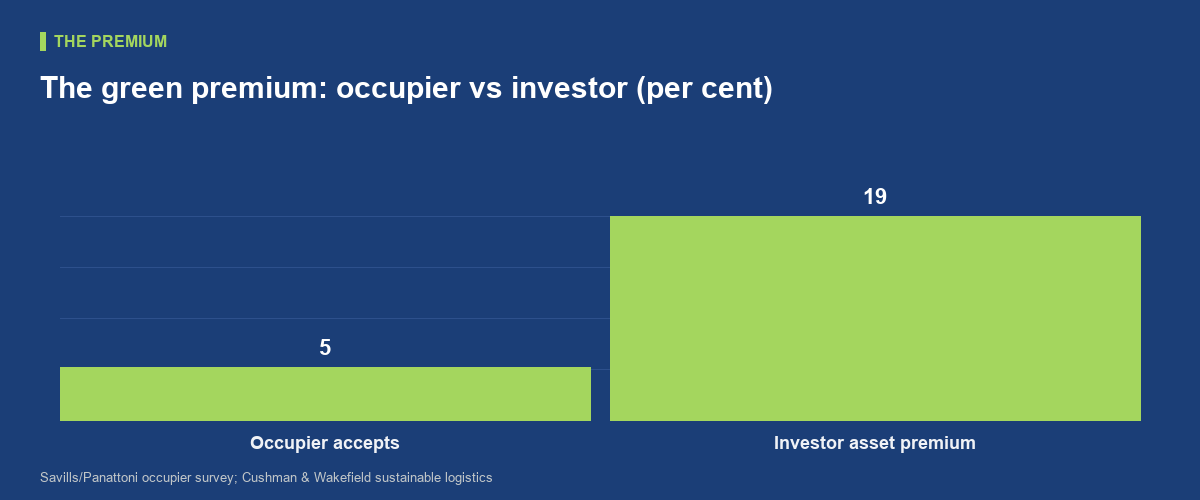
So what does the market actually charge for all this? At the investment level the premium is large. Cushman & Wakefield’s work on sustainable logistics puts the average pricing premium for assets with a high ESG rating at around 19 per cent over comparable buildings with a low rating or none (Cushman & Wakefield, via Clarion Partners). That gap reflects investor demand, not tenant rent, but it explains why developers protect their certificates so carefully. On the occupier side the willingness is real but more measured. In a survey of logistics users by Panattoni and Savills, almost 90 per cent said they would pay more for a green-certified building. Close to 70 per cent accepted a rental surplus of 5 per cent or more (Savills), and a clear majority said they were increasing their own sustainability spending. Read those numbers together and the tenant’s position is clear. The certificate is priced into the rent, and the market has agreed it is worth paying for, but the accepted premium is a single-digit percentage, not the double-digit gap investors pay each other. That is the negotiating line. Pay the green premium, but insist it buys the credits that cut your bills: on-site solar rights, real power capacity, charging infrastructure and honest metering. And trade term for it, because a longer lease that lengthens the landlord’s income is the cleanest thing to swap for a better-specified building at a controlled rent.

Conclusion

ESG in Slovak logistics is no longer a choice a tenant makes; it is the condition of the building on offer. The certificate on the wall, whether BREEAM Excellent or DGNB Gold, costs little to award but shapes the whole specification, and that specification arrives in the rent. The tenant who treats the label as marketing overpays. The tenant who reads the scorecard, counts the running savings against the premium, and negotiates for the credits that cut real bills turns a compliance cost into an operating advantage. In a market where certified space is the default, that reading is the difference between paying for a badge and buying performance.

Comparing certified space on the D1 in 2026? Talk to our team about which green credits actually cut your occupancy cost.

Industrial Rent Levels in Slovakia 2026: What Occupiers Actually Pay

Industrial rent levels in Slovakia enter 2026 with a prime headline of 5.30 euros per square metre per month, the figure Cushman & Wakefield report for the first quarter. That single number hides a wide spread. The market average sits nearer 5.07 euros, entry rents around Senec start at 3.90 euros, and the gap between the headline and the effective deal has rarely been wider. This article sets out what occupiers actually pay across Bratislava and the regions, what service charges add on top, which incentives are realistic, how indexation works, and what all of it means for a lease negotiation on the D1 corridor this year.

Industrial rent levels in Slovakia: the 2026 headline numbers

Industrial rent levels in Slovakia: the 2026 headline numbers

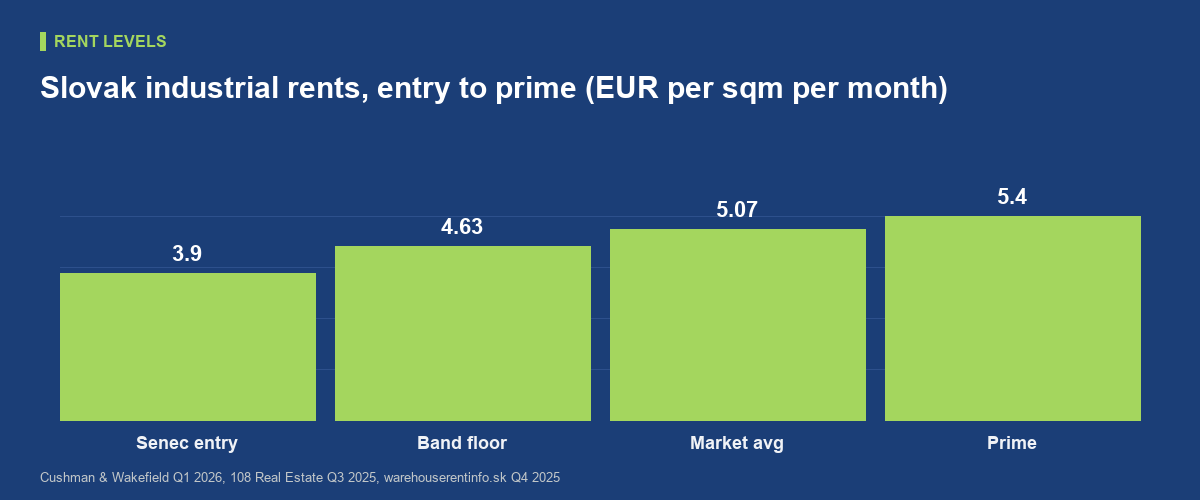
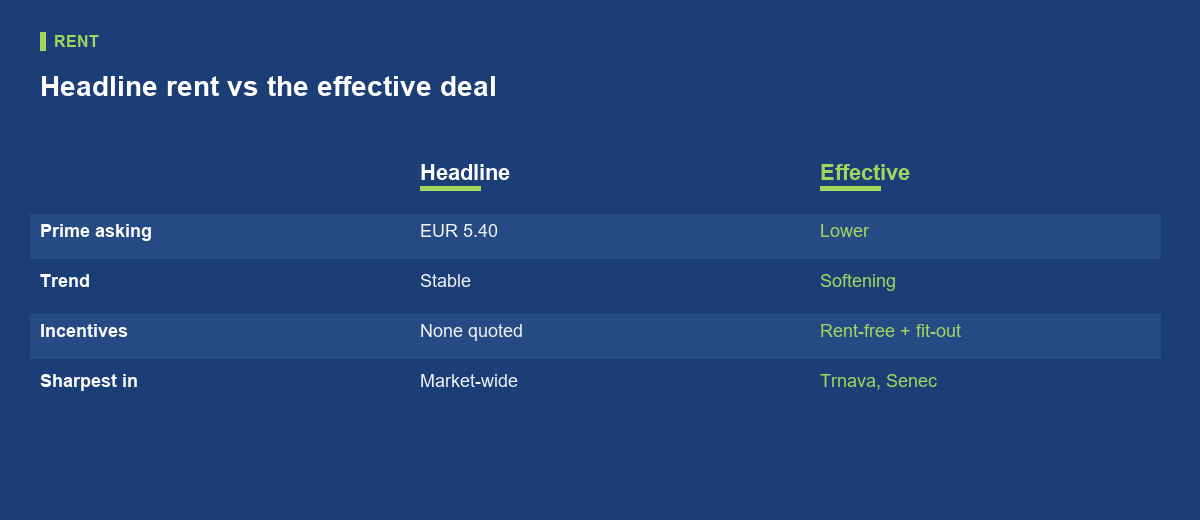
Start with the numbers every negotiation quotes. Cushman & Wakefield’s Slovakia MarketBeat puts prime industrial rent at 5.30 euros per square metre per month in the first quarter of 2026, easing from 5.50 euros in mid-2025 (Cushman & Wakefield). Reviews of the fourth quarter of 2025 still held prime at 5.40 euros, with the average headline rent at 5.07 euros (warehouserentinfo.sk), and 108 Real Estate’s third-quarter report put typical rents between 4.63 and 5.22 euros (Property Forum, 108 Real Estate). Three things follow. First, prime describes a handful of the best units in the best parks around Bratislava, not the market; most occupiers should budget from the average band. Second, the average deal signs well below the prime print, and the distance between the two has widened as vacant space has accumulated. Third, the research houses no longer agree on direction: one prints a falling prime, another a flat one. When the data providers disagree, the market is moving, and everything else in the dataset says it is moving the tenant’s way. The honest anchor for a standard grade-A unit in the west is the band, not the headline. Where a unit lands inside that band depends on age, clear height, power supply and how long it has stood empty, and the last of those is the tenant’s information advantage.

Bratislava versus the regions: where the spread opens up

Slovakia holds about 4.67 million square metres of modern A-class industrial stock, and most of it stands in the west (Property Forum). Bratislava and the Senec node on the D1 set the top of the pricing curve, yet Senec is also where entry rents start lowest: units there have been offered from 3.90 euros per square metre per month, because that is where ready-to-occupy vacant space runs deepest (warehouserentinfo.sk). Across selected locations in the wider market, asking rents of 4.00 to 4.50 euros were typical through 2025 (Q2 2025 market review). The automotive belt of Trnava, Nitra and Zilina prices between those poles, anchored by plant supply chains rather than broad distribution demand, while Trnava and Senec are the two sub-markets where analysts expect further incentive offerings and rent reductions (108 Real Estate). Kosice and the east remain a thinner market: institutional stock is limited and pricing is set deal by deal rather than by a deep leasing market. The practical lesson is that the regional discount is really an availability discount. Rents fall where empty space concentrates, and right now that is the D1 corridor west of the capital, the spine we describe in Cross-Border Logistics Slovakia: CEE’s Pivot Point.

Service charges: the cost that sits on top of the rent

Service charges: the cost that sits on top of the rent

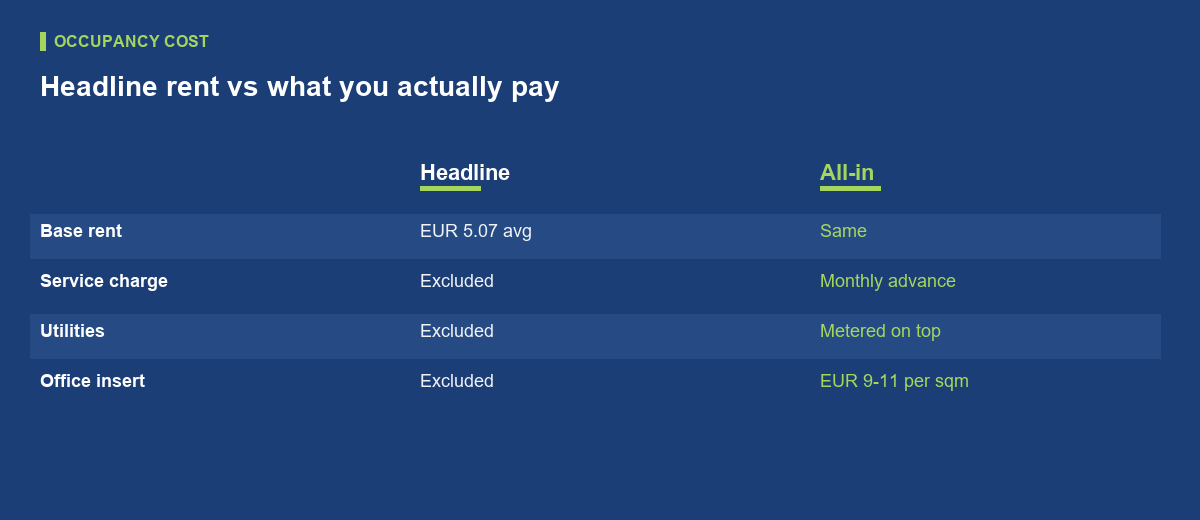
A headline rent is not the cost of occupation. Slovak industrial leases are typically structured as a triple net lease: the tenant pays the base rent, a service charge on top, and its own metered utilities. The service charge funds common-area maintenance, security, landscaping, snow clearing, building insurance and, in many parks, a property tax pass-through, billed as a monthly advance and reconciled once a year against actual costs. Two practical warnings follow. First, no two parks define the charge identically, so two identical headline rents can produce different total occupancy costs; ask for the last full-year reconciliation before comparing offers, not just the current advance. Second, the priced-separately components add up quickly. Integrated office space inside a warehouse unit was quoted at 9.00 to 11.00 euros per square metre per month in 2025, roughly double the warehouse rate, so an occupier fitting a ten per cent office share carries a visibly higher blended rent (Q2 2025 market review). On a five-year term those line items move the true cost per square metre further than the last ten cents of headline rent ever will, so a serious offer comparison carries every column, not the rent alone. Utilities sit outside both rent and service charge, and electricity capacity has become a negotiation of its own for automated operations, a constraint we set out in Industrial Power Capacity in Slovakia.

Incentives and indexation: the deal behind the headline

Incentives and indexation: the deal behind the headline

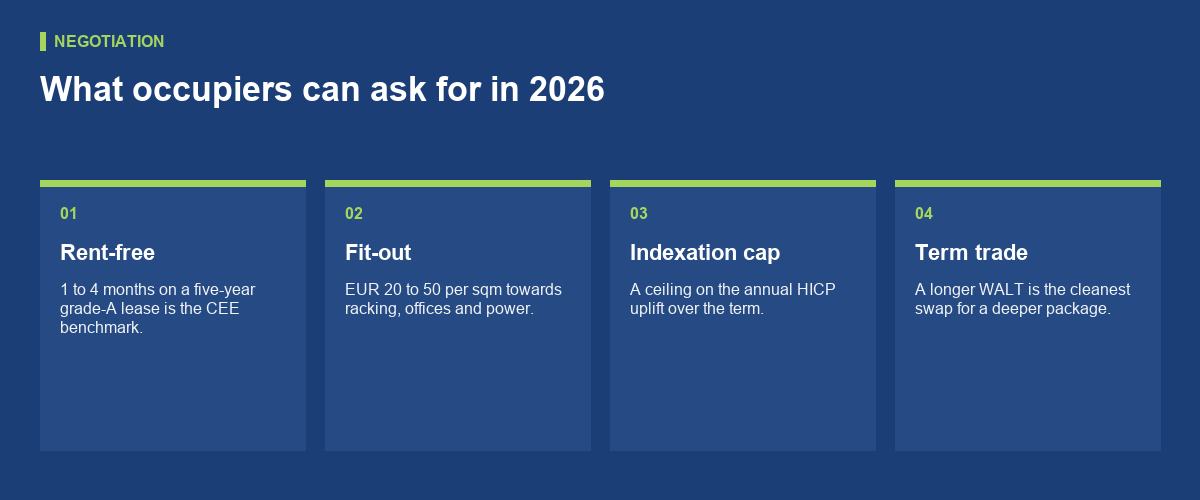
Incentives are where a soft market shows up first, because landlords protect the headline rent and give value away around it. The going CEE benchmark for a five-year grade-A lease is 1 to 4 months rent-free and a fit-out contribution of 20 to 50 euros per square metre, with larger requirements and longer commitments securing better packages (2026 CEE leasing guide). Slovak landlords are inside that range now: analysts tracking Trnava and Senec anticipate further incentives and rent reductions as speculative space completes (108 Real Estate). The arithmetic matters, because three rent-free months on a five-year term cut the effective rent by five per cent before any fit-out money is counted. Indexation is the other quiet lever. Euro-denominated CEE leases typically index annually to the harmonised index of consumer prices (Cushman & Wakefield), and euro-area inflation averaged 2.1 per cent in 2025 (Eurostat). That looks benign after the spike of 2022 and 2023, but uncapped indexation compounds over a term, so a ceiling on the annual uplift is a legitimate ask. Remember what the landlord wants in return: term. A longer commitment lengthens WALT, the income-security measure investors price, and it is the cleanest thing to trade for a deeper package.

What this means for rent negotiations on the D1 in 2026

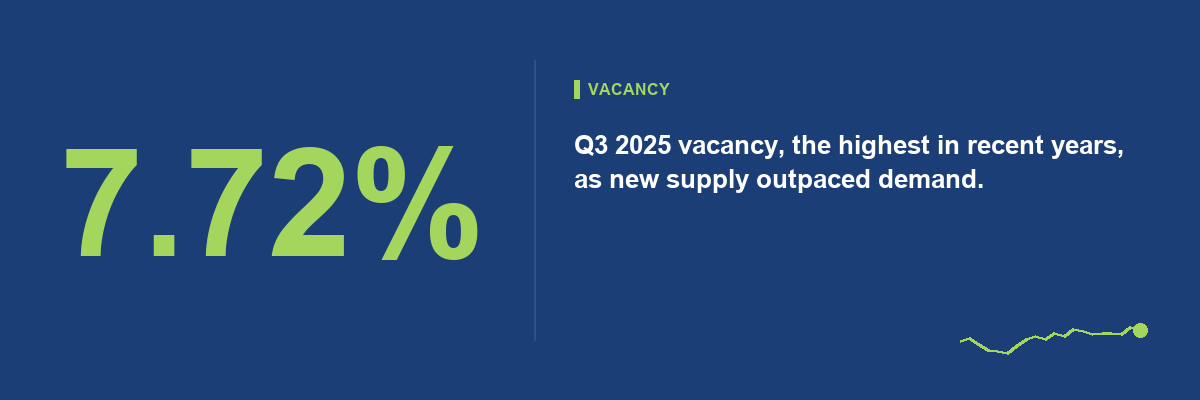
The backdrop is the strongest occupier position in years. Vacancy reached 7.72 per cent in the third quarter of 2025, its highest level in recent years, before a strong final quarter of leasing, 82,496 square metres of net take-up, trimmed it to 7.40 per cent (Property Forum, warehouserentinfo.sk). Supply has not stopped: 311,365 square metres were under construction at the last count, roughly half of it speculative (108 Real Estate). Demand exists but it is selective, and third-party logistics operators took 33 per cent of newly leased space in the final quarter (warehouserentinfo.sk). The negotiating playbook follows from that. Benchmark against the effective rent of recent deals, not the asking rent on the brochure. Put the whole structure on the table at once, rent-free months, fit-out, an indexation cap and break options, because a landlord who will not move on one lever will often move on another. Press hardest where vacancy is deepest, in the Senec and Trnava stretch of the D1. And move while the window is open: speculative completions are still delivering into thin demand through 2026, which is exactly the condition that makes landlords compete. A built-to-suit commitment, by contrast, still prices like a landlord’s product, because bespoke space is financed against your signature.

Conclusion

Industrial rent levels in Slovakia are best read in 2026 as a band, not a number: from 3.90 euros at the accessible end of Senec to a prime print of 5.30 to 5.40 euros depending on who is counting, with the typical western deal signing in between. The headline has barely moved; everything around it has. Service charges deserve scrutiny, incentives are back on the table, indexation can be capped, and landlords along the D1 are competing for credible tenants. Occupiers who price the full structure over the full term will sign better deals than the sticker suggests. That window will not stay open once the speculative pipeline is absorbed.

Negotiating industrial space on the D1 in 2026? Talk to our team about what current rent levels let you ask for.

The Slovak Industrial Property Market in 2026: A Tenant’s Market on the D1

The Slovak industrial property market enters 2026 tilted firmly towards the occupier. After a decade in which warehouses were scarce and rents only rose, vacancy has climbed to its highest level in years, new supply keeps arriving, and landlords in the busiest sub-markets are quietly reducing rents and adding incentives. For a business planning warehouse or production space along the D1 corridor, that shift changes the maths of when to move and what to ask for. This article sets out where the market actually stands in early 2026, with the numbers behind it, and what a tenant-side market means in practice.

How big is the Slovak industrial property market in 2026?

Slovakia has quietly built one of Central Europe’s more substantial logistics bases. By the third quarter of 2025 the country held roughly 4.67 million square metres of modern A-class warehouse and production space, and completions through the rest of the year pushed the total past 4.8 million (Property Forum, Cushman & Wakefield MarketBeat). The stock is heavily concentrated in the west, along the D1 motorway that links Bratislava to Trnava, Nitra and onward to the Czech border. The Bratislava region and the Senec node in particular sit at the centre of the map, close to the capital, the airport and the Austrian and Hungarian borders. Demand has long been anchored by the automotive sector, whose plants and suppliers cluster around Trnava, Nitra and Zilina. For an occupier the practical point is that the useful market is smaller than the national figure suggests: most grade-A space a distribution or light-production tenant would actually consider lies within an hour of Bratislava, which is exactly where the current swing in conditions is most visible. Within that core, the A-cities of the west, Bratislava, Trnava and Nitra, hold the bulk of institutional-grade stock, and the D1 acts as the spine that connects them to the Czech and Austrian markets in a single day’s drive.

Vacancy at a multi-year high

Vacancy at a multi-year high

The clearest signal of the shift is vacancy. In the third quarter of 2025 the national industrial vacancy rate reached 7.72 per cent, described by market analysts as the highest level in recent years (Property Forum). Only a few years ago the same market ran below two per cent, tight enough that tenants took whatever came available. The rise is supply-led rather than a collapse in occupancy: developers kept building into a slowing economy. Around 28,000 square metres were completed in the third quarter alone, and roughly 311,000 square metres were under construction at that point, close to half of it speculative, meaning built without a signed tenant (108 Real Estate). As that speculative space completes into soft demand, vacancy is widely expected to edge higher before it stabilises. For occupiers this is the difference between a market where you accept what exists and one where several landlords compete for your signature. Empty modern units, ready to occupy, are now a normal feature of the western sub-markets rather than a rarity, and that is a structural change in how the market behaves, not a one-quarter blip. It also changes pricing psychology: when a tenant can view three comparable units in a single week, the landlord who holds out for the last euro of rent is the one left with an empty building.

Rents look stable, but effective deals are softening

Rents look stable, but effective deals are softening

Headline rents have not fallen far, which can mislead. Prime asking rent held at about 5.40 euros per square metre per month through 2025, with the market-wide average nearer 5.07 euros (Cushman & Wakefield). The real movement is in what tenants actually pay. Facing weak demand, landlords in the most active locations, particularly Trnava and Senec, have started to offer incentives and reduce rents to keep units filled (Property Forum). Those incentives take familiar forms: rent-free months at the start of a term, a contribution towards fit-out, or a cap on annual indexation. The gap between the headline number and the effective rent, the all-in cost averaged across the lease, has widened accordingly. Two tenants can sign at the same 5.40 euros and pay very different real rates once free months and contributions are counted. For anyone negotiating in 2026 the lesson is to ignore the sticker price and model the effective rent over the full term. That Senec appears by name in the analysts’ commentary matters for the D1 corridor specifically, because it is one of the sub-markets where the balance of power has moved furthest towards the tenant.

Demand is thinner, and automotive-led

Underneath the supply story sits softer demand. Net take-up in the third quarter of 2025 was about 50,615 square metres, from total leasing activity of 64,365, and the second quarter had already recorded the weakest leasing since 2018 (Property Forum). What activity there was leaned heavily on automotive occupiers and stayed concentrated in the Bratislava region. That concentration is a double-edged sword: it keeps the western sub-markets liquid, but it ties the whole market’s fortunes to one cyclical industry at a time when European car production is under pressure. The longer-term supports are still in place. Nearshoring continues to pull supply chains back towards Central Europe, and Slovakia’s position on the regional trade routes remains an asset, a theme we set out in Cross-Border Logistics Slovakia: CEE’s Pivot Point. But those are structural tailwinds measured in years, not the near-term demand that fills a speculative hall this quarter. For 2026 the realistic base case is thin, selective take-up, with occupiers moving when the numbers are compelling rather than because space is scarce. Occupiers with automotive exposure of their own should stress-test their footprint against a slower production schedule, because space that is easy to take in a soft market is equally easy to be left holding when volumes turn.

What a tenant-side market means for occupiers in 2026

What a tenant-side market means for occupiers in 2026

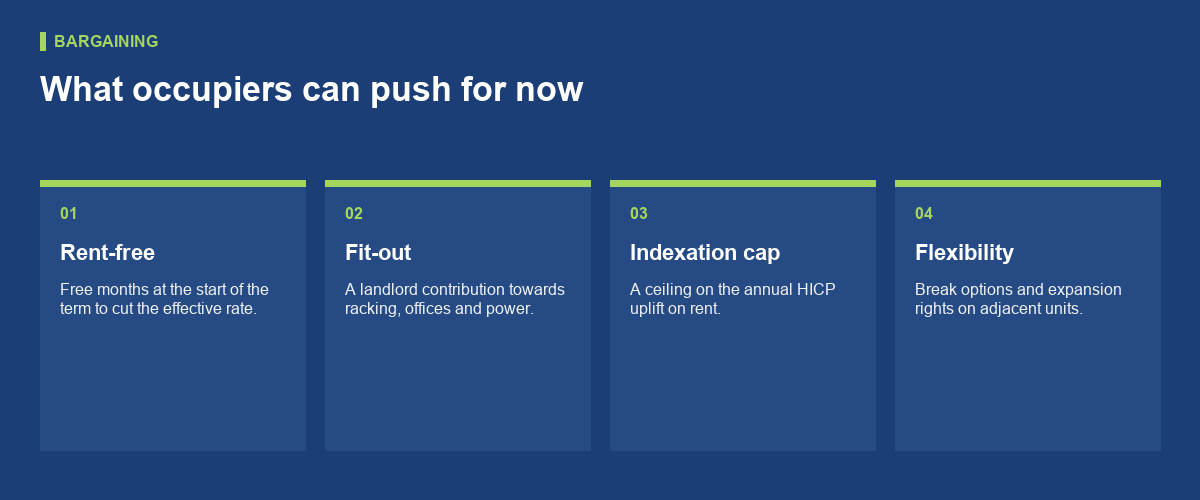
A tenant-side market rewards occupiers who negotiate the whole lease, not just the rent. With vacancy high and landlords competing, the concessions described above, rent-free periods, fit-out contributions, indexation caps and expansion rights, are genuinely on the table for a credible covenant. Two structural points are worth watching. First, on the investment side, buyers value logistics assets partly on their Weighted Average Lease Term (WALT), so a landlord may trade a rent concession for a longer commitment that lengthens income security; an occupier can use that appetite to win incentives in exchange for term. Second, build-to-suit remains a commitment game even in a soft market, because bespoke space is financed against a signed tenant, and one further constraint has grown sharper: grid capacity for power-hungry automation, a point we cover in Industrial Power Capacity in Slovakia. The timing signal for 2026 is simple. Renewals and relocations carry unusual bargaining power right now, and that advantage is strongest exactly where vacancy is highest, including the D1 sub-markets around Senec. Occupiers who prepare, benchmark the effective rent and come with a clear brief will find landlords more willing to move than at any point in the past five years.

Conclusion

Slovakia’s warehouse market has swung from landlord-led to tenant-led faster than most expected. Vacancy sits near a multi-year high, headline rents look stable but effective deals are softening, and demand is thin and automotive-dependent. For occupiers that adds up to bargaining power, the most they have had in years. For developers it is a reminder that in a fuller market, location and building quality decide who fills space and who carries the void. On the D1 at Senec, well-specified, well-managed units still let. The rest of the market is negotiating.

Weighing up warehouse space on the D1 in Slovakia? Talk to our team about what the current market lets you negotiate.

Warehouse Lease Terms in Slovakia: What Occupiers Sign in 2026

Warehouse lease terms in Slovakia are being written in a market that has quietly turned in the tenant’s favour. Prime industrial rents eased to €5.30 per square metre per month in early 2026 while vacancy climbed to 7.72 percent, the highest level in years, and nearly half of the construction pipeline is speculative. In that environment the lease structure, not the headline rent, decides what a building really costs over five or ten years. In this article we walk through term lengths, HICP indexation, service charges, deposits and break options as they are typically agreed in 2026, and show where an occupier has genuine room to negotiate. Written from the perspective of a developer that structures these leases along the D1 corridor every day.

A tenant’s window: where the Slovak market stands in 2026

Slovakia’s industrial market has handed occupiers a rare negotiating window. According to Cushman & Wakefield’s Slovakia MarketBeat, prime industrial rents stood at €5.30 per square metre per month in the first quarter of 2026, down from €5.50 a year earlier, after roughly 105,000 square metres of new space was delivered and vacancy rose to 7.72 percent.

Data from 108 Real Estate fills in the rest of the picture: total grade-A stock of about 4.67 million square metres, average asking rents of €4.63 to €5.22 per square metre, and some 311,000 square metres under construction, almost half of it speculative. More competing space means landlords compete on lease structure before they move the headline rent. Two leases signed at €5.30 can differ by ten percent or more in real cost once indexation, service charges, rent-free periods and reinstatement obligations are counted. The number on the brochure is where the conversation starts; the structure is where the money is.

How long do warehouse leases in Slovakia run?

How long do warehouse leases in Slovakia run?

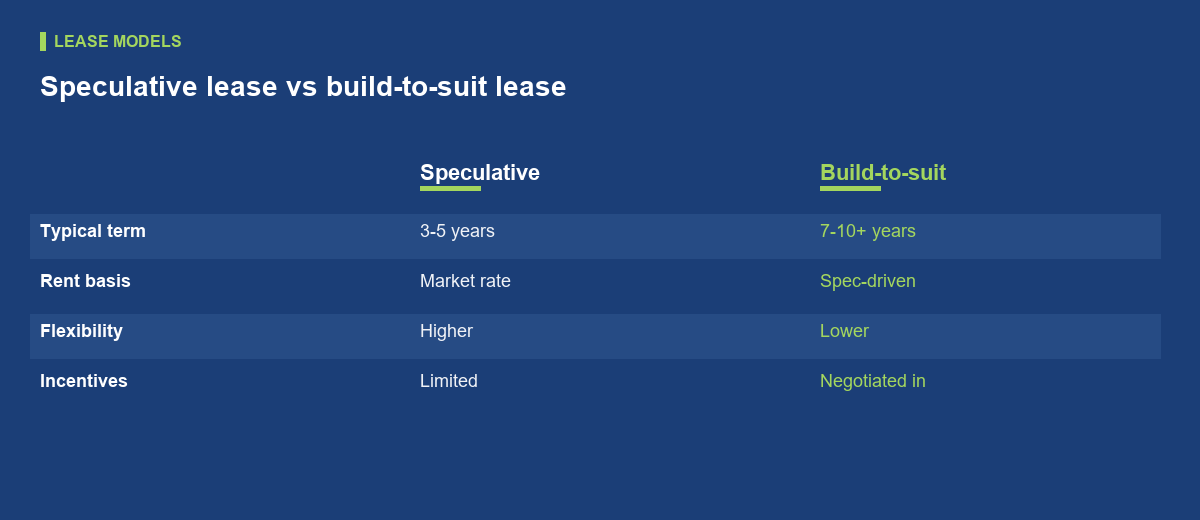
For speculative grade-A space, five years remains the institutional standard, with three-year terms achievable on smaller units and five to seven years common on newly delivered stock, a pattern documented across the neighbouring Czech market and mirrored in Slovak parks. Build-to-suit is different: because the landlord finances a bespoke design, terms of seven to ten years or more are needed to underwrite the investment.

Demand composition explains who signs what. Leasing activity reached 128,800 square metres in the first quarter of 2026, concentrated in the automotive sector around Bratislava, and 108 Real Estate attributes 69.7 percent of demand to producers rather than distributors. Manufacturers bolt equipment to the floor, so they trade flexibility for term, incentives and certainty; distribution operations keep terms shorter and options open. Occupiers planning around power-hungry automation should also check grid capacity early, a constraint we examined in Industrial Power Capacity in Slovakia.

Indexation: how euro-zone inflation flows into Slovak rents

Indexation: how euro-zone inflation flows into Slovak rents

Slovak logistics leases are euro-denominated and indexed once a year, almost always to the harmonised index of consumer prices (HICP) published by Eurostat. Cushman & Wakefield’s guidance on indexation clauses is blunt: the lease should name the exact index and state whether the annual rate or the twelve-month average applies, because vague drafting is what ends up in court.

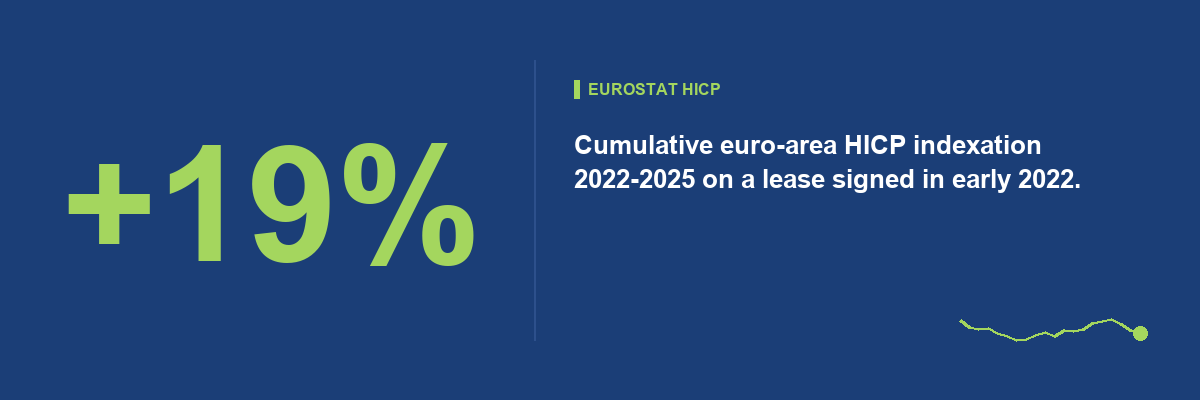
The recent cycle shows why the clause deserves attention. Euro-area HICP averaged 8.4 percent in 2022, 5.4 percent in 2023, 2.4 percent in 2024 and 2.1 percent in 2025. Compounded, a lease signed at the start of 2022 carries roughly 19 percent more rent in 2026 through indexation alone, on an unchanged building. By default the mechanism is uncapped and one-directional: rent follows the index upward and stays flat when inflation falls. The negotiable levers are a cap on the annual uplift, a collar defining both floor and ceiling, or a fixed annual step-up that replaces the index entirely and makes the cash flow fully predictable for both sides.

Service charges and the second line on the invoice

Beside the rent sits the service charge, typically in the range of €0.80 to €1.20 per square metre per month in modern Slovak parks. It usually covers property management, maintenance of common areas and yards, snow removal, landscaping, security, building insurance and the property tax passed through from the landlord. Electricity and gas are metered and billed separately, so an occupier should model them independently, especially for energy-intensive operations.

The detail worth negotiating is transparency. An open-book regime with annual reconciliation against actual costs, or at minimum a cap on the annually chargeable amount, keeps the second line on the invoice predictable. In a market where the headline rent is publicly benchmarked at €5.30, an unmanaged service charge can move total occupancy cost by more than the last round of rent negotiation did.

Break options, deposits and what 7.72 percent vacancy buys you

Break options, deposits and what 7.72 percent vacancy buys you

Security is standard and rarely moves: a bank guarantee or cash deposit covering roughly three months of rent plus service charge, occasionally more for weaker covenants. Break options in short speculative leases remain rare, since the landlord has priced the term into the deal; where they appear, they are paired with a longer overall term and a break penalty.

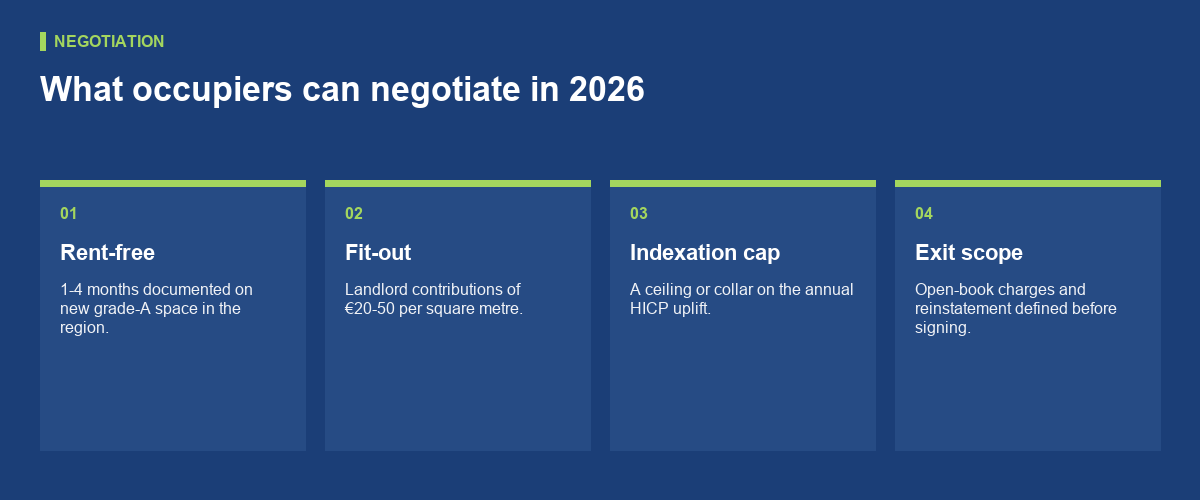
The genuine negotiating space is in incentives, and the current market has widened it. On new grade-A space in the region, one to four months rent-free and fit-out contributions of €20 to €50 per square metre are documented practice, and with vacancy at 7.72 percent and a construction pipeline that is nearly half speculative, Slovak landlords compete on exactly these terms before touching the headline rent. On a five-year lease an occupier can reasonably discuss rent-free months, a fit-out contribution, a cap on indexation, expansion or first-refusal rights on adjacent units, and a clearly defined reinstatement scope at exit. Each of these moves the effective rent; none of them shows up in the brochure.
Conclusion

A warehouse lease is a system, not a price. Term length sets your flexibility, indexation sets the trajectory, service charges set the second line on the invoice, and incentives decide what you actually pay per square metre over the term. The 2026 market, with prime rents easing to €5.30 and vacancy at its highest level in years, gives occupiers more leverage than they have had in this cycle, but windows like this close as speculative space is absorbed. As we argued in Cross-Border Logistics Slovakia: CEE’s Pivot Point, the location decides your operating cost; the lease decides what you pay for it. Negotiate the structure while the market is listening.

Looking for the right industrial space on the D1 in Slovakia? Talk to our team.

Cross-Border Logistics Slovakia: CEE’s Pivot Point

Cross-border logistics in Slovakia’s CEE position is no accident of geography, it is the product of three converging forces: the EU single market eliminating customs friction, a motorway spine that runs from Vienna to the Ukrainian border, and a national footprint small enough that a single distribution hall can reach four major industrial economies within one driver’s shift. According to Cushman & Wakefield’s H1 2025 CEE Investment Market Update, Slovakia posted a 315% year-on-year surge in commercial real estate investment volume, driven overwhelmingly by industrial transactions. This article unpacks why Germany, Austria, Hungary, and Poland are the demand engine, and why Slovakia is the operational answer.

Why Cross-Border Logistics in Slovakia Outperforms a Multi-Country Footprint

The conventional argument for Slovakia as a logistics hub starts with land cost. That argument misses the more durable structural advantage: operating from one Slovak location eliminates the compliance overhead of maintaining separate warehouse leases, labour contracts, and customs declarations across four jurisdictions.

Inside the EU single market, goods move without border checks, but a multi-country footprint still multiplies administrative touch-points: separate VAT registrations, differing national transport regulations, fragmented carrier contracts, and duplicated safety stock per country. Consolidating into one cross-border logistics node in Slovakia collapses those layers into a single operational entity.

The dwell-time argument is equally sharp. In a fragmented network, each national hub adds a load-unload cycle, a transit day, and a handoff between carriers. A centralised Slovak node serving Germany, Austria, Hungary, and Poland replaces four overnight line-haul legs with direct outbound routes, typically reducing total cycle time by one to two days on the DE-AT-HU-PL matrix. For manufacturers running just-in-time replenishment or e-commerce operators chasing next-day SLAs, that compression is material.

The investment market has noticed. According to Cushman & Wakefield, industrial and logistics properties account for up to 58% of total investment volume in Slovakia, the highest sectoral concentration in the CEE region. That skew reflects occupier demand, not speculative development: tenants selecting Slovakia are making an operational, not a financial, decision first.

Three TEN-T Corridors Through One Country

Three TEN-T Corridors Through One Country

Most logistics markets sit on one or two Trans-European Transport Network corridors. Slovakia sits on three, a structural fact that shapes every distribution network model operating in Central Europe.

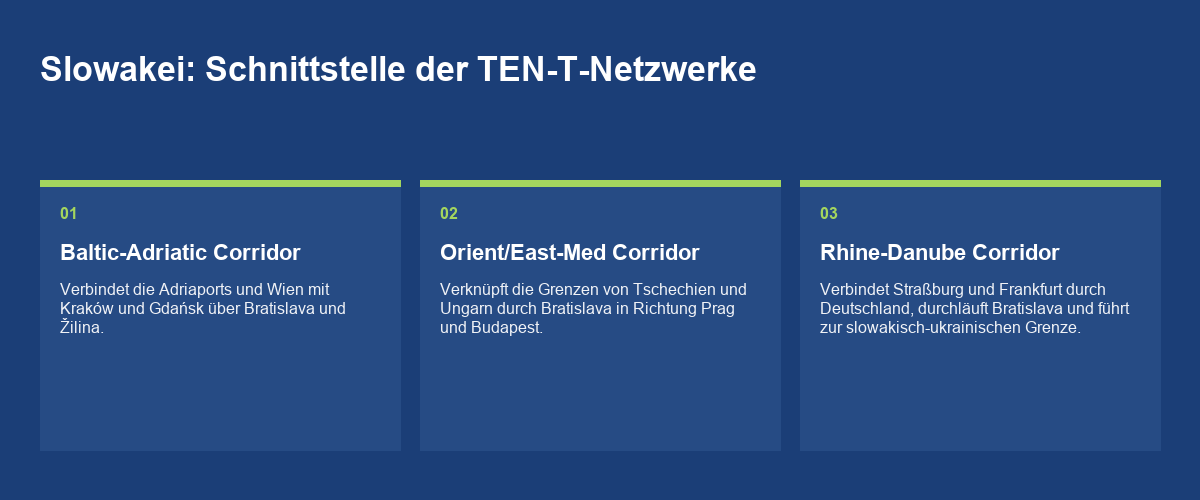
The Baltic-Adriatic Corridor runs between the Austrian and Polish borders via Bratislava and Žilina, connecting the Adriatic ports and Vienna with Kraków and Gdańsk. The Orient/East-Med Corridor links the Czech and Hungarian borders through Bratislava, threading northward toward Prague and southward toward Budapest and the Balkans. The Rhine-Danube Corridor connects Strasbourg and Frankfurt through southern Germany, entering Slovakia via Vienna and continuing east toward Budapest, and, via a northern branch through Žilina, all the way to the Slovak-Ukrainian border.

As the European Commission confirms, more than 700 km of Slovakia’s rail network belongs to TEN-T Core Network Corridors, all converging on Bratislava. This is not a coincidence of route-planning; it reflects Slovakia’s position as the natural switching point between the Rhine-Main-Danube axis and the north-south Baltic-Adriatic spine.

For logistics operators, three overlapping corridors mean redundancy. If one route faces congestion or infrastructure works, alternative corridor capacity exists within the same national perimeter. That operational resilience is rarely priced into location decisions, but it should be.

The EU is investing heavily to maintain and expand this advantage. The CEF Transport programme for 2021–2027 carries a total budget of €25.8 billion, with Slovakia explicitly named among priority cohesion countries receiving rail and road upgrades.

Dwell Time, Customs Design, and the Hidden Cost of a Wrong Location

The cost competition in CEE logistics real estate tends to focus on headline rent per square metre. That framing obscures where the real money is lost: dwell time and customs processing, the hours or days a load sits stationary between origin and delivery.

Inside the EU customs union, Slovakia offers a frictionless transit environment for goods moving between Germany, Austria, Hungary, and Poland. There are no border formalities, no phytosanitary checks, no certificate-of-origin requirements for intra-EU freight. A truck departing Bratislava’s western fringe can reach Vienna in under an hour, Budapest in under two, and cross into Poland via the D1-D3 interchange at Žilina within three. That radius, four national markets, one fuel stop, is the operational logic behind the Slovak hub model.

The underappreciated design variable is yard configuration. A cross-border distribution hub handling four destination markets simultaneously needs sufficient dock capacity and maneuvering depth to run simultaneous inbound and outbound waves without creating yard congestion. Facilities that optimise for a single national market often lack the dock ratio and trailer parking depth to absorb multi-directional flows. This is the specification gap that separates a general-purpose warehouse from a genuine cross-border logistics node.

Customs-readiness is a secondary consideration for intra-EU flows, but matters immediately for any tenant handling third-country goods (UK post-Brexit, or goods originating in Asia or the Americas). Slovakia’s Customs Administration operates within the EU Customs Union framework, and proximity to Vienna International Airport adds air-freight inbound capability for time-sensitive components destined for onward road distribution across the DE-AT-HU-PL quadrant.

Companies evaluating sites should model total landed cost per pallet delivered, not rent per square metre. The differential frequently inverts the apparent cost advantage of a cheaper but less connected location.

Nearshoring Demand and the Structural Pull on Slovak Industrial Space

The supply chain disruptions of 2020–2022 triggered a structural reassessment of production geography across European corporates. The pattern that has emerged, nearshoring manufacturing and regional distribution closer to end-consumer markets, has created sustained occupier demand across CEE, with Slovakia positioned to absorb a disproportionate share.

Savills’ Autumn 2025 European Real Estate Logistics Census notes that occupiers are increasingly favouring CEE markets, whether for nearshoring purposes or as end-consumer markets in their own right, with the Czech Republic and Poland drawing the highest stated new-entrant interest. Slovakia sits downstream of that trend: it captures manufacturing and assembly operations that serve the same four-country distribution perimeter described above.

The automotive sector illustrates the dynamic most clearly. Slovakia hosts a disproportionately large automotive manufacturing base relative to its population. Component suppliers and finished-goods logistics operators serving those plants require cross-border inbound from German Tier-1 suppliers and cross-border outbound to Hungarian and Polish assembly lines, precisely the multi-directional flow that a centrally located Slovak hub handles efficiently.

Beyond automotive, Savills’ Q2 2025 European Logistics Outlook highlights that food and beverage, pharmaceutical, and defence-related manufacturing occupiers have been especially active across CEE. Each of those sectors carries temperature, security, or regulatory requirements that favour dedicated, purpose-built facilities over multi-tenant commodity space, and that preference aligns with the build-to-suit and design-build procurement models available at established Slovak logistics parks.

For institutional investors, nearshoring demand translates into longer lease terms and higher tenant covenant quality. That combination is driving the rerating of Slovak industrial assets visible in H1 2025 transaction volumes.

What Occupiers and Investors Should Scrutinise Before Signing

Slovakia’s structural case is compelling, but location within Slovakia matters as much as the country-level argument. The DE-AT-HU-PL distribution thesis works only if the facility sits on or near the D1 motorway corridor, where road access to all four markets is direct and uninterrupted.

Sites away from the D1, particularly in central or eastern Slovakia, add transit time toward Austria and Hungary that partially undermines the single-hub logic. A 90-minute detour to reach the Austrian border negates much of the dwell-time advantage described above. The D1 corridor around Bratislava and the Senec area represents the densest concentration of established logistics infrastructure in the country, with 3.1 million people accessible within 60 minutes and 6.4 million within 90 minutes, a catchment that spans both Slovakia and adjacent Austrian and Hungarian population centres.

Occupiers should also evaluate intermodal access. The Rhine-Danube and Orient/East-Med rail corridors converge on Bratislava, and intermodal terminals at Dunajská Streda and the wider Bratislava agglomeration provide rail-to-road transfer capability for high-volume flows. For operators running weekly block trains from German production sites, rail inbound combined with road outbound distribution is a material cost-reduction lever, but only if the facility is within practical docking distance of those terminals.

ESG compliance is the final variable that is reshaping location decisions. According to Savills’ Autumn 2025 Census, 88% of logistics occupiers now rate ESG regulation as an important factor in real estate decisions. Facilities that already carry BREEAM or DGNB certification, solar roof capacity, and EV charging infrastructure reduce the occupier’s own decarbonisation cost, and increasingly, that drives lease preference over marginal rent differences. The D1 Park Senec development land and adjacent Slovak logistics infrastructure are being designed with these specifications in mind.

Conclusion

Slovakia’s case for cross-border logistics in the CEE region rests on three interlocking pillars: EU customs-union frictionlessness, three converging TEN-T corridors, and road-time access to four major industrial economies within a single driver’s working day. The investment market has validated this thesis, Slovak industrial real estate recorded a 315% year-on-year investment surge in H1 2025, per Cushman & Wakefield, driven by occupiers making operational rather than purely financial decisions. For corporate real estate teams, site selectors, and institutional investors building logistics exposure in Central Europe, the key question is not whether Slovakia belongs in the network design, it is where within Slovakia, and with what specification, to extract the full distribution advantage.

Contact the IPEC Group team to assess distribution requirements and available logistics space along the D1 corridor.

Related Reading

Industrial Power Capacity in Slovakia: The New Site-Selection Constraint

Grid capacity has quietly overtaken land cost as the binding constraint on industrial site selection in Slovakia. A wave of EV and battery manufacturing investment — led by projects such as the Gotion-InoBat site in Šurany — is placing unprecedented MVA demand on a transmission network whose upgrade timelines are measured in years, not months. This article unpacks why industrial power capacity in Slovakia is now priced into land values before a single shovel breaks ground, what the SEPS coordination process actually means in practice for developers, and how the market is already sorting itself between sites that have secured capacity reservations and those that have not.

Why Industrial Power Capacity in Slovakia Has Become the Decisive Variable

Why Industrial Power Capacity in Slovakia Has Become the Decisive Variable

For most of the past decade, site-selection decisions in Slovakia’s industrial corridors turned on three familiar variables: motorway proximity, labour cost, and land price. Power was an afterthought — a line item the utility would sort out within a few months of a planning application.

That assumption is no longer valid. New EV plants require roughly 60% more electricity than their conventional predecessors, and battery gigafactories operate at power intensities that would have been associated with smelters a generation ago. At the same time, Slovakia’s distribution zones are absorbing the cumulative load of a manufacturing boom that has added millions of square metres of modern industrial stock.

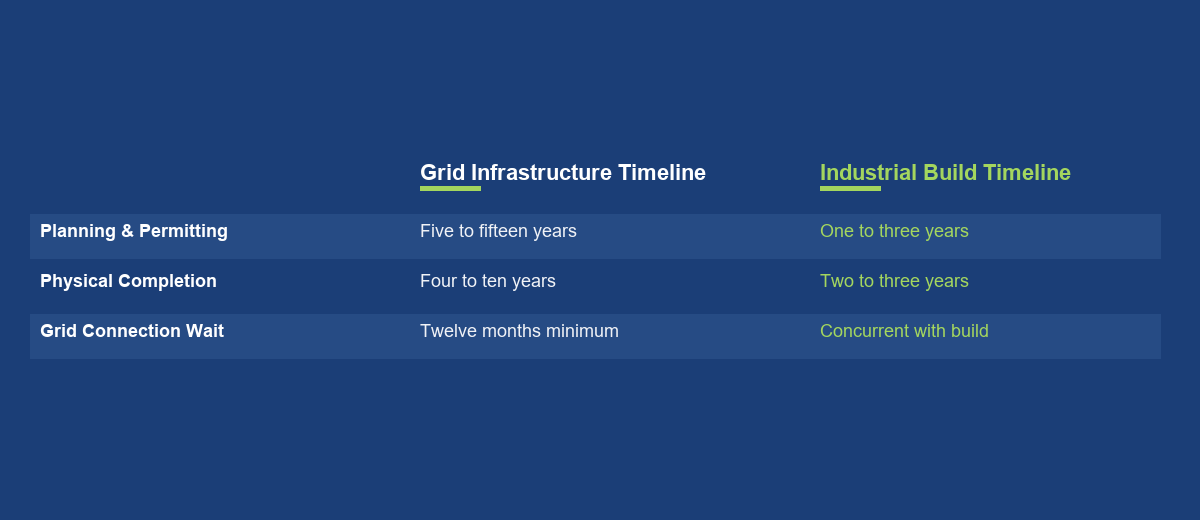
The structural problem is timing. According to the IEA’s Electricity 2026 report, planning, permitting, and completing new grid infrastructure can take anywhere from five to fifteen years — while the industrial facilities being built to connect to it are completed in one to three years. That gap is not a Slovak peculiarity; it is a Europe-wide misalignment. But Slovakia feels it acutely because the pace of new high-voltage demand arrivals — automotive, battery, and logistics combined — has compressed the queue on a grid that was not dimensioned for simultaneous greenfield mega-loads.

The result: power availability is now screened in the earliest phase of site feasibility, ahead of land tenure and labour catchment. Developers who cannot demonstrate a credible MVA reservation increasingly find that institutional tenants will not sign heads of terms, regardless of how competitive the rent or how direct the motorway access.

The SEPS Queue and What a Capacity Reservation Actually Costs

SEPS — Slovenská elektrizačná prenosová sústava — operates Slovakia’s high-voltage transmission backbone and is the first port of call for any industrial connection above distribution voltage. The practical reality facing developers is that a formal grid connection request triggers a multi-stage technical study process at SEPS and the relevant distribution system operator, with lead times that industry practitioners report stretching well beyond twelve months for larger loads before any physical work begins.

The European Commission’s December 2025 Guidance on efficient grid connections (C(2025) 8473) acknowledges the structural cause directly: “lack of physical grid capacity has been quoted as a prominent reason behind grid connection queues”, driven by the mismatch between infrastructure construction times of four to ten years and demand-side connection timelines of two to three years. As of mid-2025, at least 16 EU Member States face grid connection queues — Slovakia among them.

For developers, the financial implication is direct. Securing a capacity reservation requires early-stage capital commitment: connection studies, substation design fees, and in some cases co-financing of upstream grid reinforcement. Sites where a developer has already absorbed these costs — and holds a dated, documented MVA reservation — carry a structural premium over undeveloped plots nearby. The reservation is, in effect, a licensed monopoly on scarce infrastructure for the term of the agreement. Industrial plots with strong power infrastructure have seen values appreciate by 35–45% between 2023 and early 2026, a trajectory that reflects power scarcity as much as land scarcity.

The Transmission-Distribution Interface: Where Projects Stall

The Transmission-Distribution Interface: Where Projects Stall

Most commentary on grid constraints focuses on the high-voltage transmission tier — the 400 kV and 220 kV lines managed by SEPS. The less-discussed bottleneck sits one level down: the 110 kV distribution interface, operated by the regional DSOs. This is where the majority of industrial connections physically land, and where technical study backlogs are most acute for loads in the 5–50 MVA range typical of logistics halls, automotive component plants, and mid-scale battery module assembly facilities.

A project that obtains a positive SEPS feasibility opinion can still stall at the DSO stage if the nearest 110/22 kV substation lacks available transformer capacity. Upgrading or extending that substation — a project the DSO must programme, permit, and fund — follows its own multi-year timeline. The EU’s broader grid investment picture signals the scale of the challenge: with 40% of Europe’s distribution grids over 40 years old, and EU electricity consumption expected to rise by around 60% by 2030, the investment requirement across the continent is estimated at €584 billion.

For Slovakia specifically, the IEA’s 2024 country review flagged that while some infrastructure bottlenecks have recently been removed, “more effort is needed to simplify, streamline and accelerate approval and permitting processes.” That is diplomatic language for a structural drag that developers operating on two-year build programmes cannot simply wait out.

The practical implication for site selection: proximity to a recently upgraded or over-built substation — one with headroom — is now a material differentiator in Slovakia’s industrial land market, on a par with motorway junction distance.

How Developers Are Pricing the Premium — and Who Gets Left Behind

A two-tier market is forming. On one side: industrial parks and build-to-suit plots where the developer has invested in early-stage grid engagement, secured a documented capacity reservation, and — in some cases — co-funded substation upgrades to create a site-wide power envelope that can be parcelled across multiple tenants. These sites command premium land values and shorter lease-up timelines because they remove the single greatest risk that a corporate occupier faces in Slovakia today: the risk of completing a building and then waiting twelve to twenty-four months for a grid connection.

On the other side: opportunistic land positions assembled without power due diligence. These may offer attractive headline prices, but sophisticated tenants — particularly automotive-tier suppliers and logistics operators running automated dark warehouses — are disqualifying them at the earliest stage of site scoring.

Slovakia’s industrial market added 4.6 million square metres of modern warehouse stock, but the distribution of viable power-ready sites within that stock is far from uniform. The Cushman & Wakefield H1 2025 CEE investment report confirms that industrial real estate accounted for 58% of total Slovak investment volume in H1 2025, with Slovakia’s investment volume reaching €536 million — a year-on-year increase of 315%. That capital is increasingly discriminating: acquirers and occupiers are underwriting power capacity alongside yield and lease term. Developers who cannot provide a clear answer to “how many MVA, reserved to when, and under what conditions” are losing mandates to those who can.

The build-to-suit segment is adapting fastest. Chinese investors — active in Slovakia’s battery corridor — frequently opt for build-to-suit deals rather than standard lease agreements, and their technical briefs now open with power specifications, not floor-plate dimensions.

Nuclear Baseload and the Medium-Term Outlook for Industrial Consumers

Slovakia’s power supply profile offers one structural advantage that developers should factor into medium-term positioning. Nuclear energy accounts for close to two-thirds of the country’s electricity generation, providing baseload reliability that markets with higher renewable penetration cannot match on a 24/7 basis. The Mochovce 3 unit — 471 MWe — reached successful completion in 2023. Mochovce 4, an additional 471 MWe unit, was expected to connect to the grid in 2025, adding meaningful national generation capacity.

For energy-intensive industrial tenants — battery module assembly, automotive painting lines, data-centre-adjacent logistics — baseload reliability and predictable off-peak pricing are operational requirements, not ESG talking points. Slovakia’s nuclear-weighted generation mix positions it ahead of coal-heavy peers in the region when corporate tenants are assessing long-run energy cost and carbon footprint under EU taxonomy frameworks.

The medium-term constraint, however, is not generation adequacy — it is transmission and distribution throughput. Slovakia’s overall electricity consumption is set to grow with the electrification of manufacturing, and delivering on energy and climate targets requires the timely expansion of robust transmission and distribution systems. Generation capacity alone cannot resolve a connection queue. The pipeline of grid reinforcement projects — and the permitting timelines attached to them — will determine whether Slovakia’s low-carbon generation advantage translates into a genuine competitive edge for industrial occupiers, or whether that advantage is stranded behind a congested interconnection queue.

Developers and investors watching this space should track SEPS’s ten-year network development plan alongside property fundamentals. The two documents, read together, tell the real story of where industrial power capacity in Slovakia will be available — and on what timeline.

Conclusion

Grid capacity has become the hidden yield driver in Slovakia’s industrial property market. Sites with documented MVA reservations command a structural premium; sites without them face tenant attrition regardless of location or specification quality. The asymmetry will widen as EV and battery manufacturing demand accelerates and the infrastructure gap — measured by the IEA in decades, not years — remains only partially closed. For institutional investors, developers, and corporate occupiers, the actionable implication is clear: power due diligence must begin at site origination, not at planning consent. The developers who understood this earliest are already pricing the new market. Contact IPEC Group to discuss how power capacity is assessed and secured in the site-selection process.

Contact IPEC Group to discuss power-ready industrial sites and the grid due diligence process in Slovakia.

Related Reading