
Rent gets negotiated to the second decimal place and service charges are argued line by line, but warehouse energy costs usually arrive on a separate invoice from a separate company and nobody in the property team ever sees them. That is a mistake worth about fifteen per cent of the rent. Slovakia has quietly become one of the more expensive places in Central Europe to run an electric load, while its gas remains cheap, and that combination decides more about your next building than the headline rent does. Here is the arithmetic, from official price data, and what it changes.
Where warehouse energy costs actually land per square metre
Start with consumption, because nobody publishes it for Slovakia. The best public measurement of what a warehouse actually uses comes from the British statistics office: ND-NEED 2024 reports metered consumption for England and Wales in 2022, and puts the median warehouse at 26.59 kilowatt hours of electricity and 54.74 kilowatt hours of gas per square metre a year, across roughly 75,000 and 20,000 buildings respectively. Both figures have fallen by about a quarter since 2012, mostly through lighting. A cold store or a heavily automated hall sits well above those medians.
Now apply Slovak prices. In the second half of 2025, Eurostat puts industrial electricity for a mid-sized consumer, the band from 500 to 1,999 megawatt hours a year, at EUR 0.2090 per kilowatt hour excluding recoverable taxes, and gas for the comparable band at EUR 0.0731. Multiply through and a Slovak hall spends roughly EUR 5.56 per square metre a year on electricity and EUR 4.00 on gas. Together that is EUR 9.56 a year, or EUR 0.80 per square metre per month.
Set that against a prime rent of EUR 5.30 per square metre per month in the first quarter of 2026 and the energy bill is fifteen per cent of the rent line. It is not a rounding error and it is not in your rent review. The combination is ours: British medians on Slovak prices, offered as an order of magnitude rather than a measurement of your building.
Why the electricity side is the expensive one
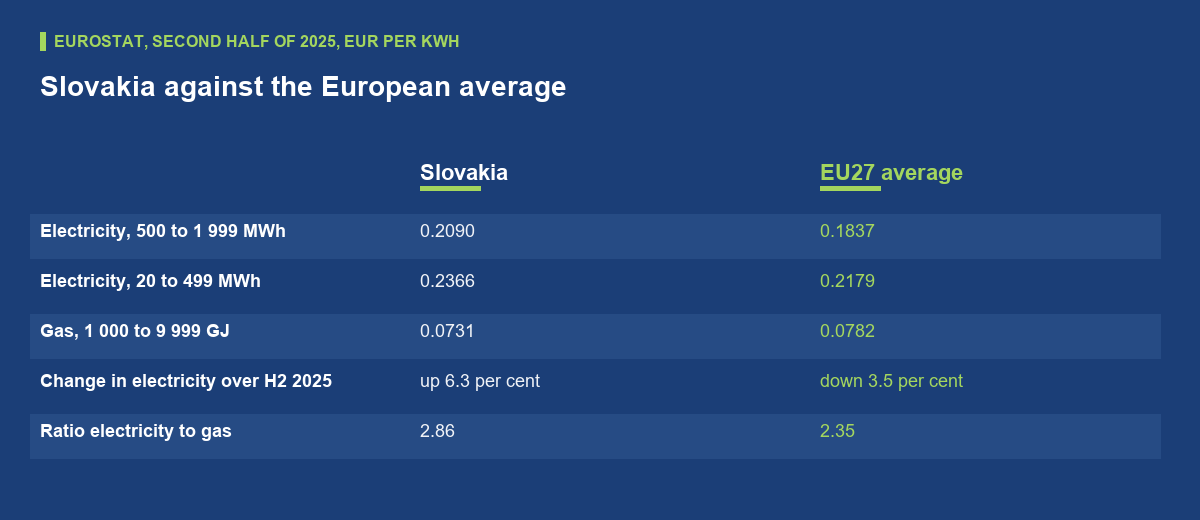
The interesting part is not the total, it is the split. On the same Eurostat series, second half of 2025, Slovakia sits at EUR 0.2090 per kilowatt hour against Czechia at 0.1825, Poland at 0.1915, Austria at 0.1986 and an EU average of 0.1837. Only Hungary at 0.2132 and Germany at 0.2264 are dearer. Slovak industry pays about fourteen per cent more for a kilowatt hour than the European average and about the same premium over its Czech neighbour.
The direction matters more than the level. In the first half of 2025 Slovakia was at 0.1967 and the EU average at 0.1903, a gap of three per cent. Over the next six months the Slovak price rose 6.3 per cent while the EU average fell 3.5 per cent. The smaller consumption band, 20 to 499 megawatt hours, did the same thing: Slovakia up from 0.2200 to 0.2366 while the EU average fell from 0.2291 to 0.2179. Two bands, one direction, and it is the opposite of everyone else.
Part of that is regulated rather than traded. The regulator amended its decree in November 2025 and the regulated commodity price moves from 61 to 104 euros per megawatt hour for 2026, with a discounted rate of 72.70 for the protected segment, and distribution and system tariffs added on top in separate proceedings. A large industrial supply is bought on the market, not at that price, but the regulated components sit in every bill.
The gas side tells the opposite story
Gas is where Slovakia looks good. On the Eurostat gas series for the 1,000 to 9,999 gigajoule band, second half of 2025, Slovakia is at EUR 0.0731 per kilowatt hour against an EU average of 0.0782 and Austrian and Polish prices of 0.0793 and 0.0776. Only Czechia at 0.0715 and Hungary at 0.0626 are cheaper. A Slovak occupier heating a hall with gas is paying below the European average to do it.
Put the two together and you get the number that actually matters, which nobody quotes: the ratio. In Slovakia a kilowatt hour of electricity costs 2.86 times a kilowatt hour of gas. In Czechia the ratio is 2.55, in Poland 2.47, in Austria 2.50, and across the EU 2.35. Only Hungary, at 3.41, is more lopsided. Slovakia is not an expensive energy market. It is a market with an unusually wide spread between the two media.
That spread is why the same building costs different money in different countries even at identical consumption. Run the same hall in Czechia and the annual bill is EUR 8.77 per square metre against EUR 9.56 in Slovakia. On 10,000 square metres that is about EUR 7,900 a year, roughly what 125 square metres of prime space costs to rent. Small on its own, permanent over a ten-year term.
What the ratio does to every electrification project
Now the part that turns a price table into a decision. Every regulatory push in front of you moves energy from the cheap medium to the expensive one. The European Commission defines a zero-emission building as one that “has no on-site carbon emissions from fossil fuels and a very high energy performance”, mandatory for new public buildings from 1 January 2028 and for all new buildings from 1 January 2030. Certificates are tightening on the same schedule, and automation adds electric load to a building that used to be mostly empty air.
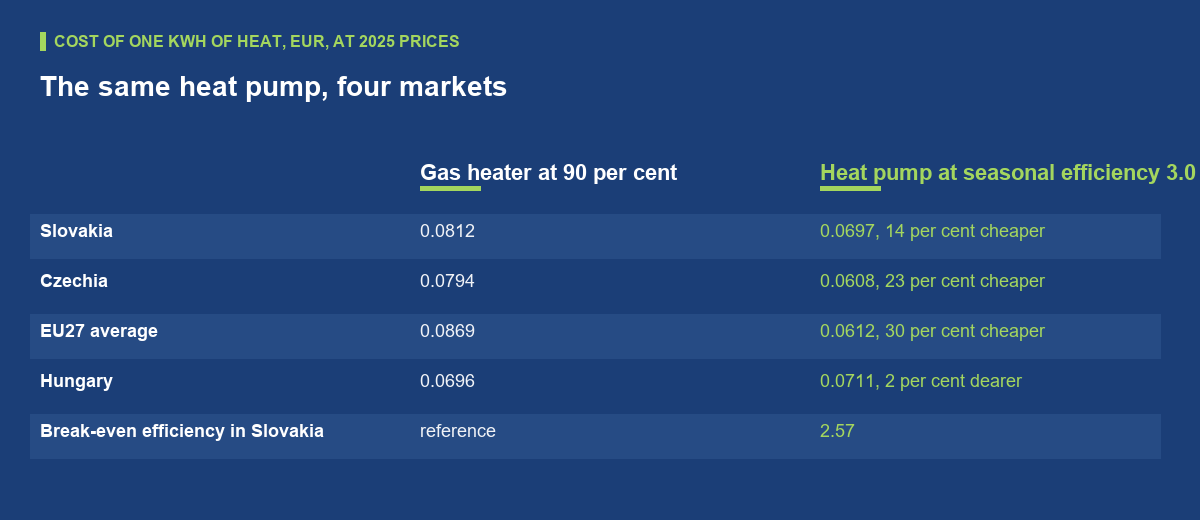
So price the swap. A gas heater at ninety per cent efficiency delivers a kilowatt hour of heat for EUR 0.0812 at Slovak prices. A heat pump at a seasonal efficiency of 3.0 delivers the same kilowatt hour for EUR 0.0697. The heat pump wins, by fourteen per cent. Run the identical machine on Czech prices and it wins by 23 per cent, on the EU average by 30 per cent, and on Hungarian prices it loses by two per cent. Same equipment, same physics, different answer, purely because of the ratio.
The practical form of that is a threshold. In Slovakia a heat pump has to beat a seasonal efficiency of 2.57 to be cheaper to run than the gas heater it replaces. At the EU average, 2.11 is enough. If the machine you are being offered is quoted at 2.8 on a test bench, a Slovak winter in a badly sealed hall will spend that margin. Ask for the seasonal figure at the design temperature, in writing, before the payback slide.
What to put in the lease before any of this matters
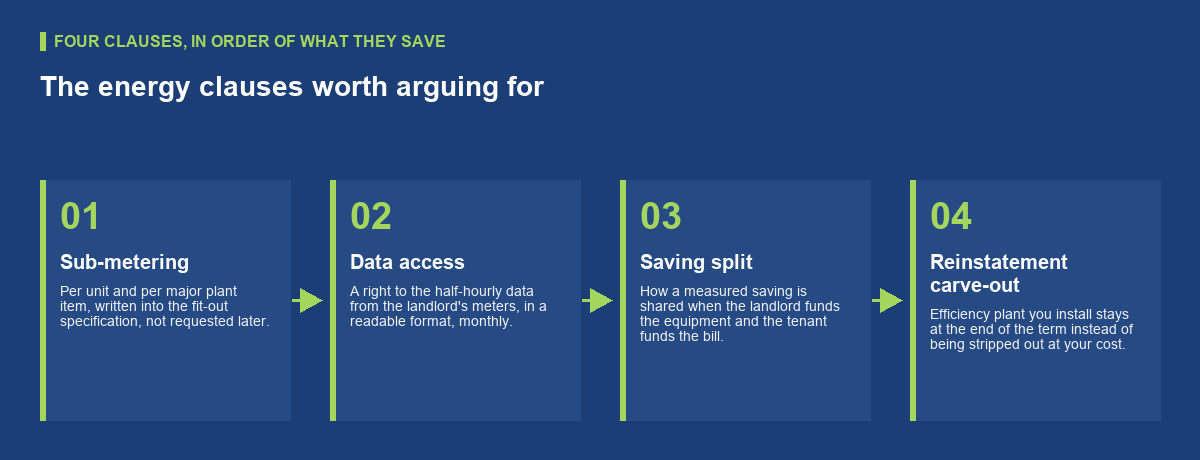
Most of this is decided by documents rather than by equipment. First, metering. If the hall is not separately metered for power and heat, the service charge becomes the only mechanism you have, and the full breakdown of that charge is a different argument with a different counterparty. Sub-metering per unit and per major plant item is cheap at fit-out and impossible to retrofit cheaply.
Second, who owns the improvement. If the landlord pays for the roof and you pay for the power, a rooftop array or a heat pump saves the tenant money and improves the landlord’s asset. That split is the classic reason nothing happens. A green lease clause that lets the landlord recover part of a measured saving is the usual fix, and it is far easier to write at heads of terms than at year four.
Third, the term. Retrofit economics need years, and a certified building carries its own value into the taxonomy tests that lenders apply. With vacancy at 7.72 per cent and renegotiations running at 54 per cent of demand, landlords are competing. Clauses that cost the landlord no cash today are the ones a tenant wins, and they change the effective rent more reliably than another ten cents off the headline.
Conclusion
Slovakia is not an expensive place to heat a warehouse. It is an expensive place to run one on electricity, and the gap widened in the same half-year in which the rest of Europe got cheaper. That matters because every rule now in front of occupiers moves load from gas to power. The projects still pay in Slovakia, but with roughly half the margin the European average would give you, so the assumptions have to be checked rather than accepted. Ask for the meter data before the payback model, and ask for the metering clause before the machine.