The 3PL Decision: Outsourcing Logistics vs Leasing Your Own Slovak Warehouse

Every growing occupier in Slovakia eventually faces the same fork: hand the operation to a 3PL, or lease a warehouse and run it yourself. The market data says both camps are busy – logistics providers signed almost a third of all Slovak industrial leases in the first quarter of 2026, which means outsourcing demand is ultimately paying for much of the country’s shed space either way. The fork is not ideological; it is arithmetic plus honesty about your own operation. This article lays out what each route costs, where the commitments differ, and the four questions that settle the choice more reliably than any benchmark.

What the first quarter of 2026 says about the outsourcing wave
What the first quarter of 2026 says about the outsourcing wave

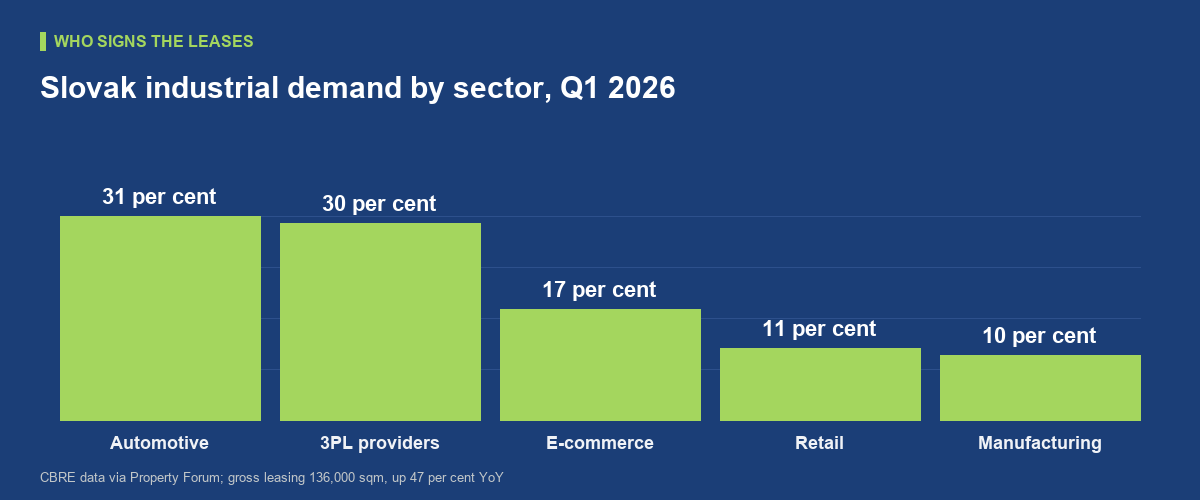
The demand mix is the headline. Of the 136,000 square metres of gross leasing recorded in the first quarter of 2026 – up 47 per cent year on year – automotive companies took 31 per cent and logistics providers 30 per cent, ahead of e-commerce at 17, retail at 11 and manufacturing at 10 per cent (CBRE data via Property Forum). Read that carefully: nearly a third of the space leased in Slovakia is signed by operators whose business is running other companies’ logistics. When a retailer outsources, its volumes do not leave the market – they reappear inside a provider’s shed. The occupier’s real choice is who signs the lease, not whether space gets used. Conditions currently favour whoever does sign: vacancy stands at 8.12 per cent nationally – from 10.27 per cent in Western Slovakia down to 2.66 per cent in the East – the average rent has softened 6 per cent year on year to EUR 4.55 per square metre per month, and more than half of all activity is renegotiation rather than relocation. A tenant-friendly market cuts both ways in this decision: your own lease is cheaper to sign than it was, and so is your provider’s – which is worth remembering when the quote arrives.

What a 3PL contract actually costs – and how it is priced

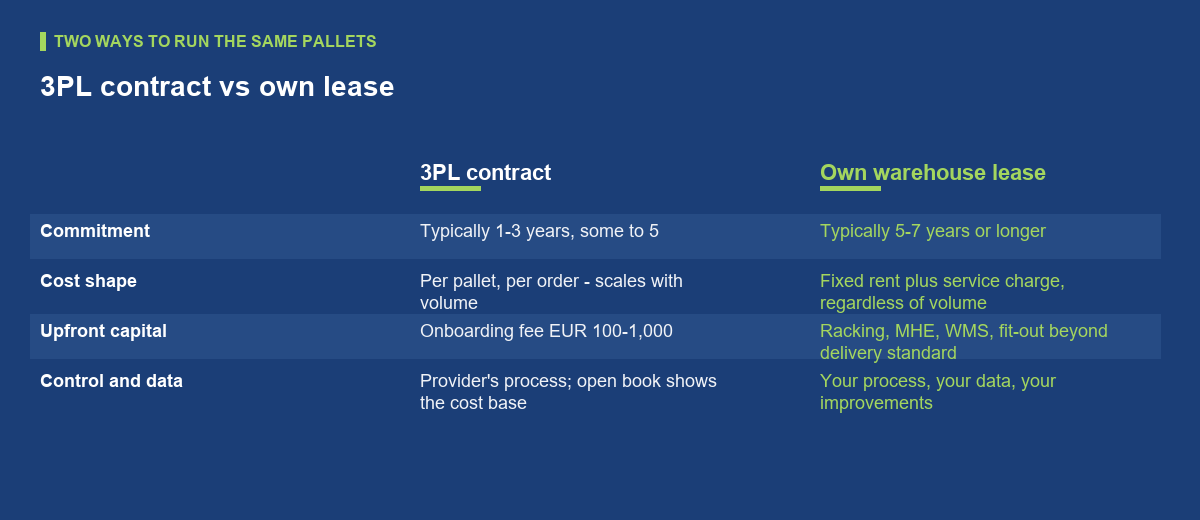
Outsourced logistics is bought by the unit, not by the square metre. European benchmarks collected by Masson International (June 2025) put storage at EUR 8 to EUR 45 per pallet per month depending on product size and dwell time, picking and packing at EUR 1.00 to EUR 4.50 per order, returns processing at EUR 1.50 to EUR 3.00 per item, and one-time onboarding at EUR 100 to EUR 1,000. The structure of the contract matters as much as the rates. Davies and Robson distinguish open book contracts – the provider bills actual costs plus an agreed margin, so you see the cost base but carry its swings – from closed book contracts, where fixed unit prices leave efficiency risk and reward with the operator. Logistics Bureau notes that a contract in this market typically runs one to three years, some up to five, and that rate-based pricing tends to reflect the work actually performed. Scale one example honestly: a 2,000-pallet operation at EUR 12 per pallet per month – our arithmetic on a mid-range assumption, not a quote – is EUR 288,000 a year before a single order is picked. Outsourcing is not cheap; it is variable. That distinction decides the whole question.

What your own lease actually costs – the full stack
What your own lease actually costs - the full stack

The headline rent is the visible layer. At the Q1 2026 average of EUR 4.55 per square metre per month, a 10,000 square metre unit costs EUR 546,000 a year – our multiplication – and prime space in Bratislava commands EUR 5.95 (CBRE via Property Forum; Cushman & Wakefield’s own series puts prime at EUR 5.30 with vacancy at 7.72 per cent – C&W Industrial MarketBeat Q1 2026 – a reminder that broker definitions differ and only trends within one series compare cleanly). On top of rent comes the service charge – typically EUR 0.80 to EUR 1.20 per square metre per month in Slovak parks, our established market-practice range – which adds EUR 96,000 to EUR 144,000 a year on that same unit, our arithmetic again. Then the capital the quote never shows: racking, mechanical handling equipment, a warehouse management system, and the fit-out beyond the landlord’s delivery standard, only partly softened where a fit-out contribution is negotiated. Then people – recruitment, shifts, sickness, seasonal peaks – in a labour market where the tight western regions carry most of the stock. And the commitment underneath it all: Slovak institutional leases habitually run five to seven years or longer, as we set out in our review of what occupiers actually sign. The per-unit cost of a well-run own warehouse at steady volume usually beats the provider’s rate card. The operative words are well-run and steady.

Flexibility against control: the asymmetries that decide it

Strip out the rates and two asymmetries remain. The first is time. A provider contract of one to three years against a lease of five to seven means the outsourced route re-prices and re-sizes itself roughly twice as often as an own lease even allows. If your volumes are volatile – new market entry, tender-driven contracts, seasonal swings – that difference is worth real money, because an under-used own warehouse keeps costing EUR 546,000 a year while a unit-priced contract shrinks with the volume. The second asymmetry runs the other way: control. In your own operation you own the process, the data, the customer experience at the dock and every improvement you engineer; the savings from a faster pick path are yours, not shared through someone’s margin. Under an open book arrangement you at least see the cost base; under a closed book you see a price and trust the market to keep it honest at renewal. There is also a quieter risk on the outsourced side that Q1 illustrates: 53 per cent of Slovak leasing activity is renegotiation, and your provider is renegotiating its own rent into your next rate card (CBRE via Property Forum). Neither asymmetry is an argument to refuse; both are arguments to price.

A decision framework for 2026
A decision framework for 2026

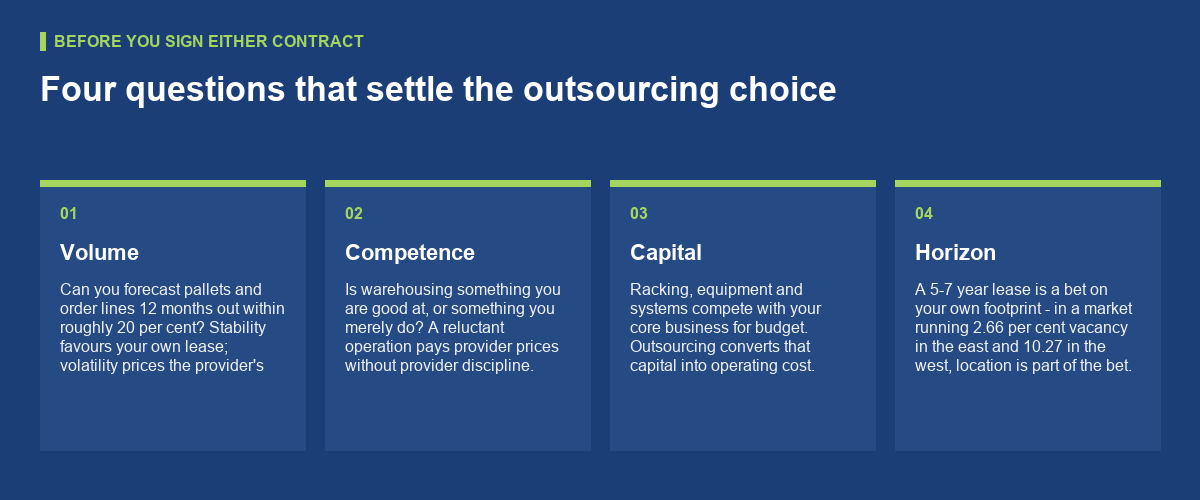
Four questions separate the cases better than any benchmark table. First, volume predictability: can you forecast pallet positions and order lines twelve months out within perhaps 20 per cent – our rule-of-thumb threshold, not a study? Stable volume amortises fixed costs and favours the own lease; volatility prices the provider’s flexibility. Second, competence: is warehousing something your company is actually good at – processes, systems, people – or merely something it does? An operation run reluctantly converges on provider pricing without the provider’s discipline. Third, capital: racking, equipment and systems compete with your core business for the same investment budget, while the outsourced route converts that capital into operating cost. Fourth, horizon: a five-to-seven year lease is a bet on your own footprint; in a market where the east runs at 2.66 per cent vacancy and the west at 10.27, the location you would commit to matters as much as the commitment itself (CBRE via Property Forum). The honest hybrid deserves a mention: many occupiers start outsourced, learn their real cost-to-serve from the provider’s invoices, and take their own space once volume stabilises – with the contract data as their business case.

Conclusion

The Slovak market will serve you either way: providers are expanding – 30 per cent of Q1 demand – and landlords are negotiating, with average rents 6 per cent softer than a year ago. The wrong move is drifting into either camp by default: outsourcing because a quote landed on the desk, or leasing because ownership feels like progress. Run the four questions, price both stacks fully – rent plus service charge plus capital plus people against the full rate card – and let the arithmetic, not the habit, sign the contract.
Weighing a 3PL contract against your own Slovak warehouse – or trying to price the switch? Talk to our team before you commit either way.

Sale-Leaseback for Slovak Manufacturers: Freeing Capital from the Factory Floor

A sale-leaseback answers a question more Slovak manufacturers are asking in 2026: how do you get capital out of a factory without moving out of it? The mechanics are simple – sell the property to an investor and sign a long lease back on the same day – but the economics have shifted from theoretical to topical. The country’s largest such deal since 2018 closed in Senec, long-income buyers are hunting exactly this product across CEE, and bank debt is not getting cheaper. This article assembles what the evidence supports: the deals that actually closed, the yields that price them, and the lease terms that decide whether the capital raised was cheap or expensive.

What a sale-leaseback is – and why manufacturers reach for it now

What a sale-leaseback is - and why manufacturers reach for it now

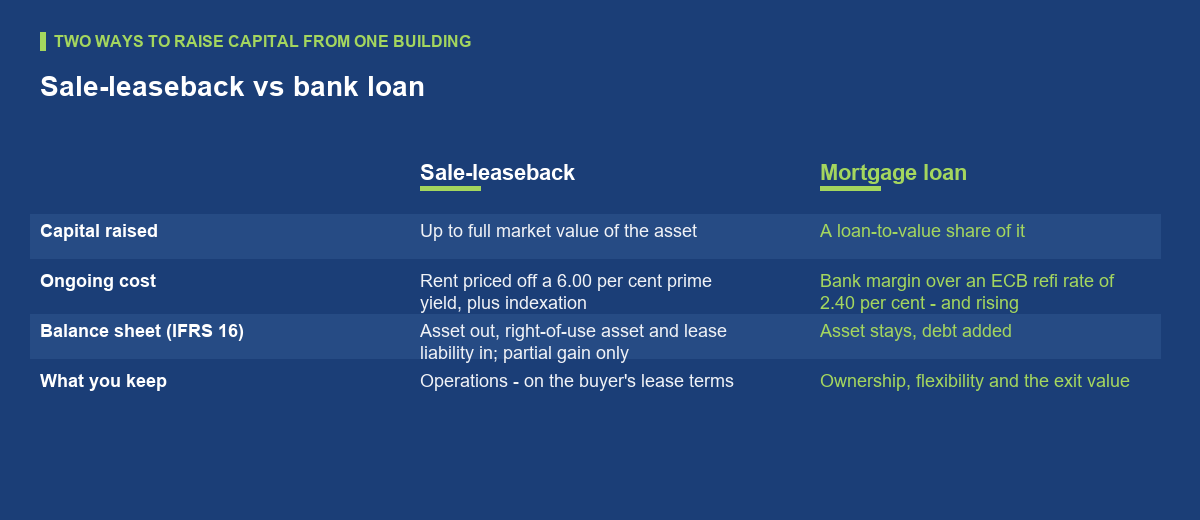
The structure has two legs signed together: a sale of the property at market value, and a lease back to the seller – typically long, typically triple net, so the occupier keeps paying for repairs, insurance and property costs much as an owner would. The seller trades ownership for liquidity while operations continue uninterrupted on the same floor. Why now: the financing alternative is not improving. The European Central Bank raised its key rates by 25 basis points with effect from 17 June 2026 – deposit facility at 2.25 per cent, main refinancing at 2.40 per cent (ECB key interest rates) – so the era of ever-cheaper bank debt is over, and a leaseback prices against property yields rather than bank margins. One honest caveat belongs up front: under IFRS 16 the transaction does not simply move the asset off the balance sheet. The seller books a right-of-use asset for the lease it retains, recognises a gain only on the rights actually transferred, and a deal that fails the sale test is accounted for as a financing (KPMG on IFRS 16 seller-lessee accounting). The case for the structure is cash and flexibility, not accounting cosmetics.

The Slovak deals that prove the market

This is no longer a theoretical CEE product. In February 2025 REICO’s long-income fund bought the DSV logistics hub in Senec – around 69,600 square metres – for EUR 65 million, a transaction reported as the largest sale-and-leaseback in Slovakia since 2018 (Property Forum). Cushman & Wakefield’s half-year review named two leasebacks among the period’s defining deals: the DSV hub and the Tesco retail-gallery portfolio, with Tesco staying on as tenant (C&W Slovakia). Manufacturers followed. In November 2025 W. P. Carey closed an EUR 88 million sale-leaseback with Valeo Foods covering six food production facilities – one of them in Slovakia – around 121,000 square metres in total, on 25-year triple net master leases with annual rent increases linked to consumer price indices (Property Forum). That deal is the template Slovak plant owners should study: production real estate, sold at portfolio scale, leased back for a generation with indexation built in. The market context helps sellers too: 2025 investment volume reached EUR 967 million against a long-term average of roughly EUR 700 million, with industrial taking 46 per cent of it (Property Forum, C&W data).

What buyers pay: the yield arithmetic of a leaseback

What buyers pay: the yield arithmetic of a leaseback

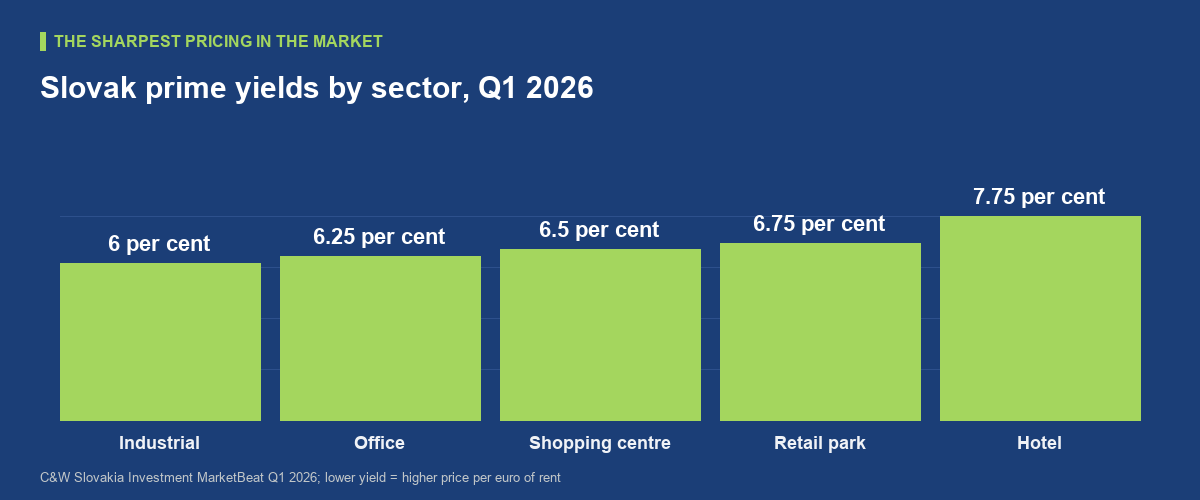
Price in a leaseback is not negotiated from sentiment; it is the rent divided by a yield. Slovak prime industrial yield held firm at 6.00 per cent in the first quarter of 2026 – the sharpest pricing in the country’s property market, ahead of offices at 6.25 per cent and retail parks at 6.75 per cent (C&W Slovakia Investment MarketBeat Q1 2026). At 6.00 per cent, every euro of sustainable annual net rent is worth roughly 16.7 euros of purchase price – our arithmetic. Scale it: a 20,000 square metre plant at the prime rent of EUR 5.30 per square metre per month (C&W Industrial MarketBeat Q1 2026) produces EUR 1.27 million of annual rent and, capitalised at the prime yield, a price around EUR 21 million – again our illustration, and secondary assets price wider. The same report explains what earns the sharpest yield: top-grade assets with long unexpired lease terms. In a leaseback the seller manufactures exactly that – the buyer’s WALT is whatever term the seller signs. The spread does the selling: 6.00 per cent against a 10-year Slovak government bond at 3.4 per cent leaves 260 basis points of premium – our subtraction – for an income stream the investor can underwrite for decades.

The CEE context: long-income capital is hunting this product

Slovak sellers are negotiating into a tailwind, because the buyers closing these deals are pan-European and hungry. The landmark is Polish: window manufacturer Eko-Okna sold and leased back two production facilities to US-listed Realty Income for over PLN 1 billion – about EUR 253 million – described as the biggest transaction of its kind ever in CEE (EurobuildCEE). In the Czech Republic, Clarion Partners Europe bought a 47,000 square metre production and logistics complex in Zatec from automotive interiors maker Yanfeng for around EUR 50 million on a 15-year triple net lease (Clarion Partners) – an automotive supplier monetising its plant, the exact profile of dozens of Slovak factories. The niche keeps compounding: logistics operator DSV agreed a further leaseback of a cross-dock terminal near Prague with Prologis in April 2026. And capital is available at home too: Slovakia’s first quarter of 2026 saw EUR 89 million transact across five deals, all of it capital of Slovak origin, with industrial described as the most liquid asset class of recent years (C&W Investment MarketBeat). A quiet quarter by volume – but for a seller, five domestic buyers plus the pan-European long-income funds is a real auction.

The lease you sign back decides everything

The lease you sign back decides everything

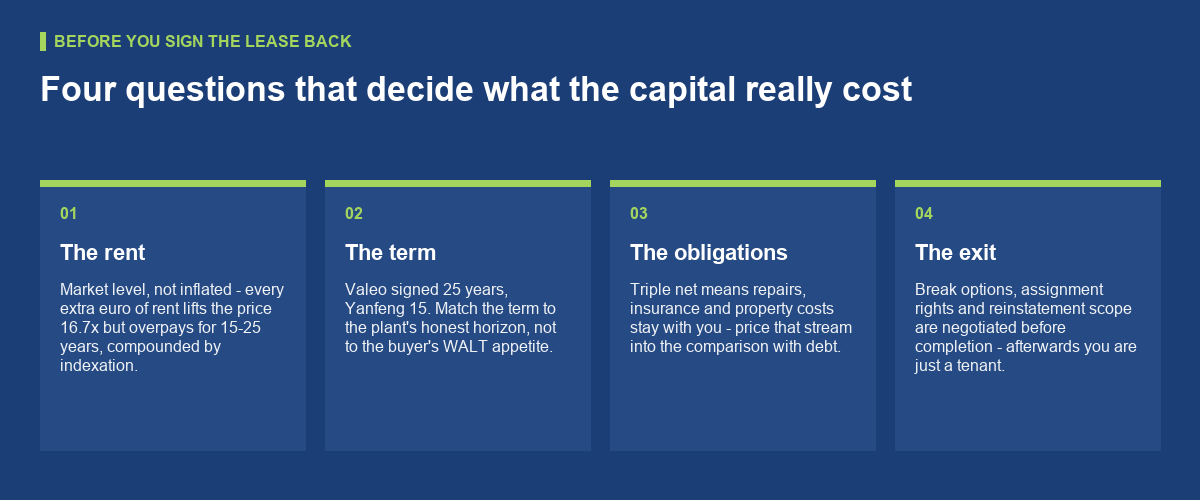
The purchase price gets the headlines; the lease determines whether the deal was good. Every term the seller concedes raises the price and the cost simultaneously – the rent because the buyer capitalises it, the cost because the seller pays it for 15 or 25 years. The discipline list is short. Set the rent at market, not above it: an inflated rent lifts the price by 16.7 times the inflation – our arithmetic from the 6.00 per cent yield – but locks the operating company into overpaying for a generation, compounded by indexation of the kind the Valeo Foods leases carry. Match the term to the plant’s real horizon: 25 years of triple net obligations on a facility the business might outgrow in ten is capital raised against the company’s own flexibility. Negotiate the exit architecture – break options, assignment rights, reinstatement scope – while you still own the building, because afterwards you are one tenant among many in a renegotiation market where 54 per cent of gross take-up is already lease renegotiation (C&W Industrial MarketBeat). Run the counterfactual honestly: rent at 6.00 per cent plus indexation against debt service at bank margins over the ECB’s 2.40 per cent refinancing rate – for some balance sheets the loan still wins.

Conclusion

The evidence says the window is open: the largest Slovak leaseback since 2018 has closed, manufacturers from food to automotive components have monetised plants across CEE at 15 to 25 year terms, and prime industrial money prices at 6.00 per cent while government bonds pay 3.4. For a manufacturer, the decision is not whether the structure works – the closed deals settle that – but whether the lease you would have to sign back is one your operation can live in for its full term. Price the lease first, the building second.

Weighing a sale-leaseback of your plant against bank debt – or wondering what your facility would fetch? Talk to our team before you open the data room.

Industrial Land Prices in Slovakia 2026: What Plots Actually Trade At

Ask three people what industrial land prices in Slovakia look like and you will get three confident, incompatible answers – because unlike rents, land has no broker index, no quarterly MarketBeat line and no official statistic worth the name. Prices are set plot by plot, and the printed number is routinely the smallest part of the story. This article assembles what can actually be evidenced in 2026: regional asking prices, a concrete Bratislava benchmark, the hidden second price of utilities and zoning, what full servicing costs when the state does it at scale – and how all of it flows into the rent occupiers end up paying.

Why quoted industrial land prices tell you so little

Why quoted industrial land prices tell you so little

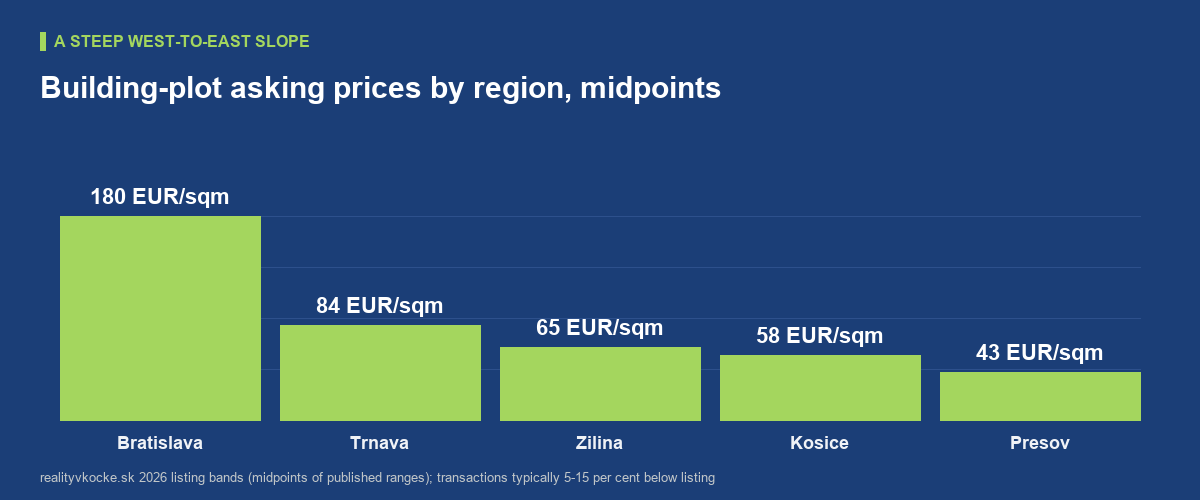
Slovakia publishes no industrial land price index. What exists is listing data – and listings are an opening position, not a result. Portal analysis compiled by realityvkocke.sk puts typical building-plot asking prices at EUR 150 to 210 per square metre around Bratislava, EUR 60 to 107 in the Trnava region, EUR 40 to 90 around Zilina, EUR 45 to 70 around Kosice and EUR 25 to 60 in the Presov region – with actual transactions typically closing 5 to 15 per cent below the listed number (realityvkocke.sk market overview). Those figures skew towards residential-grade plots, so treat them as a gradient rather than a tariff: what they reliably show is the shape of the market – a steep west-to-east slope, and a Bratislava premium of roughly three to five times the eastern regions. Industrial plots follow the same slope but price on different variables: zoning status, utility capacity at the boundary, geometry and access. Two neighbouring fields can differ in value by an order of magnitude because one is zoned and serviced and the other is, legally speaking, still a meadow. That is why the only honest answer to the price question is a range – and why the second half of this article is about everything the headline number hides.

The Bratislava benchmark: what a real plot asks in 2026

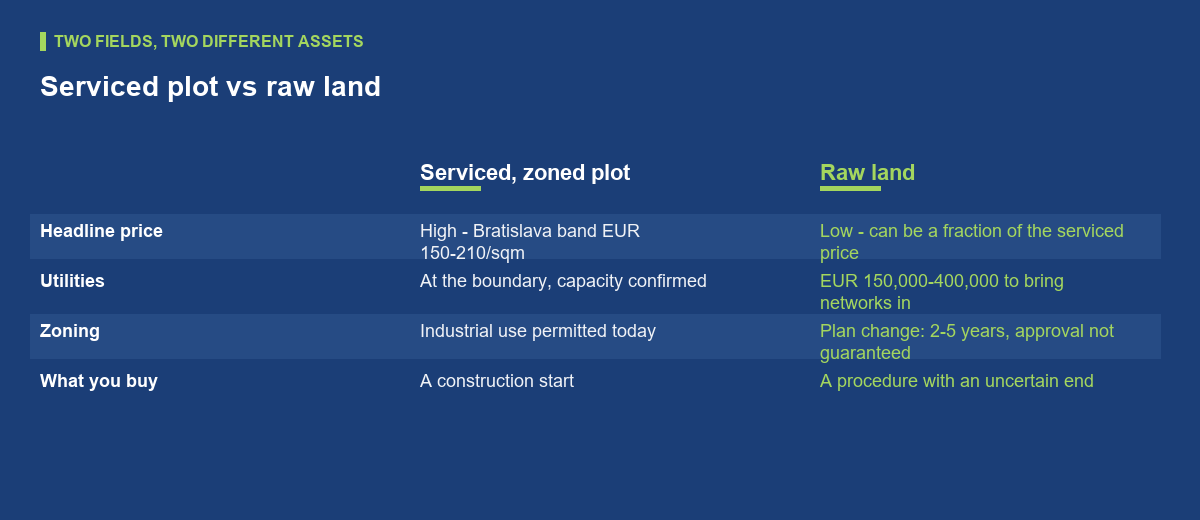
Concrete asking prices are rare in public, which makes the exceptions valuable. A live listing on Majerska Street in Bratislava-Ruzinov offers 30,000 square metres of industrial land at EUR 170 per square metre plus VAT, with electricity and water available on site (warehouserentinfo.sk listing) – EUR 5.1 million for the plot, our multiplication. That sits exactly inside the EUR 150 to 210 Bratislava listing band above, and it illustrates what the top of the market buys: city-fringe location, utilities at hand, scale suitable for a mid-size distribution or production building. The corridor logic familiar from rents applies to land with more force: proximity to the D1, to labour and to power capacity has become a site-selection constraint in its own right, and plots that combine all three trade at multiples of the regional average. The same 30,000 square metres in a Presov-region village might list below EUR 60 per square metre – but the saving is only real if the cheaper plot can actually be built on, powered and reached, which is precisely what the asking price does not tell you.

The hidden second price: utilities and zoning

The hidden second price: utilities and zoning

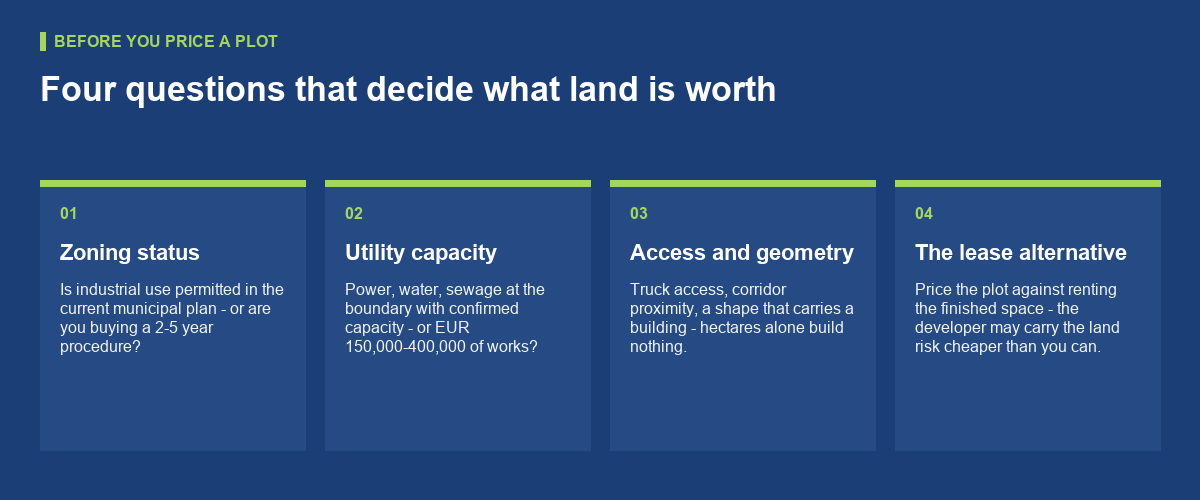
The number on the listing is the first price. The second one is buried in the ground. Slovak agency Atte Reality, which specialises in plot acquisitions, puts the cost of bringing all utility networks to an unserviced plot at EUR 150,000 to 400,000, with a new transformer station and high-voltage connection alone running EUR 50,000 to 200,000 and more (Atte Reality, the hidden price of a plot). Spread over a 30,000 square metre site, that adds up to EUR 13 per square metre to the real entry cost – our arithmetic – before a single foundation is poured. Time is the harsher currency: where the municipal zoning plan does not permit industrial use, a zoning-plan change takes two years in the ideal case and three to five years normally, involves public consultation where neighbours can object, and approval is not guaranteed – the municipality can simply decline (Atte Reality, same guide). This is what the price gap between raw and ready land actually buys: not convenience but risk transfer. A plug-and-play plot at EUR 170 can be the cheaper purchase than a EUR 40 field that spends four years in procedure and still needs a transformer.

The Valaliky yardstick: what full servicing costs at scale

For a sense of what industrial readiness is worth when priced honestly, look at the largest land project in the country. The strategic park at Valaliky near Kosice spans over 700 hectares including infrastructure land, and the state’s planned investment is EUR 731 million (Valaliky Industrial Park) – with over EUR 280 million already committed at the 2023 construction launch for transport links, water supply, sewage and park infrastructure (DRIVEN report). Divide the planned total by the area and the state is spending the equivalent of roughly EUR 100 per square metre to turn eastern Slovak fields into a site an investor like Volvo – approximately EUR 1 billion, 12,000 expected jobs – will actually build on. That is our arithmetic, and the spend covers more than bare servicing; but the order of magnitude is the lesson. Readiness costs as much as, or more than, raw land – which is why regional investment aid exists to close the gap, and why privately quoted prices for genuinely ready plots in strong locations are not the anomaly they may seem. Someone always pays for the pipes; the only question is whether it is visible in the price or hidden in the project.

Rent or buy: how land prices reach the occupier

Rent or buy: how land prices reach the occupier

Most occupiers never buy a square metre of land – and the land market reaches them anyway, through the developer’s spreadsheet. Slovakia’s modern industrial stock stands at 4.87 million square metres with vacancy at 8.12 per cent and a prime rent of EUR 5.95 per square metre per month (CBRE figures via Property Forum); Cushman & Wakefield’s Q1 2026 read has prime rent at EUR 5.30, vacancy at 7.72 per cent and more than 105,000 square metres newly delivered (C&W Slovakia MarketBeat). Land is one of the few development inputs still rising while rents flatten, and developers underwrite it years ahead through land banks – one reason speculative supply concentrates where plots were secured cheaply. For an occupier, the buy case is narrow but real: owner-occupiers with long horizons, specialised facilities that no landlord would fund, or a built to suit where controlling the plot strengthens the negotiation. For everyone else, leasing means renting the land risk along with the building – the developer absorbed the zoning procedure, the utility connections and the price of being wrong. Seen that way, the gap between a prime rent and a secondary one is partly just land price in monthly instalments.

Conclusion

Industrial land in Slovakia has no price list, and anyone quoting one number is quoting the wrong one. What the evidence supports in 2026: a steep west-to-east gradient in asking prices, a Bratislava benchmark around EUR 170 per square metre for serviced city-fringe land, a hidden second price of up to several hundred thousand euros in utilities and years in zoning procedure – and a state yardstick at Valaliky showing that readiness itself costs on the order of EUR 100 per square metre. Whether buying or leasing, the discipline is the same: price the plot’s status, not its surface.

Weighing a plot purchase against a lease – or trying to price a site someone quoted you? Talk to our team before you commit either way.

Rooftop Solar on Slovak Warehouses: Economics, Leases, and Who Keeps the Power

Slovak warehouses sit under some of the country’s most valuable unused land – their own roofs. Rooftop solar has moved from sustainability brochure to lease negotiation: commercial and industrial installations are the fastest-growing segment of Slovakia’s photovoltaic market, grid connections for new capacity are scarce, and the question of who installs, owns and profits from the panels is landing in heads of terms. This article covers what a logistics roof actually yields, the three ownership models and what each does to the lease, the Slovak permitting rulebook, and the questions occupiers should settle before they sign.

The fastest-growing segment of a small market

The fastest-growing segment of a small market

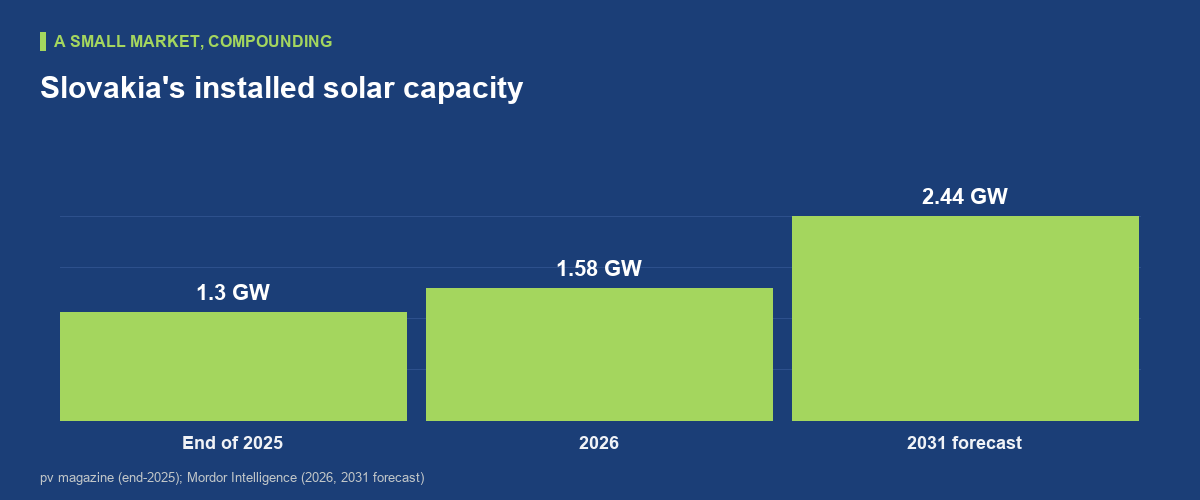
Slovakia’s solar base is modest but compounding quickly. Cumulative capacity passed 1.3 GW by the end of 2025, with almost 16,000 new installations connected in that year alone (pv magazine). Mordor Intelligence expects the market to grow from 1.58 GW in 2026 to 2.44 GW by 2031, a 9.06 per cent annual rate – and within that, commercial and industrial rooftops are the fastest segment at 17.92 per cent a year (Mordor Intelligence). Logistics parks are the natural carrier of that growth: flat roofs measured in hectares, daytime consumption underneath, and a modern stock of 4.87 million square metres (CBRE figures via Property Forum). Apply the standard sizing rule – roughly 8 to 10 square metres of usable roof per kilowatt-peak, with 70 to 80 per cent of a roof usable (Evo Energy) – and the national warehouse stock is, in order-of-magnitude terms, a 300 to 500 MWp roof bank. That is our arithmetic, not a broker forecast, but it frames the prize: the sector could carry a meaningful share of the country’s entire solar build-out without touching a field. The grid is the catch: new connection capacity is scarce and slowly allocated, which is exactly why generation that never leaves the building has become the segment to watch. A roof does not stand in the connection queue.

What rooftop solar actually yields on a logistics roof

The sizing physics are well established: a standard 10,000 square metre warehouse roof accommodates a 700 to 900 kWp system, enough to offset 40 to 70 per cent of annual electricity consumption for a high-energy-use facility (Evo Energy commercial solar guide – UK figures, and Slovak irradiation is no worse). Slovakia already has a reference case. Photon Energy built rooftop plants on three CTParks – 407.68 kWp in Bratislava, 354.90 kWp in Trnava and 499.59 kWp in Zilina, a combined 1.26 MWp, commissioned between May and September 2022. The buildings had been constructed solar-ready, and CTP handled the AC connections itself (Photon Energy case study). CTP runs these under energy-service contracts that bundle solar with storage and EV charging (Mordor Intelligence). The economics rest on self-consumption: power used where it is generated avoids the substantial non-commodity costs a licensed supplier adds, so the benefit is greatest where the building itself is the customer (CMS). For occupiers, solar-ready matters more than it sounds: structural reserve, cable routes and inverter space planned at construction are what separate a weekend installation from a year of retrofit engineering. And in a market where power capacity has become a site-selection constraint, behind-the-meter generation is one of the few hedges an occupier can actually buy.

Who owns the panels: three models, three different leases

Who owns the panels: three models, three different leases

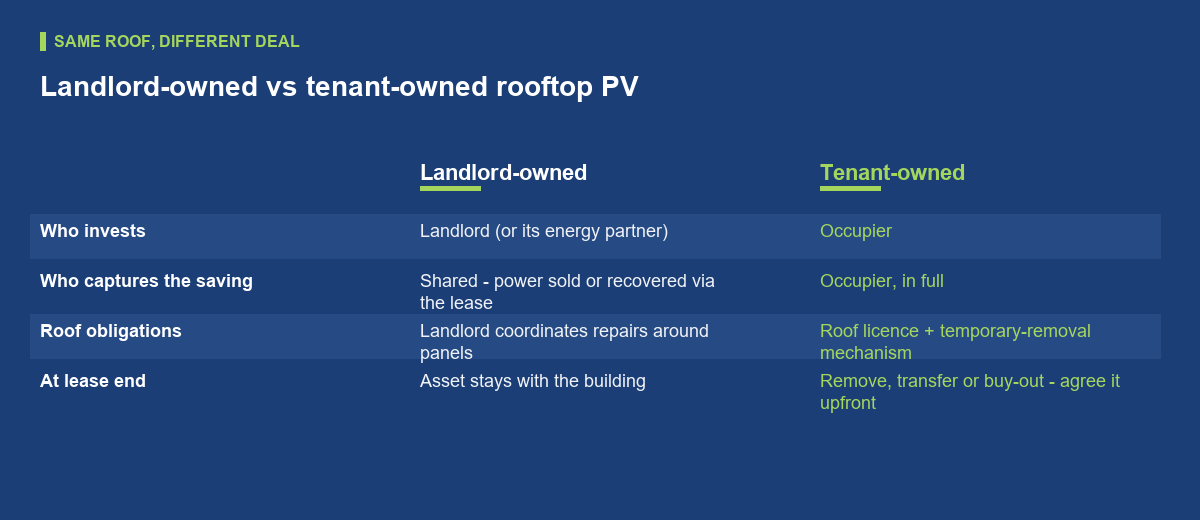
The core structuring decision is who procures the installation, operation and ownership of the panels (CMS, The roof space race). Landlord ownership is the cleanest for multi-let parks: the landlord invests, sells the power to tenants or recovers costs through the lease, and keeps the asset at expiry – the CTP schemes follow this logic. Tenant ownership suits single-let buildings with long terms: the occupier captures the full saving but needs a roof licence, and must agree what happens to the equipment at lease end. The third-party model – an energy company owns the plant and sells power under a power purchase agreement – moves the capital cost off both balance sheets and prices the electricity instead. Whichever model applies, the agreements have to dovetail with the lease rather than fight it. If the tenant holds roof-repair obligations, a mechanism for the temporary removal of the solar apparatus is needed; and panels installed on a completed building can risk invalidating subsisting roof warranties (CMS). On a triple net lease the insurance and maintenance split needs explicit words – and where costs are recovered, the service charge schedule is where the solar clause either pays the tenant back or quietly does not. The clean test is cash flow: follow who pays the capital cost, who bills the kilowatt-hour and who books the asset at expiry, and the real model reveals itself.

The Slovak rulebook: notification, not licence

Slovak permitting is friendlier to rooftop projects than its reputation. Installations up to 1 MW – which covers essentially every single-building warehouse system – are subject to a notification obligation rather than a full production licence; the licence for constructing an energy installation only applies above 5 MW. Statutory permitting timeframes run 30 days for standard cases and 60 for complex ones, though in practice they are often exceeded (CMS CEE Expert Guide). The fiscal side has been moving in the producer’s favour: the excise-duty exemption threshold rose to 50 kW from 2025, prosumers may export up to 1,000 MWh a year, and legislation effective January 2026 introduces contract-for-difference payments, flexible grid-connection deals and electricity sharing (Mordor Intelligence). That last item matters most for parks: Slovakia is preparing an energy-community framework built mainly around rooftop PV combined with battery storage, local consumption and electricity sharing (pv magazine) – which would let one big roof serve several tenants, or several buildings, without each needing its own plant. One caution: exporting power still needs a connection agreement with the distribution operator, and the statutory priority access for renewable producers is, in CMS’s words, rather a theoretical right – one more argument for sizing a system to the building’s own load. The regulatory direction of travel is clear even where the detail is not yet law.

Four questions before you sign

Four questions before you sign

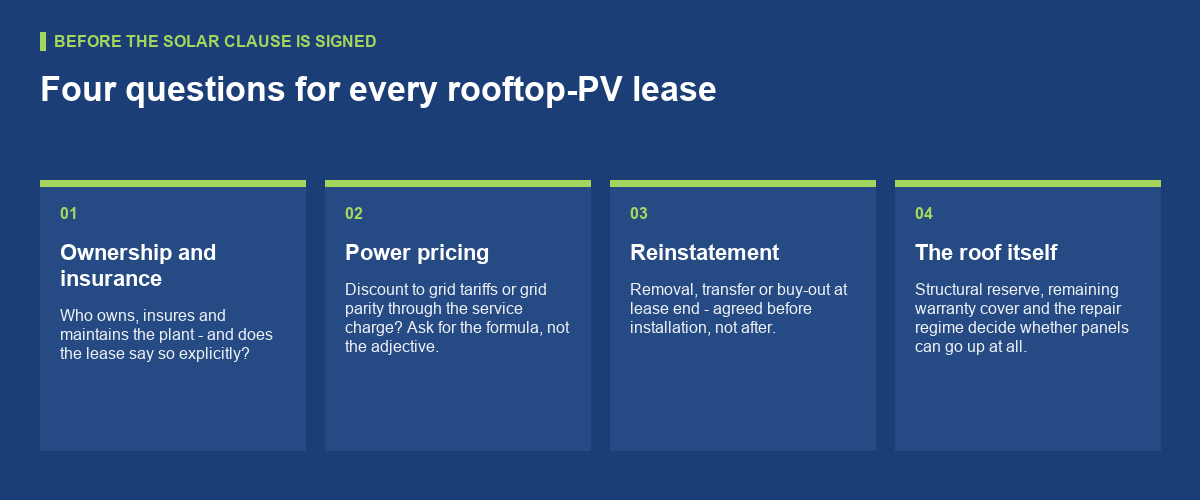
First: who owns, insures and maintains the plant – and does the lease say so in those words? Ownership decides who claims the savings, who carries the replacement risk and who benefits from subsidy schemes. Second: how is the power priced? A landlord selling roof power at a discount to grid tariffs is sharing the gain; one charging grid-parity rates through the service charge is keeping it. Ask for the formula, not the adjective. Third: what happens at reinstatement? A tenant-owned plant needs an agreed end-of-lease treatment – removal, transfer or buy-out – before installation, not after. Fourth: does the roof itself cooperate? Structural reserve, remaining warranty cover and the repair regime determine whether panels can go up at all without creating a liability (CMS). Occupiers already pay attention to what BREEAM and DGNB certification costs them – the same discipline belongs on the solar clause, because it moves real money every month. A building whose roof cuts 40 to 70 per cent off the power bill at a fair price is a different economic proposition from an identical building next door whose roof only shades the racking. And put the answers in the lease itself, not in a side letter that quietly dies at assignment or sale.

Conclusion

Slovakia’s warehouse roofs are becoming the cheapest new power plant in a grid-constrained market, and the growth numbers say the build-out has started. But the panels themselves decide nothing: the lease decides who invests, who saves and who owns the asset when the term ends. Occupiers who negotiate the solar clause with the same care as the rent clause will capture a share of the roof’s value – the rest will watch it flow, kilowatt by kilowatt, to the other side of the table.

Taking a lease on a building with – or without – panels on the roof? Talk to our team about what the solar clause should say before you sign.

Last-Mile Logistics in Bratislava and Kosice: Small Units, Big Premiums

Slovakia’s industrial statistics describe a market of big boxes on motorway junctions – and miss the segment where the queue is. Last-mile logistics, the final leg between a depot and the customer’s door, runs on a different product: compact units inside the city, served by vans rather than articulated trucks, leased short and priced high. While standard warehouse space in Slovakia reprices in the tenant’s favour, urban small units remain scarce in Bratislava and close to unobtainable in Kosice. This article maps what that space actually is, what it costs across the region, and when the premium is worth paying.

Two markets in one country: big boxes soften, small units queue

On paper the Slovak industrial market has swung the tenant’s way. The national vacancy rate climbed to 8.12 per cent in the first quarter of 2026, and the average rent slipped 6 per cent year on year to EUR 4.55 per square metre per month even as total leasing jumped 47 per cent to 136,000 sqm (CBRE figures reported by Property Forum). Landlords of standard big-box space are working to keep income in place – renegotiations made up 53 per cent of all transactions. Small urban units sit at the opposite end of that cycle. Alto Real Estate, whose STORE.TO scheme is one of the few modern small-business-unit projects in the capital, describes the segment as undersupplied, with many companies still operating from outdated facilities (interview with warehouserentinfo.sk). The capital’s weight makes that mismatch matter: the wider Bratislava area took 72 per cent of national leasing in the first quarter, and e-commerce contributed 17 per cent of demand. When most of the country’s requirements point at one city, and the product those requirements increasingly need – compact, close-in, van-served – barely exists in modern form, the usual cycle logic stops applying. Big boxes reprice; small units queue.

What a small unit in Bratislava actually is

What a small unit in Bratislava actually is

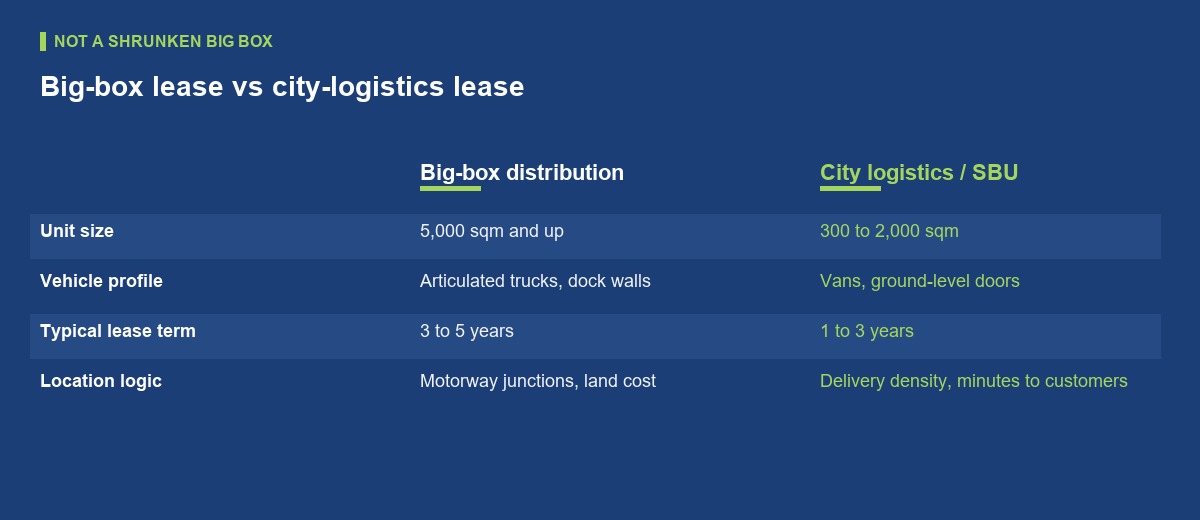
The product has its own grammar, and it is not a shrunken big box. City-logistics units in Bratislava typically run from 300 to 2,000 square metres, with development concentrated in urban districts such as Petrzalka and Raca (warehouserentinfo.sk market guide). At STORE.TO, standard units range between 500 and 1,000 sqm, and the developer is explicit that this is not a traditional logistics park designed for heavy truck traffic – the scheme is optimised for van logistics and fast access (Alto Real Estate). The specification differs in kind: ground-level doors instead of full dock walls, parking and charging for van fleets instead of trailer yards, and a visibly higher office and showroom share – integrated office space within industrial buildings rented for EUR 9.00 to 11.00 per square metre per month in mid-2025, roughly double the big-box warehouse rate (Industrial Research Forum data summarised by warehouserentinfo.sk). Lease terms are shorter too: city-logistics deals commonly run one to three years against three to five for distribution space. The tenant mix explains the design – e-commerce operators, service businesses, parcel carriers and showroom-plus-storage concepts value proximity and flexibility over cubic volume.

The premium, quantified: what small space costs across CEE

The premium, quantified: what small space costs across CEE

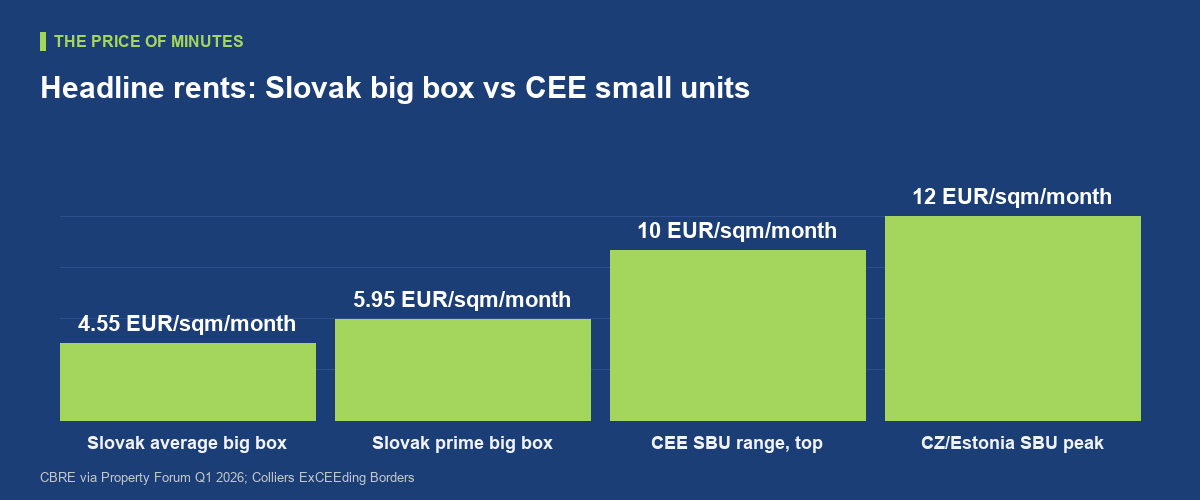
There is no published Bratislava SBU rent series yet – the segment is too young and too thin – so the honest benchmark is regional. Colliers’ CEE-15 analysis of the small-business-unit and last-mile segment, published in 2022, put headline rents for this type of space at EUR 4.00 to EUR 10.00 per square metre per month, reaching EUR 12.00 in the Czech Republic and Estonia, and noted that rents and service charges run significantly higher than in standard buildings (Colliers, ExCEEding Borders). Stock across the fifteen markets exceeded 3 million square metres, roughly 2 million of it in Poland – Slovakia’s share was marginal then and remains thin now. Set the top of that range against what occupiers actually pay for Slovak big boxes – a prime of EUR 5.95 and an average of EUR 4.55 in the first quarter of 2026 (Property Forum) – and the scale of the premium comes into focus. The reasons are structural rather than cyclical: urban land competes with residential and retail uses; small floorplates carry more walls, doors and management per square metre; shorter leases price the tenant’s flexibility into the rent; and the office share is higher. The premium is not an inefficiency waiting to correct. It is the price of minutes.

Kosice: the tightest market nobody builds in

Eastern Slovakia is the small-unit story at its most extreme. The east runs the country’s tightest vacancy rate at 2.66 per cent, yet it took just 6 per cent of national leasing in the first quarter (CBRE via Property Forum) – not because nobody wants the space, but because almost nothing modern gets built there speculatively. The demand side is not standing still. The expected Volvo plant near Kosice is anticipated to pull suppliers and services east (warehouserentinfo.sk), the city anchors Slovakia’s rail-connected logistics for Ukraine-facing flows, and the parcel networks that carry Slovak e-commerce need eastern depots regardless of where developers prefer to build – DPD alone maintained almost 3,700 pickup points across Slovakia as of May 2026 (E-commerce Germany News). The national online market those networks serve turned over EUR 1.84 billion in 2024, still below the 2021 record of EUR 2.08 billion but growing again (Trade.gov). For occupiers the practical reading is uncomfortable: in Kosice the constraint is not the rent, it is the option set. Units of the right size surface rarely, lease fast, and reward tenants who have scoped requirements before the space appears rather than after.

Pricing the premium: four questions and the investor angle

Pricing the premium: four questions and the investor angle

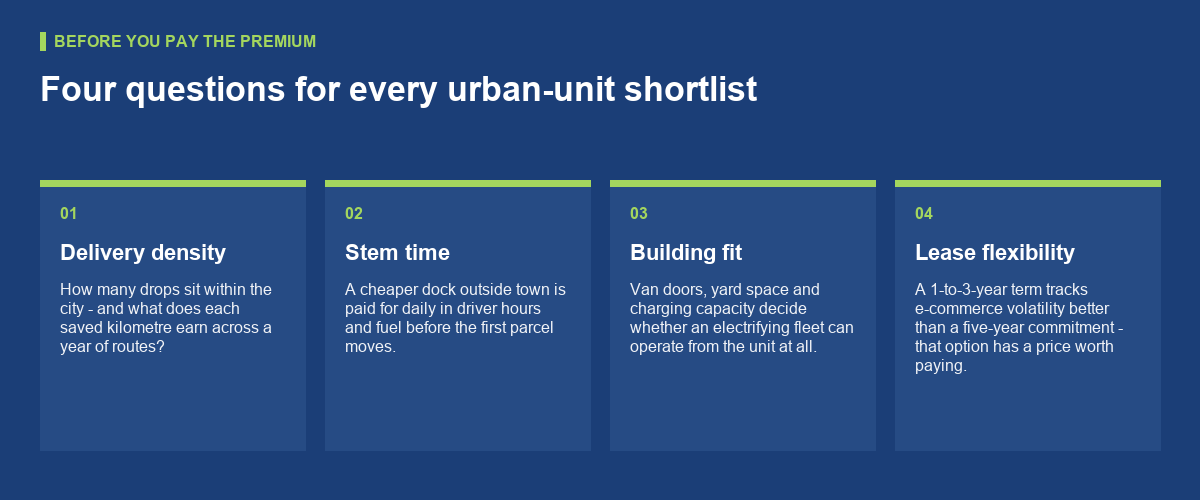
Whether the urban premium pays is arithmetic, not taste. First, delivery density: how many drops sit within the city, and what does each saved kilometre earn across a year of routes? Second, stem time: a cheaper dock in Senec is paid for daily in driver hours and fuel before the first parcel moves – the rent saving has to beat that recurring bill. Third, building fit: van doors, yard space and charging capacity decide whether an electrifying fleet can actually operate from the unit, and EV charging infrastructure is now a standard tenant requirement (warehouserentinfo.sk). Fourth, lease flexibility: a one-to-three-year term tracks e-commerce volatility far better than a five-year commitment, and that option has a value worth paying for. The investor side explains why landlords rarely blink first. Slovak investment volume reached EUR 536 million in the first half of 2025, up 315 per cent year on year, with industrial assets taking 58 per cent of it, and the Bratislava prime industrial yield stood at 6.00 per cent (Cushman & Wakefield CEE investment report). Scarce urban logistics is exactly the profile buyers underwrite hardest for rental growth – which means owners of small-unit schemes can afford patience that big-box landlords currently cannot.

Conclusion

Slovakia’s headline statistics describe a softening big-box market and quietly omit the segment moving the other way. Small urban units in Bratislava are scarce, specified differently, leased shorter and priced above the big-box prime; in Kosice they are close to unobtainable. Occupiers who run the density and stem-time arithmetic will know precisely when the premium pays – and occupiers who wait for the tenant’s market to reach the city centre are likely to find that it never arrives.

Weighing an urban unit against a cheaper dock on the motorway? Talk to our team about where the premium pays for itself – and where it does not.

Labour Availability as a Site-Selection Factor in Slovak Logistics

Rent gets the attention in every site-selection deck; labour decides whether the building ever works. Labour availability – how many people a location can realistically staff, at what wage, against which competing employers – has quietly become the binding constraint on Slovak logistics operations, the way power capacity became one for manufacturers. The uncomfortable geography: the regions with the deepest labour pools host almost no modern industrial space, and the regions with the space are running out of people. This article maps that inversion with first-quarter 2026 data and walks through the arithmetic occupiers should run before they negotiate a single cent of rent.

Two maps, one country – and they barely overlap

Two maps, one country - and they barely overlap

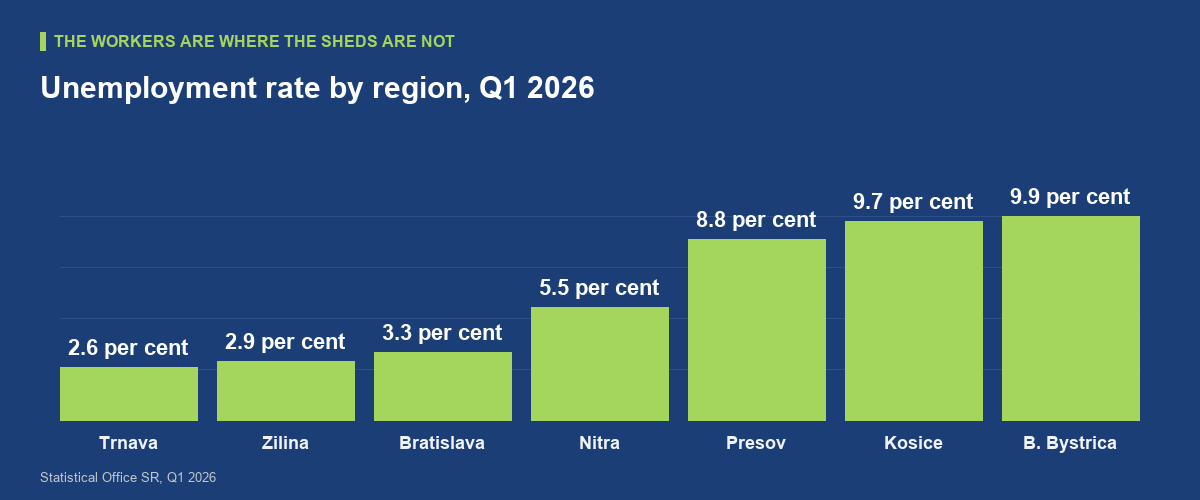
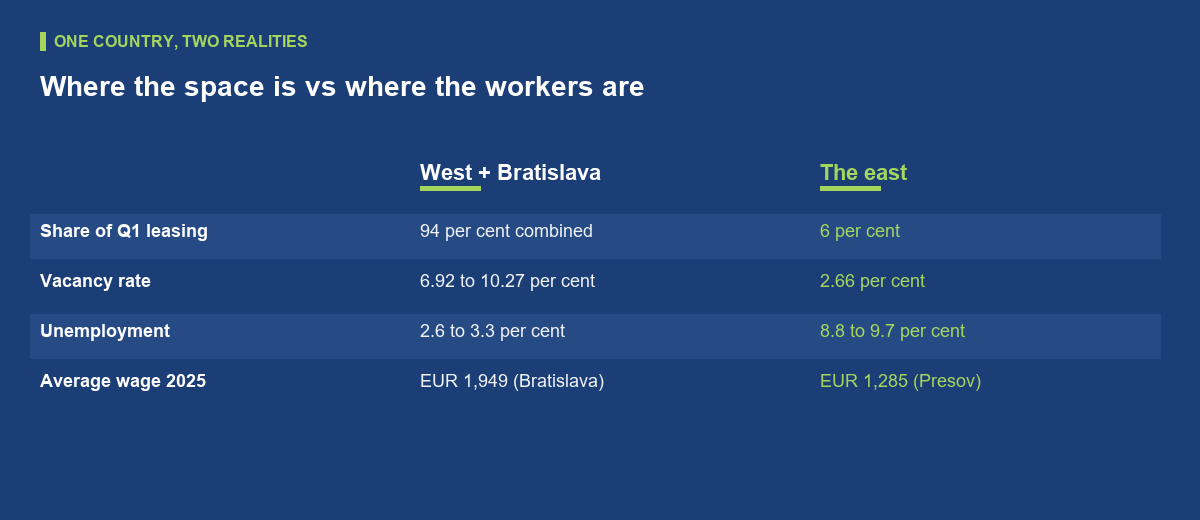
Lay Slovakia’s unemployment map over its leasing map and the mismatch is almost comic. In the first quarter of 2026 the Statistical Office put unemployment at 9.9 per cent in the Banska Bystrica region, 9.7 per cent in Kosice and 8.8 per cent in Presov – against 2.6 per cent in Trnava, 2.9 per cent in Zilina and 3.3 per cent in Bratislava (Statistical Office SR). Now the leasing map: the wider Bratislava area took 72 per cent of all leasing activity in the same quarter, western Slovakia another 22 per cent, and the entire east just 6 per cent (CBRE figures reported by Property Forum). The workers are in the east; the sheds are in the west. Eastern Slovakia also runs the country’s tightest vacancy rate at 2.66 per cent – not because demand is surging, but because almost nothing speculative gets built where institutional landlords see thin exit liquidity. The result is a structural short: labour-rich regions with no space to lease, and space-rich regions where every new operation is a raid on a neighbour’s shift plan. Understanding that inversion is the starting point of any honest Slovak site decision in 2026.

What labour actually costs, region by region

The wage spread across Slovakia is wide enough to change a business case. The full-year 2025 average nominal monthly wage stood at EUR 1,620 nationally, up 6.3 per cent year on year – the ninth consecutive quarter of real growth. Only one region sits above that line: Bratislava, at EUR 1,949. At the other end, Presov averages EUR 1,285 and Trencin EUR 1,522 (Statistical Office SR). Between Bratislava and Presov that is a gap of EUR 664 per employee per month – roughly a third off the capital’s labour bill – before any logistics-specific premium for forklift licences, night shifts or seasonal peaks. The floor is rising too: the statutory minimum wage stepped up to EUR 915 per month from 1 January 2026, from EUR 816 in 2025 (Grant Thornton Slovakia) – a 12 per cent jump that lands hardest exactly where warehouse pay grades cluster near the statutory line. Two caveats keep the comparison honest: these are all-economy averages, not logistics rates, and gross wage is not employer cost once levies are added. But the direction and the scale of the regional spread hold, and they are larger than most occupiers assume.

The arithmetic occupiers should run before the rent negotiation

The arithmetic occupiers should run before the rent negotiation

Put the rent line and the wage line side by side and the hierarchy becomes obvious. Take a 20,000 square metre fulfilment operation. The spread between CBRE’s prime rent of EUR 5.95 per square metre per month and the national average rent of EUR 4.55 (Property Forum) is EUR 1.40 – on 20,000 square metres, EUR 28,000 per month. That is the entire corridor-versus-secondary rent argument. Now staff the building: a two-shift operation of 150 warehouse employees, priced at the regional average wage gap between Bratislava and Presov of EUR 664 per month, moves EUR 99,600 per month – three and a half times the rent lever, every month, before overtime and agency premiums. The point is not that everyone should move east; it is that the labour line deserves at least the diligence the rent line gets. A EUR 0.20 saving on headline rent is celebrated in every deal review, while a location that forces a 10 per cent wage premium to poach staff quietly costs multiples of it. The take-up statistics never show this – leasing volume measures where space was signed, not whether the operations inside it can hire.

Everyone is fishing in the same pool

The competition for warehouse labour is not other warehouses – it is the automotive industry. Automotive was the single largest source of industrial demand in the first quarter at 31 per cent of leasing, ahead of third-party logistics at 30 per cent and e-commerce at 17 per cent (Property Forum), and the plants of the automotive belt – Bratislava, Trnava, Nitra, Zilina – anchor exactly the districts where industrial employment already runs deepest. A distribution centre near Nitra hires against Jaguar Land Rover’s supplier park; one near Zilina against Kia’s. The macro picture is shifting, though. National unemployment rose to 5.9 per cent in the first quarter of 2026, up 0.6 percentage points year on year, with 161.9 thousand people unemployed – 10.4 per cent more than a year earlier (Statistical Office SR). Bratislava even lost its long-held position as the lowest-unemployment region, slipping to fourth behind Trnava, Zilina and Trencin. Slack is returning at the margin – but from historically tight levels, and unevenly: Presov cut its unemployed count by almost a fifth even as the national figure rose. Any staffing plan built on 2024 hiring assumptions deserves a fresh look at the district-level numbers.

How to read labour availability into a Slovak site decision

How to read labour availability into a Slovak site decision

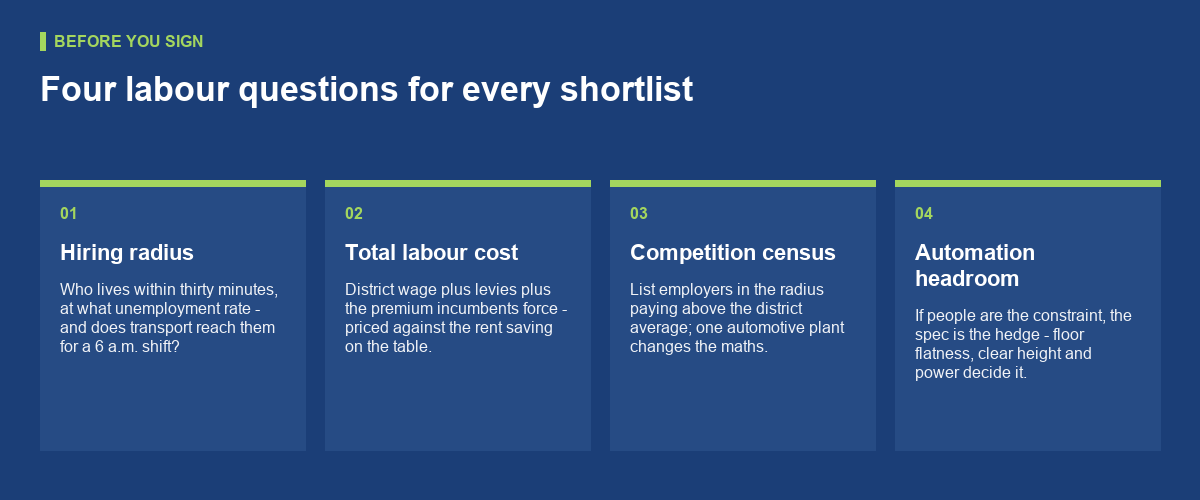
Four questions turn labour availability from a slide into a decision input. First, the hiring radius: who actually lives within thirty minutes of the site, at what unemployment rate, and does public transport or a works bus reach them for a 6 a.m. shift? Second, the total labour cost: benchmark the district wage, add the levy load and the premium the incumbent employers force, and price the package against the rent saving on the table. Third, the competition census: list the employers within the radius who pay above the district average – one automotive plant on the list changes the maths more than one euro on the rent. Fourth, the automation headroom: if the labour pool is the constraint, the building specification becomes the hedge, and the warehouse automation wave sweeping CEE is as much a labour story as a technology one – floor flatness, clear height and power capacity decide whether robots can substitute for the staff the district cannot supply. Landlords can read the same list in reverse: in labour-tight submarkets, a building specified for automation and a site served by public transport lease faster and hold their vacancy rate down through the cycle.

Conclusion

Slovakia’s industrial geography prices concrete precisely and people poorly. The leasing market concentrates 94 per cent of activity in the west of the country while the deepest labour reserves sit in the east, and the wage spread between regions moves an occupier’s monthly P&L by multiples of any achievable rent saving. The occupiers who win in 2026 will be the ones who run the labour arithmetic with the same rigour as the rent arithmetic – and the landlords who win will be the ones whose buildings and locations answer the staffing question before the tenant has to ask it.

Weighing rent against wages for your next Slovak site? Talk to our team about locations where the building and the labour pool both work.

The D1 Corridor vs the South: Where Slovak Industrial Rents Diverge and Why

On a national dashboard, Slovakia looks like one industrial market with one headline rent. Walk the geography and it splits in two. The D1 corridor – the motorway spine running from Bratislava through Senec, Trnava and Zilina towards Kosice – carries most of the country’s institutional stock and nearly all of its leasing liquidity. South of it, along the R1 and the Danube belt from Nitra to Dunajska Streda, Nove Zamky and Komarno, sits a second market: thinner, cheaper and priced deal by deal. This article walks through where the rents actually diverge, why the gap exists, and when paying the corridor premium is worth it.

One motorway, most of the market

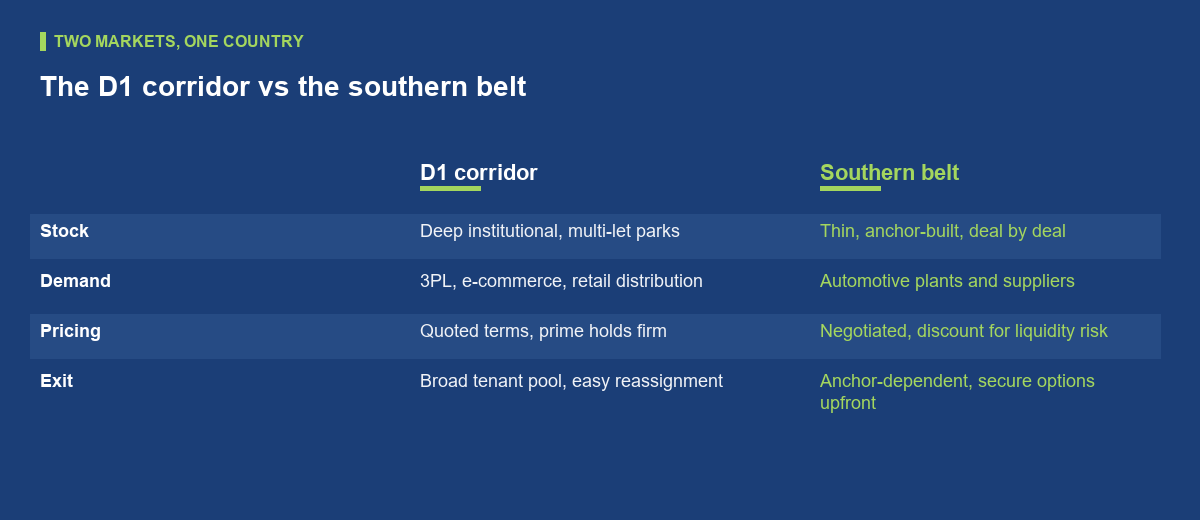
The concentration is starker than most occupiers assume. In the first quarter of 2026 the wider Bratislava area alone accounted for 72 per cent of all leasing activity, western Slovakia for another 22 per cent, and eastern Slovakia for the remaining 6 per cent (CBRE figures reported by Property Forum). Modern stock stands at 4.87 million square metres, and the bulk of it lines the D1 between the capital and Zilina, clustered around the A-cities where developers, lenders and investment buyers all feel at home. The south is a different landscape. Nitra anchors it with automotive volume, and the Danube belt towns – Dunajska Streda, Nove Zamky, Komarno, Sturovo – host terminals, plants and owner-built sheds, but institutional multi-let parks are scarce. Where the corridor has a leasing market with quoted terms and comparables, the south often has a negotiation: one landlord, one building, one tenant requirement, and a price discovered rather than quoted. The far east of the corridor tells the same story from the other side: eastern Slovakia took just 6 per cent of first-quarter leasing, yet runs the country’s lowest vacancy rate at 2.66 per cent – not because demand is booming, but because hardly anything speculative gets built there. That structural difference, more than construction cost or land value, is where the rent divergence begins – liquidity itself is priced.

What the rent stack actually shows

What the rent stack actually shows

Start with the paradox in the national numbers. CBRE puts Slovakia’s prime rent at EUR 5.95 per square metre per month in the first quarter of 2026, up 3 per cent year on year – while the average rent fell 6 per cent to EUR 4.55 (Property Forum). The top of the market and the middle of the market are moving in opposite directions, which is exactly what a two-speed geography produces: scarce prime space on the corridor holds its price, while everything secondary competes harder. The stack deepens the further you look. 108 REAL ESTATE reported a fourth-quarter 2025 prime of EUR 5.40 and an average headline of EUR 5.07, with entry rents around Senec starting from EUR 3.90 (warehouserentinfo.sk), and Cushman & Wakefield’s MarketBeat puts prime at EUR 5.30 for the same quarter CBRE calls EUR 5.95 (Cushman & Wakefield). Three houses, three definitions of prime rent – each tracks a different basket of buildings. The lesson for occupiers is not that one broker is wrong; it is that a Slovak headline rent without a location attached is close to meaningless. And every one of these figures is a headline, not an effective rent: once incentives are netted off, the regional spread widens further, because concession packages are exactly where landlords in oversupplied submarkets compete first.

Why the D1 corridor prices at a premium

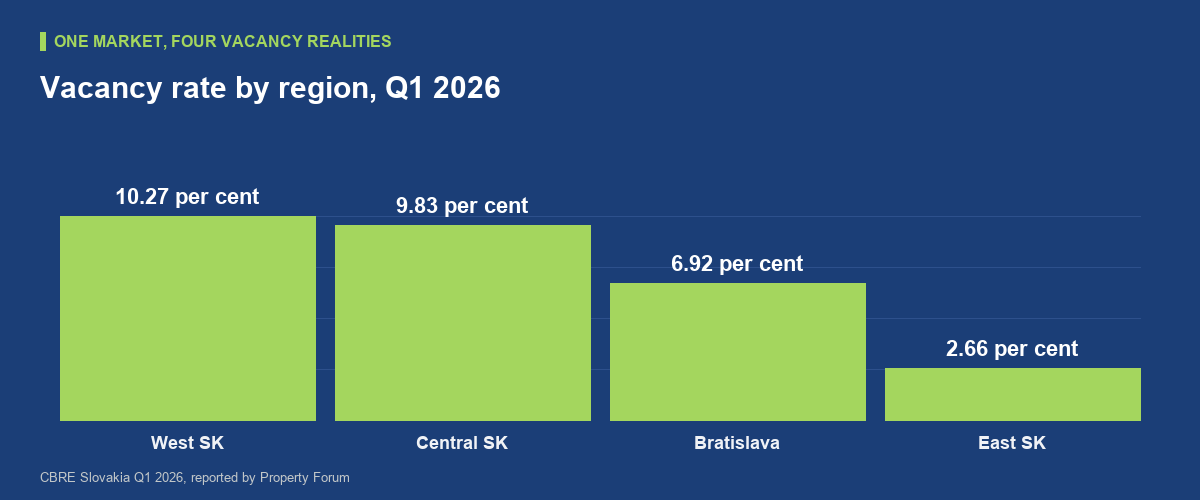
The corridor premium is a network effect, not a landlord conspiracy. Demand on the D1 is distribution demand: third-party logistics took 30 per cent of first-quarter leasing, e-commerce 17 per cent and retail 11 per cent (Property Forum) – operators whose business case is reach, and whose trucks need the motorway junction more than they need the cheapest slab. Because those occupiers cluster, the corridor also concentrates the behaviour that keeps rents firm: renegotiations made up 53 per cent of all first-quarter transactions and pre-leases another 26 per cent, meaning tenants overwhelmingly stay put or commit before buildings exist. Yet the premium coexists with the country’s highest vacancy rate – 10.27 per cent in western Slovakia and 9.83 per cent in the centre, against 6.92 per cent around Bratislava and just 2.66 per cent in the east – because that is where the speculative pipeline lands: 83,000 square metres delivered in the first quarter and 178,000 under construction. Empty new space on the corridor does not drag prime pricing down; it widens the gap between the best buildings and the rest, which is precisely the divergence the averages reveal.

Why the south trades at a discount – and why the gap narrows

Why the south trades at a discount - and why the gap narrows

The south’s discount is real, but so are its anchors. Jaguar Land Rover’s Nitra plant – a site of roughly 300,000 square metres opened in October 2018, with a planned capacity of 150,000 vehicles a year building the Discovery and the Defender (Wikipedia) – pulls a supplier ecosystem deep into the Nitra region, and automotive was the single largest demand sector in the country in the first quarter at 31 per cent of leasing (Property Forum). Dunajska Streda has grown into a rail-connected logistics hub in its own right, and the R1 and R7 expressways have shortened the distance argument that once justified much of the corridor premium. What keeps southern rents lower is the thinness of the market rather than the quality of the buildings: fewer institutional owners, fewer comparable lettings, and an exit that depends on one anchor industry. Investors price that liquidity risk into yields, lenders into terms, and both flow through to what a landlord must charge. For an occupier whose network tolerates it, that risk premium is a genuine saving – manufacturing tied to a plant does not care about a broad tenant pool. For a distribution operator who may need to exit or expand quickly, the discount can cost more than it saves.

Choosing a corridor in 2026: the occupier’s arithmetic

Choosing a corridor in 2026: the occupier's arithmetic

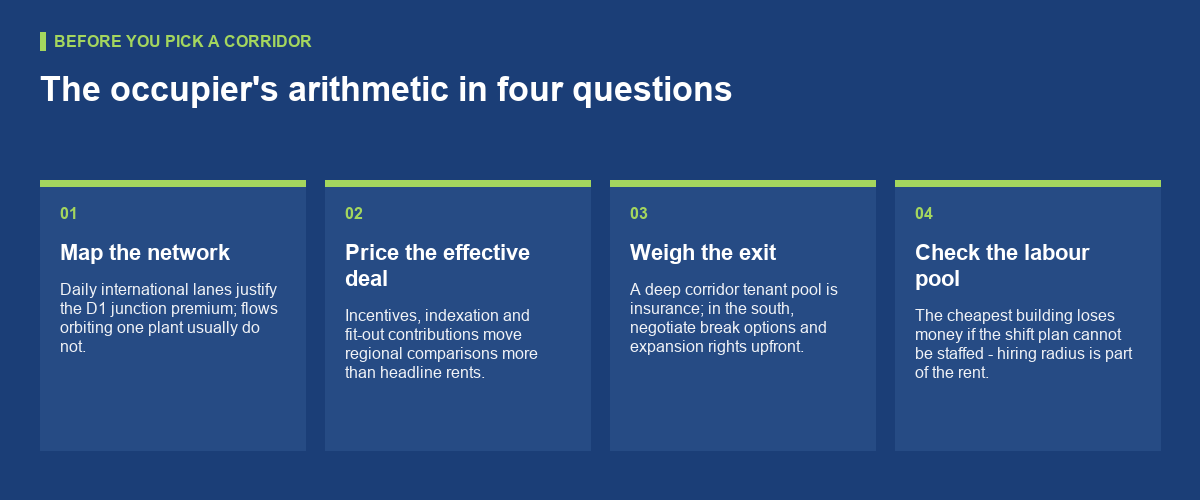
The current market hands occupiers an unusual amount of room to run this arithmetic properly. National vacancy stands at 8.12 per cent, leasing activity rose 47 per cent year on year to 136,000 square metres, and net demand 35 per cent to 59,000 (Property Forum) – a live market in which landlords still compete hard for signatures, as we argued in our review of a tenant’s market on the D1. The decision framework is straightforward. First, map the network: if your trucks run international lanes daily, the D1 junction premium usually pays for itself; if your flows orbit one plant or one border crossing, the south’s discount is money on the table. Second, price the effective deal, not the headline – incentives, indexation and fit-out contributions move regional comparisons more than quoted rents do, a gap our analysis of industrial rent levels quantifies. Third, weigh the exit: on the corridor you can reassign or sublet into a deep pool; in the south, negotiate break options and expansion rights upfront, because the building next door may not exist. Landlords face the mirror image – on the D1 the fight is specification against new supply; in the south it is proving liquidity to tenants who doubt it.

Conclusion

Slovakia’s rent map diverges because markets price more than concrete: they price liquidity, anchors and infrastructure. The D1 corridor charges for a deep tenant pool and motorway reach; the south discounts for thinness and single-industry exposure. Neither number is wrong, and neither is universally better – the right rent is the one attached to the corridor your network actually uses. In a year when vacancy sits above eight per cent and averages are falling, occupiers who do the geography homework will sign the best Slovak industrial deals in a decade.

Comparing locations on and off the D1? Talk to our team about industrial space across Slovakia – corridor by corridor, deal by deal.

Warehouse Automation in CEE: What Robotics Change about the Building Spec

Warehouse automation used to be a question for the operations director; in 2026 it has become a question for whoever signs the lease. Robot fleets change what a building must be able to do – the flatness of its floor, the capacity of its slab and frame, the electrical headroom behind its meters – and they change it before the first tote moves. With Europe’s automation spend on course to more than double by 2031, occupiers across Central and Eastern Europe are discovering that the building specification, not the software, decides how far the business case carries. This article walks through what robotics actually change about the industrial building – and what that means in Slovakia’s occupier-friendly market.

The spending curve: Europe’s automation market is doubling

The spending curve: Europe's automation market is doubling

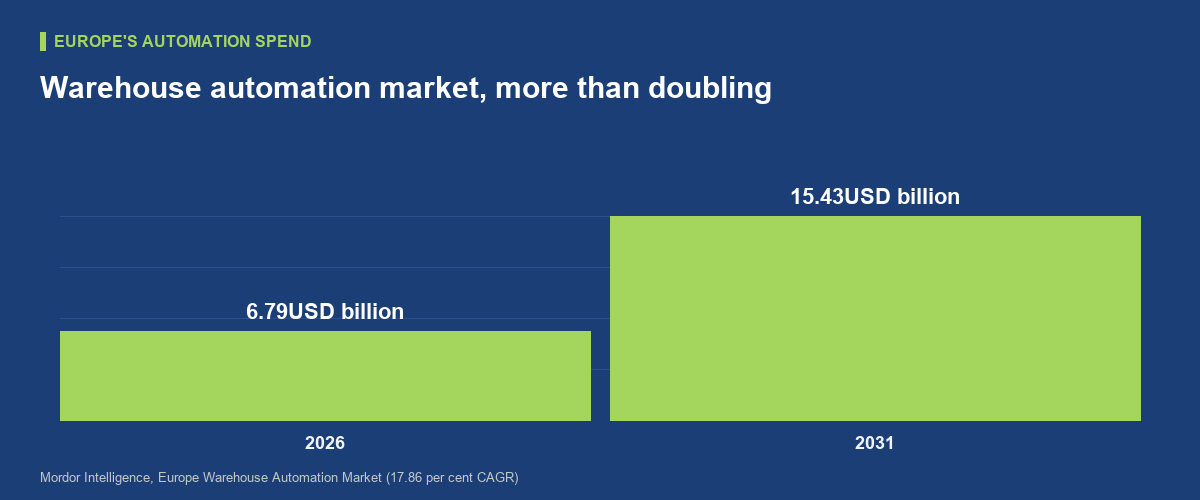
The direction of travel is not in dispute. Mordor Intelligence values Europe’s warehouse automation market at USD 6.79 billion in 2026 and forecasts USD 15.43 billion by 2031 – a 17.86 per cent compound annual growth rate (Mordor Intelligence). Germany alone accounted for 29.35 per cent of 2025 revenue, and the pattern across the continent is a west-to-east diffusion: the technology matures in the high-labour-cost markets and then follows the supply chains into CEE, where labour is scarcer every year and the buildings are newer. Two details in the data matter more for occupiers than the headline. First, e-commerce and grocery operators generated 32.45 per cent of 2025 revenue, but manufacturing is the fastest-growing end user at a forecast 19.15 per cent annual rate – and manufacturing is precisely what fills Slovak industrial parks. Second, sites below 10,000 square metres are the fastest-growing size class at 18.55 per cent a year, even though large sites above 40,000 square metres still carried 51.05 per cent of 2025 revenue. Automation is no longer a mega-shed phenomenon; it is spreading down the size curve into exactly the units most CEE occupiers actually lease.

Floors: the tolerance nobody sees until the robots arrive

Floors: the tolerance nobody sees until the robots arrive

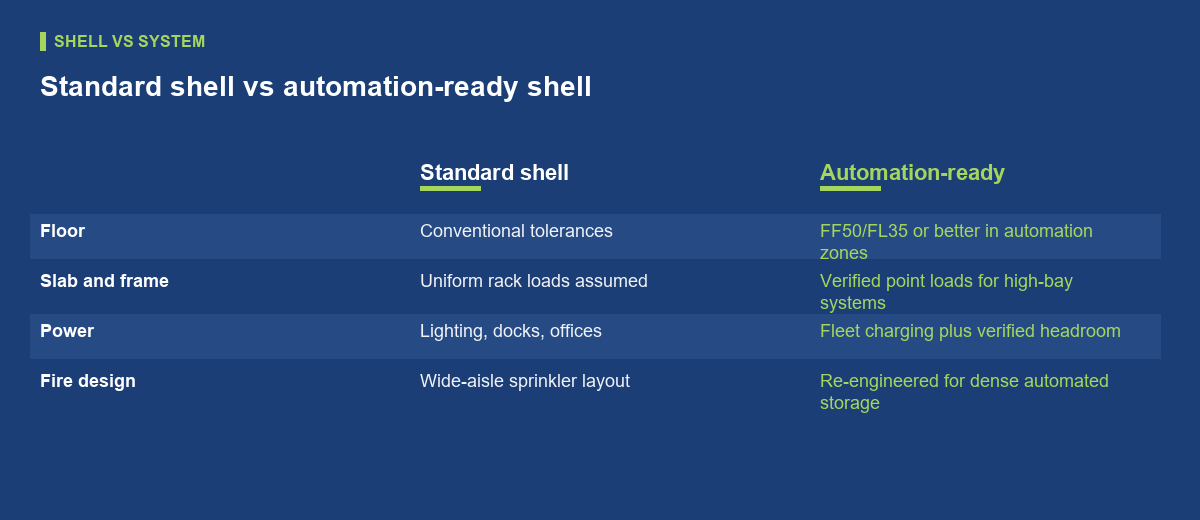
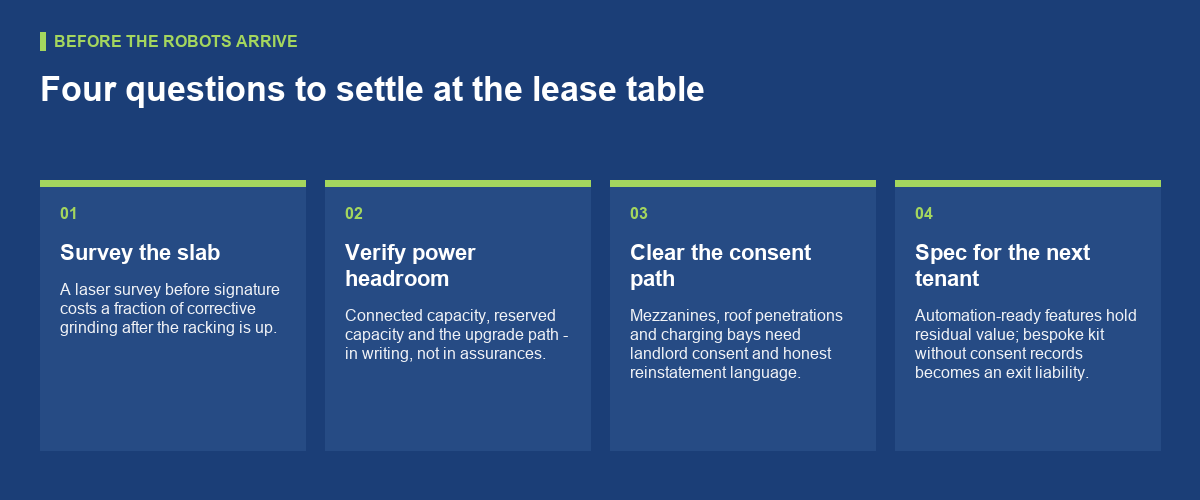
Every automated system stands, drives or racks on the same component: the slab. Autonomous mobile robots – at 36.20 per cent of the 2025 technology mix the largest single category in Europe (Mordor Intelligence) – navigate by sensors that assume the floor is a plane. It rarely is. Flooring specialists advise that automation zones should meet FF50/FL35 flatness and levelness tolerances or better, because slight waviness or elevation transitions between slabs can throw off sensors, cause vibrations and accelerate wear on drive components (Global Polishing Solutions). That is a materially tighter specification than a conventional shell assumes, and in Europe the conversation quickly reaches the measurement regime of DIN 18202 and, for very narrow aisle systems, defined-movement tolerances along the actual travel paths. The commercial point for occupiers: verify before you sign. A laser survey of the slab costs a fraction of what corrective grinding costs after the racking is up, and joints – where wheels cross a discontinuity thousands of times a day – deserve as much attention as the panels between them. High-bay storage adds the structural dimension: automated racking concentrates point loads the original slab design may never have contemplated.

The vertical consequences: height, structure and fire

Automation pushes buildings upwards. Shuttle systems and automated storage lift goods far higher than a reach truck comfortably works, which turns clear height from a nice-to-have into the variable that decides how much inventory a given footprint can hold. The consequences cascade through the structure. Taller, denser storage means heavier point loads into the slab and foundations; conveyor systems and sortation decks hang capacity demands into a roof structure that was sized for insulation and services; pick towers and mezzanine levels insert whole steel structures that need their own permits and their own fire engineering. Fire design is the discipline most often underestimated. Dense automated storage changes how a fire develops and how sprinklers must respond, and a system designed for wide-aisle pallet racking will usually need re-engineering – in-rack protection, revised head layouts, sometimes a different design standard altogether – before an insurer signs off an automated scheme. None of this is a reason to avoid automation; all of it is a reason to involve the landlord, the structural engineer and the insurer before the integrator finishes the layout. The building sets the ceiling, in both senses, on what the robots can deliver.

Power and data: the new utility question

A conventional warehouse draws power for lighting, dock doors and offices; an automated one adds a fleet that charges around the clock and control systems that must never brown out. Charging bays concentrate demand into short windows, peak loads rise, and suddenly the question is not the unit rate but whether the site connection has headroom at all – the constraint we examined in detail in our analysis of power capacity in Slovakia, where grid access has become a site-selection factor in its own right. Occupiers evaluating a building for automation should ask for the connected capacity, the reserved capacity and the upgrade path in writing, and treat a vague answer as a finding. Data infrastructure is the quieter sibling of the same issue: robot fleets coordinate over wireless networks that must cover every aisle, cold corner and mezzanine deck without dead zones, and the racking itself reshapes radio coverage as it fills. The practical consequence is cabling routes, antenna positions and server room space that belong in the fit-out design from day one – and in the consent conversation with the landlord, because punching cable trays through a roof deck retrospectively is exactly the kind of alteration that surfaces again in the reinstatement negotiation at exit.

What warehouse automation means for Slovak occupiers and landlords in 2026

What warehouse automation means for Slovak occupiers and landlords in 2026

Slovakia’s market is currently structured in the occupier’s favour, and that shapes the automation conversation. CBRE’s first-quarter 2026 figures, reported by Property Forum, show total leasing of 136,000 square metres, up 47 per cent year on year, net leasing of 59,000 square metres, up 35 per cent, and a vacancy rate of 8.12 per cent – up 31 basis points on the quarter – across a modern stock of 4.87 million square metres, with prime rents around EUR 5.95 per square metre per month (Property Forum). The regional spread is wide: 10.27 per cent in western Slovakia and 9.83 per cent in the centre, against 6.92 per cent around Bratislava and just 2.66 per cent in the east. For occupiers, empty space is negotiating power: renegotiations already make up 53 per cent of transactions and pre-leases another 26 per cent, which means landlords are competing hardest exactly where automation clauses are agreed – at renewal and at pre-lease. This is the moment to write the automation agenda into the lease: slab surveys and floor tolerances, verified power headroom, consent frameworks for mezzanines and roof penetrations, and realistic reinstatement language. Where requirements outgrow the standard shell, a built-to-suit project prices the specification honestly from the start – our review of industrial rent levels shows how wide the gap between headline and effective terms already runs. Landlords hold the mirror image of the argument: as new supply – approximately 83,000 square metres delivered in the first quarter alone – competes for tenants, an automation-ready specification is becoming the cleanest way to differentiate stock.

Conclusion

Warehouse automation is usually bought as technology and delivered as construction. The robots are the visible part; the decisive parts are a slab flat enough to navigate, a structure strong enough to load, a fire concept an insurer will sign, and a power connection with headroom. Occupiers in Slovakia negotiate all of that most cheaply now, while vacancy sits above eight per cent and landlords compete on flexibility. The specification you secure at signature – not the fleet you buy later – sets the limit on what automation can return.

Planning an automation project – or looking for a building that can carry one? Talk to our team about automation-ready industrial space in Slovakia.

Exit Strategies for Tenants: Break Options, Assignment and Subletting under Slovak Law

Exit strategies for tenants are the part of a Slovak industrial lease that gets the least attention on signing day and the most attention three years later. A lease that runs its full term costs exactly what the rent schedule says; a lease that has to end early costs whatever the exit clauses allow – and under Slovak law, the statutory default allows very little. This article walks through the three routes out of a lease before its term ends – break options, assignment and subletting – what Act No. 116/1990 Coll. actually permits, and what occupiers should negotiate while the market still favours them.

Why exit flexibility is negotiated in good times

The paradox of exit rights is that they are cheapest exactly when they feel least necessary. Slovakia’s industrial market is currently generous to occupiers: CBRE’s first-quarter 2026 figures, reported by Property Forum, show total leasing of 136,000 square metres, up 47 per cent year on year, vacancy of 8.12 per cent across a modern stock of 4.87 million square metres, and prime rents around EUR 5.95 per square metre per month (Property Forum). In a tenant’s market, landlords compete on incentives – and flexibility is an incentive like any other, negotiable at the same table as the rent-free months and the fit-out budget. The problem the flexibility solves is a mismatch of horizons. Institutional leases in Slovakia commonly run five to ten years, while the supply chains inside them are redrawn far faster: nearshoring decisions, automation projects and customer wins or losses can double or halve a space requirement inside two years. Our review of warehouse lease terms in Slovakia shows how much of the contract is negotiable at signature; the industrial rent levels analysis shows what the headline figures hide. The same logic applies to leaving: the exit is drafted at entry, or it does not exist.

The statutory baseline: what Act No. 116/1990 actually allows

The statutory baseline: what Act No. 116/1990 actually allows

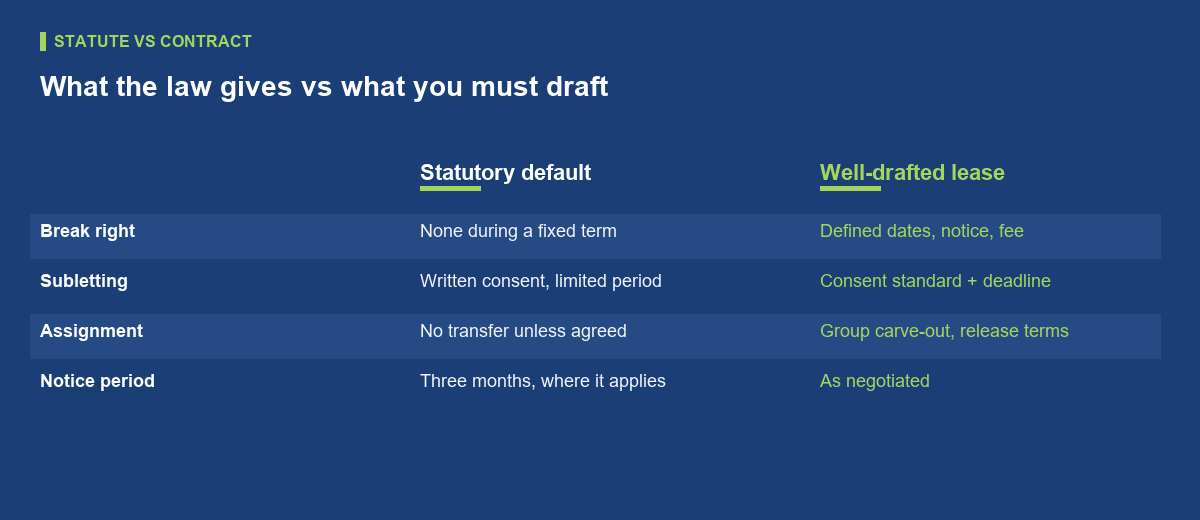
Slovak commercial leases live under two layers of law: the Civil Code, Act No. 40/1964 Coll. as the general regime, and Act No. 116/1990 Coll. on the lease and sublease of non-residential premises for anything used for business, commercial, administrative or storage purposes (CEE Legal Matters). The statute was built for stability, not flexibility. A fixed-term lease simply ends when the term expires; before that date, the landlord can terminate early only on a short list of enumerated grounds – the tenant using the premises contrary to the agreement, rent unpaid for more than one month, unauthorised subletting, or the building facing alteration or demolition, among others (DLA Piper REALWORLD). Where notice applies at all, the default period is three months, unless the parties agree otherwise. What the statute does not contain is any general right for a tenant to walk away from a fixed term because the business changed. There is no statutory break, no implied right to hand the lease onwards, and no consent standard a landlord must meet. Every usable exit route in a Slovak lease is therefore a creature of contract – which is precisely why the drafting matters more here than in jurisdictions whose statutes do more of the work.

Break options: flexibility you must write in

A break option is the cleanest exit: a contractual right to end the lease at a defined point before the term expires. Because the statute provides nothing of the kind, a break exists only if it is written into the lease – and its mechanics decide whether it is real or decorative. The anatomy is standard. Fixed break dates or a rolling window define when the right can be exercised; a notice period, measured in months rather than weeks, gives the landlord time to remarket; conditions precedent – no arrears, vacant possession, sometimes completed reinstatement – define what a valid exercise requires; and a break fee prices the landlord’s loss. That fee is not spite but arithmetic: incentives such as rent-free periods and fit-out contributions are amortised across the full term, and a tenant leaving at year five of ten walks away from half the period that was meant to pay them back. Occupiers should press for conditions that are objective and few – a break conditional on perfect compliance with every covenant is a break the landlord can usually defeat. And the timing interlocks with the handback: an underestimated reinstatement obligation can quietly disable a break that looked solid on paper.

Assignment and subletting: the consent gate

Assignment and subletting: the consent gate

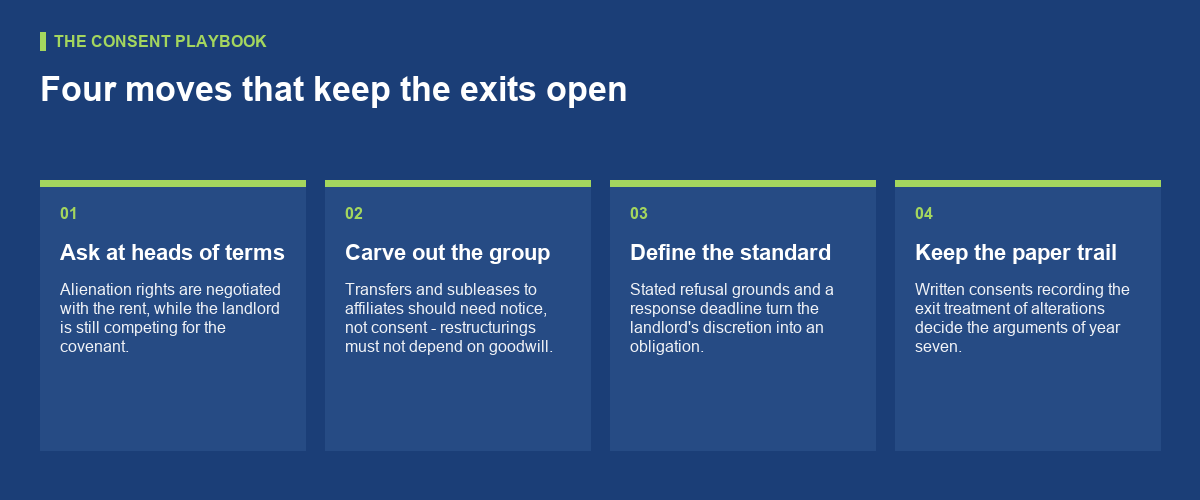
The second and third routes pass the space to someone else – entirely, by transferring the lease, or partially, by putting a subtenant underneath it. Here the statute speaks, and it speaks strictly. A tenant may sublet non-residential premises only with the landlord’s written consent and only for a limited period; subletting without consent is itself a statutory ground for the landlord to terminate the lease early (DLA Piper REALWORLD). A transfer is gated from the other side: under Slovak law a lease cannot be transferred unless the parties have agreed otherwise, so any change of tenant needs the landlord’s prior consent and cooperation (CMS), in practice documented in a trilateral agreement that also settles whether the outgoing tenant is released or stays on as guarantor. Crucially, the statutory default sets no standard for consent – no duty to be reasonable, no deadline, no obligation to give grounds. The discipline has to be negotiated: a carve-out for transfers within the corporate group, a consent standard with stated refusal grounds, a response period, and written consents that record the exit treatment of alterations. Institutional landlords process such requests routinely, but only the lease text turns their goodwill into an obligation.

Exit strategies for tenants in practice: the sublease market and the playbook

Exit strategies for tenants in practice: the sublease market and the playbook

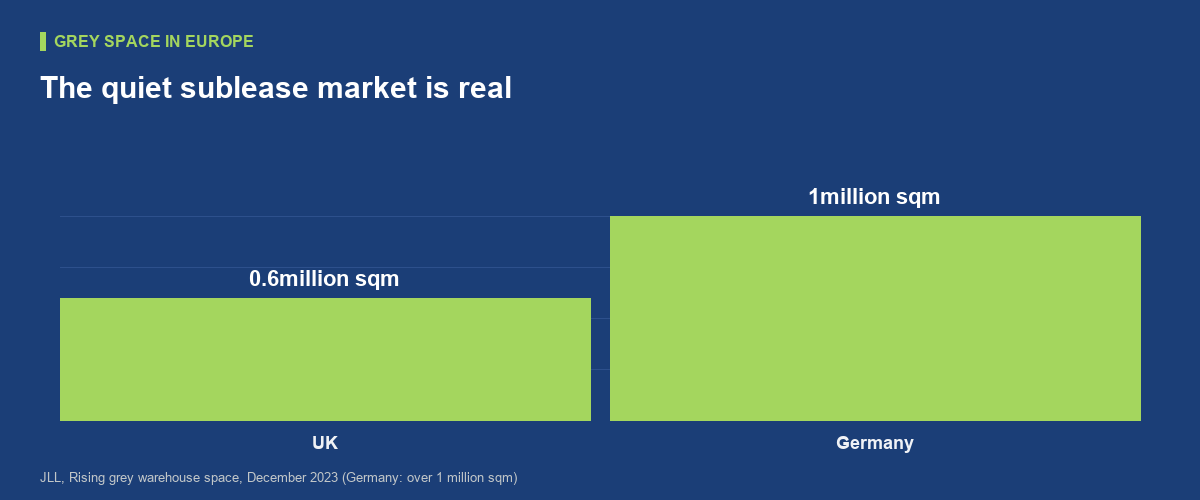
What do these routes deliver when space actually turns surplus? Europe’s quiet sublease market – grey space – gives the honest benchmark. JLL measured it at around 600,000 square metres in the UK and over 1 million square metres in Germany as of December 2023, noted that occupiers increasingly scan sublease availability before approaching the wider market, and judged that grey space is unlikely to move prime rental levels significantly (JLL). Slovakia’s version of that market is smaller and quieter still: surplus bays move through agents rather than portals, subleases rarely recover the full head rent, and a transfer usually needs a corporate event – an acquisition, a carve-out, a country exit – to supply the incoming tenant. The playbook for occupiers follows from everything above. Negotiate the break, the group carve-out and the consent standard at heads of terms, while the landlord is still competing for the covenant. Align the first break date with the amortisation of the incentives, so the fee conversation is short. Keep the paper trail – consents, condition records, alteration approvals – centralised from day one. And when surplus space appears, start the consent conversation with the landlord twelve months early: the tenant who asks in good time negotiates, the one who asks late pleads.

Conclusion

Slovak lease law gives occupiers stability and almost nothing else: fixed terms bind until expiry, subletting needs written consent, and a lease transfers only if the contract says so. Exit strategies for tenants are therefore drafted, not discovered – in the break clause, the alienation provisions and the consent standards agreed at signature. With vacancy above eight per cent and landlords competing hard for occupiers, 2026 is the moment to write those routes in. The lease you sign in a tenant’s market is the one you will have to live with when the market turns.

Negotiating a new lease – or sitting inside one that no longer fits? Talk to our team about building exit routes into your next Slovak lease.

Cold Storage in CEE: Why Capacity Lags Demand

Cold storage in CEE is the strange corner of the logistics market where demand compounds every year and supply still barely moves. The region’s cold chain turns over more than twenty billion dollars annually, pharmaceutical flows are growing faster than any other application, and yet an occupier who needs 10,000 square metres of chilled space in Slovakia will find almost nothing standing empty – in a market whose overall vacancy sits above eight per cent. This article follows the money to explain the gap: what drives demand, why developers hesitate, what energy really costs, and how occupiers should respond in 2026.

The demand side: food, pharma and the compounding cold chain

The demand side: food, pharma and the compounding cold chain

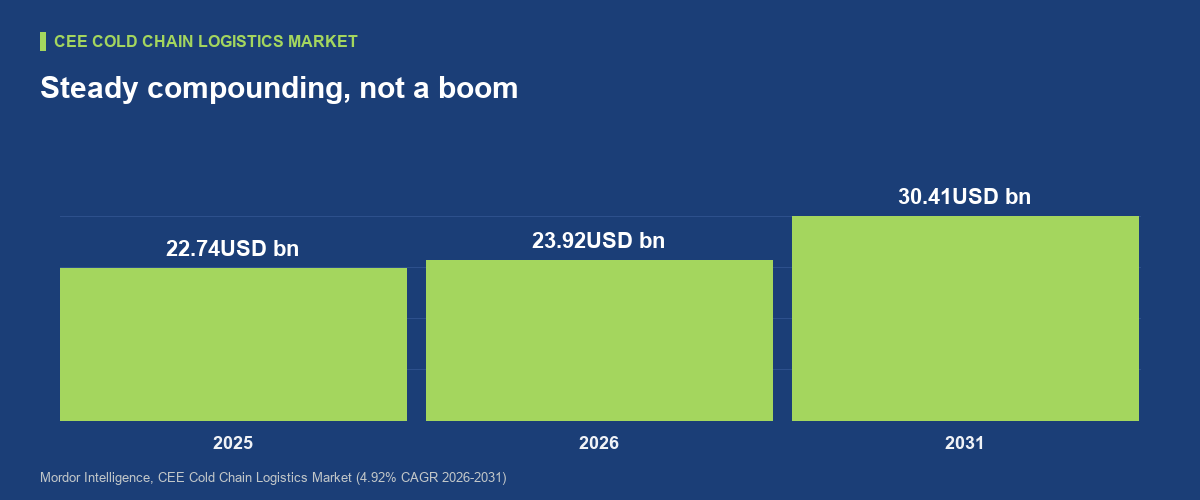
The demand numbers are not dramatic, and that is exactly their strength. Mordor Intelligence sizes the Central and Eastern European cold chain logistics market at USD 22.74 billion in 2025, rising to a projected USD 23.92 billion in 2026 and USD 30.41 billion by 2031, a compound rate of 4.92 per cent (Mordor Intelligence). Beneath the headline, the mix is shifting towards the expensive end. Chilled storage between zero and five degrees holds 45.1 per cent of revenue, but the frozen segment is accelerating at 6.11 per cent a year, and pharmaceuticals and biologics form the fastest-growing application of all at 6.73 per cent – flows that demand validated, documented, always-on cooling rather than a chilled corner of a dry hall. Geography tells the same story of catch-up: Romania leads the region with 33.72 per cent of revenue, while Poland grows fastest at 5.43 per cent a year. None of this is cyclical demand that arrives with a boom and leaves with a downturn. People eat, medicines need cold, and grocery supply chains keep consolidating – which is why cold chain revenue compounds through exactly the kind of soft leasing years that empty ordinary warehouses.

Why supply lags: the economics of building cold

Why supply lags: the economics of building cold

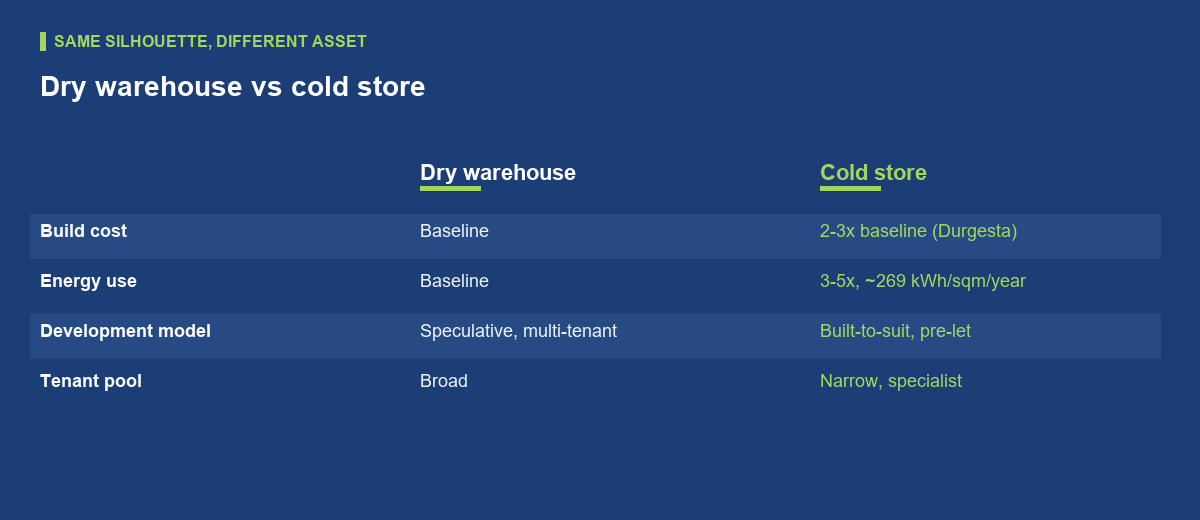
If demand is steady, why does supply not simply follow? Because a cold store is a different asset wearing a warehouse’s silhouette. Construction analysis by Durgesta puts the cold room itself at 110 to 235 euros per square metre depending on the temperature regime – fruit and vegetable rooms at the bottom, pharmaceutical and controlled-atmosphere rooms at the top – and a complete cold storage facility at 2 to 3 times the cost of a conventional warehouse (Durgesta). The premium buys insulated envelopes, refrigeration plant, reinforced slabs, vapour barriers and doors that behave like airlocks. That capital intensity breaks the speculative model the region’s logistics boom was built on. A developer who builds a standard hall can lease it to almost anyone; a developer who builds a minus-25 freezer store has narrowed the tenant pool to a handful of operators before the slab is poured. Worse, the fit-out is specific: the racking, the temperature zoning, the dock configuration all follow one user’s flows. So speculative cold space is almost never built, and nearly every new cold facility in CEE arrives as a built-to-suit with a pre-committed tenant and a lease long enough to amortise the plant.

Energy: the operating cost that shapes everything

The second brake on supply is not the building but the meter. A cold store consumes about 269 kWh per square metre per year – roughly 3 to 5 times the energy of a conventional warehouse – and refrigeration alone accounts for 70 to 80 per cent of the electricity bill (Durgesta). Across the sector, energy absorbs an estimated 15 to 18 per cent of a cold operator’s revenue, which makes it the single largest operating expense and the line item that decides whether a facility is viable at all. For site selection the consequences are blunt. Power capacity at the plot matters more than the rent: a cold user needs a grid connection measured in megawatts, and in Slovakia grid capacity has already become a binding constraint on industrial development generally. Tariff structure matters almost as much, since refrigeration loads can flex into cheaper off-peak hours and thick insulation lets a well-run store ride through price peaks. And every euro per megawatt-hour of difference between two national grids quietly moves cold chain investment across borders, because no other warehouse type carries so much electricity in its cost base. Cheap land with a weak connection is, for this asset class, expensive land.

Cold storage in CEE and Europe: where capacity actually stands

Seen from the capacity statistics, Europe’s cold chain looks like a growth story, not a shortage. The Global Cold Chain Alliance’s 2026 Top 25 list puts the world’s largest operators at a combined 7.76 billion cubic feet, up 6.3 per cent in a year and 41.2 per cent since 2021 – and Europe’s top operators grew their capacity by about 90 per cent over six years, the fastest expansion of any region (GCCA). Both readings are true at once, and the reconciliation matters. The growth comes off a low base, it is concentrated in the hands of a consolidating group of specialist operators, and much of it lands in western European gateway markets rather than in CEE. Capacity is also not fungible the way dry space is: a chilled meat facility in Rotterdam does nothing for a pharma distributor in Kosice. So the region can post the fastest capacity growth in the world and still leave a mid-sized occupier in Slovakia without a single standing chilled option on the shortlist. Growth is real; availability is local, specific and mostly pre-let before construction starts. That distinction is the whole cold storage market in one sentence.

What the gap means in Slovakia: occupiers and developers

What the gap means in Slovakia: occupiers and developers

Slovakia illustrates the mismatch precisely because its dry market is currently comfortable. CBRE’s first-quarter 2026 figures, reported by Property Forum, show total leasing of 136,000 square metres, up 47 per cent year on year, overall vacancy of 8.12 per cent across a modern stock of 4.87 million square metres, and prime rents around EUR 5.95 per square metre per month (Property Forum). An occupier of dry space negotiates from strength. An occupier of cold space does not: the vacancy that matters to them rounds to zero, and in eastern Slovakia even general vacancy sits at just 2.66 per cent. The practical playbook follows from the economics. Occupiers should treat cold requirements as build-to-suit projects with two-year lead times, secure the power connection before the land, and expect leases long enough to carry the plant – ten years is the entry ticket, not a concession. Developers holding well-connected plots near food production, pharma manufacturing or grocery distribution hubs are sitting on scarce raw material: the industrial rent levels of dry space no longer describe what a committed cold tenant will pay for the right site. The gap between capacity and demand is not closing quickly – and for both sides of the deal, that is the opportunity.

Conclusion

Cold storage in CEE lags demand for reasons that are structural, not cyclical: a building that costs 2 to 3 times its dry neighbour, an energy bill that claims up to 18 per cent of revenue, and a speculative development model that cannot carry either. Demand, meanwhile, compounds quietly through food, frozen and pharmaceutical flows that do not care where the leasing cycle stands. For occupiers the lesson is to start early, buy power before space, and treat the lease as project finance. For developers and investors it is that the scarcest asset in the region’s logistics market is not another hall on the D1 – it is a grid-connected plot where cold can actually be built.

Weighing a chilled build-to-suit against converting existing space? Talk to our team about what cold capacity really costs on your corridor.