
Every rent quote for a Slovak warehouse arrives with a tax line, and almost nobody asks where it comes from. VAT on industrial leases is not a rate that applies automatically. The letting of a building is exempt by default, and the 23 per cent on your invoice is there because the landlord decided it should be. Since 2019 that decision is only available where the tenant is a taxable person, and behind it sits a twenty year clock on the landlord’s own deduction. This is why the question about your tax status often arrives before the question about your covenant, and why two tenants can be quoted differently for the same unit.
Why VAT on industrial leases is a decision, not a rate
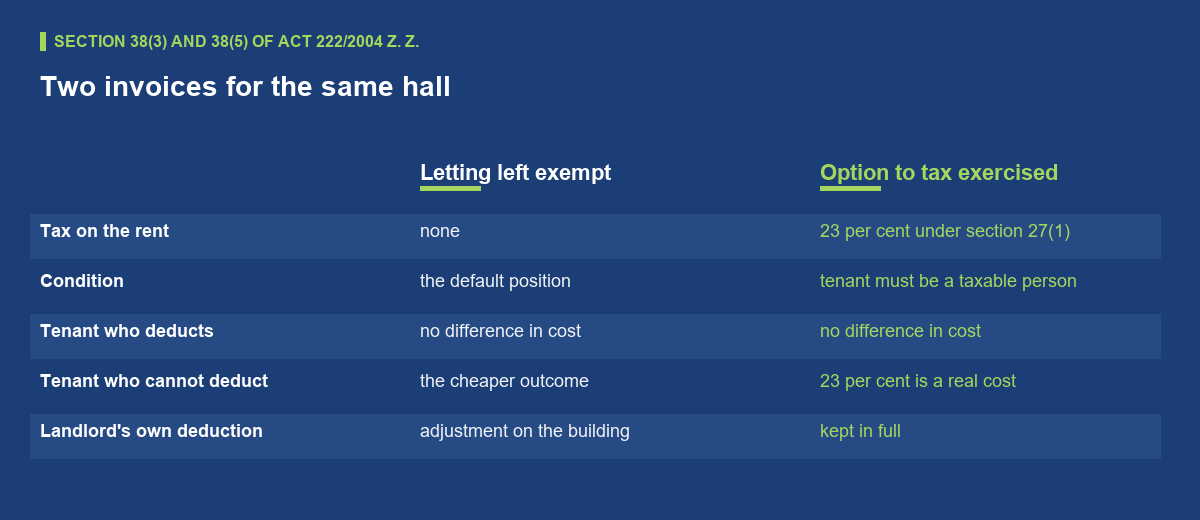
The starting point is in the Slovak VAT Act. Under section 38(3) of Act 222/2004 Z. z., in the consolidated version in force for 2026, the letting of immovable property is exempt from tax. Four things are carved out of that exemption and stay taxable in every case: accommodation services, the letting of spaces and places for parking vehicles, the letting of permanently installed equipment and machinery, and the letting of safe deposit boxes.
Section 38(5) then gives the landlord a choice. A taxable person letting a property to another taxable person may decide that the letting will not be exempt, which puts the standard rate of 23 per cent under section 27(1) on the rent. The wording matters twice over. The choice belongs to the landlord, not to the tenant. And it exists only where the tenant is a taxable person, so a body that is outside the scope of VAT cannot be charged tax on the rent at all.
Older buildings can behave differently for a reason that has nothing to do with the building. Under the transitional rule in section 85kg(5), the 2019 version of section 38(5) applies to leases concluded after 31 December 2018 where the property was handed over after that date. A lease signed before that sits under the older regime, which is worth knowing before you assume an assignment simply carries the same treatment across.
The parts of the rent that were never exempt
The four exceptions in section 38(3) are not academic in an industrial park. Letting spaces and places for parking vehicles is taxable, and a hall usually comes with a yard. Where the lease prices the truck court, the trailer bays or the car park as a separate item, that item carries tax on its own footing, whatever the landlord decided about the hall.
The same applies to permanently installed equipment and machinery. A class A unit is rarely an empty box: dock levellers, racking supplied by the landlord, a sprinkler system contributed as part of a fit-out contribution, a compressor plant. Where those are let rather than owned by the tenant, they belong to the taxable side of the invoice.
Section 38(6) extends the whole regime to subleases. A tenant who sublets surplus space, the situation behind most grey space, is making the same decision as a landlord and is bound by the same condition about the subtenant. That is a point worth settling in the assignment and subletting clause rather than discovering it when the first sublease invoice goes out.
The twenty year clock behind the landlord’s answer
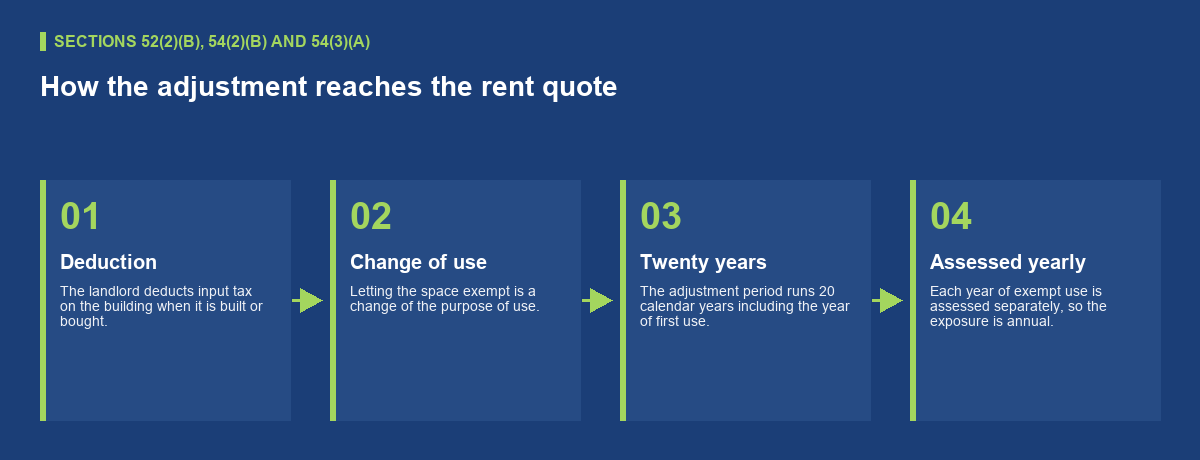
The reason a landlord cares so much about the tenant’s tax status sits two sections further on. A building is investment property under section 54(2)(b), and the period for adjusting deducted tax on it is 20 calendar years under section 52(2)(b), including the year of first use. Letting the space exempt is a change of the purpose of use within the meaning of section 54(3)(a), because the property is then used for supplies without the right to deduct.
The consequence is an annual assessment. For each calendar year in which the purpose has changed, the landlord adjusts the tax deducted on the building, and the adjustment is calculated per year against the remaining part of the period. On a building where one million euro of input tax was deducted, one year of exempt letting therefore moves roughly one twentieth, or about 50,000 euro, in the wrong direction. That figure is our own arithmetic on a round number, not a quoted case, and the statute rounds and thresholds it in ways an adviser has to run properly.
Seen from that side, the screening question is rational rather than rude. A landlord underwriting a cap rate on stabilised net operating income is not going to accept an unpriced twenty year exposure for one tenant, which is also why the answer rarely changes after the heads of terms are signed.
The tenant who cannot deduct
Most industrial occupiers never feel any of this, because they deduct the tax and it washes through. The exceptions are the tenants whose own output is exempt or outside the scope: financial and insurance businesses, healthcare and education providers, public bodies acting as authorities, and foreign entities that are not registered in Slovakia. For them the tax on the rent is not a cash flow item, it is a cost.
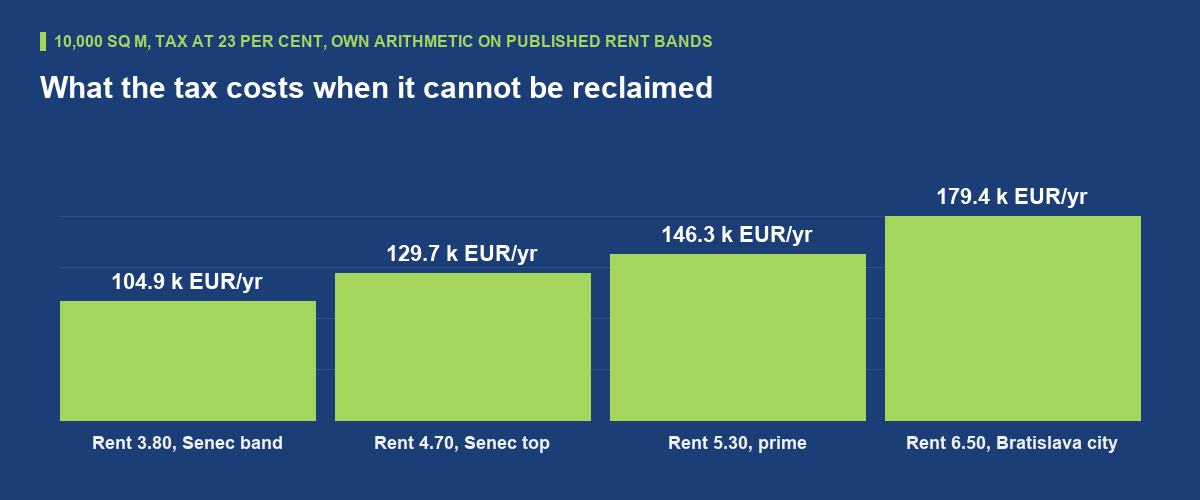
The size of it is easy to state. At the prime rent of EUR 5.30 per square metre per month reported in the second quarter of 2026, a 10,000 square metre unit costs EUR 636,000 a year, and 23 per cent of that is EUR 146,280 a year that never comes back. In the cheaper submarkets the same calculation runs from about EUR 104,880 at EUR 3.80 to EUR 179,400 at the top of the Bratislava city band. That is our own arithmetic on the published rent bands, not a quoted transaction. It is also worth remembering that a logistics quotation prices the same space in a different unit, the pallet position, with the building cost already inside the price, so the tax question attaches to the rent and not to that comparison.
What follows is a negotiation, not a complaint. A tenant in that position should price the rent gross from the first offer, treat it the way an effective rent calculation treats incentives, and take it into the term discussion: the longer the term, the more a difference of a few cents in headline rent is dwarfed by the tax question.
Service charges and utilities are a separate question
The next line on the invoice follows different rules. In Case C-42/14 Wojskowa Agencja Mieszkaniowa, decided on 16 April 2015, the Court of Justice held that the letting of immovable property and the water, electricity, heating and refuse collection that accompany it must in principle be regarded as several distinct and independent supplies. They are treated as one supply only where the elements are so closely linked that splitting them would be artificial.
The criteria are practical ones. Where the tenant can decide on consumption, where meters record it individually and the invoice itemises it, the supply is separate. Where the tenant has no choice of supplier and no influence on consumption, it tends to follow the letting. In a Slovak industrial park that puts metered electricity and gas on one side and the pooled costs of the estate, the ones a service charge collects, on the other.
For a tenant who deducts, this is administration. For a tenant who does not, it decides real money, and it is worth agreeing in writing which items are billed as metered supplies and which are recharged as part of the letting, before the first annual reconciliation rather than during it.
Conclusion
None of this is exotic tax planning. It is one decision by the landlord under section 38(5), a handful of items that were never exempt under section 38(3), and a twenty year adjustment period that explains why the decision is taken so seriously. An occupier who deducts can note it and move on. An occupier who cannot deduct should raise it at the heads of terms stage, because by the time the lease is engrossed the landlord’s position is usually fixed and the only remaining variable is the rent itself.