
Fit-out depreciation in Slovakia is the item that gets settled last in a lease negotiation and paid for longest afterwards. Racking, a mezzanine floor, an office block inside the hall, upgraded power, a sprinkler change: the occupier signs the contractor’s invoice and books it as the cost of moving in. The Income Tax Act sees something else. Above a threshold of EUR 1,700 in a tax period the works stop being an expense and become an asset, the asset runs on the building’s clock rather than the lease’s, and on the last day of the term the part nobody managed to write off reappears on the other party’s tax return.
What fit-out depreciation in Slovakia actually attaches to
The starting point is section 29(1) of the Income Tax Act, Act 595/2003 Z. z.. Technical improvement is expenditure on completed superstructures, extensions, built-in works, building modifications, reconstructions and modernisations exceeding EUR 1,700 in aggregate per tax period for the individual asset. Section 29(4) defines reconstruction as an intervention that changes the purpose of use, the qualitative performance or the technical parameters, and adds that swapping a material for one with comparable properties is not a change of parameters. Section 29(5) defines modernisation as adding equipment or usability the original asset did not contain.
That wording is where most fit-out packages split in two. Replacing a worn dock leveller with an equivalent unit is a repair and goes through the profit and loss account in the year it happens. Cutting a new dock into the wall, adding a mezzanine, converting part of the hall into offices or upgrading the sprinkler system to a different hazard class changes the parameters, and the invoice becomes capital.
The threshold is per tax period and per asset, so a package delivered in stages can fall on either side of it. Section 29(2) lets a taxpayer treat expenditure below EUR 1,700 as technical improvement anyway if it prefers to. Section 22(6)(d) then makes technical improvement of leased property above EUR 1,700 that is carried out and depreciated by the tenant a category of property in its own right, which is what allows a tenant to depreciate something it does not own.
Who is allowed to write it off
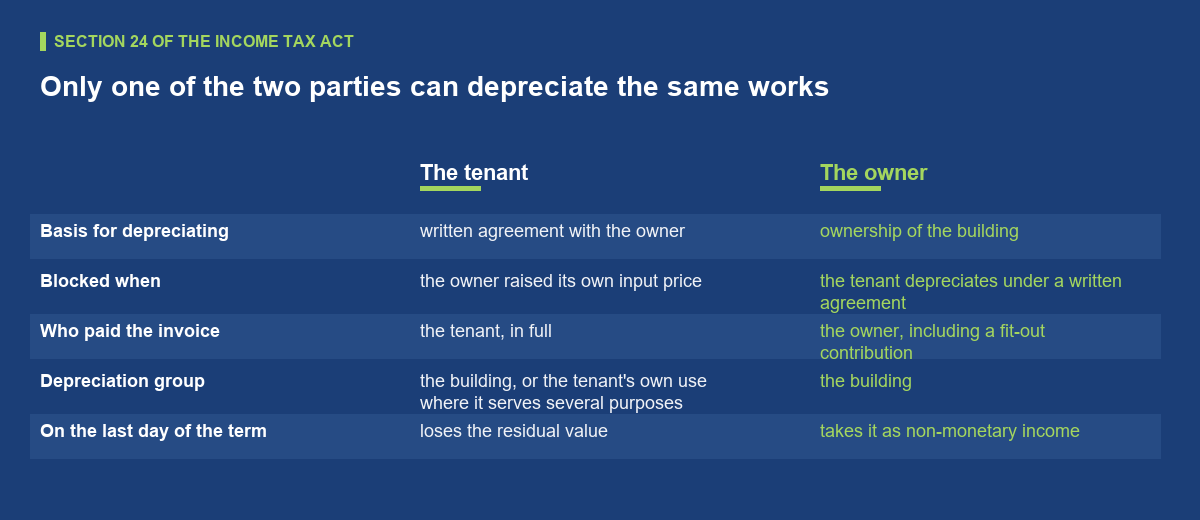
Section 24(1) sets the default: the taxpayer that holds the ownership right depreciates the asset. Section 24(2) opens the exception that matters in every lease of industrial space. Technical improvement of leased tangible property paid for by the tenant may be depreciated by the tenant on the basis of a written agreement with the owner, provided the owner has not increased the input price of the building by those expenses.
Two conditions, one document, and both conditions are easy to lose. A lease that is silent on the works leaves the tenant with a capital sum it cannot depreciate at all, because a written agreement is the statutory gateway rather than a formality. An owner that quietly capitalises the same works into its own input price closes the gate from the other side, and the two parties then discover the conflict in the year the tax returns are prepared rather than in the year the works were done.
The money flow decides less than the paperwork does. Where the landlord funds part of the works through a fit-out contribution, the part it paid for is its expenditure and not the tenant’s. Our post on what occupiers actually sign puts those contributions at EUR 20 to 50 per square metre in the current market, which on a 10,000 square metre unit is enough to decide who is capitalising what. The point belongs in the heads of terms, not in the final drafting round.
The clock belongs to the building, not to the lease
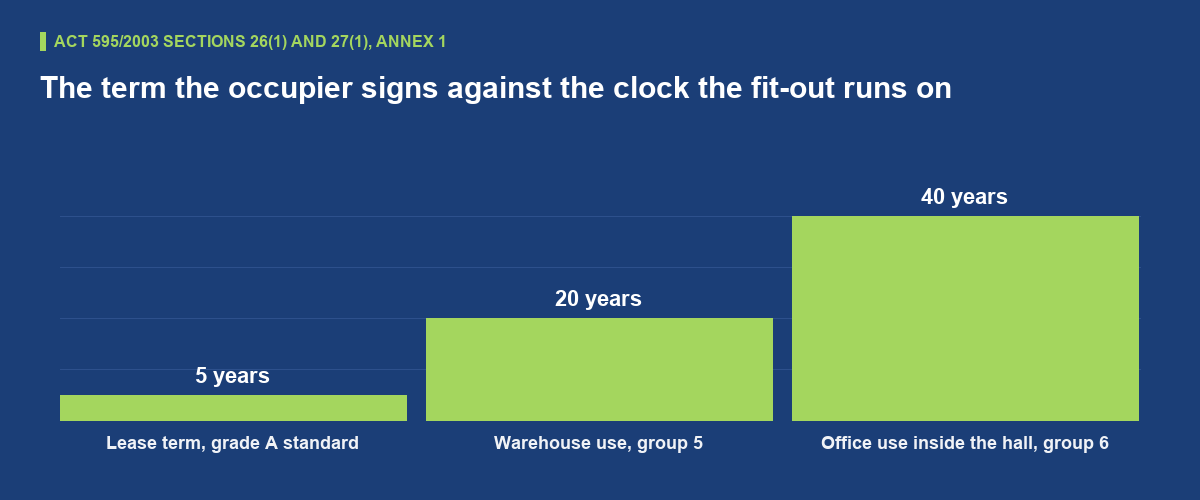
Section 24(2) also fixes the period, and it does so without looking at the lease. The tenant places the technical improvement in the depreciation group in which the leased asset sits. Section 26(1) sets those groups: group 5 runs 20 years and group 6 runs 40. Under Annex 1 to the Act, group 5 item 5-1 covers buildings other than the codes listed in group 6, and group 6 lists residential buildings, hotels, buildings for administration under code 1220 of the building classification, buildings for culture, education and health, and other non-residential buildings under code 127. A warehouse sits under code 125 and therefore in group 5. Section 27(1) then allows one twentieth a year on a straight line, and section 27(2) gives the first year only the months from the month the works were put into use.
Set that against the term. For speculative grade A space five years remains the institutional standard in Slovakia. Five full years of a twentieth is a quarter of the fit-out, which means three quarters of it is still sitting on the tenant’s balance sheet on the day the keys go back.
The last sentence of section 24(2) is the part occupiers rarely see coming. Where the building serves several purposes under section 26(2), the tenant classifies its technical improvement by the purpose for which the tenant uses the leased property. An office block fitted out inside a warehouse is administration, code 1220, group 6. The same EUR 400,000 then runs at one fortieth a year instead of one twentieth.
What happens on the last day of the term
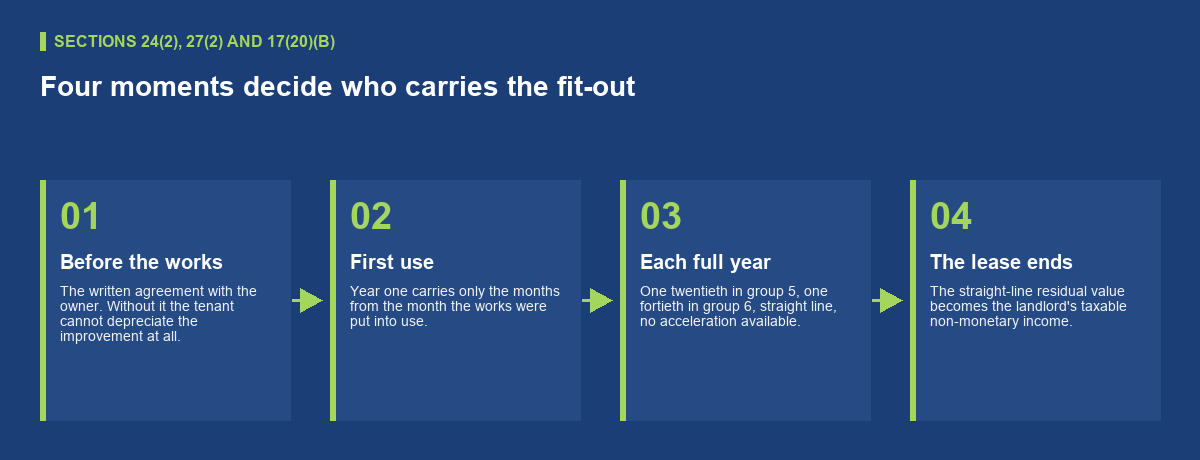
Section 17(20) is the provision that turns a construction decision into a tax event for the party that did not make it. The lessor’s tax base includes non-monetary income at the level of the expenditure the tenant made on technical improvement of the thing, with the lessor’s prior written consent, beyond the obligations agreed in the lease and not reimbursed by the lessor. The timing has two branches: the tax period in which the improvement was put into use, where the owner increased its input or residual price by that value, or the tax period in which the lease ended, in which case the amount is the residual value the improvement would have under straight-line depreciation.
Take the warehouse case. A EUR 400,000 fit-out in group 5 is written down at EUR 20,000 a year. A lease that ends after five full years leaves a residual value of EUR 300,000, and that figure is the landlord’s non-monetary income in the year of expiry. At the 21 per cent corporate rate in section 15(b) that is EUR 63,000 of tax, and at the 24 per cent rate that applies above EUR 5 million of revenue it is EUR 72,000. In the office variant, at one fortieth a year, the residual value after the same five years is EUR 350,000. These are worked examples on round numbers, not a calculation of any particular case.
Section 17(21) extends the same treatment to repairs the tenant expensed beyond its obligations under the lease. This is why a reinstatement clause is a tax clause as much as a building one, and why the schedule of condition and the handover protocol earn their place in the file. Our post on what happens at lease expiry follows the same day from the contractual side.
What belongs in the lease before the first invoice
Four points, and all four are cheaper to agree at heads of terms than to argue after the works. First, the written agreement under section 24(2), naming which party depreciates the technical improvement and confirming that the owner will not increase its own input price by the same expenditure. Second, the treatment at the end: whether the improvement is removed, left and compensated, or left and not compensated, because only the third of those produces the non-monetary income under section 17(20)(b). Where the answer is removal, the obligation to strip out and hand back is a non-monetary one, and the only route to it without a full court action is a notarial deed in which the tenant has consented to enforceability in advance.
Third, a split of the works into repair and technical improvement before the contractor invoices, with the EUR 1,700 test applied per asset and per tax period. A single invoice covering a repaired roof light and a new mezzanine is a problem for both parties. Fourth, the interaction with everything else in the lease that moves on a different clock: the break option that can bring the end forward, an assignment that moves the improvement to another occupier, and the option to tax the rent, which is a separate decision on a separate section of a separate act.
None of this changes what the works cost to build. It changes who carries them, over how long, and who is holding the residual value when the term ends. On a triple net structure that question is not answered by the heading on the term sheet either, because the nets describe who pays the running costs and not who owns the improvements.
Conclusion
The Slovak treatment of a fit-out is consistent and unforgiving in equal measure. Above EUR 1,700 in a tax period the works are an asset. The tenant may depreciate them only under a written agreement with the owner, and only where the owner has kept them out of its own input price. The period comes from the building’s depreciation group, which is 20 years for warehouse use and 40 where the tenant’s own use is office, so a five-year term will never come close to writing the works off. What is left on the last day is not written off at all, it is transferred: section 17(20)(b) makes it the landlord’s taxable non-monetary income at the straight-line residual value. Two sentences in the lease and one classification decision are what stand between that outcome and a settled position.