
The statute puts the annual rate at 0.033 euro per square metre, and no occupier in Slovakia has ever paid that. Real estate tax on industrial property is a local tax, set by the town in its own ordinance, and the only ceiling the law imposes is measured against the town’s own lowest rate rather than against any absolute figure. Two identical halls, one in a district town on the western corridor and one in a village in the east, are therefore taxed five to six times apart. Worse for budgeting, the rate that applies to a given hall depends on who is inside it rather than on how it was built.
Why real estate tax on industrial property differs between two towns
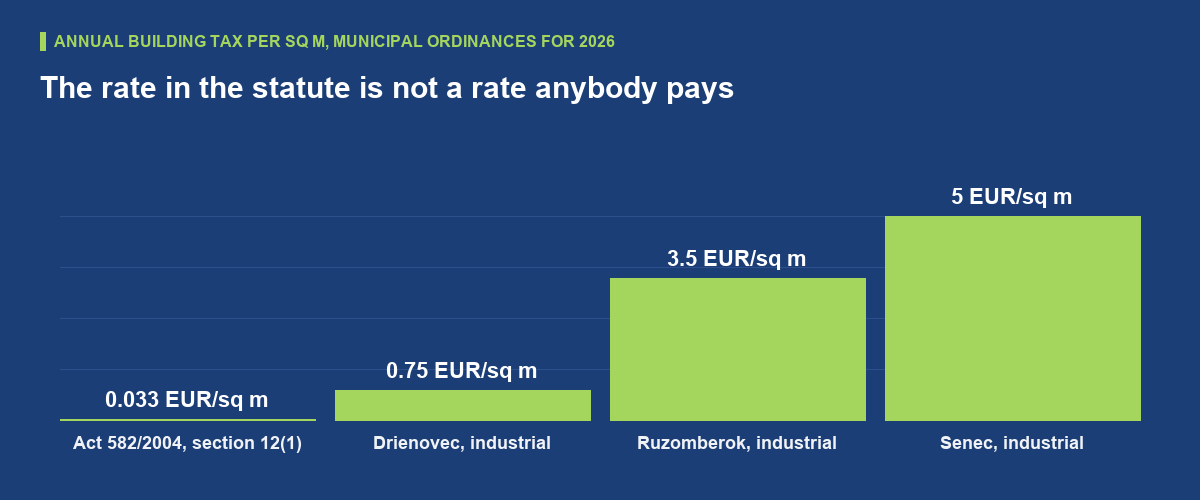
Section 12(1) of Act 582/2004 Z. z., in the version in force from 1 January 2026, sets the annual rate on buildings at 0.033 euro for every square metre of built-up area, started square metres included. Section 12(2) then hands the number to the municipality, which may reduce it or raise it by ordinance with effect from 1 January of the tax year, and may set different rates for each of the categories in section 10(1).
The ceiling in that same subsection is the part worth reading twice. The rate a municipality sets must not exceed ten times the lowest annual rate on buildings that the same municipality has set in its own ordinance. It is a relative limit, not an absolute one. A town that keeps its residential rate high has room to charge more on industry, and nothing in the statute caps the result against the 0.033 it starts from.
The spread that produces is not theoretical. For 2026 the town of Senec charges 5.00 euro per square metre on industrial buildings under its ordinance 12/2025. Ruzomberok charges 3.50 under ordinance 10/2025, and the village of Drienovec charges 0.75 under ordinance 2/2025. Senec is therefore at roughly 151 times the figure in the statute, and at about six and a half times Drienovec, for a building that could be the same class A shed in both places.
The category depends on who is inside, not on the building
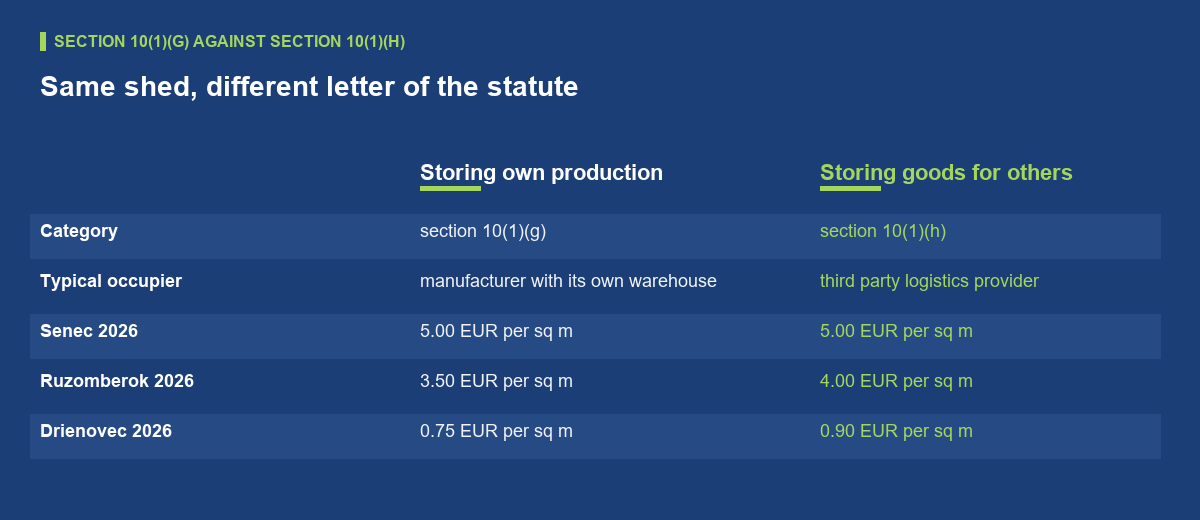
Section 10(1) splits buildings into nine categories, and two of them cover almost every industrial unit. Letter (g) covers industrial buildings, buildings serving energy and construction, and buildings used for storing the taxpayer’s own production. Letter (h) covers buildings for other business and gainful activity, storage, and the administration that goes with it.
The dividing line is whose goods are on the racking. A manufacturer storing what it made sits in (g). A logistics provider storing goods for third parties sits in (h). The building does not change, the pallet positions do not change, and the yard does not change. Only the occupier does.
Municipalities price that difference. Ruzomberok charges 3.50 under (g) and 4.00 under (h), Drienovec 0.75 and 0.90. Senec happens to charge 5.00 for both, which is why the point is easy to miss if you only ever look at one town. For a built to suit unit that changes hands from a producer to a third party logistics operator, the tax line moves by around 14 to 20 per cent in those two towns without a brick being touched, which is a question to settle in the heads of terms rather than after the assignment.
The land is taxed on a value the market never sets
Land runs on a separate track. Section 8(1) sets the annual rate on land at 0.25 per cent, and section 7 makes the base the area multiplied by a value per square metre taken from the annexes to the act. Annex 2 does not ask what the plot is worth. It asks how many inhabitants the municipality had on 1 January: 13.27 euro per square metre of building land in a village under a thousand people, 33.19 above twenty five thousand, 46.47 in a district seat, 53.11 in a regional seat and 59.74 in Bratislava. A municipality may replace those with its own figures by ordinance, and the taxpayer may displace either with an expert valuation.
The classification of the plot moves once during a project, and it moves the wrong way for a developer. Under section 6(4) a plot named in a final building intent decision counts as building land until the occupancy certificate is issued. In Senec that means 46.47 euro per square metre at the 2.50 per cent building land rate during construction, against the 4.64 euro at 2.00 per cent that applies to built-up areas and yards afterwards, so roughly 1.16 euro per square metre a year against 0.09.
That is a factor of about twelve, and it runs for exactly as long as the occupancy permit takes. On a project where the building permit stage has already slipped, the land tax on a forty thousand square metre plot is quietly costing about 46,000 euro a year instead of 3,700. That is our own arithmetic on the published rates, not a quoted assessment.
What it looks like next to the rent
Put a 20,000 square metre unit on the numbers above. In Senec the building tax alone is 20,000 times 5.00, or 100,000 euro a year, which is 0.42 euro per square metre per month. In Drienovec the same unit under letter (h) is 18,000 euro a year, or 0.075 per square metre per month. At the statutory rate it would be 660 euro a year.
Set that against the rent. The Senec area band in the second quarter of 2026 runs from 3.80 to 4.70 euro per square metre per month, so the building tax is somewhere between roughly 9 and 11 per cent of the headline rent. It is not a rounding error, and unlike energy it does not fall when the hall runs quietly. All of these are our own calculations on the published rates and rent bands rather than quoted transactions.
Two further multipliers sit in the same section and are easy to forget. Section 12(3) lets a municipality add a surcharge for every storey above the first, capped at 0.33 euro, which is 0.20 in Senec and turns a mezzanine into a permanent line item. Section 12(7) lets a municipality apply a coefficient of more than one and up to ten to a neglected building, which is a real consideration on a brownfield holding that is not yet in use.
Who pays it, and what to check before signing
Section 9(1) makes the owner of the building the taxpayer, so the assessment arrives at the landlord. In a triple net structure it does not stay there: taxes are one of the three nets, and the amount reaches the occupier through the service charge or as a separate recharge. What the lease should say is which of the two, and whether an increase in the municipal ordinance passes through in full.
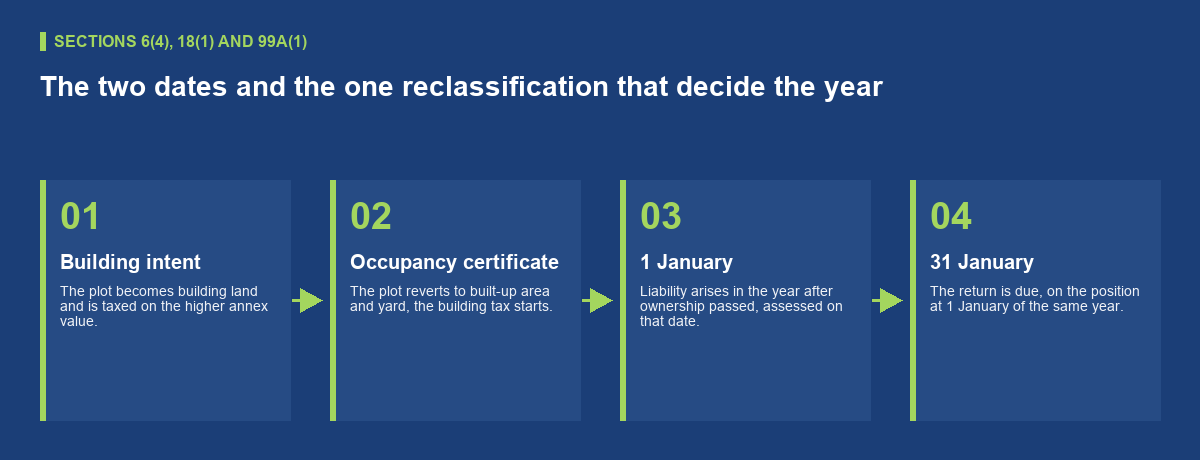
Two dates decide the year. Under section 18(1) liability arises on 1 January of the year following the one in which the taxpayer became owner, and ends on 31 December of the year in which ownership ends. Under section 99a(1) the return is due by 31 January of the tax year, assessed on the position at 1 January. A hall completed in October therefore produces no building tax at all for that year, and a sale and leaseback closed in December moves the whole of the following year to the buyer.
One line settles an argument that comes up at every handback. Section 10(2) says that the fact a building has ceased to be used has no effect on the tax liability. Empty space is taxed exactly like occupied space, which is worth knowing when a landlord underwriting a cap rate on stabilised net operating income models a void period, and worth knowing before lease expiry when the tax keeps running whatever the racking looks like.
Conclusion
Real estate tax is the one occupancy cost in Slovakia that is decided entirely outside the lease and outside the market. The statute contributes a number nobody pays, the municipality sets the one that matters, and the category depends on the use rather than the structure. Two checks cover most of the exposure: read the town ordinance for the year rather than assuming last year’s figure, and confirm which of letters (g) and (h) your intended use falls into before the rent is agreed. Both take an afternoon, and both are cheaper before signature than after.