
Every conversation about eastern Slovakia now starts with the car plant at Valaliky. The expectation attached to it is simple: a factory that size arrives, suppliers follow, and the warehouse market around Kosice grows to meet them. The expectation is reasonable and largely untested, because Slovakia has run this experiment exactly once before. Jaguar Land Rover opened at Nitra in October 2018 with a comparable plant. Eight years of market data later, we can measure what that did to the leasable stock nearby. The answer is more useful than the forecast, and it points occupiers at a different set of decisions.
How tight is the Kosice market before the plant even starts?
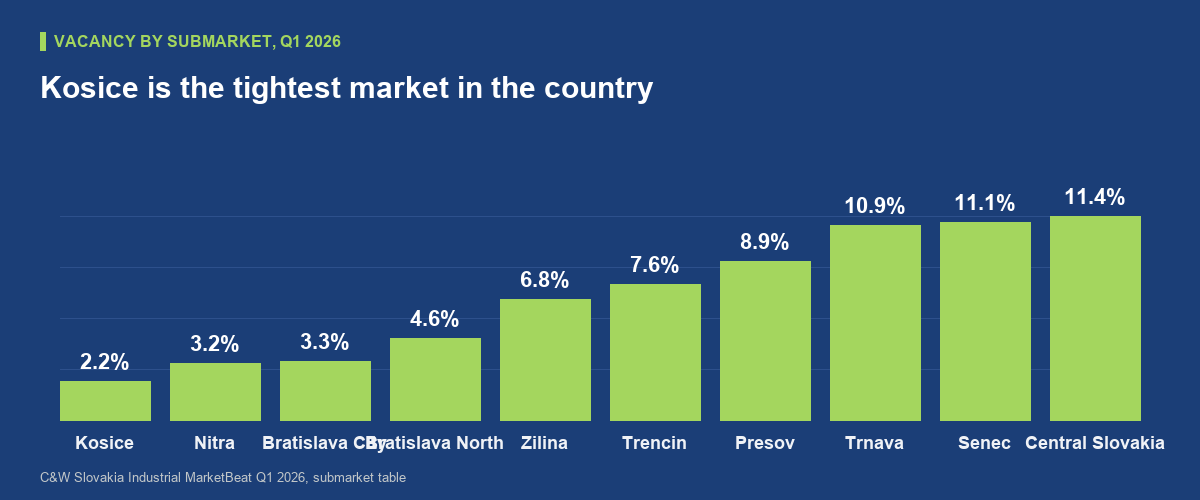
Tighter than anywhere else in the country. The submarket table in the Cushman and Wakefield Slovakia Industrial MarketBeat for Q1 2026 puts the Kosice area at 255,800 square metres of stock with 5,600 square metres standing available, a vacancy rate of 2.2 per cent against a national 7.72 per cent. No other Slovak submarket is that tight. Prime rents in the area run EUR 4.80 to 5.30 per square metre per month, and the report notes that “prime achievable rents held up better in lower-vacancy regions such as the Kosice, Zilina, and Nitra area” while rents softened almost everywhere else. Two numbers explain the paradox. Eastern Slovakia took roughly 42 per cent of all Q1 completions, 44,159 square metres, so the east is being built. But the demand side of the same quarter reads “Greater Bratislava remained the most attractive for leasing activity, capturing 91,110 sq m, followed by Western Slovakia with 29,400 sqm”, and the Kosice area records only 8,300 square metres of quarterly take-up. The new eastern space is not sitting empty, it is being spoken for before completion: the quarter’s largest eastern delivery, CTPark Kosice at 26,500 square metres, arrived 100 per cent pre-let. A market can look calm in the take-up column and still leave a newcomer with nothing to view, and the smaller units around the city already carried a premium before any of this, as we set out in our note on last-mile space in Bratislava and Kosice.
What did Nitra actually deliver after Jaguar Land Rover?
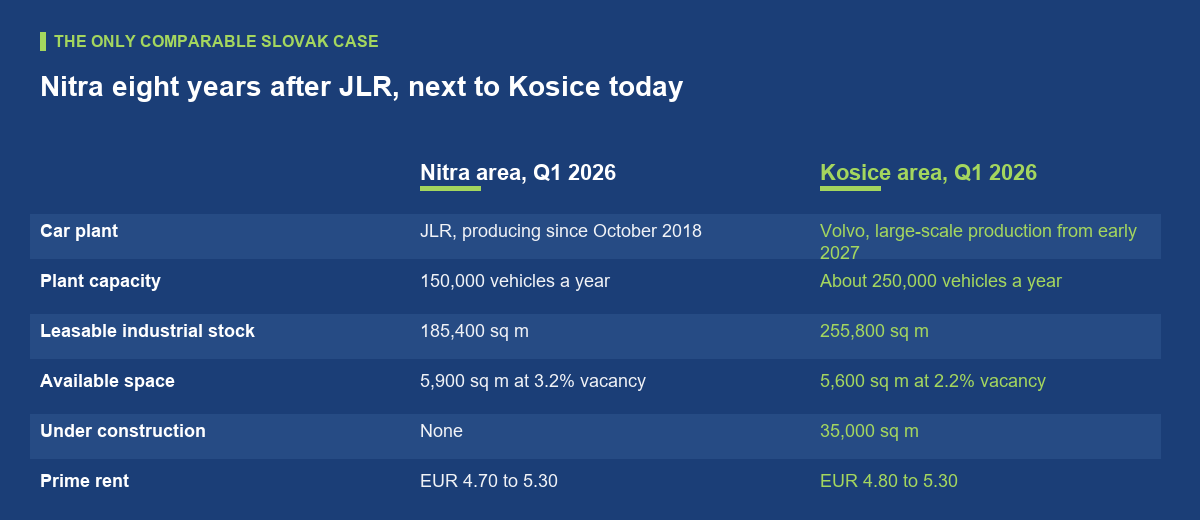
This is the part worth sitting with. Jaguar Land Rover opened its Nitra plant on 25 October 2018: a EUR 1.4 billion facility of 300,000 square metres, annual capacity 150,000 vehicles, one of the four carmakers along the Slovak automotive belt we mapped separately, around 1,500 people at opening with a further 850 recruited, and a supply chain effect the company described as having “sourced and localised a number of components, such as seats and wheels, to support production of the Land Rover Discovery in Nitra delivering several thousand additional jobs in the automotive supply chain in Slovakia”. By any measure the plant worked. Now look at the leasable market it sits in. Eight years on, the same C&W table gives the Nitra area 185,400 square metres of stock, the third smallest submarket in Slovakia, with 5,900 square metres available, 3.2 per cent vacancy, and nothing under construction. For comparison, the Trnava area alone holds 933,100 square metres. A plant that put several thousand supply chain jobs into a region did not produce a large rental warehouse market around it. The reason is structural rather than surprising: tier-one suppliers to a car plant build their own facilities on serviced land in the state industrial park, on built-to-suit terms or as owner-occupiers. Those buildings never enter the leasable stock a market report counts, which is why the land market we covered in what Slovak plots actually trade at moves before the rent table does.
So when does the ripple actually arrive?
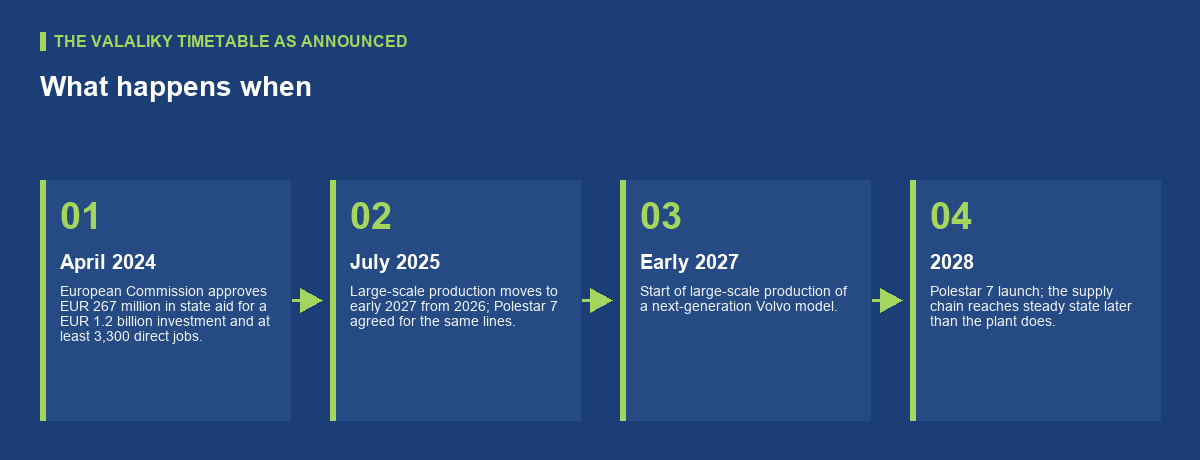
Later than the plan most occupiers are working from. The European Commission approved EUR 267 million of Slovak state aid on 8 April 2024 for a EUR 1.2 billion investment at Valaliky, at least 3,300 direct jobs and an initial capacity of about 250,000 electric vehicles a year, in an area eligible for regional aid under Article 107(3)(a) and identified as a Just Transition Fund territory. That aid framework is the same machinery we described in our note on incentives and state aid. The timetable then moved: large-scale production slipped to early 2027 from 2026, and the Polestar 7 agreed for the same plant is a 2028 launch, with Volvo’s chief executive putting the logic plainly, “Sharing the plant would be really good for us because, at the end, it’s a cost that has to be carried with production volume in the factory”. For a supplier that sequence matters more than the headline. Volume ramps after start of production, not at it, and a second model in 2028 means the supply chain reaches steady state later still. A five-year lease signed in mid-2026 spends its first year serving a plant that is commissioning, and expires roughly when the second programme matures. That is a timing mismatch, and it is fixable at the heads of terms stage rather than later.
Where will eastern Slovakia find the workforce?
Not in the city, on the current numbers. Registered unemployment by district from the Employment Institute for June 2026 puts the four Kosice city districts between 3.16 and 3.73 per cent, which is close to Bratislava’s 2.58 to 3.23 per cent and effectively means the urban labour pool is spoken for. The slack sits in the ring around it and further out: Kosice-okolie at 6.18 per cent, Michalovce 6.92, Trebisov 8.18, Sobrance 8.33, then Sabinov 9.45, Vranov nad Toplou 11.14, Kezmarok 11.99, and Rimavska Sobota at 13.85 per cent, the highest in the country. A plant recruiting at least 3,300 people plus its suppliers will draw across that whole map, which turns bus routes and shift patterns into a site selection criterion, exactly the argument we made in our note on labour availability as a site-selection factor. The practical consequence for an occupier choosing between two sites near Kosice is that the cheaper plot 30 kilometres out may sit closer to the available workforce than the expensive one at the gate, and that the competitor for those workers is no longer the warehouse next door. It is a car plant with an automotive wage structure.
What should an occupier do about it now?
Four things, in this order. First, treat pre-letting as the default, not the premium option: with 5,600 square metres available across the entire Kosice area and the quarter’s biggest delivery fully committed before handover, waiting to view standing space is not a strategy. Second, look at Presov. The neighbouring submarket holds 212,100 square metres of stock with 18,900 square metres available at 8.9 per cent vacancy and quoted rents of EUR 4.50 to 4.90, which is more than three times the space available around Kosice at a lower rent, roughly half an hour further from the plant. For anything that is not sequenced to the line, that trade is worth pricing, and it is the same corridor logic we set out in the D1 corridor versus the south. Third, price the whole deal rather than the headline: in a tight submarket the concessions that make up an effective rent are the first thing to disappear, so the quoted EUR 4.80 to 5.30 behaves differently here than the same number in a market at 11 per cent vacancy, as our breakdown of what occupiers actually pay sets out. Fourth, match the term to the ramp: a lease that starts in 2026 and ends before the second model programme matures asks you to renegotiate at the worst possible moment, in the tightest submarket in the country.
Conclusion
The plant at Valaliky will change eastern Slovakia. Nitra suggests how: more through land, owner-occupied supplier plants and wages than through a boom in leasable warehouse stock, and later than the announcement calendar implies. Meanwhile the Kosice area is already the tightest submarket in Slovakia at 2.2 per cent vacancy, for reasons that have nothing to do with a car that is not being built yet. Both facts point the same way for an occupier: secure space before it exists, and write the term around the ramp rather than around the ribbon-cutting.