
Most occupiers plan the move and forget the exit. Then a schedule arrives six weeks before lease expiry, priced by a surveyor who has never met you, listing every mark on a floor slab you inherited. The money is real: on a large warehouse a handback claim can run into six figures, and it lands at the exact moment your cash is tied up in the new building. Slovakia has no statutory dilapidations code, so the size of that claim is decided almost entirely by wording agreed years earlier. This article sets out what the landlord can actually ask for, what your lease has probably imported from English practice, and the timetable that keeps the final account small.
What does Slovak law require at lease expiry?
Less than most tenants fear, and far less than most leases say. There is no Slovak equivalent of the English dilapidations regime, so the starting point is the ordinary law of lease plus whatever the parties wrote down. DLA Piper’s country guidance on repairs in Slovak commercial leases sets the default division: the landlord is obliged to maintain the property in good condition to enable its normal or agreed use, although in the case of commercial premises it is open to the parties to agree otherwise. The tenant covers the costs of normal maintenance and of minor repairs, and any other repairs are the responsibility of the landlord unless the contract says something different. There is also a duty that catches tenants out later: the tenant must notify the landlord without unreasonable delay when the need for a repair arises, otherwise the tenant may be liable for the resulting damage. Read those two sentences together and the shape of the exit becomes clear. Almost every phrase ends with unless the lease says otherwise, and in Slovak industrial leases it almost always does.
Reinstatement: the clause that decides the number
The single largest item in most handback accounts is not repair. It is putting the building back the way it was. The same guidance is blunt about alterations: the landlord’s consent is required before any changes are made to the property, otherwise the tenant will be required to restore the property to its original condition at the end of the lease. Where consent was given, the position is open: the parties must agree whether the premises need to be restored to their original condition and how the costs and benefits of the alterations and improvements are allocated. There is even an upside most occupiers never claim. Where the landlord approved works but did not pay for them, the tenant may be able to claim the amount by which the property has increased in value as a result. Three practical consequences follow. Undocumented fit-out is the expensive kind, because without a consent letter the default is restoration at your cost. A reinstatement clause that says all alterations is a blank cheque, so it should name what comes out and what stays. And racking anchors, mezzanines, dock equipment and slab penetrations belong on that list by name, because those are the items argued about in industrial buildings.
Why your lease speaks English dilapidations, and why that matters
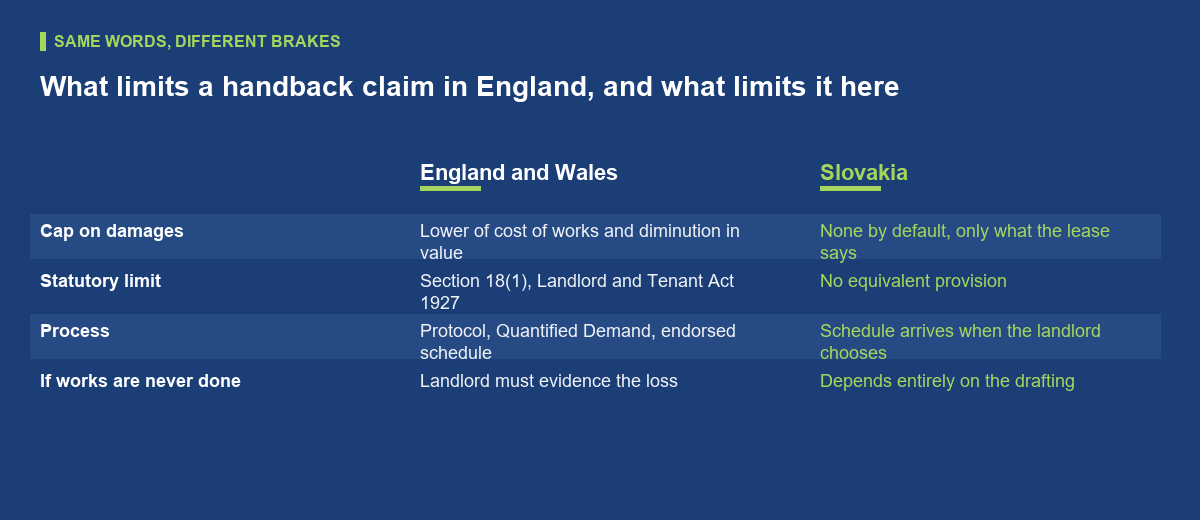
Slovak industrial leases are drafted for international landlords, so the vocabulary is imported wholesale: schedule of dilapidations, terminal schedule, quantified demand. It is worth knowing what that language does at home. Under the RICS professional standard Dilapidations (England and Wales, seventh edition, September 2016, effective from 1 December 2016), a claim runs through a defined process with two real brakes on it. The first is a cap: as a broad rule of thumb, the amount recoverable by a landlord will typically be the lower of the cost of the works and the diminution in value, that is the reduction in value of the landlord’s interest caused by the breaches. The second is statutory. Section 18(1) of the Landlord and Tenant Act 1927 limits the damages recoverable for breaches of the repairing covenant. Neither brake exists in Slovakia. On our reading, that is the asymmetry occupiers miss: the drafting travels, the limits do not, so a Slovak landlord who never intends to carry out the works can still hold you to the wording you signed. The protection has to be written into the lease itself, which is why a cap by reference to actual loss belongs in the heads of terms rather than in a later argument.
What the final account actually contains
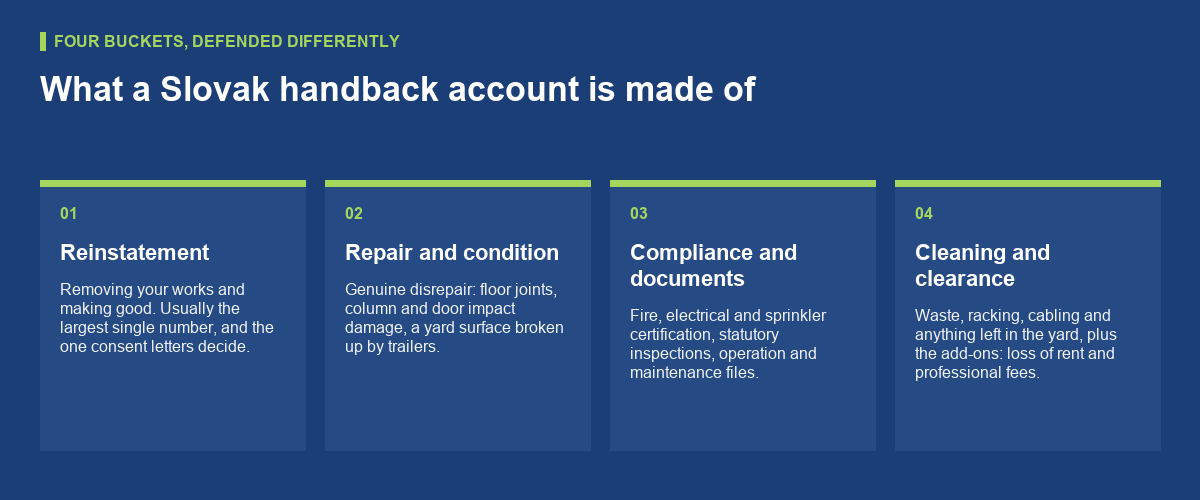
Four buckets, and they are worth separating because they are defended differently. Reinstatement is the removal of your works and the making good that follows. Repair and condition covers genuine disrepair: damaged floor joints, impact damage to columns and doors, a yard surface broken up by trailers. Compliance and documents is the quiet one: fire certification, electrical and sprinkler test records, statutory inspections for cranes or lifting equipment, and the operation and maintenance files. Cleaning and clearance closes it out, including waste, racking, IT cabling and anything left in the yard. Then come the add-ons that turn a schedule into a claim: loss of rent for the period the landlord says the works take, plus professional fees. Two items should not be there at all. Fair wear and tear is not disrepair, and items already recovered through the service charge cannot be charged twice, a point worth checking line by line against the last three years of statements. If the building was recently built, check the defects liability period too, because a fault the contractor should have remedied is not a tenant breach.
The exit timetable that keeps the account small
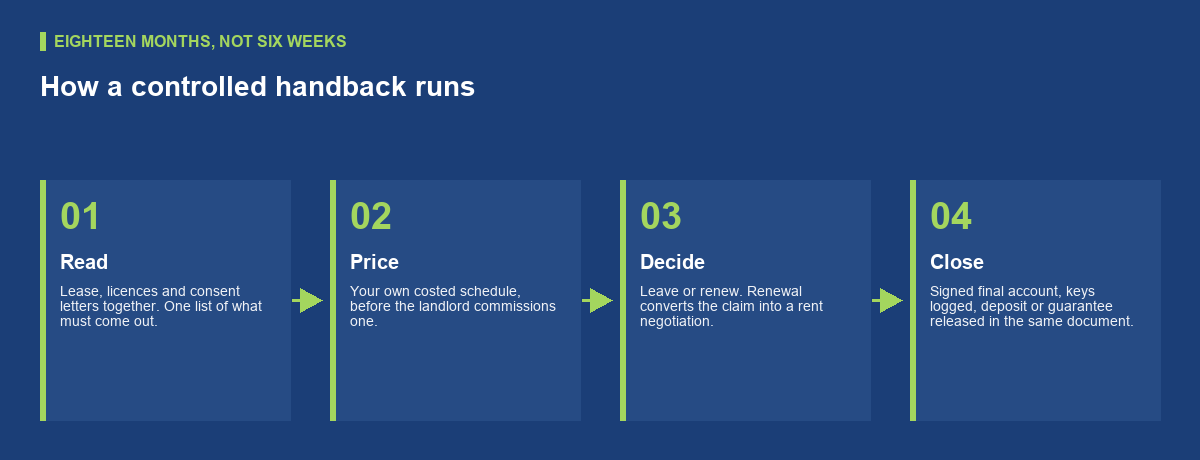
Start eighteen months out, not six weeks. First, read the lease with the licences and consent letters next to it, and build one list of what must come out. Second, commission your own priced schedule before the landlord commissions theirs. A tenant who arrives with a costed position negotiates. A tenant who arrives with nothing responds. If the exit date is driven by a break option rather than by expiry, deal with its conditions first, because an unsatisfied condition can invalidate the notice. Getting out before the end is a separate exercise with its own machinery. Third, decide early whether you are leaving at all, because the market answer is often no. In the first quarter of 2026 renegotiations accounted for 54 per cent of total demand in Slovakia, and Cushman and Wakefield note that this elevated trend is expected to persist through the year. A renewal converts the whole account into a negotiation about future rent, which is a far cheaper currency than cash for works. Fourth, use the market. Vacancy stood at 7.72 per cent and prime rent had declined to EUR 5.30 per square metre per month, with 203,200 square metres under construction at only 35 per cent pre-let. Fifth, close it properly: a signed final account, keys and access cards logged, and the release of the deposit or bank guarantee written into the same document.
Conclusion
Handback is not a building exercise, it is a documentation exercise that happens to involve builders. The lease decides what can be claimed, the consent letters decide what has to come out, and the condition evidence decides who wins the argument about the rest. Slovakia gives you none of the statutory protection the English wording implies, so the work has to be done twice: once when the clause is drafted and again eighteen months before the end. With more than half of Slovak demand now coming from renegotiation, the strongest exit position is usually the one that keeps a renewal on the table.