
Importers arriving in Slovakia ask for a free zone, because that is what the brochures in neighbouring countries advertise. The honest answer is that Slovakia does not have one, and has not had one for years. What it has instead is the ordinary European toolkit: temporary storage, the customs warehousing procedure and a deferment of import VAT that most occupiers never apply for. A bonded warehouse in Slovakia is therefore not a place on a map, it is an authorisation attached to a building you lease. This article sets out what each instrument does to your cash, what 2026 changed, and which clauses in the lease decide whether any of it is possible at all.
Does Slovakia have a free zone, or only a bonded warehouse route?
Only the second. The Commission publishes the definitive answer itself: its register of free zones in operation in the customs territory of the Union, compiled from what the member states report, lists the zone or zones for each country. We parsed the list. Twenty member states operate at least one. Seven report the single word None, and Slovakia is one of them, alongside Austria, Belgium, Finland, Ireland, the Netherlands and Sweden. Every neighbour with a port or a border terminal appears on the other side of that line: the Czech Republic through Ostrava, Hungary through Zahony, Poland through its port zone and Slovenia through Koper. That absence is less dramatic than it sounds. A free zone is an enclosed area where non-EU goods sit free of import duty and other charges until they are released, and the Commission describes it in exactly those terms. The customs warehousing procedure achieves the same suspension without the fence, because the suspension follows the goods and the authorisation rather than the postcode. The practical difference for a Slovak occupier is where the paperwork sits, not what it costs. What you cannot do is walk into an existing zone and rent a unit inside it. You build the arrangement yourself, inside a building you have chosen for ordinary reasons.
How customs warehousing works, and what it does to your cash
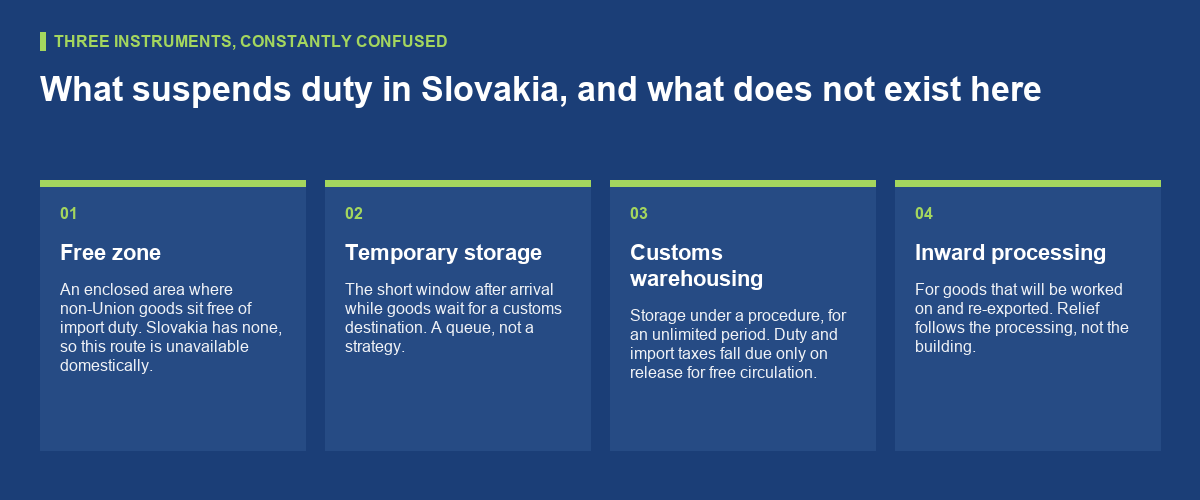
Three instruments sit in sequence and are constantly confused with one another. Temporary storage is the short window after arrival while the goods wait for a customs destination. Customs warehousing is the storage procedure proper. The Commission’s guidance on storage procedures is unusually generous about time. Storage may be for an unlimited period, unless the nature of the goods means they could pose a threat to health or to the environment if stored for a long time. Inward processing is the third, for goods that will be worked on and re-exported. The cash effect of the middle one is the reason importers care. Duty and import taxes do not fall due while the goods sit under the procedure. They fall due when the goods are released for free circulation, and if the goods are re-exported instead, they never fall due in the Union at all. For a distributor holding regional stock for several markets, that is the difference between financing duty on the whole consignment at arrival and financing it pallet by pallet as orders leave. The conditions are not onerous, but they are real. The holder must be established in the customs territory of the Union. It must give the authorities assurance that the facility will be properly run, and provide a guarantee where a customs debt is incurred. That guarantee is the number to model before anything else.
What 2026 changed at the border, and why it lands in the warehouse
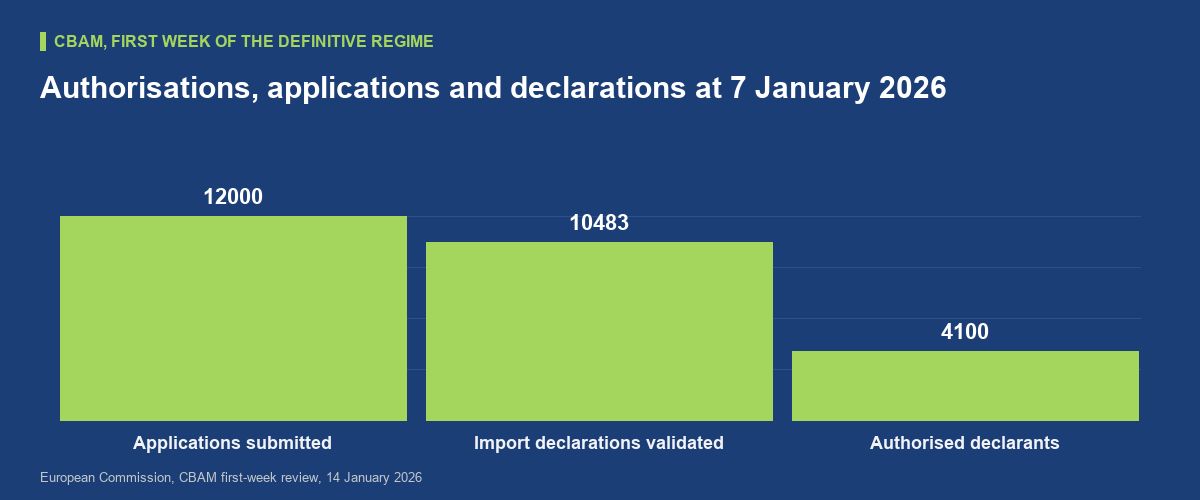
Two changes, both live now, both with consequences for stock that arrives from outside the Union. The first is the end of the low-value exemption. The Commission’s own guidance of 8 June 2026 sets out Council Regulation (EU) 2026/382. It brings a temporary customs duty of EUR 3 per item, from 1 July 2026 until 1 July 2028. It replaces the duty relief for consignments under EUR 150, which ran until the end of June. The Commission had already announced the political agreement in November 2025, and describes the flat fee as an interim measure until the EU Customs Data Hub is operational in the middle of 2028. The second is the carbon border mechanism. According to the Commission’s own first-week review, CBAM entered into force on 1 January 2026, and the authorisation is now validated by customs before goods are released for free circulation. More than 4,100 operators had obtained authorised declarant status. Over 12,000 applications had been submitted by 7 January. In the first week customs validated 10,483 import declarations containing CBAM goods, covering roughly 1.66 million tonnes. Iron and steel made up 98 per cent of that volume. Read those two together and the warehousing question changes shape. A customs warehouse buys you time before release. It does not buy you the authorisation you need at the moment of release, and in Slovakia, where steel and automotive components dominate third-country inflows, that distinction is the one that strands pallets.
Import VAT: the Slovak rule that quietly decides your working capital
Duty is usually the smaller number. Import VAT is the one that ties up cash for weeks between payment at the border and recovery through the return, and Slovakia changed the mechanics recently. As DLA Piper set out when the rule was introduced, from 1 July 2025 a deferment scheme applies to imports of goods into Slovakia from third countries. Under it the customs office does not levy the tax. The importer accounts for it in its own VAT return instead. The catch is in the eligibility. The firm’s summary is blunt: the mechanism is available only to VAT payers who hold an authorised economic operator permit and have their registered seat, place of business or establishment in Slovakia. No separate consent from the customs or tax office is needed, the regime simply applies to the declaration once the conditions are met and the importer opts in. From 1 January 2026 the scope widened to taxable persons established in another member state, with the AEO licence, the Slovak VAT identification and the taxable-use condition all still in place. The consequence for a mid-sized importer is worth stating plainly. Without AEO status, the deferment is closed to you, and the customs warehousing procedure becomes the main lever you have left for delaying the same payment. The two instruments are usually presented as separate topics. In a cash-flow model they are alternatives.
What this means when you sign the lease
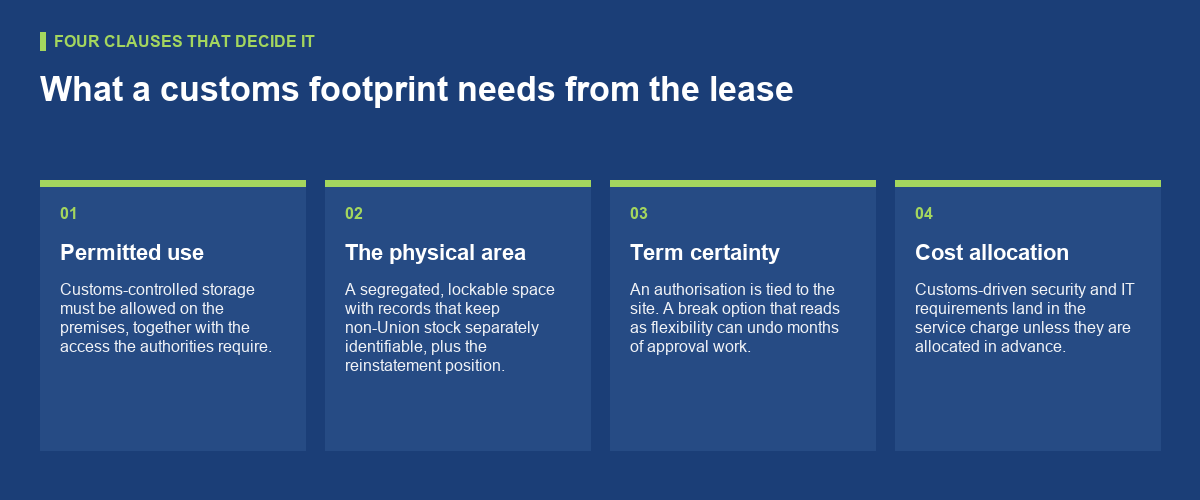
This is where the customs question stops being a tax question. An authorisation for customs warehousing attaches to the storage facility named in it. That is our own summary of how the approval works in practice. It produces four clauses that belong in the heads of terms rather than in a later side letter. First, permitted use: the lease must allow customs-controlled storage on the premises and allow the authorities the access they require, which many standard Slovak leases simply do not address. Second, the physical arrangement: a segregated, lockable area with records that keep non-Union stock separately identifiable, plus whatever the landlord must consent to in order to create it, and the reinstatement position at the end. Third, term. An authorisation you spend months obtaining is worth little in a building you can be asked to leave, so the break option that looks like flexibility on the tenant side can be the item that undermines the whole structure. Fourth, cost allocation, because customs-driven security and IT requirements will show up in the service charge unless they are allocated in advance. Ask now rather than later. Slovak vacancy stands at 7.72 per cent and is rising. Prime rent is down to EUR 5.30 per square metre per month, and 203,200 square metres is under construction at only 35 per cent pre-let. A landlord has more reason to write these clauses your way than at any point in the last three years.
Conclusion
Slovakia’s missing free zone is not the problem it looks like. The suspension of duty and import taxes travels with the procedure and the authorisation, not with a fenced site, so the same cash-flow effect is available inside an ordinary leased warehouse. What has changed is the cost of getting the paperwork wrong: CBAM authorisation is now checked before release, the low-value exemption is gone, and the Slovak import VAT deferment is closed to anyone without an AEO permit. Decide which instrument you are relying on before you choose the building, because the authorisation is tied to the site and the site is tied to a lease term you are about to fix.