
Most occupiers treat the Slovak road toll as a haulage line: a per-kilometre cost that belongs to whoever drives. It is better understood as a property cost, because the tariff does not price distance at all. It prices the class of road a lorry is on, and the plot decides which classes a lorry can reach. Two sites twenty kilometres apart on the same corridor can differ by tens of thousands of euros a year on identical volumes, and nothing in the lease will tell you so. This piece sets out the tariff, the road classes behind it, what changed in January 2026, and how to read the difference before a site is chosen.
What does the Slovak road toll charge for a kilometre?
The rates are not a commercial matter. Act 474/2013 Z. z. on the collection of tolls for the use of specified road sections empowers the government to set them, and it does so in Government Regulation 418/2024 Z. z., effective 1 July 2025, which repealed the 2013 regulation that had governed the system until then. Section 3 splits the rate into three components: an infrastructure charge, an external charge for traffic-related CO2 emissions, and an external charge for traffic-related air pollution. The occupier never sees the split, only the sum. What the charge covers, which vehicles fall inside it and how the tables are built is set out in our glossary entry on road toll.
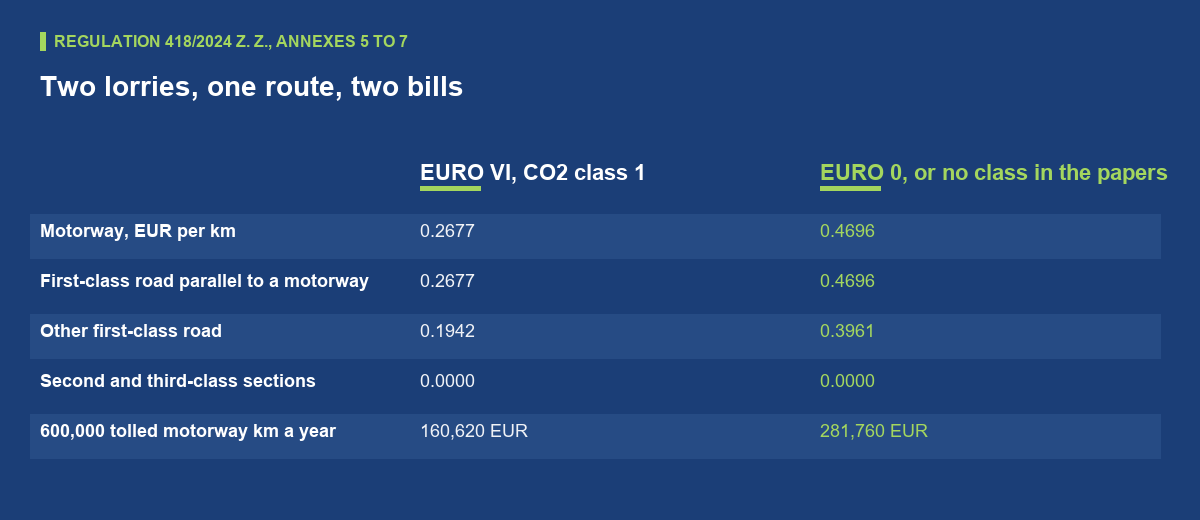
The sum depends on four things: permissible weight, number of axles, the EURO emission class, and since July 2025 a CO2 emission class from 1 to 5. Take the vehicle most estates actually load, an articulated lorry above 12 tonnes with five or more axles. On a motorway the annex 5 rate is 0.2677 euros per kilometre excluding VAT for EURO VI in CO2 class 1. The same vehicle at EURO V pays 0.2951, at EURO III 0.3438, and at EURO 0 it pays 0.4696. A zero-emission tractor unit in CO2 class 5 pays 0.2419.
Rigids between 3.5 and 12 tonnes are charged uniformly for any number of axles and pay 0.1039 at EURO VI. Buses have their own table. What matters for an estate is the spread: the difference between the cleanest and the dirtiest tractor unit on the same road is 0.23 euros a kilometre, which is more than the entire rate for a light rigid.
Why the parallel road is not a way out
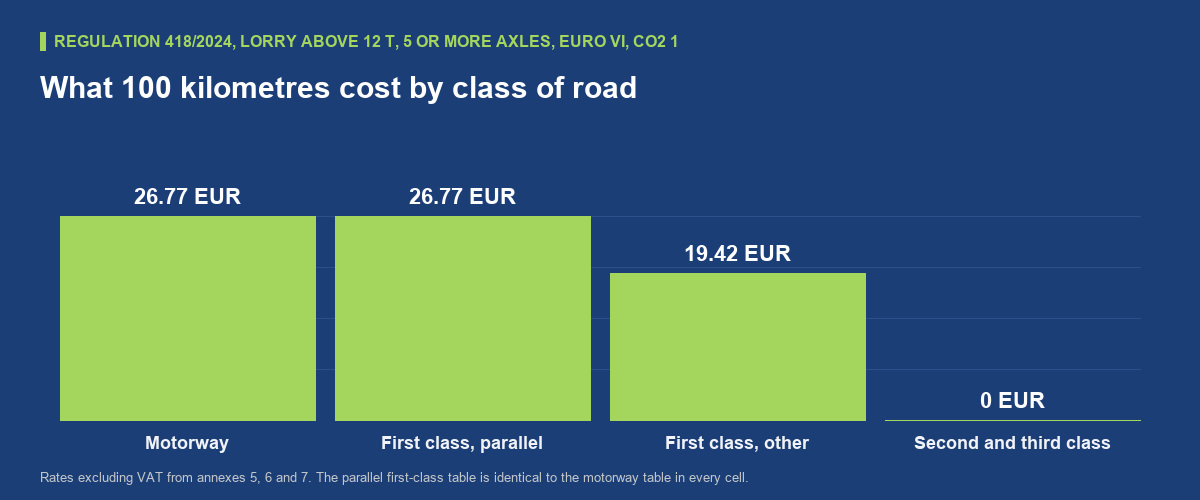
The obvious response to a motorway toll is to send the fleet down the old first-class road beside it. Annex 6 of the regulation closes that door before it opens. It has two tables, and the first one covers first-class roads running parallel to motorways. Every figure in it is identical to the motorway table: 0.2677 for our reference lorry, 0.4696 at EURO 0, 0.1039 for a light rigid. The route is slower, the bill is the same.
The second table is the one worth reading. First-class roads that are not parallel to a motorway are cheaper by roughly a quarter: 0.1942 per kilometre for the same EURO VI tractor unit against 0.2677, and 0.3961 against 0.4696 at EURO 0. Annex 7 then sets the rate for the specified sections of second and third-class roads at zero for every vehicle type and every emission class.
So Slovakia does not have one toll, it has three prices and a free tier, and which one applies is a question of geography rather than of driving. A distribution site whose first thirty kilometres in each direction run on a non-parallel first-class road is on a different tariff from a site whose thirty kilometres run on a motorway, on identical mileage. That is the same logic that already separates rents along the D1 corridor from rents in the south, arriving on the cost side instead of the rent side.
What changed on 1 January 2026
The tolled network grows, and it grows into exactly the sections that were previously the free workaround. According to the operator announcement of 18 December 2025, the list of specified sections was extended by more than 27 kilometres to 8,309.977 kilometres as of 1 January 2026.
Three additions carry it. On the R2 expressway the Krivan to Mytna section, 10.6 kilometres, became tolled on 1 January 2026. On the D1 the Lietavska Lucka to Dubna Skala section, 13.3 kilometres including the 7.5-kilometre Visnove tunnel, became tolled on the same date. The D1 section Hubova to Ivachnova, 13.4 kilometres including the 3.6-kilometre Cebrat tunnel, follows in the first half of 2026.
The detail that decides budgets is the deferral. The parallel first-class roads beside those new sections do not become tolled at the same moment: the first tranche follows on 1 March 2026 and the second on 1 July 2026. For a few months a route is genuinely cheaper on the old road, and then it is not. Anyone who priced a contract on the gap has a rate increase built into the middle of the year. Where volumes are large enough, this is the point at which the rail-connected alternative stops being a presentation slide and becomes an arithmetic question.
The class you are in until you prove otherwise
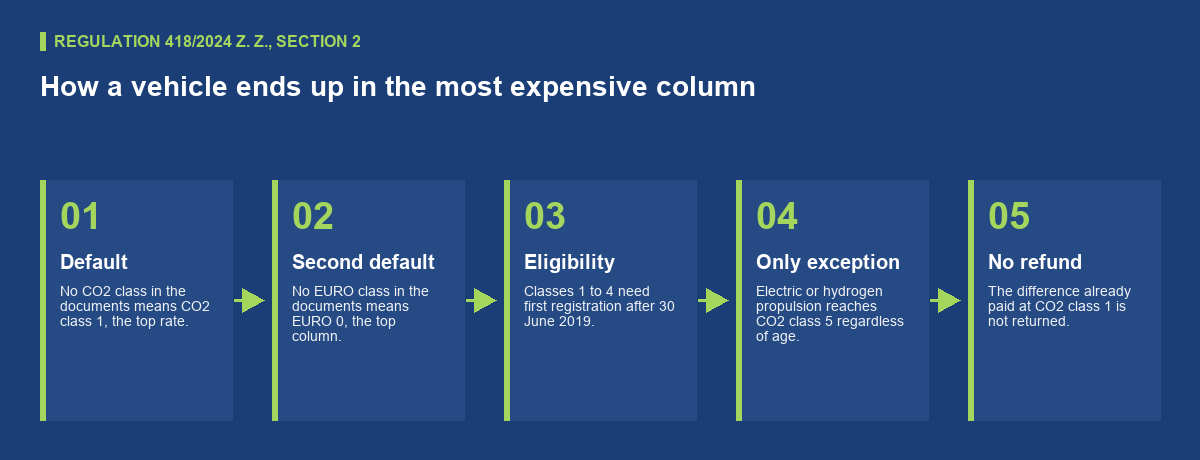
Two defaults in the regulation cost real money, and both of them are administrative rather than technical. Under section 2(4), if the vehicle documents do not state a EURO emission class, the toll is calculated at EURO 0. That is the most expensive column in every table, 0.4696 per kilometre for our reference lorry against 0.2677.
Under section 2(3) the same happens with the CO2 class. Any vehicle whose CO2 class cannot be determined from its documents is placed in CO2 class 1, and it stays there until the document is produced. Then comes the sentence that should be read twice: the difference between the toll calculated at CO2 class 1 and the toll calculated at the newly determined class is not refunded to the operator. Proof works forwards only.
The eligibility rules limit how much there is to prove. Section 2(1) puts vehicles with exclusively electric or hydrogen propulsion in CO2 class 5. Section 2(2) allows classes 1 to 4 for vehicles first registered after 30 June 2019, by subgroup and specific CO2 emissions, and requires the classification in classes 2 and 3 to be reassessed every six years from first registration. A diesel tractor unit registered before that date has no route into a better class at all. The discount system in annex 8 is modest by comparison: above 50,000 kilometres in a calendar year the reduction reaches 11 per cent for vehicles over 12 tonnes, and it applies only to the kilometres above the threshold, not to the whole bill.
What this does to a site appraisal
Put the tariff into an estate. Take twenty heavy movements a day over 250 working days, so 5,000 movements a year, and assume 120 tolled kilometres per movement. That is 600,000 tolled kilometres. At the motorway rate for a EURO VI tractor unit in CO2 class 1 the annual toll is 160,620 euros excluding VAT. This is our own calculation on those assumptions, not a market figure, and the point is not the total but what moves it.
Shift thirty kilometres of every movement from a motorway to a first-class road that is not parallel to one, and the rate falls from 0.2677 to 0.1942 over 150,000 kilometres: 11,025 euros a year. Put those same thirty kilometres on second or third-class specified sections and the charge for them disappears entirely, worth 40,155 euros a year on the same volumes. Neither number appears in a rent comparison, and both are decided by where the gate is.
Two practical consequences follow. First, ask for the routing profile before the appraisal, not after: movements a day, origin and destination, and the road classes in between. Second, look at who carries the cost. Where the occupier runs its own fleet the toll is a direct operating line; where a third party runs it, the toll is inside a rate per pallet or per drop and re-prices at the next renewal, which is one of the quieter differences in the decision between a 3PL and your own warehouse. Either way the road class is fixed on the day the plot is chosen.
Conclusion
The Slovak toll is a location cost wearing a transport label. The tariff prices the class of road rather than the kilometre, motorways and their parallel first-class roads are charged identically so the diversion saves nothing, other first-class roads are roughly a quarter cheaper, and the specified second and third-class sections are free. The network grew by more than 27 kilometres in January 2026 and the parallel roads beside the new sections follow during the year. None of this is negotiable once a site is signed, and all of it is calculable before it is. The routing profile belongs in the appraisal next to the rent, the service charge and the power connection.