
A hall has no thermostat and a summer has no schedule, which is why warehouse heat is usually treated as weather rather than as a term of the lease. It is neither. Slovak law sets a number for the inside of a working building, it cuts the hours that may be worked once that number is passed, and it puts the whole duty on the occupier. The building that decides whether the number can be met belongs to the landlord. Between those two facts sits a gap that no standard lease closes, and the summer of 2026 has made it expensive enough to read.
What warehouse heat does Slovak law actually permit?
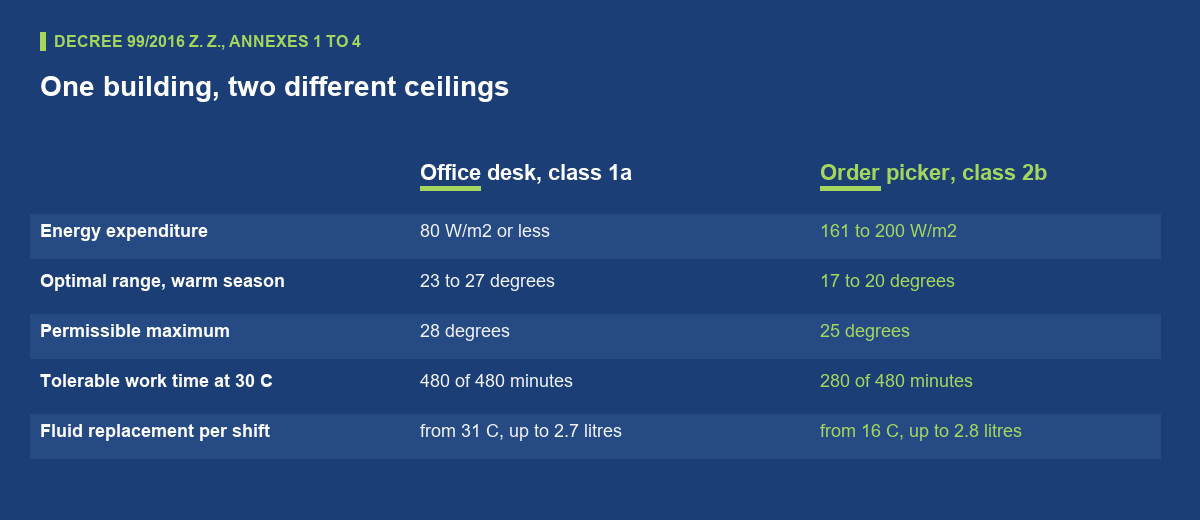
The ceiling is not a rule of thumb. Decree 99/2016 Z. z. of the Ministry of Health sorts work into classes by average energy expenditure and then gives each class a permissible operative temperature. Class 1a is desk work at 80 watts per square metre or less. Class 2a runs from 131 to 160, class 2b from 161 to 200: sustained manual handling, order picking, loading by hand. Annex 2, table 1 sets the warm-season maximum at 28 degrees for class 1a, 27 for 1b, 26 for 1c and 25 degrees for both 2a and 2b. The optimal range for 2b is 17 to 20 degrees.
Two details decide how the number behaves. First, it is an operative temperature, not the reading on the office thermometer: section 2 defines it through air temperature, mean radiant temperature, humidity and air velocity, and in a hall under a hot roof the radiant component is what moves it. Second, the permissible relative humidity band for long work is 30 to 70 per cent in both seasons, and above a permanent 90 per cent the employer must act.
The decree also caps what the sun may do to a person directly. Head irradiance from radiant heat must not exceed 200 watts per square metre, and where daylight openings let direct sun in, the geometry has to keep a worker’s head out of it for more than ten minutes in a shift.
The summer that turned a table into a problem
Until recently the ceiling was theoretical for most of the year. In 2026 it was not. The Slovak Hydrometeorological Institute reported in its assessment of the heat wave at the end of July and the start of August 2026 that five days reached 40 degrees or more, against three such days in the entire prior measurement record. The highest reading was 42.2 degrees at Dolne Plachtince on 6 August 2026, a day after 41.4 degrees at Kamenica nad Hronom. The institute flagged the values as operational and subject to physical verification of the station, and that caveat belongs with the figures.
For an occupier the record itself matters less than the category it creates. Section 2 of the decree defines an exceptionally hot day as one where the shade air temperature exceeded 30 degrees. On such days, and on any workplace where technology makes the ceiling unreachable, section 3 releases the employer from the permissible values. That sounds like relief and is the opposite. What replaces the ceiling is section 4, which requires the working time to be adjusted so that the long-term and short-term tolerable work times are respected.
In other words, the law does not expect a distribution hall in Galanta to hold 25 degrees on 6 August. It expects the shift to change instead.
What a shift loses at thirty degrees
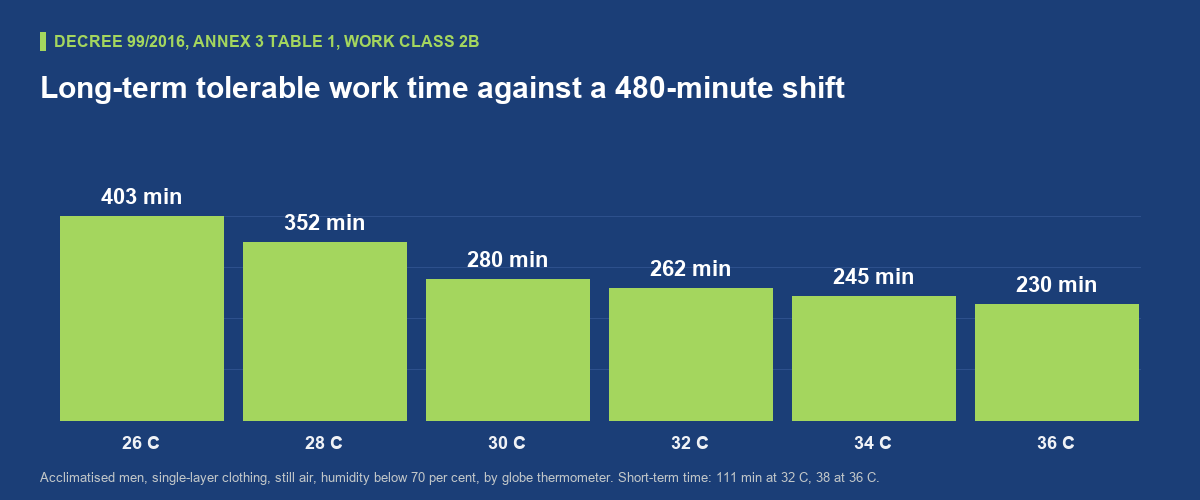
Annex 3 puts numbers on that. Table 1 covers acclimatised men in single-layer clothing at still air and humidity below 70 per cent, and reads by globe thermometer temperature. For class 2b the long-term tolerable work time is 403 minutes at 26 degrees, 352 at 28, 280 at 30, 262 at 32 and 245 at 34. Against a 480-minute shift, thirty degrees costs roughly two hours of lawful working time per person.
The short-term figure moves faster and is the one that breaks a plan. It is identical to the long-term figure up to 30 degrees, then collapses: 111 minutes of uninterrupted work at 32 degrees, 59 at 34, 38 at 36. Above thirty degrees the constraint stops being the length of the day and becomes the length of a single stretch between breaks, which is what a pick rate is built on.
The drinks are priced too. Under section 7 the employer must replace at least 70 per cent of the fluid lost in a shift and must supply mineral drinks, not just water, to anyone in classes 1b to 4 once the working time has to be adjusted. Annex 4 sets the minimum for class 2b at 0.9 litres from 16 degrees, rising by 0.17 litres per degree to 2.8 litres. Where a hall runs agency crews the arithmetic doubles back on itself, because the hours a temporary worker may be billed for are the same hours the decree is shortening.
Why the lease is silent on the number that binds you
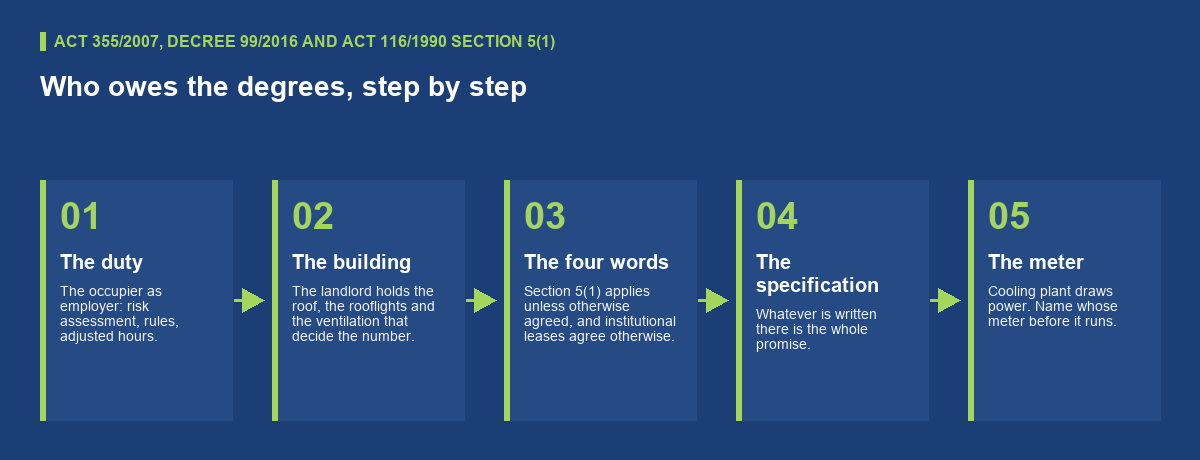
The duty sits with the employer. It flows from Act 355/2007 Z. z. on the protection of public health and is made concrete by the decree: the operating rules, the risk assessment and the work-time adjustment are the occupier’s to produce. Nothing in that chain reaches the landlord.
The building does. Section 5(1) of Act 116/1990 Zb. on the lease and sublease of non-residential premises requires the landlord to hand over the premises in a condition fit for the agreed or customary use, to maintain that condition at its own cost, and to ensure the proper provision of services connected with the use. The subsection opens with four words that carry the whole risk: unless otherwise agreed. Institutional leases agree otherwise, and the temperature obligation is then whatever the technical specification says it is.
So read the specification, not the covenant. Ask what the design internal temperature is and in which season it is guaranteed. Ask whether the roof build-up and the rooflight ratio were designed for summer gain or only for winter loss. Ask whether the ventilation is mechanical or opening-based, and what air change rate it delivers at a 35-degree outside temperature. If none of that is written down, the answer is that nobody owes you a degree.
What cooling costs, and whose meter reads it
Cooling a distribution hall is an electricity question. Eurostat’s half-yearly series for industrial consumers puts Slovak electricity in band IC, from 500 to 1,999 megawatt hours a year, at 0.2090 euros per kilowatt hour excluding VAT and other recoverable taxes in the second half of 2025. That is above Austria at 0.1986, Poland at 0.1935, Czechia at 0.1825 and the EU average of 0.1837, and below Hungary at 0.2132. It is also the only one of those six that rose between the two halves of 2025, from 0.1967. A summer load added to that tariff is not a rounding error, and it lands on top of what a Slovak hall already spends on energy.
The harder question is who is billed. Splitting one boundary meter into tenant-level readings is utilities sub-metering, and Slovak metrology law decides whether the resulting number is one a payer has to accept. Destratification fans, high-volume low-speed fans, evaporative units and a shaded dock apron all draw power, and in a multi-let estate they usually draw it through whichever meter the schedule happens to name. If the cooling serves one unit, it belongs on that unit’s sub-meter. If it serves the estate, it belongs in the service charge with a stated apportionment key. What must not happen is the third case, where a tenant installs plant, the landlord meters the estate, and the bill is split by floor area to everyone including the neighbour who installed nothing.
Measure before you specify. A globe thermometer reading at pick height in the aisle furthest from the docks on an afternoon in August is a cheaper piece of evidence than any model, and it is the reading the decree actually works from.
Conclusion
Heat in a warehouse is not a comfort question and it is not weather. It is a measured number with a legal ceiling, a schedule of tolerable working times behind it, and a bill for drinks and electricity attached. The duty belongs to the occupier, the building belongs to the landlord, and Slovak lease law hands the whole allocation back to the parties with four words. Summers like 2026 turn that gap into lost picking hours rather than an argument about principle. The work is to get the design temperature, the ventilation rate and the meter written into the specification while the lease is still a draft.