
A pallet does not change when it comes off the lorry, but the rule that governs it changes completely. On the vehicle it is covered by CMR liability, a regime with a hard arithmetic ceiling that ignores what the goods are worth. Inside the shed it is covered by the Slovak storage contract, which has no ceiling at all. Occupiers negotiate rent per square metre and service charges per pallet position, then leave the largest single number in the arrangement, who answers for the goods and up to what amount, to whichever standard terms happen to be attached. This piece sets out where one regime ends, where the other begins, and what the difference is worth in euros on ordinary cargo.
What does CMR liability actually cover?
The Convention on the Contract for the International Carriage of Goods by Road, done at Geneva on 19 May 1956, applies to carriage by road for reward when the place of taking over and the place of delivery lie in two different countries and at least one of them is a contracting party. Within that scope, article 17(1) of the Convention is blunt: the carrier is liable for the total or partial loss of the goods and for damage to them occurring between the time he takes over the goods and the time of delivery, as well as for any delay. Article 17(2) relieves him only where the loss was caused by the claimant, by the claimant instructions, by inherent vice of the goods, or by circumstances he could not avoid and whose consequences he could not prevent.
Two dates matter for a Slovak consignment. The Convention itself binds Slovakia as a successor state. The 1978 Protocol, which is what actually sets the modern ceiling, was acceded to separately: according to the United Nations depositary status list the Protocol has 48 parties, and Slovakia acceded on 20 February 2008. Austria has been a party since 1981 and Germany since 1980. A claim heard in Bratislava on a lorry from Vienna is therefore decided under the amended article 23, not the original one.
Why the cap is a weight rule and not a value
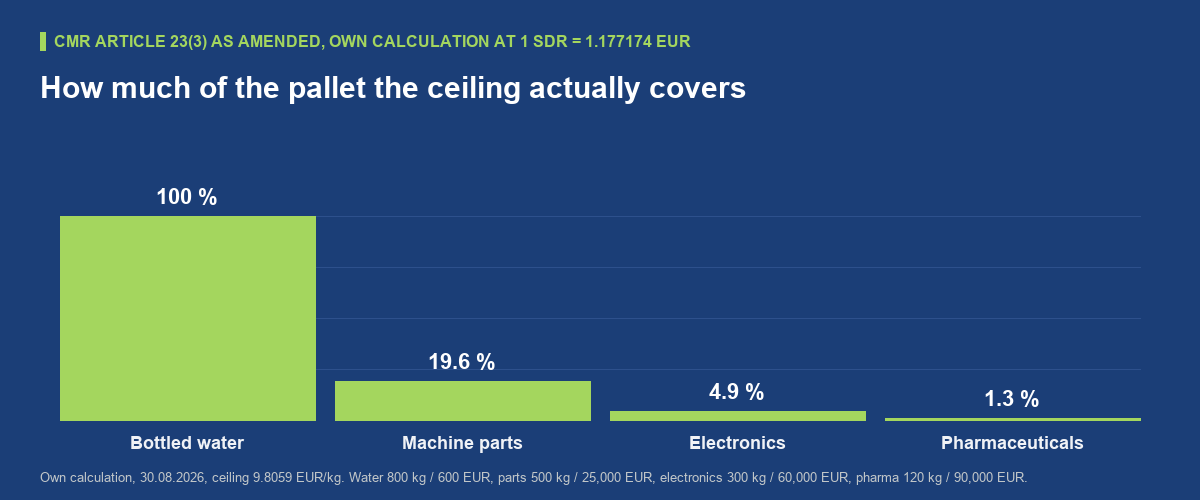
Article 23(1) starts sensibly. Compensation is calculated by reference to the value of the goods at the place and time at which they were accepted for carriage, fixed by commodity exchange price, current market price, or the normal value of goods of the same kind. Then article 23(3) puts a lid on it. In the original 1956 text the lid was 25 gold francs per kilogram. Article 2(1) of the 1978 Protocol replaced that paragraph with a single sentence: compensation shall not exceed 8.33 units of account per kilogram of gross weight short. The new paragraph 7 defines the unit of account as the Special Drawing Right of the International Monetary Fund and, importantly, converts it at the value on the date of the judgement rather than the date of the loss.
One SDR was worth 1.177174 euros on 30 August 2026, which puts the ceiling at about 9.81 euros per kilogram of gross weight. That number is indifferent to what is on the pallet. A pallet of bottled water is covered many times over. A pallet of electronics is covered to roughly a twentieth of its value. Two escapes exist and both are deliberate acts: a declared value under article 24, which the carrier prices as a surcharge, and wilful misconduct under article 29, which strips the carrier of the limit altogether but has to be proved.
What changes the moment the pallet is unloaded?
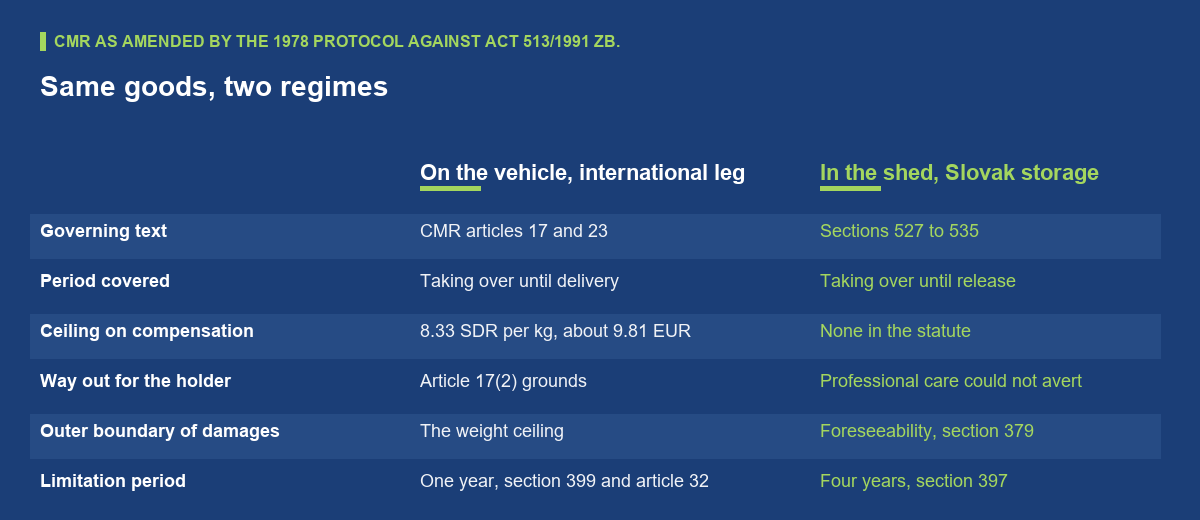
Delivery is the end of the carriage regime, and nothing replaces the ceiling. Once the goods are taken into a Slovak warehouse, the governing text is the storage contract in the Commercial Code, Act 513/1991 Zb. Section 527 defines it: the warehouse keeper undertakes to take over the item, store it and look after it, and the depositor undertakes to pay storage charges. Section 533(1) then states the liability, and it is worth reading slowly. The warehouse keeper is liable for damage to the stored item arising after it was taken over and until it is released, unless he could not have averted the damage while exercising professional care.
There is no figure in that sentence. No euros per kilogram, no multiple of the storage charge, nothing that scales with weight. Section 533(2) grants three narrow exemptions only: damage caused by the depositor or owner, damage from a defect or the natural character of the goods, and damage from defective packaging that the keeper flagged on the receipt. The outer boundary is the general rule in section 379, under which damages do not extend beyond what the party in breach foresaw or could have foreseen when the obligation arose. The limitation period moves too: section 399 gives carriage claims one year, while a storage claim falls under the general four years of section 397.
Why the domestic leg is not the international one
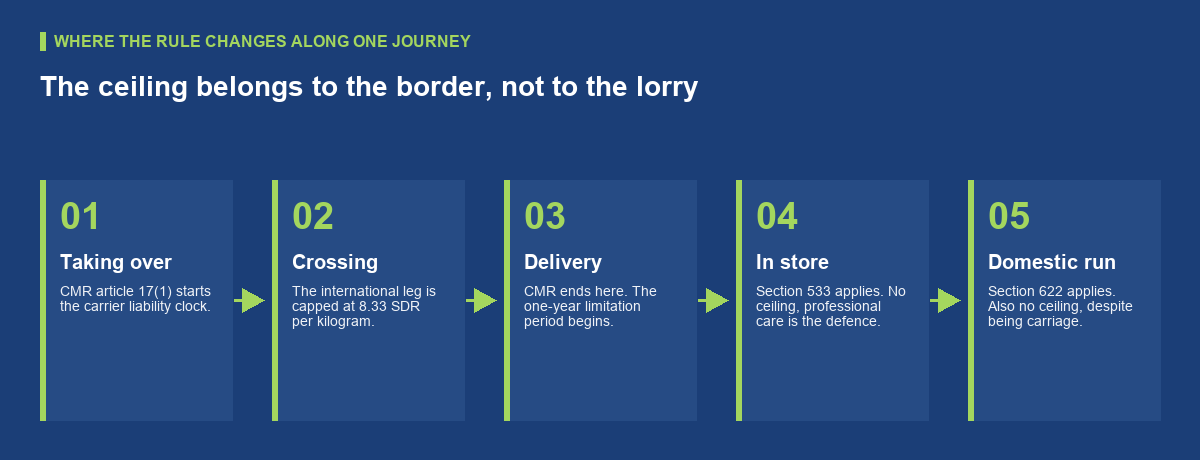
The tempting shortcut is to assume that the ceiling belongs to transport as such, so that a lorry is a lorry wherever it drives. Slovak law does not work that way. A purely domestic carriage sits under section 610 and following of the same Commercial Code, and section 622(1) reads almost word for word like the storage provision: the carrier is liable for damage to the consignment arising after he took it over and until it is released to the consignee, unless he could not have averted it while exercising professional care. Again there is no weight-based ceiling. Section 629 goes further and forbids implementing regulations from limiting the liability that sections 622 and 624 establish.
The consequence is worth stating plainly, because it runs against instinct. The 8.33 SDR ceiling is not a property of road haulage. It is a property of the CMR regime, and the CMR regime is defined by a border. The leg that crosses one is capped. The domestic feeder run from the Bratislava estate to a customer in Zilina, on the same vehicle with the same driver, is not. For an occupier whose network mixes both, the exposure is not uniform along the route, and the point at which it changes is a place on a map rather than a clause in a contract.
What an occupier settles before signing
Four things, and none of them belongs in the rent negotiation. First, the declared value under article 24 for the consignments where 9.81 euros per kilogram is visibly inadequate. The surcharge is a known cost; an uninsured shortfall is not. Second, whether the party holding the goods is providing a warehousing service or letting space, because that fork decides who is the keeper under section 533 at all. It is the same fork that decides the tax treatment, set out in our note on warehousing services versus property letting, and the two answers should match.
Third, the operating model. Where the occupier runs its own hall, the uncapped liability of section 533 never arises between two parties, because there is only one; the exposure sits with the insurer instead. Where a third party operates, it does arise, which is one of the quieter entries in the 3PL decision. Fourth, the physical risk the insurer is actually pricing. The commodity stored, its sprinkler hazard class and the storage height decide the fire scenario long before any contract does, and what that class fixes in the water supply is set out in our glossary entry on the sprinkler hazard class, which is where our note on fire safety compliance in Slovak warehouses starts.
Conclusion
The pallet does not know where the lorry stopped, but the law does. Between taking over and delivery an international consignment is protected by a ceiling of roughly 9.81 euros per kilogram that has nothing to do with its value. From the moment it is set down in the shed, the operator answers for the whole loss, bounded only by professional care and foreseeability, and the claim window stretches from one year to four. Neither rule is negotiable in itself, and both are entirely negotiable in their consequences: through a declared value, through the choice of operating model, and through knowing which minute of the journey the goods are in.