
Rent gets the attention in every site-selection deck; labour decides whether the building ever works. Labour availability – how many people a location can realistically staff, at what wage, against which competing employers – has quietly become the binding constraint on Slovak logistics operations, the way power capacity became one for manufacturers. The uncomfortable geography: the regions with the deepest labour pools host almost no modern industrial space, and the regions with the space are running out of people. This article maps that inversion with first-quarter 2026 data and walks through the arithmetic occupiers should run before they negotiate a single cent of rent.
Two maps, one country – and they barely overlap
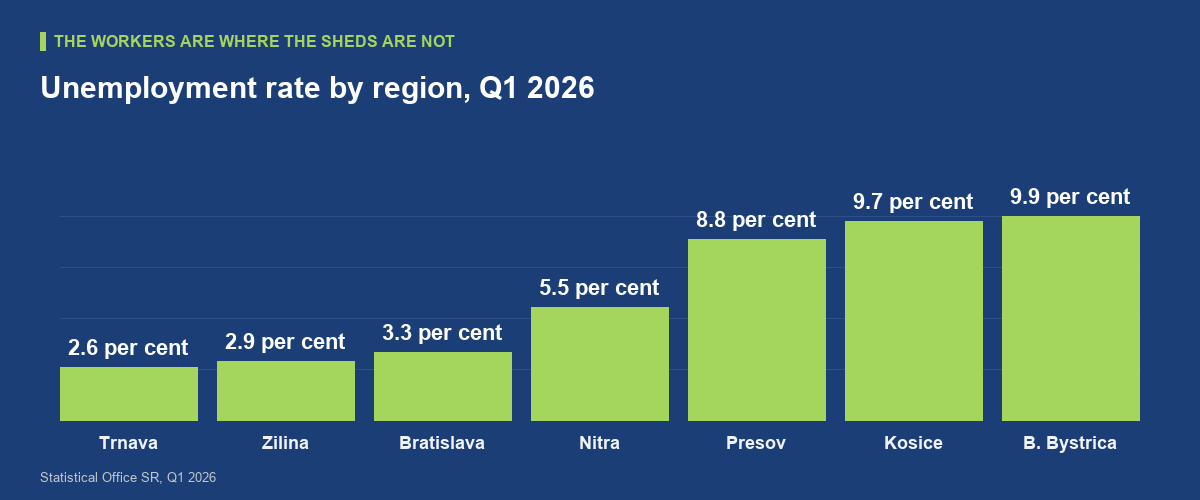
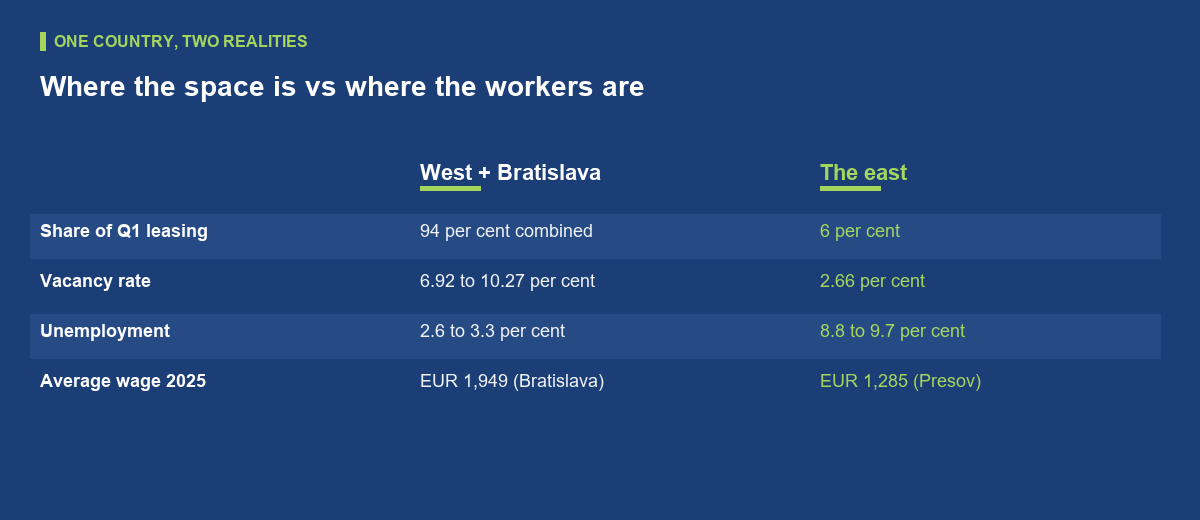
Lay Slovakia’s unemployment map over its leasing map and the mismatch is almost comic. In the first quarter of 2026 the Statistical Office put unemployment at 9.9 per cent in the Banska Bystrica region, 9.7 per cent in Kosice and 8.8 per cent in Presov – against 2.6 per cent in Trnava, 2.9 per cent in Zilina and 3.3 per cent in Bratislava (Statistical Office SR). Now the leasing map: the wider Bratislava area took 72 per cent of all leasing activity in the same quarter, western Slovakia another 22 per cent, and the entire east just 6 per cent (CBRE figures reported by Property Forum). The workers are in the east; the sheds are in the west. Eastern Slovakia also runs the country’s tightest vacancy rate at 2.66 per cent – not because demand is surging, but because almost nothing speculative gets built where institutional landlords see thin exit liquidity. The result is a structural short: labour-rich regions with no space to lease, and space-rich regions where every new operation is a raid on a neighbour’s shift plan. Understanding that inversion is the starting point of any honest Slovak site decision in 2026.
What labour actually costs, region by region
The wage spread across Slovakia is wide enough to change a business case. The full-year 2025 average nominal monthly wage stood at EUR 1,620 nationally, up 6.3 per cent year on year – the ninth consecutive quarter of real growth. Only one region sits above that line: Bratislava, at EUR 1,949. At the other end, Presov averages EUR 1,285 and Trencin EUR 1,522 (Statistical Office SR). Between Bratislava and Presov that is a gap of EUR 664 per employee per month – roughly a third off the capital’s labour bill – before any logistics-specific premium for forklift licences, night shifts or seasonal peaks. The floor is rising too: the statutory minimum wage stepped up to EUR 915 per month from 1 January 2026, from EUR 816 in 2025 (Grant Thornton Slovakia) – a 12 per cent jump that lands hardest exactly where warehouse pay grades cluster near the statutory line. Two caveats keep the comparison honest: these are all-economy averages, not logistics rates, and gross wage is not employer cost once levies are added. But the direction and the scale of the regional spread hold, and they are larger than most occupiers assume.
The arithmetic occupiers should run before the rent negotiation
Put the rent line and the wage line side by side and the hierarchy becomes obvious. Take a 20,000 square metre fulfilment operation. The spread between CBRE’s prime rent of EUR 5.95 per square metre per month and the national average rent of EUR 4.55 (Property Forum) is EUR 1.40 – on 20,000 square metres, EUR 28,000 per month. That is the entire corridor-versus-secondary rent argument. Now staff the building: a two-shift operation of 150 warehouse employees, priced at the regional average wage gap between Bratislava and Presov of EUR 664 per month, moves EUR 99,600 per month – three and a half times the rent lever, every month, before overtime and agency premiums. The point is not that everyone should move east; it is that the labour line deserves at least the diligence the rent line gets. A EUR 0.20 saving on headline rent is celebrated in every deal review, while a location that forces a 10 per cent wage premium to poach staff quietly costs multiples of it. The take-up statistics never show this – leasing volume measures where space was signed, not whether the operations inside it can hire.
Everyone is fishing in the same pool
The competition for warehouse labour is not other warehouses – it is the automotive industry. Automotive was the single largest source of industrial demand in the first quarter at 31 per cent of leasing, ahead of third-party logistics at 30 per cent and e-commerce at 17 per cent (Property Forum), and the plants of the automotive belt – Bratislava, Trnava, Nitra, Zilina – anchor exactly the districts where industrial employment already runs deepest. A distribution centre near Nitra hires against Jaguar Land Rover’s supplier park; one near Zilina against Kia’s. The macro picture is shifting, though. National unemployment rose to 5.9 per cent in the first quarter of 2026, up 0.6 percentage points year on year, with 161.9 thousand people unemployed – 10.4 per cent more than a year earlier (Statistical Office SR). Bratislava even lost its long-held position as the lowest-unemployment region, slipping to fourth behind Trnava, Zilina and Trencin. Slack is returning at the margin – but from historically tight levels, and unevenly: Presov cut its unemployed count by almost a fifth even as the national figure rose. Any staffing plan built on 2024 hiring assumptions deserves a fresh look at the district-level numbers.
How to read labour availability into a Slovak site decision
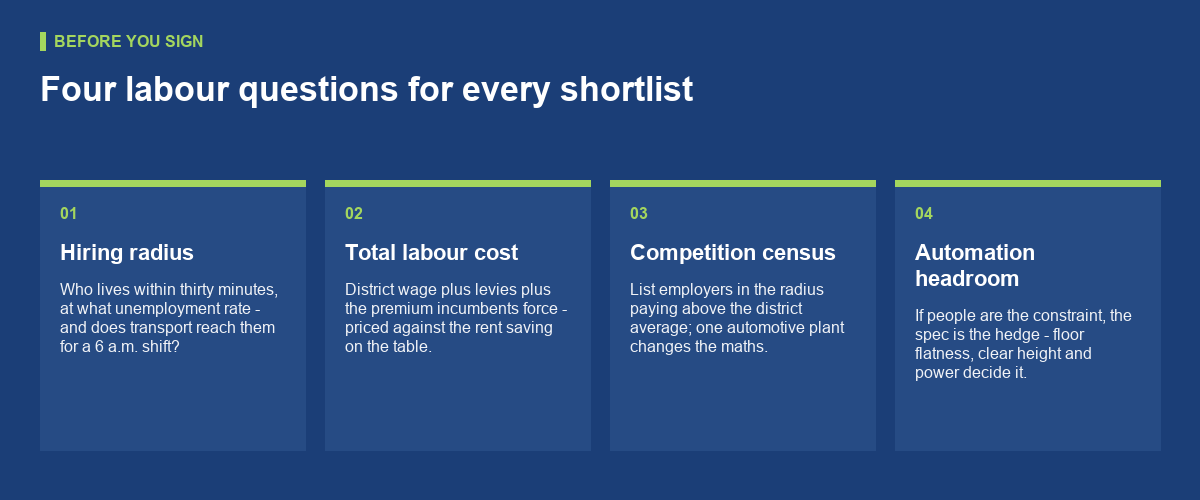
Four questions turn labour availability from a slide into a decision input. First, the hiring radius: who actually lives within thirty minutes of the site, at what unemployment rate, and does public transport or a works bus reach them for a 6 a.m. shift? Second, the total labour cost: benchmark the district wage, add the levy load and the premium the incumbent employers force, and price the package against the rent saving on the table. Third, the competition census: list the employers within the radius who pay above the district average – one automotive plant on the list changes the maths more than one euro on the rent. Fourth, the automation headroom: if the labour pool is the constraint, the building specification becomes the hedge, and the warehouse automation wave sweeping CEE is as much a labour story as a technology one – floor flatness, clear height and power capacity decide whether robots can substitute for the staff the district cannot supply. Landlords can read the same list in reverse: in labour-tight submarkets, a building specified for automation and a site served by public transport lease faster and hold their vacancy rate down through the cycle.
Conclusion
Slovakia’s industrial geography prices concrete precisely and people poorly. The leasing market concentrates 94 per cent of activity in the west of the country while the deepest labour reserves sit in the east, and the wage spread between regions moves an occupier’s monthly P&L by multiples of any achievable rent saving. The occupiers who win in 2026 will be the ones who run the labour arithmetic with the same rigour as the rent arithmetic – and the landlords who win will be the ones whose buildings and locations answer the staffing question before the tenant has to ask it.