
In August 2026, FM Slovenská told the public that its logistics site in Sereď had become a Category A establishment under the Slovak major-accident act. The halls had not changed. A long-term contract with a new client had, and that client’s cosmetics and household goods held enough flammable aerosols to cross a threshold. That is how a Seveso warehouse usually arises in Slovakia: through the stock rather than the steel. This post sets out the thresholds that catch packaged goods, who the law treats as the operator, what the duties demand and when, and what a landlord should agree before a tenant’s inventory changes the status of a hall.
When does a hall become a Seveso warehouse?
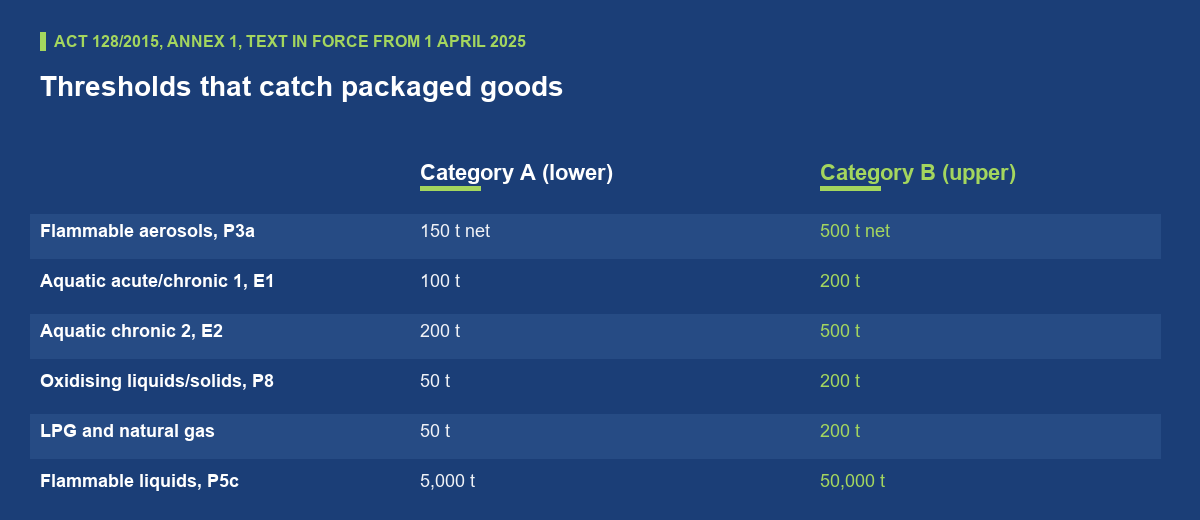
Act 128/2015 on the prevention of major industrial accidents carries the EU Seveso III directive into Slovak law. We read it in the text in force since 1 April 2025. Section 3 defines an establishment as the area one operator controls where dangerous substances are present. It falls into Category A, the lower tier, or Category B, the upper tier, by the quantities in Annex 1. The 2025 amendment only updated references to the new building act and left the thresholds alone.
Two details decide most warehouse cases. Section 2(f) counts the designed, actual or expected quantity, not the average stock. Note 3 to Annex 1 takes the most that may be present at any one time. Note 4 adds a summation rule. It is applied separately to health, physical and environmental hazards. Several classes that each stay below their own limit can therefore still add up to a Seveso site.
For packaged goods the usual triggers are low. Flammable aerosols with a flammable propellant reach Category A at 150 tonnes net and Category B at 500 tonnes. Goods in the most severe class of toxicity to aquatic life count from 100 tonnes, and liquefied petroleum gas from 50 tonnes. Ordinary flammable liquids need 5,000 tonnes. In Sereď, the aerosols alone set the category, and the summation rule did not lift the site into Category B.
Who is the operator when a tenant stores the goods?
Section 4(1) names the operator as the company or trader that runs or controls the establishment, or the person given economic and decision-making power over its technical running. The test is control of the stock and the processes, not title to the building. Section 3(1) draws the establishment around one operator’s area. On the wording of the act, two tenants under one roof are therefore assessed separately.
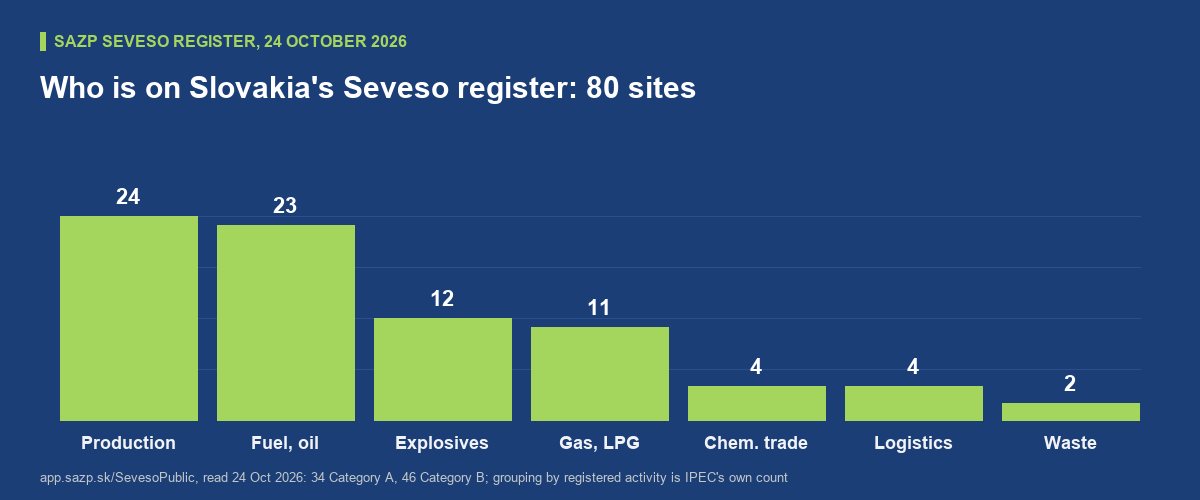
The public register kept by the Slovak Environment Agency shows how this works in practice. On 24 October 2026 its summary counted 80 establishments, 34 in Category A and 46 in Category B. By our grouping of the activity descriptions, four are contract logistics warehouses. One is a hall in Ivanka pri Dunaji, run by Action Logistics Slovakia for household goods. The other three are DSV sites in Senec, and two of them describe chemicals kept in their sales packaging, with no decanting or mixing. In each case the registered operator is the logistics firm. Neither the owner of the building nor the owner of the goods is named. A fuel distributor in Vojany, a Category B site, states that it runs its stores in leased premises.
For a landlord this is mostly good news. The duties, the fines and the paperwork sit with the tenant. The status, however, attaches to an address in a public register.
What the operator must do, and by when
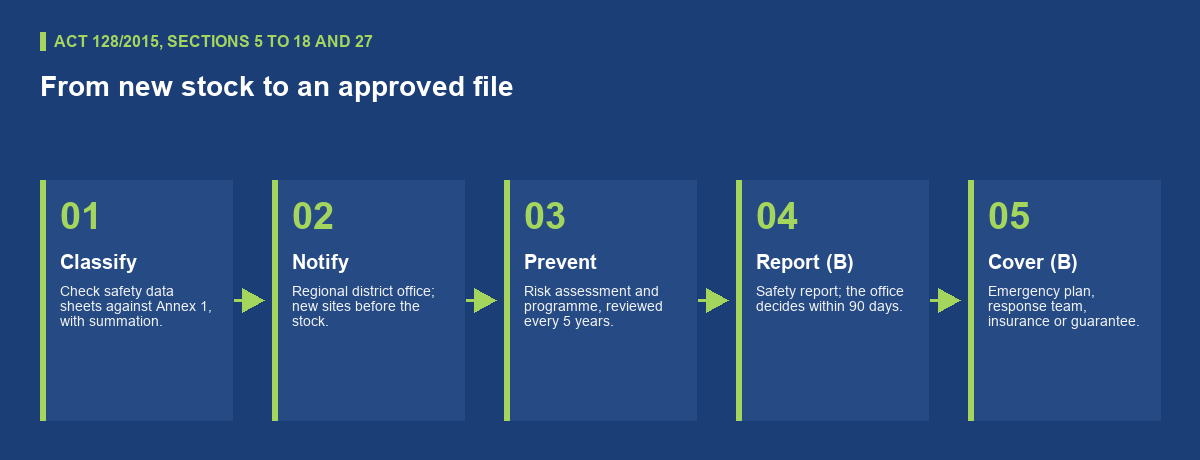
Every operator must classify the site and notify the district office at the regional seat under section 5. It must also assess the risk under section 6 and run a prevention programme under section 7, reviewed at least every five years. A Category B operator also needs a safety report under section 8 and an internal emergency plan under section 10, tested and reviewed at least every three years, plus an emergency response service under section 12. Section 18 asks for insurance or a bank guarantee for as long as the site runs.
Timing depends on whether the site counts as new. Section 3(5) treats as new any establishment built or put into operation after 31 July 2015. For such a site, sections 5(1)(a), 7(1)(a) and 8(1)(a) want the papers in good time before work starts. The same applies before it opens, or before its list of dangerous substances changes. A site in operation before August 2015 that crosses a threshold later has 12 months for the notification and the programme, two years for the safety report and the emergency plan, and three months for the cover. The district office decides on a safety report within 90 days under section 27(5), and section 8(5) lets it bar operation if the report has serious gaps.
Section 25 sets fines from EUR 1,000 to EUR 33,000. A missing notification or a wrong category costs up to EUR 20,000. A missing safety report, emergency plan or cover costs up to EUR 33,000.
What a tenant’s Seveso status means for the landlord and the park
The first effect is on planning. Section 14 makes the bodies that prepare land-use plans and permit buildings keep appropriate safety distances between Seveso sites and other buildings, transport routes and places where people gather. The district office at the regional seat takes part as an affected authority and gives a binding opinion under section 14(4). A park owner who wants to add a hall, a canteen or truck parking next to a Seveso tenant should expect that opinion in the file.
The second effect is on neighbours. Under section 13, the Ministry of Environment names groups of sites where being close together could make an accident worse. The operators in such a group must share information. The register links the Action Logistics hall in Ivanka pri Dunaji with Bratislava airport in this way. The third effect is public view. Section 15(2) makes the operator publish safety information, including on its website. A Category B operator must also inform the municipality, schools, hospitals and nearby sites at least every five years.
Fire safety runs in parallel under its own act, which our post on fire safety compliance in Slovak halls covers. A sale of the hall changes its owner, not its operator. Our glossary explains how the deposit in the cadastre moves title. The duties stay with whoever runs the stock, which matters for what a buyer of a let building inherits.
What to agree in the lease before the stock arrives
Most of the risk sits in the gap between a tenant’s new customer contract and the landlord hearing about it. A lease for a logistics hall can close that gap with a few clauses. The permitted use can name the hazard classes the tenant may store and cap them below the Category A thresholds unless the landlord agrees in writing. The tenant can be asked to give notice before any change that section 5(3) already obliges it to report to the authority, together with the safety data sheets on which the classification rests.
Copies of the notification and the prevention programme belong in the landlord’s file. For Category B, so do the approval of the safety report and proof of the cover under section 18. The lease can also oblige the tenant to share the risk information it must give planning bodies under section 14(3). And it should say who pays for extra fire protection, drainage or water retention.
Check the register as well, but do not rely on it alone. FM Slovenská described its Sereď site as Category A in August 2026, yet the site was not listed when we checked on 24 October 2026. The register’s six recorded major accidents, from 2005 to 2014, all happened at chemical plants, a steelworks or a power station, not in a warehouse.
Conclusion
A Slovak hall becomes a Seveso site when the quantity of dangerous goods it may hold crosses a line in Annex 1, and for aerosols that line is 150 tonnes. The duties fall on the operator, which in a let warehouse is the tenant or its logistics provider, not the owner. The landlord still feels the status in planning conditions, in domino groups and in a public register that names the address. Three steps keep it in hand: name the hazard classes in the permitted use, require notice before the stock changes, and keep copies of the operator’s filings.