
At Valaliky near Košice, the state needed farmland from about 1,100 owners for the Volvo plant, and only 15 of them rejected the price. Expropriation in Slovakia still had to finish the job: apart from those 15, the files concerned owners who had died, the state company said in October 2022. A private developer assembling a logistics park has no such tool. The law allows expropriation only for a purpose set by statute, and the acts that make an industrial site such a purpose reserve the power for the public side. This post explains the procedure, what the significant and strategic investment acts add, how Valaliky used them, and what an occupier signs up to inside a state park.
Who may use expropriation in Slovakia, and for what
Act 282/2015 on expropriation, in the text in force since 1 April 2025, sets four conditions in section 2(1). Expropriation must stay within the necessary extent. It must serve a public interest, either a purpose set by law or a public-benefit structure in an approved land-use plan. It needs adequate compensation, and it is only open where an agreement cannot be reached. Section 2(2) adds that it must match the goals of spatial planning, shown by a binding opinion of the planning authority.
The failed agreement is a formal step. Under section 3, the future expropriator sends a written offer with a compensation figure based on an expert valuation and a statement of the public interest. The owner then has 90 days. A written refusal, or silence for those 90 days, opens the way to a proposal, which the regional office of the Office for Spatial Planning and Construction decides under section 7(1).
A speculative logistics park does not meet the first condition on its own. It needs a statute that declares the project to be in the public interest, and the two that do so for industrial land keep the power for the state, regions, municipalities and their companies. A private developer therefore assembles land the way our post on why ten hectares take years describes: one owner, one contract, one share at a time.
How the procedure runs under Act 282/2015
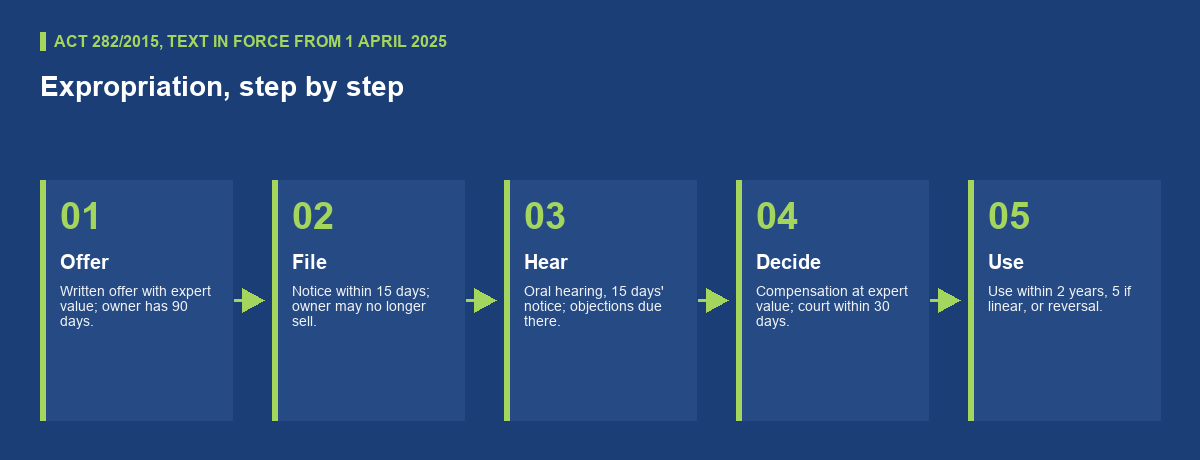
The proposal must carry an expert valuation no older than two years. Within 15 days of receiving it, the authority publishes the start of the proceedings and notifies the parties and the cadastral office. From delivery of that notice, section 10(8) bars the owner from disposing of the plot until the case ends, with one exception: the owner may still sign a lease. The cadastre records the ban as a note.
An oral hearing is mandatory and is announced at least 15 days ahead. Objections must be raised there at the latest, and section 10(12) ignores objections that were rejected, or could have been raised, when the land-use plan was discussed. The decision sets compensation at the general value from the expert opinion, and section 4(3) makes that value the floor. An owner who wants more is sent to court and has 30 days from finality to sue under section 14(2). An appeal against the compensation part does not suspend the decision.
Ownership passes on the day the decision becomes final. Section 15(2) extinguishes liens, non-statutory easements, pre-emption rights and leases of the land or buildings, unless the authority decides otherwise. Leases of flats and non-residential premises survive under section 15(5). The expropriator must start using the land within two years, or five for a linear structure, and section 17 lets the former owner ask for a reversal within five years after a missed deadline.
What the significant investment act adds for a state park
Act 371/2021 on significant investments took effect on 1 November 2021 and replaced the 1999 act under which strategic parks were certified. Its section 17(3) renames the strategic park a strategic territory, which section 2(f) defines as at least 30 ha in one cadastral area or in adjoining ones. The government declares a project to be in the public interest, and the ministry issues a certificate.
The strong version is section 3(1): a project run by a company founded by the state, a region or a municipality. On the day the government approves it, section 8 creates a statutory pre-emption right over the land. It lapses after two years unless it has been used or an expropriation has been filed. Owners receive a written offer at no less than the value under the valuation decree, and section 11(6) treats silence for 30 days as a refusal. Section 11(9) then allows expropriation, and section 11(10) lets the certificate stand in for a land-use plan that does not yet show the park.
A private company can hold a certificate too. Section 3(2) asks for a site on a strategic territory, EUR 30 million of investment and 50 new jobs, halved in the least developed districts. That certificate goes with building, integrated-permit and EIA applications under section 7(5), but not with an expropriation proposal. Section 7(4) keeps that for the public holder. Our glossary entry sets out what the certificate requires of its holder. The Ministry of Economy’s register lists 12 projects certified since November 2021, three of them private.
Valaliky: what the state assembled, and how
The certificate of 25 October 2022 covers 1,052.25 ha in eight cadastral areas around Valaliky, south-east of Košice. It is held under section 3(1) by Valaliky Industrial Park, a company owned by the Ministry of Economy, on the basis of government resolution 792/2021 of 22 December 2021. Volvo Car Slovakia holds a separate certificate for its car plant, issued under section 3(2), for 339.1 ha inside that territory. The state assembled the land, and the private investor builds on it.
The purchase ran mostly by contract. In October 2022 the company told the news agency TASR that of about 1,100 farmland owners only 15 had rejected the price, five of them from one family, and that the other expropriation files concerned owners who had died. Arable land was bought at EUR 14.13 per m², and the area under expropriation then measured 669,000 m² for EUR 9,725,000. Most contracts not yet signed involved plots under enforcement or liens.
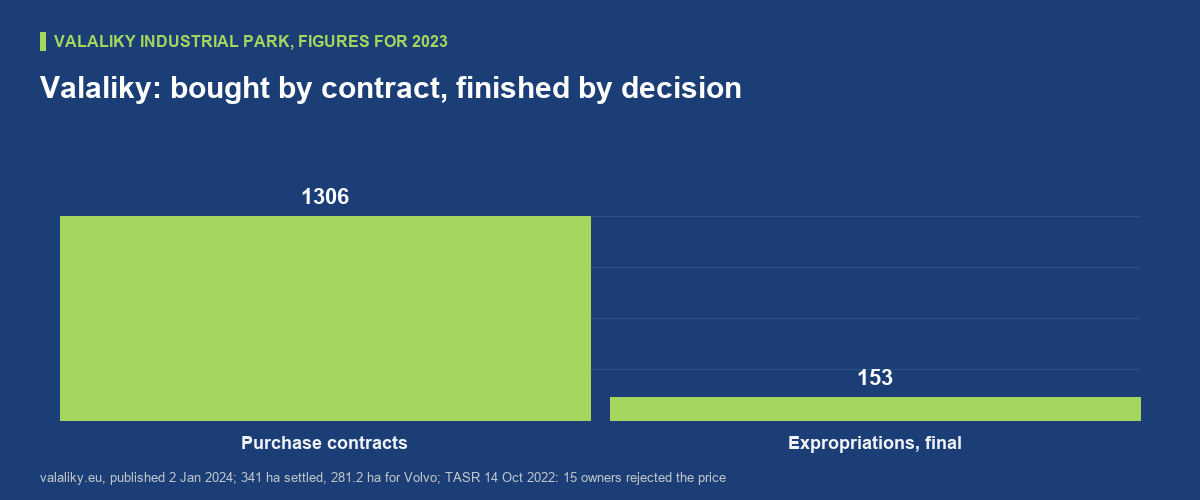
By the end of 2023, the company reported 1,306 purchase contracts and 153 expropriation proceedings that had become final, with 341 ha settled, 281.2 ha of it for Volvo. Expropriation settled a handful of price disputes. Most of its work was clearing titles that no buyer could have signed for. Our post on what Nitra tells us about eastern Slovakia covers what the plant means for the market around it.
Strategic investment since 2024, and what an occupier signs up to
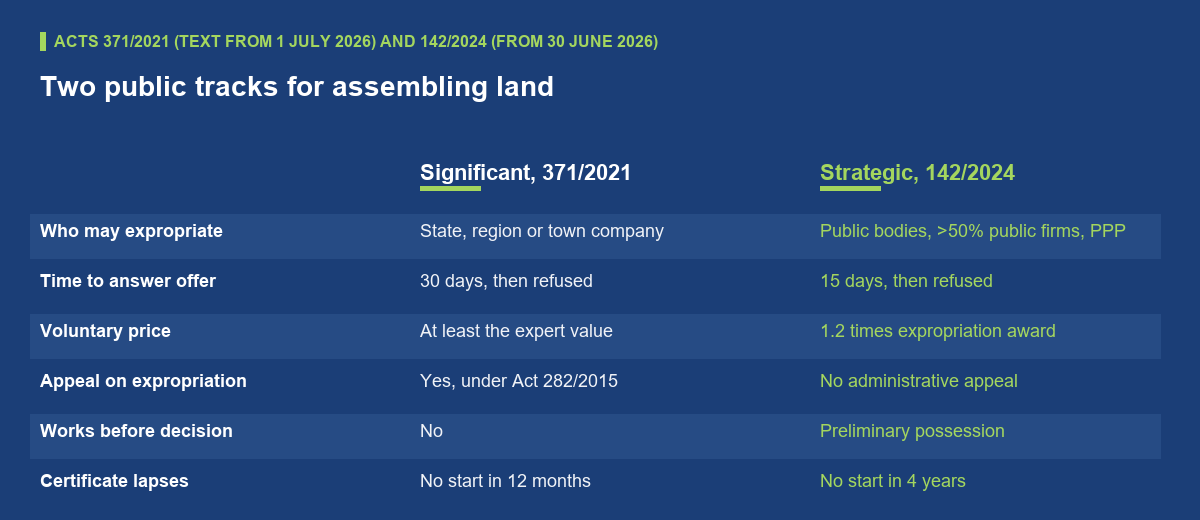
Since 27 June 2024, Act 142/2024 on strategic investments adds a faster track, again only for public investors: the state, regions, municipalities, companies more than 50% publicly owned and public-private partnerships. An owner has 15 days to accept an offer set at 1.2 times the cash compensation under the expropriation act. Section 11(12) rules out an administrative appeal against the expropriation decision, and section 12 allows preliminary possession, so that reversible works can start before it. Under section 30(2), older certificates carry over. The ministry confirmed Valaliky on 16 August 2024 and certified the 636.5 ha Šurany Industrial Park in 2025.
For an occupier, a state park changes two things. The title is cleaner: section 9 of Act 142/2024 ends third-party rights, except statutory easements, when the investor’s ownership is registered. Section 12a of Act 371/2021 does the same for certificates issued after 1 March 2025. A private certificate also carries duties under section 10(2). The holder must finish within seven years, fill the jobs within three years of completion, keep each job for two years and run the investment for seven. Section 14(2) sets the fine for the main breaches at 100% of the price paid for the land. The text in force from 1 January 2027 keeps the 15 days and the 1.2 factor.
Conclusion
Expropriation is a public tool in Slovakia, and the law keeps it that way. A private developer buys land parcel by parcel, while a state park can register a pre-emption right, shorten the answer window to 30 or 15 days and take the last parcels at expert value. Valaliky shows where that power mattered most: in titles nobody could sign, more than in prices nobody would accept. For an occupier, a plot in a state park brings a cleaner title. A certificate of its own brings duties, and a fine equal to the full land price is a risk to weigh before the term sheet.