

A change of use is the step most occupiers forget when a Slovak warehouse turns into a production hall. The racking goes out, the machines come in, and the lease already says light manufacturing. The building, however, was certified for storage, and section 68 of the Building Act 25/2025 lets it be used only for the purpose written in its certificate. Using it differently can cost a company up to EUR 150,000. This post explains what the Act counts as a change, when the building office must decide, how long that takes, and what the amendment in force from 1 January 2027 alters.
What counts as a change of use under the Building Act?
Section 68(1) of the Building Act 25/2025, which we read in the text in force from 1 November 2025 to 31 December 2026, starts with a plain rule: a building may be used only for the purpose set out in its certificate. A change of use is then defined as a change in the prevailing manner in which the building is used. A hall certified as a warehouse that mainly houses production has changed its prevailing use, whatever the lease calls it.
The definition has a second limb that catches more cases than the first. A change in the technical parameters of the operation counts as well, if it alters the original effect of the building on its surroundings, its fire safety or the safety of its use. So does turning a temporary building into a permanent one. The Act also names what stays outside. Using individual rooms differently is not a change, provided the original function of the building is kept and fire safety is not made worse. A quality lab or a packing line in one corner of a distribution hall will usually fit that exception. A paint shop, a press line or a battery assembly area usually will not, because noise, emissions, fire load and traffic all move at once.
When does a change of use need a decision?
Section 68(2) answers with a list. A decision of the building office is required where the change lies in the manner of use of the building or of its operating equipment, or in the manner and substantial expansion of production or of activities that could endanger life, health or the environment. In practice, a move from storage to manufacturing meets that test almost by definition, and so does a jump in output that brings new emissions or a higher fire load.
The route depends on whether anything is built. If the new use comes with an alteration of the finished building, section 68(3) sends the case into the construction intent procedure: the office verifies the design and approves the altered building once the works are complete. If only notified building modifications are involved, the office deals with the change after they are finished. If nothing is built at all, the decision on the new use stands alone.
One limit cannot be negotiated. Under section 68(5) the office refuses a new purpose that conflicts with the binding part of the municipal zoning documentation. A hall in a zone reserved for logistics may therefore never become a factory. A new production line can also need its own environmental check first, as our post on why the verdict is rarely the risk explains.
How long does the change of use procedure take?
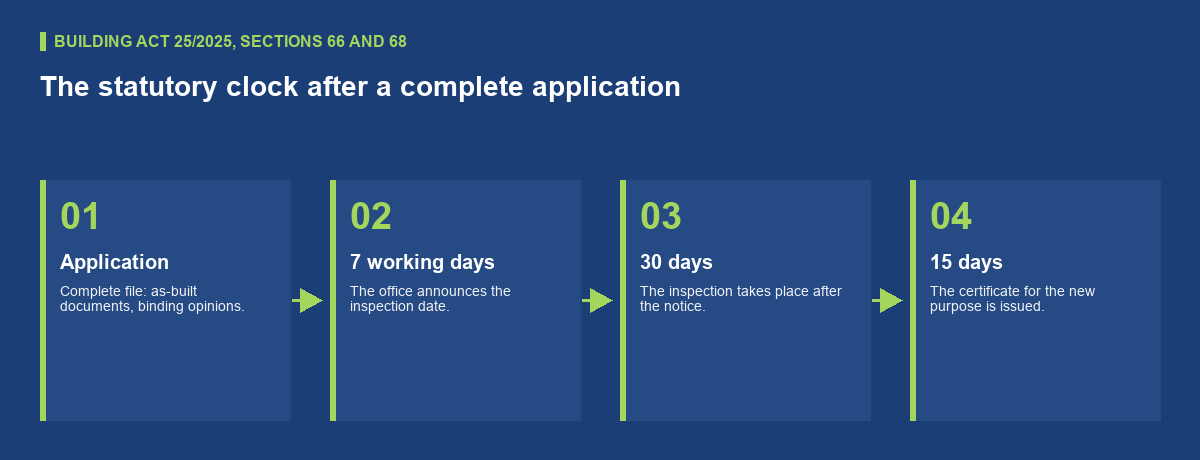
Section 68(4) applies the rules for approving a finished building, sections 66 and 67, to the change procedure as appropriate. That brings three statutory periods with it. The office announces the date of the inspection within 7 working days of receiving a complete application. The inspection must take place within 30 days of that notice. If the building is fit for the new purpose, the certificate follows within 15 days of the inspection. In our reading that is roughly two months of statutory clock, and the word that matters is complete.
Completeness is where the time goes. The application travels with the documentation of the building as actually built, the binding opinions of the authorities concerned, and the results of measurements and inspections of reserved technical equipment under section 66(2). For a production use, the fire authority and the public health authority will look at a different building from the one they approved as a warehouse. Escape routes, fire compartments, ventilation and noise all get reassessed, which our post on what the fire rules ask of a hall covers in detail. An occupier who orders the fire design and the noise study before signing the lease usually saves more time than any statutory deadline can.
What does the 2027 amendment do to a change of use?
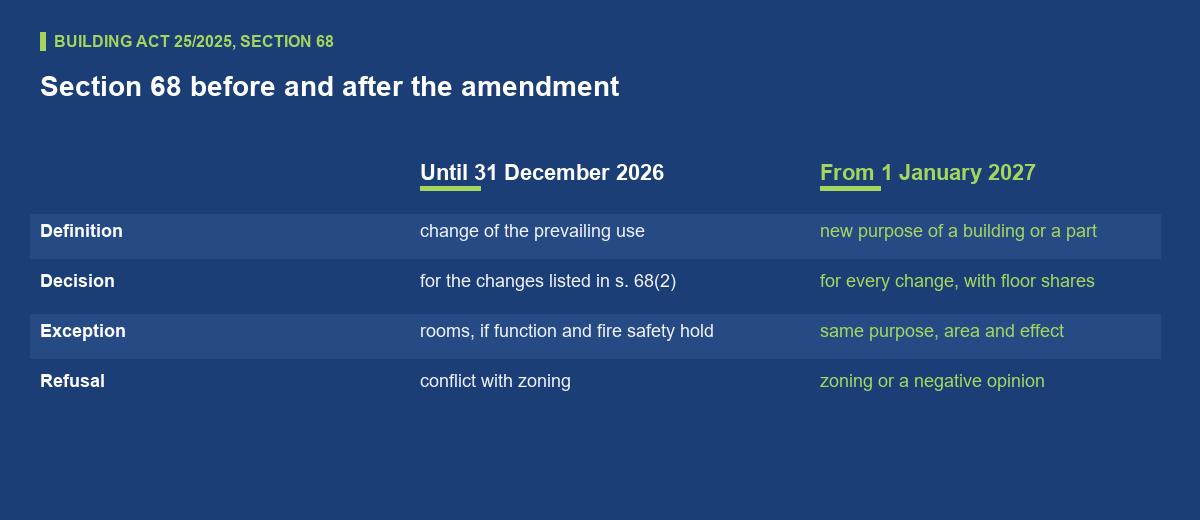
Act 243/2026 rewrites section 68 with effect from 1 January 2027, and we compared both texts word for word. Three points matter for industrial property. First, the definition no longer speaks of the prevailing use. A change of the purpose of a building or of a part of it to another purpose is a change, so converting one unit of a multi-unit hall is clearly covered. Second, every change needs a decision, and that decision must state the new shares of floor area for each purpose. Section 67(3) mirrors this: a certificate for a building with several uses lists the main purpose and the others with their floor area shares.
Third, the exception narrows. From 2027 a different use of non-residential space stays outside the procedure only if the original purpose is kept, the floor area does not change, the effect on the surroundings stays the same, and neither fire safety nor safety of use suffers. The office must also refuse a new purpose where a binding opinion of an authority concerned is negative, in addition to a conflict with zoning. Finally, the sanction becomes explicit. A company that changes the purpose or operation of a building without a decision faces a fine of EUR 1,000 to EUR 25,000 under the new section 80(3)(l).
Who carries the change of use risk in a lease?
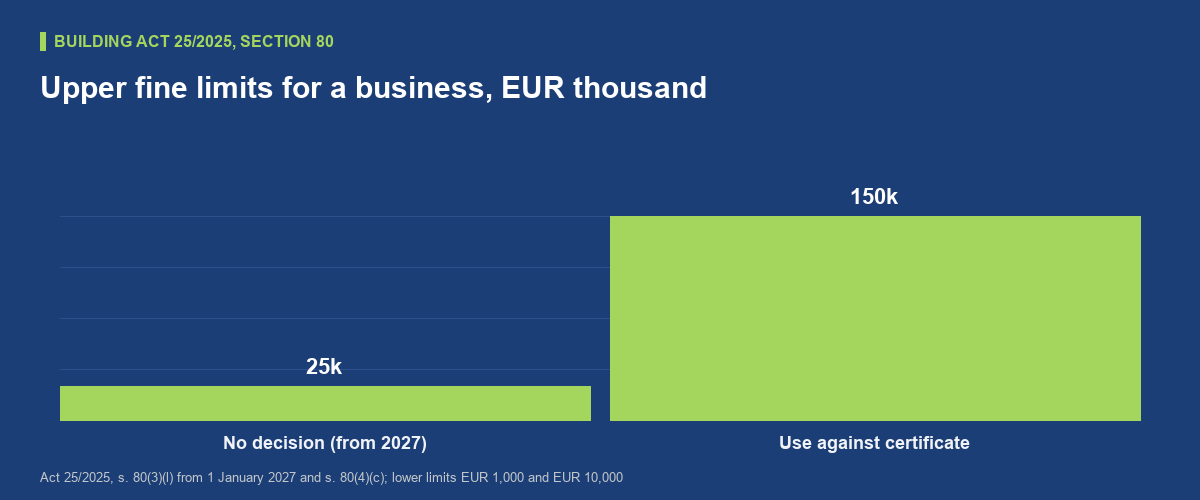
Both sides do. Section 45(2)(h) obliges the owner to use the building for the purpose in the certificate and to apply for a new approval when the purpose changes. Section 80(4)(c) then sets a fine of EUR 10,000 to EUR 150,000 for a business that uses a building without a certificate or contrary to it, and for an owner who allows such use. The 2027 text keeps that range in section 80(4)(e). A landlord cannot point to the tenant, and a tenant cannot point to the lease.
The lease should therefore settle four things before the machines are ordered. The permitted use clause has to match the certificate, or name the new purpose as a condition of the lease. One party must be responsible for the application, and the other must be obliged to sign and supply what the office asks for. The cost of the fire design, the studies and any works needs an owner. And the parties should agree what happens at the end: whether the hall goes back to storage or keeps its new purpose. The inspection reports for cranes, lifts and electrical installations belong in the same file. Our glossary explains which equipment counts and who tests it. We described the first approval of a new hall in our post on why a finished hall waits.
Conclusion
A change of use in Slovakia is decided by the certificate, not by the lease. Until the end of 2026 the test is the prevailing use and the effect on fire safety and the surroundings. From 1 January 2027 every change of purpose needs a decision, including a change in part of a building. Three steps keep a conversion on schedule: read the certificate and the zoning plan before signing, order the fire design and the studies early, and write into the lease who applies and who pays.