
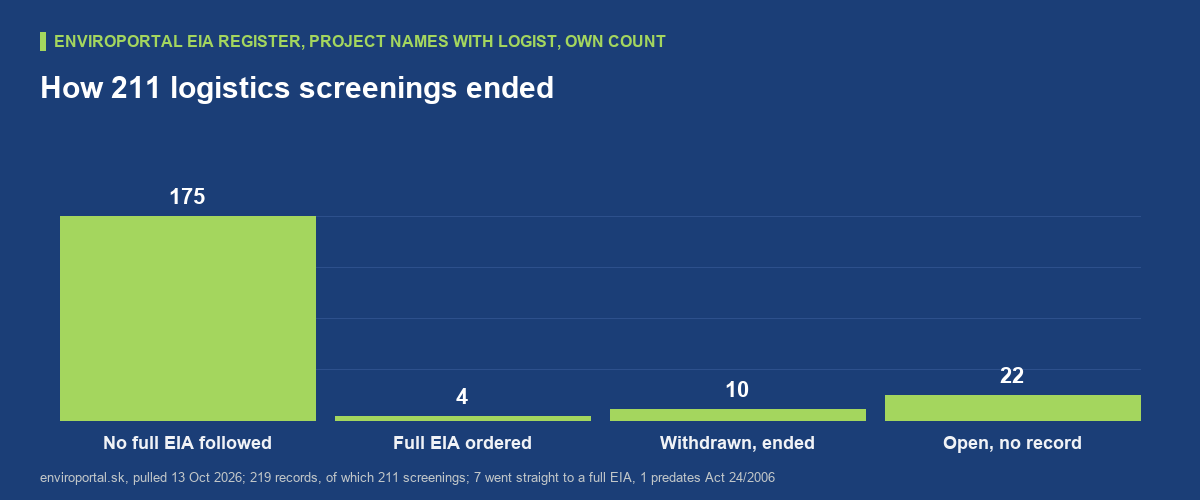
Slovakia’s EIA register lists 219 procedures with “logist” in the project name, and 211 of them went through EIA screening. Only four of those screenings ended with an order for a full assessment. For a logistics park, the verdict is rarely the risk. The thresholds of Act 24/2006 catch almost any new hall on open land, and the opinion that clears it often carries conditions on roads, drainage and design. This post explains what triggers screening, how long it takes, what the conditions look like, when a tenant’s stock forces a full assessment, and what the next version of the Act changes in 2027.
What triggers EIA screening for a logistics park
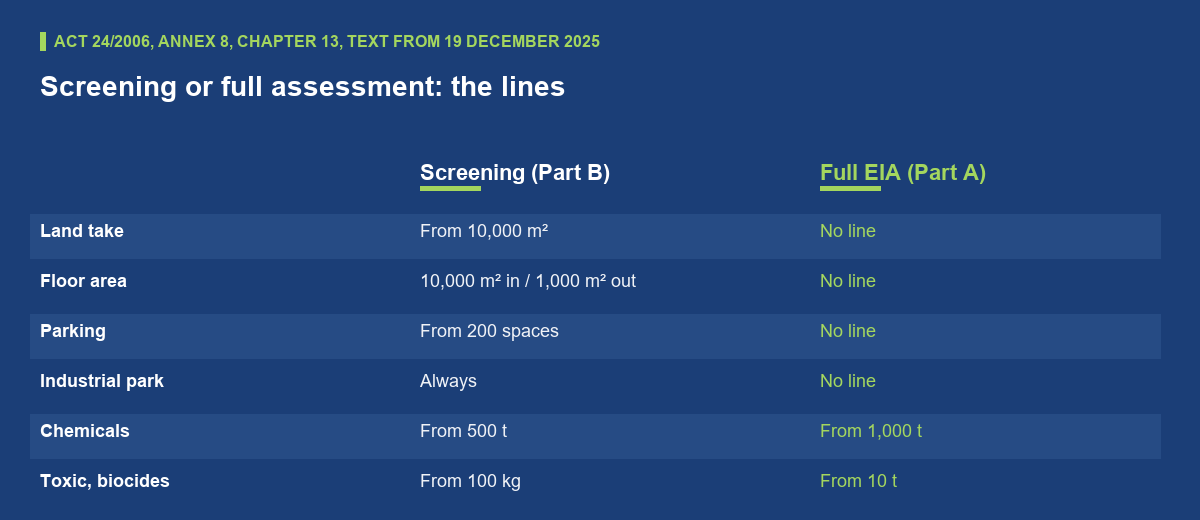
Annex 8 of Act 24/2006 on environmental impact assessment, in the text in force since 19 December 2025, sorts activities into two columns. Part A means a full assessment. Part B means screening first, and section 18(2)(b) sends every Part B activity there. Annex 10 lists what the authority then weighs: the scale of the project, its land take, noise and waste water, and the sensitivity of the location, including its fit with the land-use plan. Three items in chapter 13, on infrastructure, catch logistics parks, all in Part B.
Item 1 covers site preparation from 10,000 m² of total land take. It also covers buildings from 10,000 m² of gross floor area inside the built-up area of a municipality, but from 1,000 m² outside it. Since 1 November 2025, underground floors count towards that area too. Item 2 covers car parks from 200 spaces. Item 3 covers the development of industrial areas, including industrial parks, with no threshold at all. Section 18(4) adds successive changes together, so a series of extensions that each stay below a line counts as one.
The land take often decides, not the hall. A storage hall on Automobilová street in Trnava, with 6,002 m² of built-up area and a single parking space, needed screening in 2025 because the plot measured 15,792 m². The Trnava district office cleared it without a full assessment. Land assembly therefore shapes the screening file from the start, as our post on why ten hectares take years shows.
How long screening takes under section 29
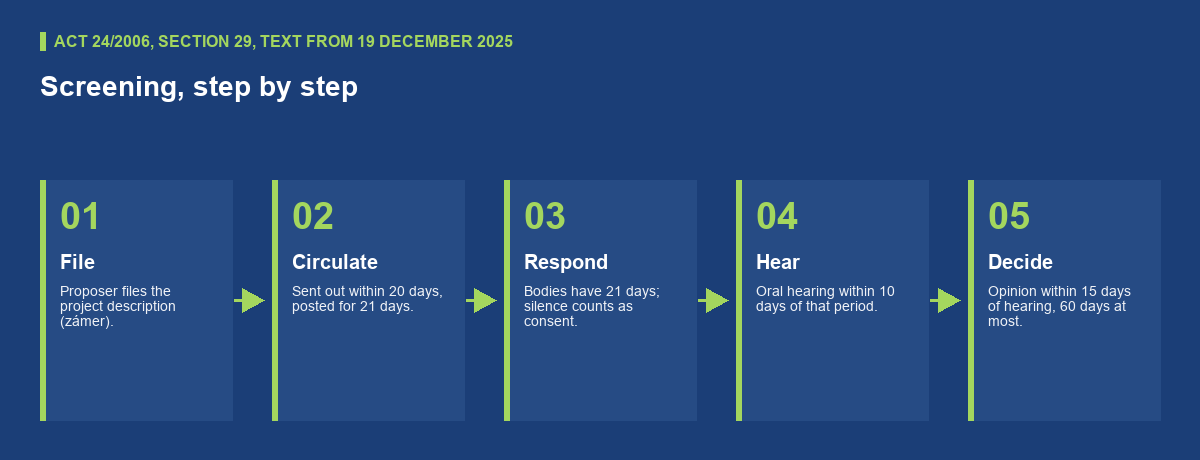
The proposer files a project description, the zámer, with the content set by Annex 9. Within 20 days the authority sends it to the permitting authority, the responsible ministry, the bodies concerned and the municipality, and publishes it online. The municipality posts it for at least 21 days. Each body then has 21 days to say whether a full assessment is needed, and silence counts as consent under section 29(5).
An oral hearing follows within ten days after that period. The binding opinion is due within 15 days of the hearing and no later than 60 days after the zámer arrived, or 90 days in particularly complex cases. Strategic investments go first. Under sections 55 and 56, the district office decides where the effects stay within its district, and the office at the regional seat where they reach further.
The Trnava file kept to that schedule. The office notified the parties on 3 July 2025, held the hearing on 31 July and issued its opinion on 6 August; it became final on 22 August. A unit in a completed production and storage hall near Žilina airport needed screening because its planned use, injection pens for diabetes treatment, falls under the pharmaceutical item of chapter 6. That file ran from 19 December 2025 to a final opinion on 26 February 2026. The use, not the building, set it off.
What a clearance asks for: the Zeleneč conditions
The logistics and production park at Zeleneč near Trnava shows what a clearance looks like. The site covers 226,717 m², with 108,654 m² of built-up area in the first variant, and the project description counts 1,387 potential jobs. Twelve bodies sent statements, the office held two hearings, on 26 August and 4 September 2025, and on 10 September it ruled that no full assessment was needed.
The same opinion set 30 conditions, and several reach into the design. The developer must reconsider the planned roundabout, check its distance from the D1 motorway junction, keep the main buildings out of the 20-metre protection zone of the access road, and route long-distance trucks onto the D1 and R1. Another condition hands the roundabout and the widened road section to the Trnava region for EUR 1 after completion. Section 38(6) then writes the conditions into the permit.
A clearance can also be contested. Under section 30, the proposer, the municipality and the public concerned may appeal within 15 days, and a timely appeal suspends the opinion. A civic association appealed the Zeleneč opinion on 25 September 2025, and the appeal body rejected it on 22 October. Section 29(20) adds a court action against an opinion that rules out a full assessment. The opinion is valid for three years, extendable by two years at a time up to seven.
When the stock turns a hall into a full assessment
Part A of chapter 13 holds the lines a warehouse crosses through its stock rather than its walls. Storing chemicals or chemical products needs a full assessment from 1,000 t, with screening from 500 t. Toxic substances, biocides and plant protection products reach Part A at 10 t, with screening from 100 kg. Fertilisers reach it at 50 t, petroleum products at 10,000 t. The lines measure storage capacity, not the stock on an average day. Under section 18(1)(a), a Part A activity skips screening altogether, and section 54(2)(k) gives it to the Ministry of the Environment.
A logistics centre in Senec shows the switch. In March 2026 the operator, DSV Solutions Slovakia, applied for a maximum design capacity of 2,980 t of chemical products in one part of an existing hall. That is above 1,000 t, so the ministry runs a full assessment. It set the scope on 2 June 2026, and the assessment report went online in July.
A change to a Part B activity that has already been permitted goes back to screening under section 18(2)(d). For a landlord, the lesson belongs in the lease. Cap the tonnage per substance category below the Part A and Part B lines, and make any increase subject to consent. Otherwise the next tenant’s stock can reopen a file the developer closed years ago.
Who may file, and what screening means for the building plan
Screening asks for no land right. Section 3(h) defines the proposer as anyone interested in carrying out the activity, so a developer can file while the land is still under option. The building plan is different. Section 57(2) of the Building Act 25/2025 makes the building authority check that the applicant has a right to the land and that the works comply with the environmental decision. Under section 29(2)(a) of that Act, a right recorded in the cadastre needs no separate proof. Our glossary entry explains what that record shows and what it leaves out.
Section 38(3) of Act 24/2006 bars any permit without the opinion where screening was due, and under section 38(9) a permit procedure that skipped it is stopped. The environmental authority also issues a binding opinion at the building plan stage and again at the final inspection. Our post on why a finished hall still waits covers that end.
The version in force from 1 January 2027 leaves Annex 8 unchanged word for word, and the December 2025 amendment, Act 383/2025, dealt with wind-power acceleration zones. The 2027 change sits in section 39a. Where the activity is an installation under the pollution control Act 39/2013, the assessment moves into the integrated permit procedure unless the proposer asks otherwise, with 45 days for written statements. Procedures started by 31 December 2026 finish under the old text. A pure storage park is untouched.
Conclusion
EIA screening is close to certain for a Slovak logistics park, and a full assessment is rare. The verdict is therefore a poor planning variable; the conditions, the appeal window and the stock are better ones. Check the triggers before the land is bought: land take, built-up area status, parking and park designation. Plan for the statutory 60 days, then 15 for appeals and 21 for the appeal body, and design the access road with the likely conditions in mind. Then write tonnage caps by substance category into every lease, because a tenant’s stock can turn a cleared hall into a ministry file.