
A Slovak park can sit inside a full labour catchment and still fail to staff a night shift. The wage is not always what binds. Worker accommodation is, because the number of people who may lawfully sleep at one address is set by a health decree in square metres, showers and lavatory bowls, not by the number of bunks a landlord can fit into a room. That capacity figure then travels into the residence file of every foreign hire, and into the permit itself where the work is seasonal. This piece sets out where the number comes from, who inspects it, and which half of the cost is deductible.
Where the worker accommodation number comes from
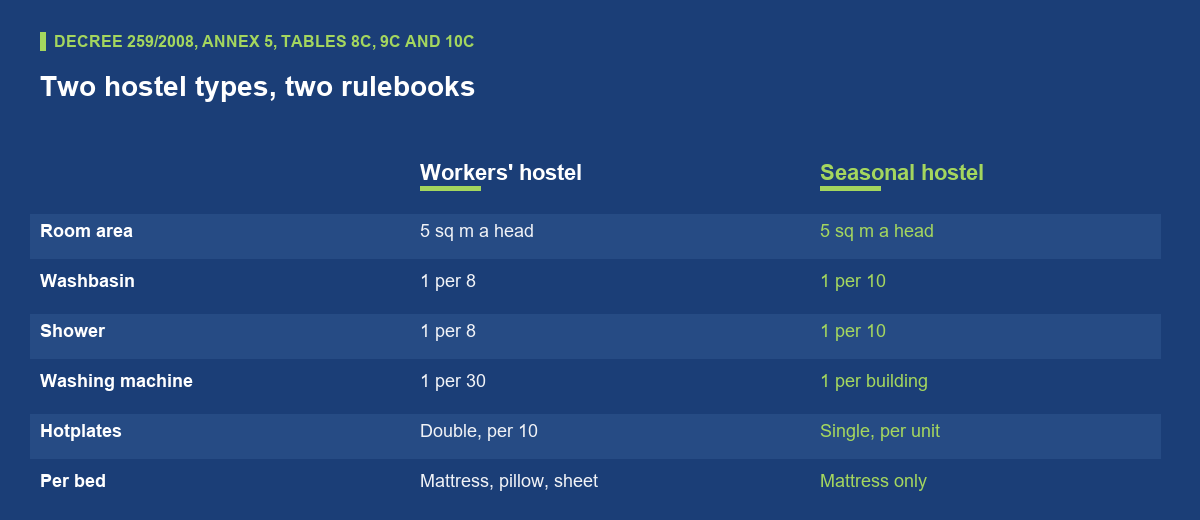
Slovak public health law does not describe a hostel in general terms. It names one. Decree 259/2008 lists accommodation facilities by type, and one type is the simple facility with temporary accommodation: a building, or part of one, where people are housed for a fixed period in connection with the performance of work. It splits in two, a workers’ hostel and a hostel for seasonal work that does not run beyond eight months. Our glossary entry carries the full set of ratios.
Annex 5 to the decree turns the type into arithmetic. A multi-bed room must give each resident at least 5 sq m. The clear height of the room must reach 2,400 mm. Bunk beds are allowed only where the clear height reaches 2,600 mm and the air volume per resident is at least 13 cubic metres, with a removable side rail and a ladder to the upper berth.
The fittings table bites harder than the floor plan. One washbasin and one shower per at most eight residents. One lavatory bowl per at most six women and one per at most ten men, with a urinal per at most fifteen men. A kitchenette with a double hotplate per ten residents, and one washing machine per at most thirty. In a converted building the drains run out before the floor area does. The text in force dates from 4 September 2025, after decree 232/2025 amended it.
Why capacity caps the permits, not just the beds
A landlord reading those ratios sees a fit-out budget. An occupier should see a hiring ceiling. The Employment Services Act reaches the same numbers twice. An application for a seasonal work permit, where the worker needs no visa, must carry proof of accommodation meeting the minimum requirements of the decree issued under the Public Health Act, for at least the expected duration of the job. And an organisation taking posted third-country workers must secure accommodation to that same standard. The footnote behind both phrases points at the health decree, so the square metres are a permit condition, not a welfare gesture.
The residence side closes the loop. The Residence of Foreigners Act lists the documents that prove secured accommodation, and one of them is a confirmation issued by the accommodation facility itself. The police will not accept that confirmation where the number of people with a granted residence registered at the facility, plus everyone else living there, exceeds the total capacity of the facility. Issuing it anyway is an administrative offence, with a fine up to EUR 3,300 and a three-year tail from the act.
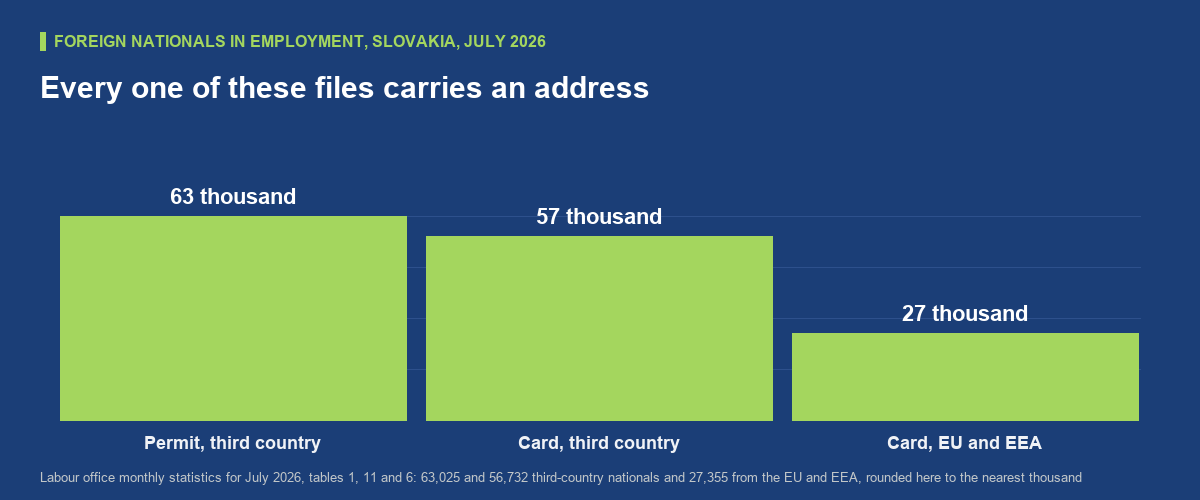
The volume behind that rule is not small. The labour office counted 63,025 third-country nationals in employment on a work permit in July 2026, another 56,732 on an information card, and 27,355 citizens of the European Union and the European Economic Area. By our own addition that is 119,757 third-country nationals, and every one of them has an address in a file that has to have room in it. In the Senec district alone the two counts are 2,777 and 943.
Nobody signs the hostel off before it opens
Most regulated premises in Slovakia need a decision from the public health authority before they may operate, and the business must hold off until it has one. Worker hostels are carved out of that duty by name. The Public Health Act switches the prior decision off for a simple accommodation facility with temporary accommodation connected with work. Nobody comes to look before the first shift moves in.
The standard does not soften with it. The same Act says such a facility may be operated only if it meets the decree, and puts two duties on the operator: meet the requirements, and draw up an operating code and file it with the authority. Breach is an administrative offence carrying a fine from EUR 150 to EUR 20,000, doubled on repeat. The building is therefore assessed after it is full, which is the wrong order for anyone who has to move people out to fix a shower count.
Inspection rights are wider than a landlord expects. Anyone who takes money for beds under an accommodation contract is an accommodation provider in law. That provider must verify each foreigner’s identity at check-in, record nationality and date of birth in the guest book, deliver the completed residence notification form to the police within five days, and admit the police to every part of the facility for a compliance check. Labour inspectors may enter freely and at any time where accommodation is provided to posted third-country workers, a channel already running through the agency market.
What a landlord may do with a hall, and what it costs
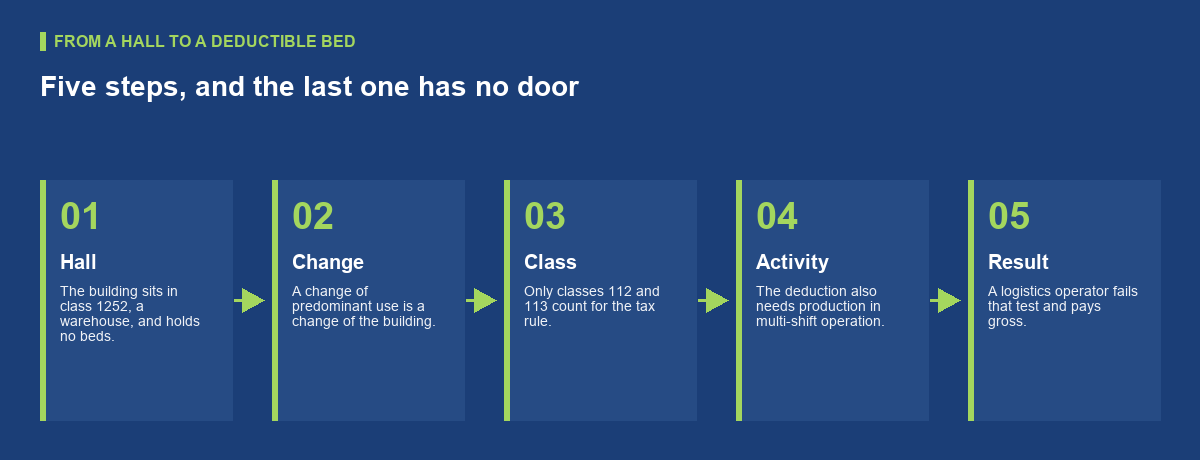
The obvious move is to convert something. It is also the move that changes the building in law. Under the Construction Act in force since 1 April 2025, a change in the predominant way a building is used is a change of its purpose, and a change of purpose is a change of the building. Changing how individual rooms are used is not. The dividing line runs between a rest area inside a hall and a hall that has become somewhere people live, and it is the same permitting chain that decides when a finished hall may open.
Then the classification decides the tax. The Statistical Classification of Constructions puts two-dwelling and multi-dwelling buildings in class 112 and other residential buildings in class 113. Short-stay accommodation sits at 1212, under hotels, and warehouses at 1252. The Income Tax Act allows an employer to deduct spending on accommodation for its employees only in buildings classified 112 or 113, and only where its predominant activity is production carried out in multi-shift operation.
Two groups fall out of that sentence. A hostel that keeps a hotel-family code fails on the building. A third-party logistics operator fails on the activity, however many shifts it runs, because distribution is not production. The same provision governs the bus: works transport is deductible only where the public operator does not run the route, or does not run it to the extent the employer needs, and only in vehicles of one product class. The bed and the bus are gated by codes, not by need.
The employee side, the town hall, and a deadline this month
The relief that is open to everyone sits on the other side of the payslip. Where an employer secures accommodation for an employee, the benefit in kind is exempt up to EUR 100 a month, and up to EUR 350 a month once that employment has run for 24 months without a break, pro-rated by the days actually housed. There is no production test and no building class. The operator that cannot deduct the cost can still deliver the benefit untaxed, which is why the two halves belong in the same model.
The charge is not free either. For a seasonal work permit, the monthly accommodation charge agreed with the worker must not be disproportionately high against that worker’s net monthly wage and the quality of what is provided, where the employer arranges it. Separately, the municipal accommodation tax reaches paid temporary accommodation and its list of premises names the hostel. The operator pays it per overnight stay; where no operator can be identified, the owner does, and co-owners are liable jointly and severally.
One date is close. From 1 September 2026 a citizen may hold only one temporary residence at a time, notified for at most five years. Anyone carrying at least two on that date loses all of them on 30 September 2026, and any temporary residence begun before 31 August 2026 ends by 31 December 2030. Domestic commuters who keep a hostel address beside a family one are inside that rule now, which changes what a catchment map is really showing.
Conclusion
None of this appears in market reporting. Our own word count on the delivered text of the Cushman and Wakefield Slovakia Industrial MarketBeat for the second quarter of 2026 found labour, workforce, worker, accommodation, housing and commuting zero times each, in a report that prices 4.89 million sq m of stock. So the questions have to come from the occupier. Ask what the registered capacity of the address is, ask for the operating code and the last inspection, and ask which building class the beds sit in. A shift plan that ignores those three answers is a plan for a headcount the address cannot hold.