
Ask who supplies the electricity in a Slovak industrial park and the answer is usually the landlord. Ask under which law, and the room goes quiet. The cable between the estate substation and a tenant’s switchboard is not a service charge line. Once enough sits behind it, it becomes a local distribution system, and that is a licensed activity with a price decision from the regulator, an approved operating code and a statutory reliability standard. This piece sets out where the line runs, what a tenant is really paying for, and which half of the bill anyone can look up.
When a park network becomes a local distribution system
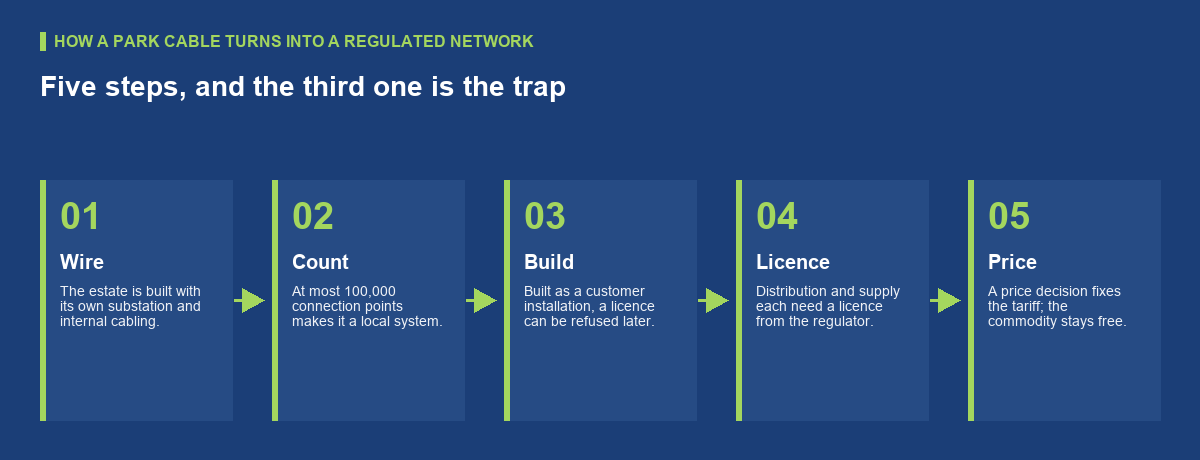
The threshold is a count, not a size. Slovak energy law calls a distribution network with more than 100,000 connection points a regional system, and one with at most 100,000 a local one. Every park network in the country falls on the local side of that line by definition. The same provision adds a warning for landlords: owning a transformer on its own, or part of a substation, is not ownership of a network. The instrument is what sits behind the kit, not the kit. Our glossary entry sets out the test in full.
There is a second description in the Energy Act, and it reads like a business park. Before the regulator will let one of these operators own a battery or a publicly accessible charging point, it applies four conditions: at most 10,000 connection points, electricity distributed only inside a locally confined area of industrial, commercial or shared activity, no household supply except to households whose members work for the owner, and users whose operations are interlinked or who are mainly the owner and its affiliates. That wording was written with estates like this one in mind.
How many exist? The regulator’s own annual report for 2024 counts three regional operators and 139 holders of an electricity distribution licence, described as operators of local systems on the premises of manufacturing and non-manufacturing companies. The same count a year earlier was 142. The public grid in Slovakia has three names. Behind the fences there are well over a hundred.
Why passing the cost on at cost stops working
Most landlords believe there is a safe harbour, and there is one. Slovak law says that supplying electricity to other people at purchase prices, including the transmission and distribution components, without any further increase, is not doing business in energy. The unit price on the tenant’s invoice has to be identical to the price on the tax document behind it. Recharge at cost, keep nothing, and no licence is needed.
Then comes the sentence most estates never read. That exemption does not apply to the supply of electricity to end customers connected to a local distribution system. Once the network behind the meter is one, the safe harbour is gone for selling as well as for distributing, and both are activities the Energy Act puts behind a licence from the regulator. A park cannot be a distributor for the wire and a bookkeeper for the electron.
There is also a door that closes behind you. Where the equipment was built and connected to the regional network as a customer installation or a service connection, and its construction would otherwise have needed a certificate for building an energy facility, the regulator must refuse a licence application over it. Only the regional operator is exempt from that refusal. Wire the estate the cheap way at construction stage and the licence route can be shut years later, when a tenant asks for its own supplier or wants to keep the output of a roof.
What the tenant pays, and which half is regulated
Two prices arrive in one envelope and they are governed differently. Access to a distribution network and the distribution of electricity sit on the statutory list of price regulated activities, so every operator, the one inside the fence included, works to a price decision from the regulator. Supply appears on that list only for the supplier of last resort and for customers the government designates as vulnerable, a class built around households and social care. An industrial tenant is not in it. The wire is a tariff. The commodity is a negotiation, which is where the energy bill of a hall is actually decided.
The tariff half is unusually visible. The price decree lets an operator adopt the tariffs of the network it hangs off, or file its own proposal and defend the cost base. An operator that stopped using adopted tariffs cannot simply go back: it must show the regulator it made no revenue surplus over the two preceding years, or that it repaid the surplus to the users on its network. Local operators file by 31 October each year, regional ones by 30 September.
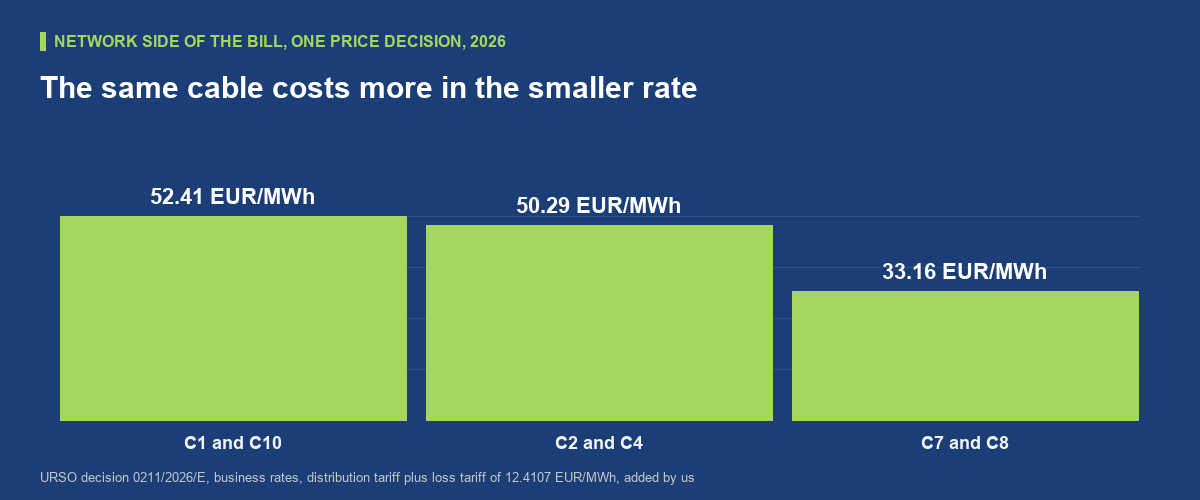
One real decision shows the shape. Decision 0211/2026/E, in force from 1 January 2026 for an operator in Nová Dubnica, sets the distribution tariff for business users at EUR 20.75 per MWh in the largest low-voltage rates and EUR 40.00 in the smallest, with a loss tariff of EUR 12.4107 per MWh on top of both. By our own addition that is EUR 33.16 against EUR 52.41 per MWh, so the small user pays 58 per cent more for the same metre of cable. One decision is not a benchmark, but it is the format every tenant can ask to see.
The reliability standard behind the fence is looser
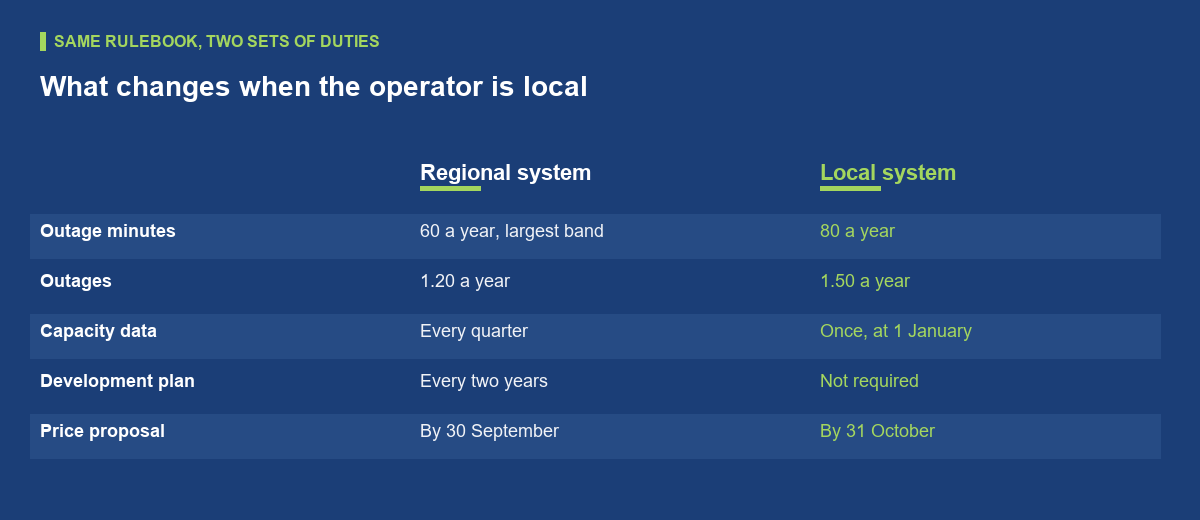
Quality standards for distribution are set by decree, and they are not the same on both sides of the gate. The average annual duration of unplanned interruptions per connection point is capped at 60 minutes for the largest regional networks and at 80 minutes for a local one. The average number of those interruptions is capped at 1.20 against 1.50. On the regulator’s own figures a tenant inside a park is entitled to a third more dark minutes a year than a tenant on the public grid, and by our arithmetic to roughly one extra interruption every three years.
The same decree gives something back, and it is worth reading before signing. If the operator fails to start distribution on the contracted date, or within five working days of the supplier’s request, the compensation payment is EUR 260 for each started day at a connection point above 1 kV and EUR 35 below it. Other breaches of the distribution standards carry EUR 14 a day above 1 kV and EUR 4 below. None of that exists where a landlord is merely re-invoicing.
Transparency is thinner too. A regional operator publishes available capacity per substation and updates it every calendar quarter. A local operator publishes the same information once a year, at 1 January, and is excused from the two-yearly network development plan the Act requires of everyone else. If the plan is a second shift, a chiller or a fleet of chargers, the number that says whether the estate can carry it may be eleven months old, which is a different problem from the queue for capacity on the public grid.
What to ask before signing in a park
None of this reaches the market reporting. Our own word count on the delivered text of the Cushman and Wakefield Slovakia Industrial MarketBeat for the second quarter of 2026 found energy, electricity, grid, connection and distribution zero times each. The MarketBeat prices 4.89 million sq m of Slovak stock at a prime rent of EUR 5.30 per sq m per month, at 7.8 per cent vacancy with 265,800 sq m under construction. It never says who sells the power in any of it, so the questions have to come from the tenant.
Start with three documents: the operator’s energy business licence number, the number of its current price decision, and its operating code, which is either approved by the regulator or the model code taken over from it. All three exist, or the network is not what it is being called. The price decision names the rates and the conditions for allocating them, so the rate a tenant lands on is checkable before signing rather than after the first invoice.
Then price the two halves apart. The regulated half is fixed and public. The unregulated half is where the money moves, so the lease should carry the pricing formula, the reference index and an audit right for the commodity, not a promise to be fair. Ask whether the tariffs are adopted from the regional operator or the park’s own. Ask what the connection charge passes through, because the maximum price into a local network is built from the operator’s own costs plus the regional charge behind it. And if the site needs a second feeder, the decree prices access through it at 15 per cent of the reserved capacity tariff.
Conclusion
A park that runs its own network is not doing anything improper. It is doing something regulated, and the regulation is public. The wire has a licence, a price decision, an operating code and a reliability standard that is measurably looser than the one on the public grid. The commodity has none of that, which is exactly why it is the half worth drafting. Ask for the three documents, price the two halves apart, and put the second feeder and the audit right into the heads of terms. The park will still be the supplier. It will simply be one whose numbers a tenant can check.