
Somewhere between the site visit and the lawyers, an occupier is handed a page or two headed rezervacna zmluva and asked to transfer a fee. It feels like the moment the site becomes yours. Legally it is nothing of the kind, because a reservation agreement in Slovakia is not a contract type the law recognises by name. What binds is what the clauses do, and two documents with the same heading can sit on opposite sides of the line: one lets a court order the other party into the deal, the other buys a refundable fee and a polite request. This piece sets out where that line runs.
What is a reservation agreement in Slovakia, legally?
A contract that Slovak law does not define. The Civil Code, Act 40/1964 Zb., allows parties in section 51 to conclude a contract that is not separately regulated, provided it does not conflict with the content or purpose of the Code. A reservation agreement lives entirely in that space. There is no chapter on it, no list of mandatory contents, and no default rule that fills the gaps if the parties leave one. The heading is a label the parties chose, and a court reading the document afterwards will look past it to what was actually agreed.
That matters because two very different instruments hide under the same name. One is a genuine agreement to conclude a future contract, which the law does regulate, twice: in section 50a of the Civil Code for ordinary parties, and in section 289 of the Commercial Code, Act 513/1991 Zb., for relations between businesses, which is where a warehouse deal will normally sit. The other is a bare promise not to market the property for a while, backed by a fee. Both get printed on the same letterhead. Which of the two is in front of you is the question our glossary entry on the reservation agreement is built around.
The practical consequence is that reading the title tells you nothing about your position, and reading three clauses tells you almost everything. Occupiers who have been through a Slovak land purchase recognise the pattern from the register side of the same transaction, described in our piece on plot assembly: the paperwork looks decisive long before it is.
Which clauses turn a reservation into an obligation?
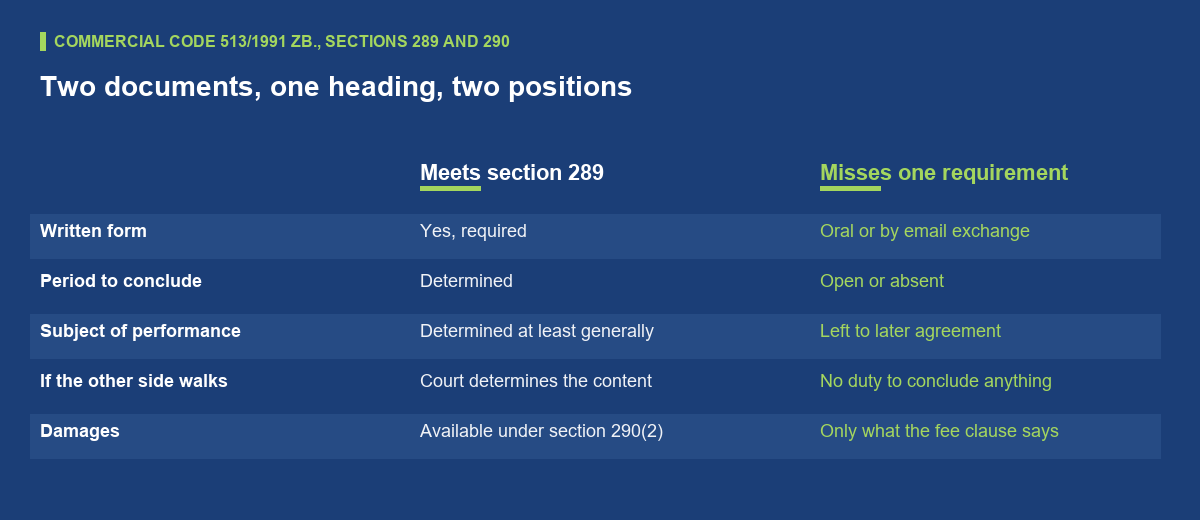
Three, and they are short. Section 289 of the Commercial Code says an agreement to conclude a future contract binds one or both parties to conclude that contract within a determined period, with a subject of performance determined at least in a general way, and that the agreement requires written form. Miss any of the three and there is no obligation to conclude anything, whatever the heading says.
Meet all three and the position changes completely. Under section 290(1) the bound party must conclude the contract without undue delay once the entitled party calls on it to do so. If it does not, section 290(2) gives the entitled party a choice: ask a court, or a person named in the agreement, to determine the content of the contract, or claim damages for the breach. Damages alongside determination of the content are available only where the bound party unjustifiably refused to negotiate at all. This is the difference that matters commercially. A determination of content is not compensation for a lost site; it is the site.
The civil-code route in section 50a is stricter on one point and weaker on another. It requires the parties to agree the essential elements of the future contract, not merely a generally determined subject, and it lets the court replace the missing declaration of will rather than shape the content. Which regime applies is not a drafting choice; it follows from who the parties are and what the transaction is. The commercial regime is the looser of the two on content, which is exactly why a badly drafted business reservation can bind more than the signatory expected.
When does the clock start, and how long does it run?
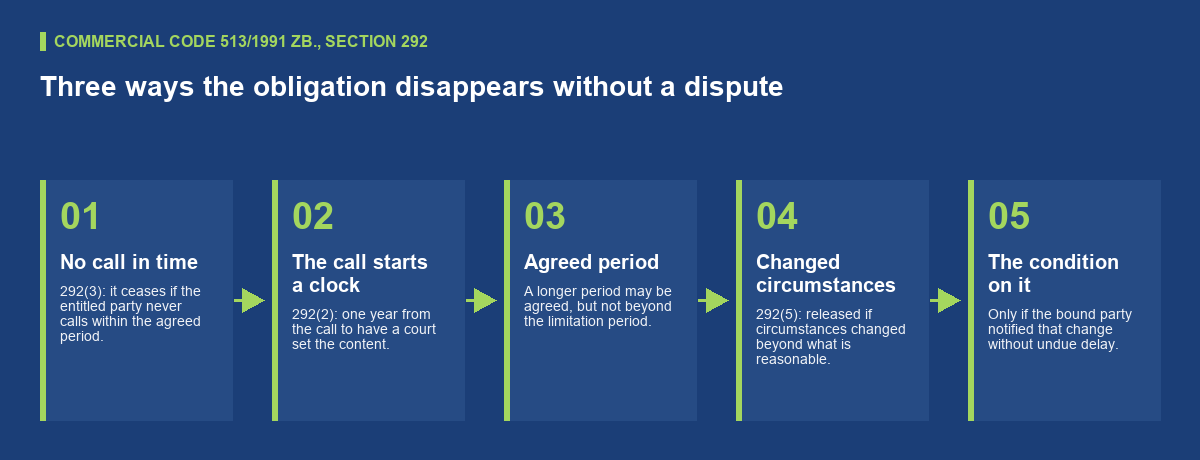
Not when you sign. Under section 292(3) of the Commercial Code the obligation to conclude the future contract simply ceases if the entitled party does not call on the other side within the time set in the agreement. No notice, no dispute, no remedy: the obligation is gone. A reservation with a generous-looking six-month window and a party that waits seven months is a reservation that has expired quietly.
Once the call has been made, a second and shorter clock starts. Section 292(2) limits the right to have the content determined by a court, and the damages claim under section 290(2), to one year from the day the entitled party called on the bound party to conclude the contract. The parties may agree a different period, but it may not exceed the general limitation period of the Commercial Code. One year from the call, not one year from the signature, and not one year from the refusal.
There is a third exit, and it is the one most reservation documents forget to close. Section 292(5) releases the bound party where the circumstances the parties evidently proceeded from have changed so far that concluding the contract can no longer reasonably be required of it. The release is not automatic: it takes effect only if the bound party notifies the other side of the change without undue delay. That notification requirement is the entitled party’s protection, and it is worth knowing that it exists, because a seller who goes quiet and then invokes changed circumstances a month later has missed it.
What does the reservation fee actually buy?
Usually less than its size suggests, and the reason is the way Slovak law treats contractual penalties. Where the fee is drafted as a zmluvna pokuta, section 544(2) of the Civil Code requires the arrangement to be in writing and to state either the amount of the penalty or the method of determining it. Section 544(1) then makes the penalty payable even if the innocent party suffered no loss at all, which is the feature that makes it attractive.
Two provisions cut the other way. Section 545(2) says the creditor may not claim damages caused by the breach the penalty covers unless the parties agreed otherwise, and may claim damages exceeding the penalty only where that too has been agreed. A penalty clause therefore usually operates as a ceiling on recovery, not a floor. And section 545a allows a court to reduce a disproportionately high penalty, taking into account the value and significance of the obligation it secures. An occupier who negotiates a large reservation fee as its only remedy has bought a number a court may later shrink.
The other common structure is not a penalty at all. If the payment is a deposit credited against the purchase price, or a commission held by the agent, the sections above do not apply and the document has to say what happens to the money in each of the three possible endings: the deal completes, the buyer walks, the seller walks. Where the agreement is silent on the third, it is usually silent because the third was never intended to cost the seller anything.
Why does the strongest reservation still bind a person, not the land?
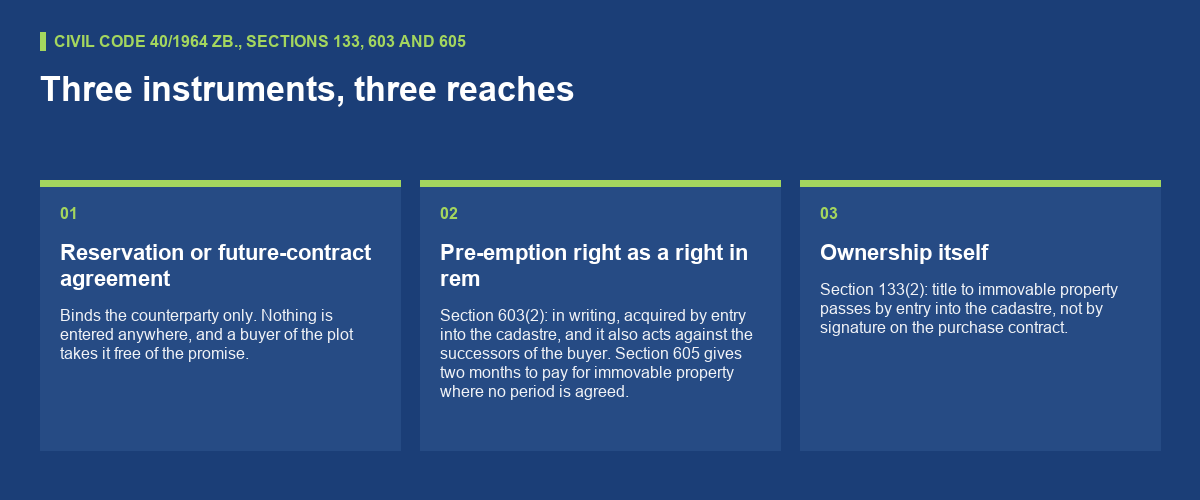
Because of what an agreement to conclude a future contract is. It creates an obligation between two parties. It does not attach to the plot, does not appear in the cadastre, and does not survive a sale to somebody else. Section 603(1) of the Civil Code states the same principle for a pre-emption right in its ordinary form: it imposes a duty only on the person who promised to offer the thing for sale. If that person sells to a third party in breach, the entitled party is left with claims against the promisor.
Slovak law does offer an instrument that binds the land, and it is worth knowing the difference. Section 603(2) allows a pre-emption right to be agreed as a right in rem that also binds the successors of the buyer. It must be in writing, and it is acquired by entry into the cadastre of real estate, kept under the Cadastral Act, Act 162/1995 Z. z. That is a different document with a different registration step, and it sits alongside the rule in section 133(2) of the Civil Code that ownership of immovable property passes by entry into the cadastre rather than by signature. Where no period is agreed, section 605 gives the entitled person two months after the offer to pay for immovable property, and the right lapses if that period passes unused.
Whether the extra step is worth taking is a market question. In the second quarter of 2026, Cushman & Wakefield recorded pre-leases at 50 per cent of Slovak industrial take-up and 37 per cent of the 265,800 sq m under construction already pre-leased, against a national vacancy rate of 7.8 per cent, the highest in five years. Half the market is therefore committing to buildings that do not exist yet, in a market with more standing space than it has had since 2021. In that combination the site that fits is rarely scarce in the abstract and often scarce in particular, which is exactly the situation in which the difference between a personal promise and a registered right is worth an afternoon. The same logic runs through heads of terms, the document that usually follows, and it is visible in the split market described in our Q2 2026 review.
Conclusion
The heading on the page is the least informative thing in a Slovak reservation document. Written form, a determined period and a subject determined at least in a general way decide whether anyone can be made to conclude anything. The call and the year that follows it decide how long that remains true. The way the fee is drafted decides whether it is a ceiling on your recovery or a floor. And nothing in the document reaches the plot itself unless a pre-emption right has been agreed in rem and entered in the cadastre. Four questions, all answerable before the money moves, and all cheaper to ask then than afterwards.