
Three lines on a service charge statement are almost never modelled before a lease is signed: clearing the yard in winter, taking the waste away, and splitting a water bill among tenants. They are small next to rent and energy, and they are the ones that produce the argument at the year end. Industrial estate operating costs of this kind sit outside the rules most occupiers assume apply. The road act stops at the gate, the waste charge is a levy rather than a price, and the water utility recognises one meter where an estate has twenty. Three different statutes, and none of them fills the gap the lease leaves open.
Why the road act stops at your gate
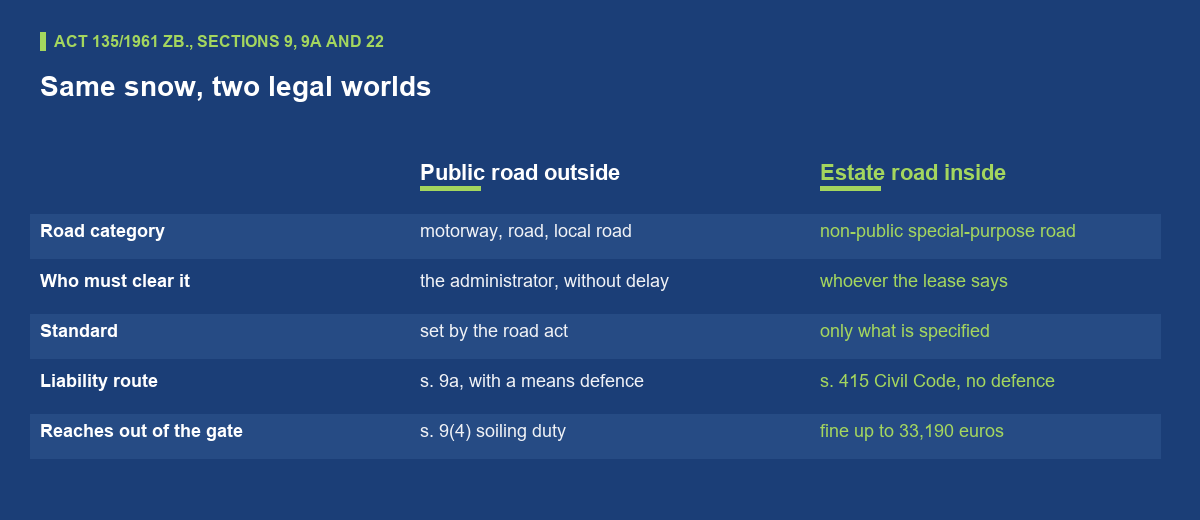
Slovak road law has a category for the tarmac inside an industrial park. Under section 22(1) of Act 135/1961 Zb. on land communications, special-purpose roads are those connecting individual production plants or buildings to the other land communications, or serving traffic purposes inside closed areas. Section 22(3) adds that those inside closed areas or objects are non-public. An estate behind a gatehouse sits squarely there.
Now read the maintenance duty. Section 9(1) requires defects in trafficability to be removed without delay by the administrators of motorways, roads and local roads. Section 9(2) puts defects in walkability of local roads for pedestrians and of pavements on the administrators of local roads. Neither subsection mentions special-purpose roads. Section 9a repeats the same three categories when it makes administrators liable for damage caused by defects in trafficability, subject to the defence that removing or signposting the defect was not within their means.
Inside the fence there is therefore no statutory winter standard and no statutory defence. What remains is section 415 of the Civil Code, the general duty of prevention: everyone must conduct themselves so that no damage occurs to health, property, nature or the environment. A driver who goes down on your dock apron argues that provision, not the road act. One duty does reach out of the gate. Section 9(4) makes whoever soils a public road remove it without delay, and section 22a(1)(c) allows a fine of up to 33,190 euros where the soiling causes, or can cause, a defect in trafficability. Mud carried out on lorry tyres is that case.
What a winter clause has to say, because the statute will not
Where the law sets no standard, the specification is the standard, and most leases carry one sentence about keeping the estate in good order. That sentence decides nothing when it snows at four in the morning. A usable clause names five things: the trigger, a depth of fresh snow or a forecast of black ice; the response window, measured from the trigger and not from the start of the working day; the hours covered, because a three-shift site is not covered by an eight-hour service; the priority order across gatehouse, dock apron, fire access routes and the pedestrian route from the car park; and who keeps the record.
The material is a legal choice, not a procurement one. Section 9(3) of the road act permits chemical de-icing materials only in accordance with special regulations and only where strictly necessary, with the manner and extent set by implementing regulation. On a yard that drains through an oil and grit separator into a watercourse, salt loading is a discharge question as much as a safety one, and the contractor who quotes cheapest is usually the one salting hardest.
The record is what makes a section 415 defence survivable two winters later: date, time, temperature, area treated, material and quantity, signed. Ask for it monthly rather than reconstructing it after an accident. Note too where this line sits in the money. Winter service is the most volatile item on an estate budget, because it follows weather rather than consumption, which is why the caps negotiated into Slovak industrial service charges so often carve it out alongside energy and insurance. A cap with the volatile lines excluded is not a cap.
The waste bill has two halves and only one is negotiable
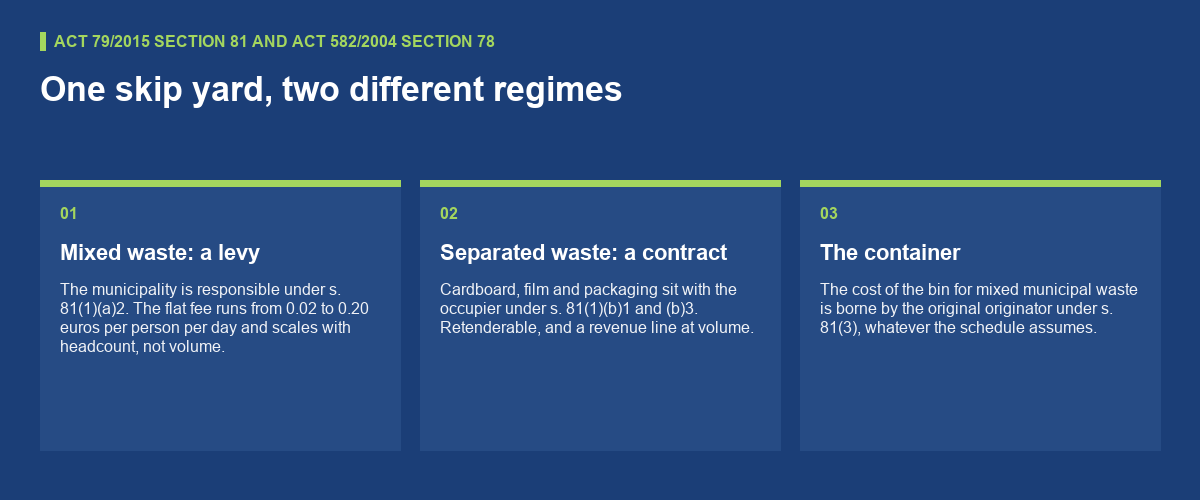
Waste from a warehouse is not one thing in law. Section 80(1)(b) of Act 79/2015 Z. z. on waste counts as municipal waste the mixed and separately collected waste from other sources that is similar in character and composition to household waste. The canteen bin and the office bin are that. Bulk stretch film off a wrapping machine is not.
Section 81(1) allocates responsibility along the same seam, and this is where the negotiating room ends. Under point (a)2 the municipality is responsible for mixed waste from other sources: an occupier cannot appoint its own contractor for it, and what it pays is a levy rather than a price. Under points (b)1 and (b)3 the business is responsible as originator for separately collected waste from other sources and for separately collected packaging waste. Cardboard, film and pallets sit there: own contract, retenderable, and at volume a revenue line. Section 81(3) puts the container cost for mixed waste on the original originator.
The fee comes from Act 582/2004 Z. z.. Section 78(1)(a) lets a municipality set a flat rate between 0.02 and 0.20 euros per person and calendar day, with quantity-based rates in points (b) to (d) from 0.01 to 0.20 euros per litre or kilogram, and section 78(3) applies the lower flat value where no ordinance exists. The sting is section 79(3): for a business the production indicator is built on the average number of people working at the property, so the flat fee scales with headcount rather than with waste. At the statutory ceiling, thirty people cost 2,190 euros a year and three hundred cost 21,900 for the same skip. Both figures are our own multiplication of that ceiling across 365 days; most ordinances sit well below the cap.
Water: one meter at the boundary, and the split is your problem
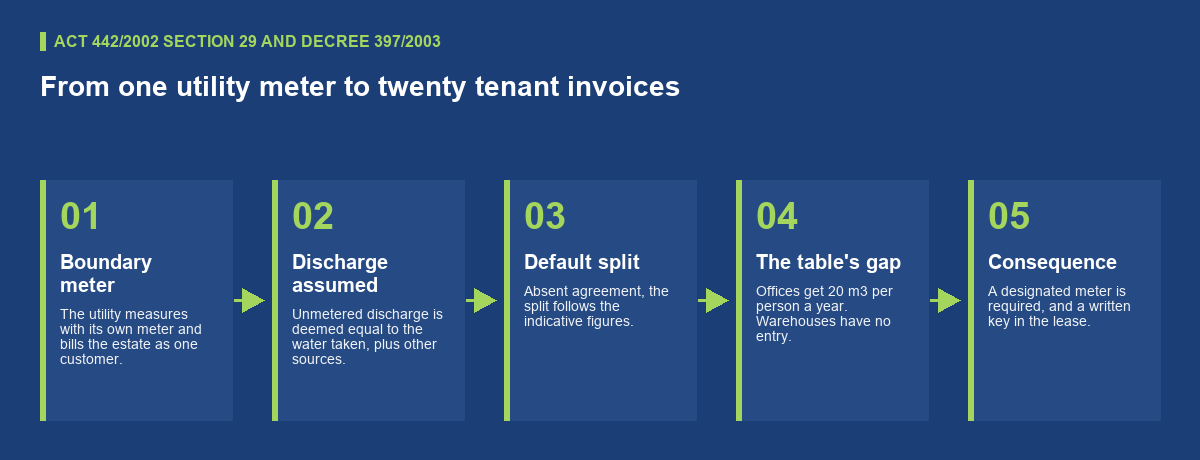
Act 442/2002 Z. z. on public water mains and public sewers is written for one customer per connection. Section 29(1) has the owner of the public water main measure the supply with its own meter, and where it is not measured the quantity is set by indicative consumption figures. Section 29(3) mirrors it for discharge: unmetered, an abstractor is deemed to discharge what it took from the mains, plus water from other sources.
Multi-let estates are handled in one sentence most landlords never read to the end. Absent agreement, a producer apportions the discharged quantity among its co-producers by the indicative consumption figures. The statutory default for splitting a shared connection is a table, not your sub-meters. Sub-meters are good evidence between landlord and tenant, but they have no standing towards the utility and govern the split only if the lease says so.
The table is Annex 1 to Decree 397/2003 Z. z.. Item 5 gives offices and similar facilities 20 cubic metres per person per year on 200 working days, adjusted for a different regime; canteen items 18 and 19 add 6 cubic metres per average diner without on-site cooking and 8 with it. There is no item for a warehouse hall, and section 6(9) then requires the quantity to be measured with a designated meter wherever the annex is silent. The fallback simply does not exist here.
The price moved recently, and in a direction that matters. Since 22 October 2025 water and sewerage are billed on a two-part tariff: a variable component plus a fixed component payable even at zero consumption. Bratislavska vodarenska spolocnost publishes 1.4830 euros per cubic metre excluding VAT for supply and 1.4345 for discharge. On an estate with several connections the fixed part is a standing charge no consumption discipline reduces.
Reading industrial estate operating costs off your own lease
Three questions settle these lines before signature. Who is the administrator of the roads and yards inside the gate, and to what written standard. Which waste fractions fall into the municipal system on your site, and what does the municipal ordinance actually charge for them. Where does the utility meter sit, and what does the lease say happens to what it measures.
All three arrive at the same place. They are budgeted as an estimate, billed monthly as an advance and settled once a year against actual spend, which is the moment the assumptions become invoices. That settlement is a service charge reconciliation, and Slovak law gives it no deadline, no format and no audit right, so whatever the lease says about it is the whole of the protection. That is why asking to see the previous year’s service charge statement with these three lines shown separately, rather than folded into a single estate figure, tells you more than any budget projection you will be handed. Compare it against the largest line of all, the energy a hall spends, and the shape of the estate’s real running cost appears.
None of this is expensive to fix at the drafting stage. A winter specification is a paragraph. A waste schedule that separates the levy from the contract is a table. A water apportionment key is a formula and a diagram of where the meters sit. All three are cheap in a heads of terms and slow in a dispute.
Conclusion
Rent is negotiated once and operating costs are settled every year, which is why the small lines outlive the big argument. The three examined here share a structure: a statute that governs the world outside the estate, a lease that is supposed to govern the world inside it, and a gap in between where the cost lands on whoever is least prepared to argue. Slovak law is unusually clear about where its own duties stop. The work is making the lease equally clear about where yours begin.