
Every industrial market in Europe is now telling itself a data centre story, and Slovakia has started telling one too: sovereign compute, nuclear baseload, an AI facility for Bratislava. It is worth checking the numbers behind the narrative before it reprices anybody’s land. Data centres in Slovakia today amount to 30 megawatts across 13 facilities – less than Europe’s colocation market adds in a fortnight. This article sets out what actually exists, what is announced, what power really costs here, and the one thing a compute campus genuinely takes away from a warehouse occupier: a place in the grid queue.
How big are data centres in Slovakia today?
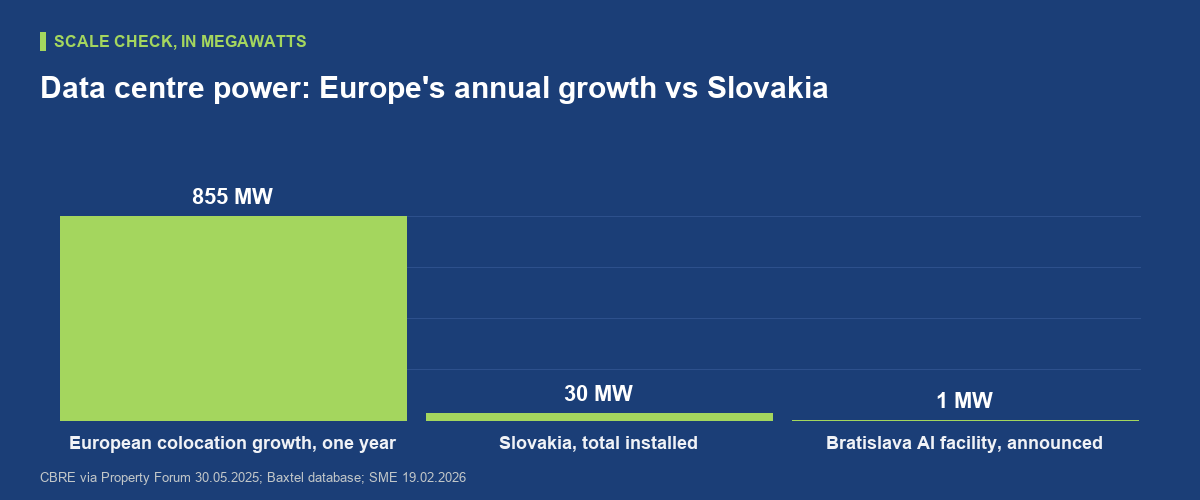
Start with the installed base, because it is smaller than the discussion suggests. The Baxtel facility database lists 13 data centres in Slovakia from five providers, totalling 139,073 square feet and 30 megawatts of power. Datacube’s Bratislava site accounts for 10 megawatts of that on its own; Deutsche Telekom operates six facilities adding up to 9.6 megawatts, including sites in Kosice and Tajov; VNET holds 5.0 megawatts across three sites and CNC a further 3.5. Now the comparison. Property Forum, reporting CBRE research in May 2025, put European colocation capacity growth at 22 per cent year on year to 855 megawatts, the fastest rate in four years, with nearly half of all annual take-up concentrated in London and Frankfurt. Divide one figure by the other – our own arithmetic – and Europe adds roughly 28 times Slovakia’s entire installed base in a single year. Colliers counts 12.5 gigawatts operational across EMEA, with Frankfurt, London, Amsterdam, Paris and Dublin held back by grid access, planning complexity and land scarcity. The same Colliers reading notes where the industry is heading as a result: towards self-generation and microgrids in the markets where the grid says no, already visible in Ireland, Germany and the United Kingdom. Slovakia is not a data centre market yet. It is a rounding error with an option on one – and the option is worth watching precisely because the established hubs are full.
What is actually being built here?
The announcements are real but modest. On 19 February 2026, speaking from New Delhi, President Peter Pellegrini said Slovakia’s first modern AI data centre would be built in Bratislava, running on chips not yet deployed in Europe, with a consumption of one megawatt. No investor, sum or completion date was named. The rationale was sovereignty rather than economics: sensitive national data should not sit in clouds on the other side of the world. Set that single megawatt against the 30 already installed – our own comparison – and the flagship project represents about one thirtieth of existing national capacity. It is a computer room with a strategic purpose, not a campus. The private-sector proposal is more ambitious in shape if not in disclosed scale: the Tatra Supercompute AI factory concept presented in December 2025 describes high-density GPU racks with liquid cooling, waste heat routed into district heating, a modular build-out and a mix of private capital, state coordination and energy partners. No megawatt figure, cost or timeline has been published. For an occupier reading the market, that absence is the story: nothing announced so far is large enough to move land values, and nothing published is firm enough to plan around. The test to apply to the next announcement is simple: how many megawatts, contracted with which operator, and energised in which year. Until those three answers exist in writing, a compute project is a press release competing for the same grid headroom as everybody else’s.
Does cheap nuclear power really make the case?
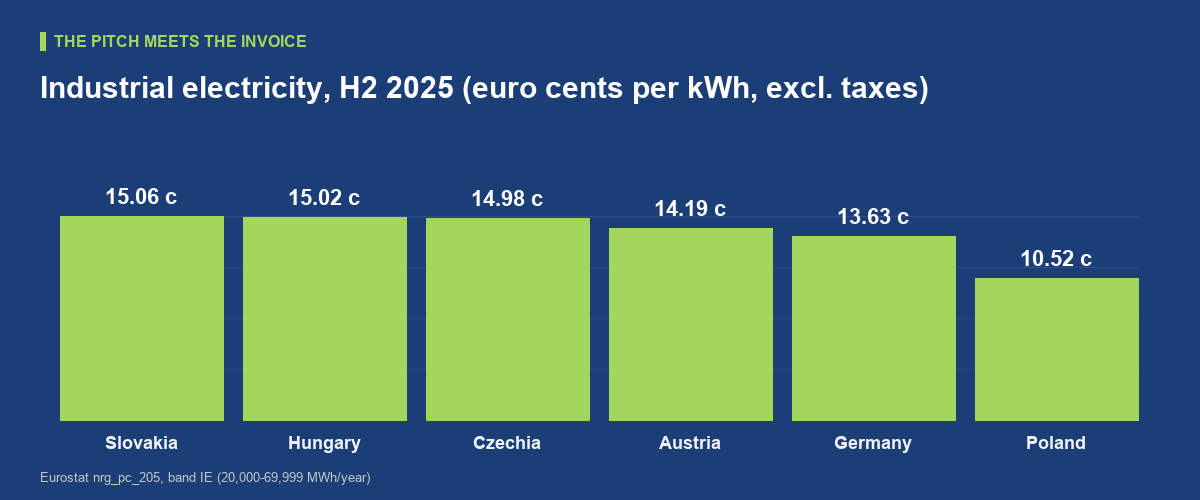
This is where the pitch meets the invoice. Slovakia’s generation mix is genuinely low-carbon and heavily nuclear, as our own industrial power capacity piece set out – and the president named nuclear and hydro as the country’s competitive advantage. Low carbon, however, is not the same as low cost. Eurostat’s price series for industrial consumers in the band that covers a mid-sized compute load – annual consumption of 20,000 to 69,999 megawatt hours – puts Slovak electricity at EUR 0.1506 per kilowatt hour in the second half of 2025, excluding taxes and levies. Hungary sits at EUR 0.1502, Czechia at EUR 0.1498, Austria at EUR 0.1419, Germany at EUR 0.1363 and Poland at EUR 0.1052. Slovakia is the dearest of the six. On our own arithmetic, the same kilowatt hour costs 43 per cent more here than in Poland – and for a workload where electricity is the dominant operating cost, that difference outweighs any rent advantage the region can offer. Two caveats belong with the table. The published band excludes taxes and levies, so the delivered bill depends on network charges and any relief a specific consumer negotiates – and very large consumers buy on bilateral contracts that no public series captures. Neither caveat rescues the pitch: the ranking is stable across the band, and nothing in it puts Slovakia ahead of Poland. The honest case for Slovak compute is carbon content, grid stability and jurisdiction, not the price per kilowatt hour.
Will data centres outbid warehouses for land?
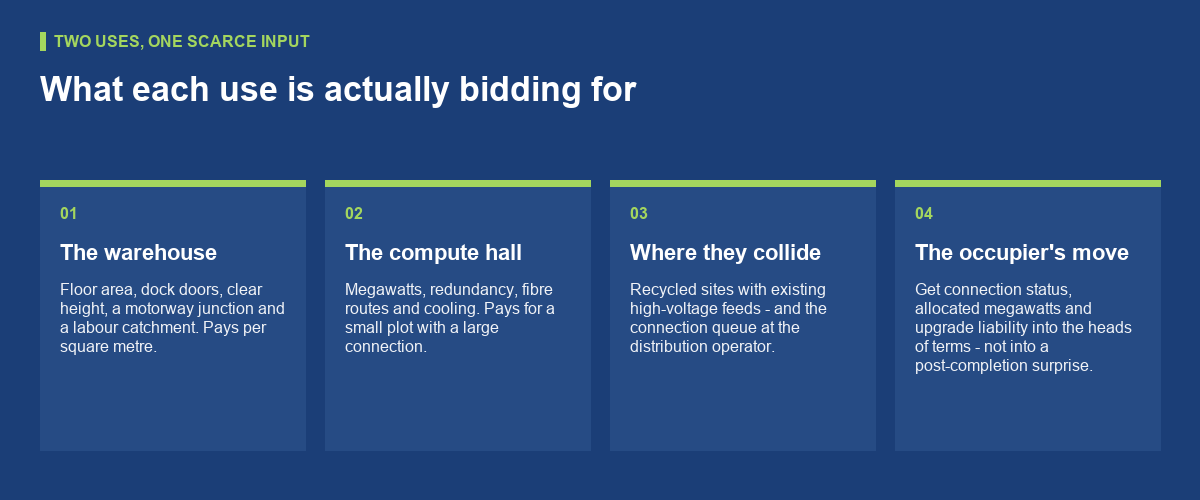
Not on square metres. A shed monetises floor area, dock doors and a motorway junction; a compute hall monetises megawatts, redundancy and fibre routes, and it will pay for a small plot with a large connection rather than a large plot with a good access road. As our land prices analysis showed, what moves Slovak plot values is servicing and consented capacity, and that is exactly the currency the two uses share. The collision point is therefore narrow but real: recycled industrial sites with existing high-voltage feeds, the same assets our brownfield analysis identified as the cheapest route to a connected site. Meanwhile the warehouse market has no shortage problem to blame on compute demand: the Cushman & Wakefield MarketBeat for the first quarter of 2026 counts 4.86 million square metres of stock with 375,700 square metres available at a vacancy rate of 7.72 per cent, prime rent at EUR 5.30 and a pipeline of 203,200 square metres only 35 per cent pre-leased. If Slovak prime rent softens or firms this year, data centres will not be the reason.
What should occupiers do about the queue?
Treat grid capacity as the contested asset, because that is what it is. Four practical moves. First, ask the developer what capacity the site holds and in what form – an indicative letter from the distribution operator is not a reservation, and the difference is years. Second, put the answer in writing at heads of terms stage: connection status, the megawatts allocated to your unit, who pays for an upgrade if your process load grows, and what happens if energisation slips. Third, ask who else feeds from the same substation. A neighbouring compute load, a battery plant or a charging hub can absorb the headroom you assumed was yours, and a park’s shared connection is a queue inside a queue. Fourth, if you already hold reserved capacity you are not using, treat it as an asset on the balance sheet rather than a line in a forgotten contract – in a market where new connections take years, spare megawatts have become negotiable currency. The data centre story may or may not arrive at scale in Slovakia. The competition for connections is already here.
Conclusion
Three findings survive the research. The installed base is tiny – 30 megawatts nationally, against 855 megawatts of colocation capacity added across Europe in a single year. The flagship announcement is one megawatt, which makes it a statement of intent rather than a market event. And the cheap-power argument does not hold: at EUR 0.1506 per kilowatt hour, Slovak industrial electricity is the dearest among six neighbouring markets. What follows for occupiers is not a land story but a queue story. Compute demand competes for connection capacity, for brownfield sites that already have a feed, and for the attention of the same distribution operators that decide when your extension energises. Price that risk into the lease, not into the hope that the grid will keep up.