
Every growing occupier in Slovakia eventually faces the same fork: hand the operation to a 3PL, or lease a warehouse and run it yourself. The market data says both camps are busy – logistics providers signed almost a third of all Slovak industrial leases in the first quarter of 2026, which means outsourcing demand is ultimately paying for much of the country’s shed space either way. The fork is not ideological; it is arithmetic plus honesty about your own operation. This article lays out what each route costs, where the commitments differ, and the four questions that settle the choice more reliably than any benchmark.
What the first quarter of 2026 says about the outsourcing wave
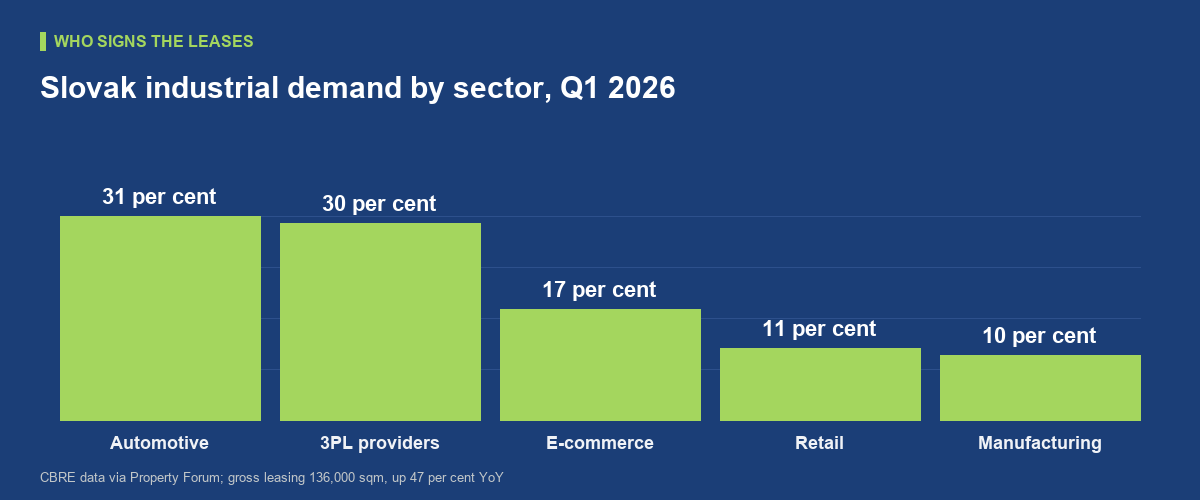
The demand mix is the headline. Of the 136,000 square metres of gross leasing recorded in the first quarter of 2026 – up 47 per cent year on year – automotive companies took 31 per cent and logistics providers 30 per cent, ahead of e-commerce at 17, retail at 11 and manufacturing at 10 per cent (CBRE data via Property Forum). Read that carefully: nearly a third of the space leased in Slovakia is signed by operators whose business is running other companies’ logistics. When a retailer outsources, its volumes do not leave the market – they reappear inside a provider’s shed. The occupier’s real choice is who signs the lease, not whether space gets used. Conditions currently favour whoever does sign: vacancy stands at 8.12 per cent nationally – from 10.27 per cent in Western Slovakia down to 2.66 per cent in the East – the average rent has softened 6 per cent year on year to EUR 4.55 per square metre per month, and more than half of all activity is renegotiation rather than relocation. A tenant-friendly market cuts both ways in this decision: your own lease is cheaper to sign than it was, and so is your provider’s – which is worth remembering when the quote arrives.
What a 3PL contract actually costs – and how it is priced
Outsourced logistics is bought by the unit, not by the square metre. European benchmarks collected by Masson International (June 2025) put storage at EUR 8 to EUR 45 per pallet per month depending on product size and dwell time, picking and packing at EUR 1.00 to EUR 4.50 per order, returns processing at EUR 1.50 to EUR 3.00 per item, and one-time onboarding at EUR 100 to EUR 1,000. The structure of the contract matters as much as the rates. Davies and Robson distinguish open book contracts – the provider bills actual costs plus an agreed margin, so you see the cost base but carry its swings – from closed book contracts, where fixed unit prices leave efficiency risk and reward with the operator. Logistics Bureau notes that a contract in this market typically runs one to three years, some up to five, and that rate-based pricing tends to reflect the work actually performed. Scale one example honestly: a 2,000-pallet operation at EUR 12 per pallet per month – our arithmetic on a mid-range assumption, not a quote – is EUR 288,000 a year before a single order is picked. Outsourcing is not cheap; it is variable. That distinction decides the whole question.
What your own lease actually costs – the full stack
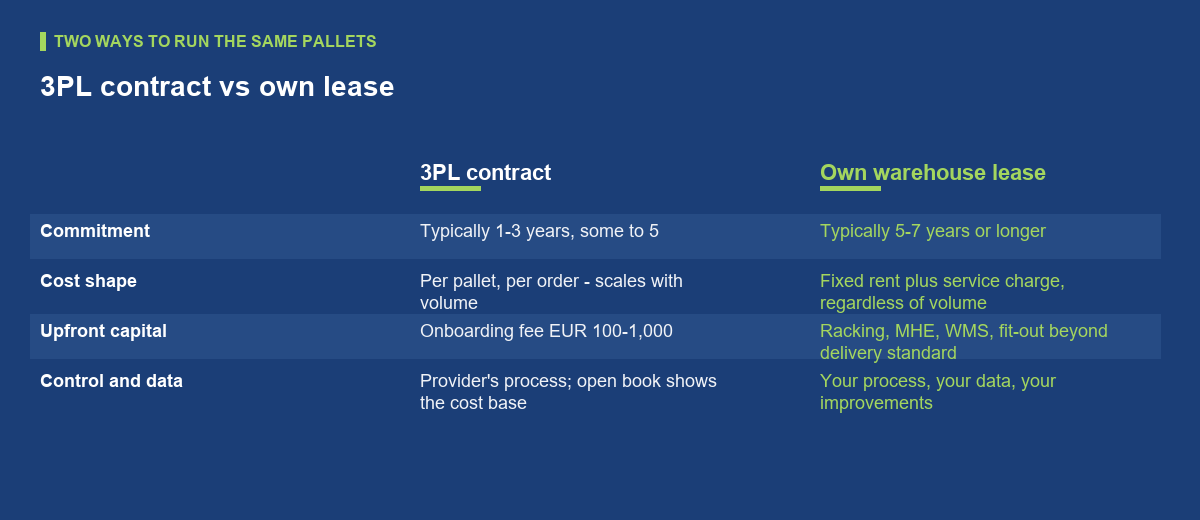
The headline rent is the visible layer. At the Q1 2026 average of EUR 4.55 per square metre per month, a 10,000 square metre unit costs EUR 546,000 a year – our multiplication – and prime space in Bratislava commands EUR 5.95 (CBRE via Property Forum; Cushman & Wakefield’s own series puts prime at EUR 5.30 with vacancy at 7.72 per cent – C&W Industrial MarketBeat Q1 2026 – a reminder that broker definitions differ and only trends within one series compare cleanly). On top of rent comes the service charge – typically EUR 0.80 to EUR 1.20 per square metre per month in Slovak parks, our established market-practice range – which adds EUR 96,000 to EUR 144,000 a year on that same unit, our arithmetic again. Then the capital the quote never shows: racking, mechanical handling equipment, a warehouse management system, and the fit-out beyond the landlord’s delivery standard, only partly softened where a fit-out contribution is negotiated. Then people – recruitment, shifts, sickness, seasonal peaks – in a labour market where the tight western regions carry most of the stock. And the commitment underneath it all: Slovak institutional leases habitually run five to seven years or longer, as we set out in our review of what occupiers actually sign. The per-unit cost of a well-run own warehouse at steady volume usually beats the provider’s rate card. The operative words are well-run and steady.
Flexibility against control: the asymmetries that decide it
Strip out the rates and two asymmetries remain. The first is time. A provider contract of one to three years against a lease of five to seven means the outsourced route re-prices and re-sizes itself roughly twice as often as an own lease even allows. If your volumes are volatile – new market entry, tender-driven contracts, seasonal swings – that difference is worth real money, because an under-used own warehouse keeps costing EUR 546,000 a year while a unit-priced contract shrinks with the volume. The second asymmetry runs the other way: control. In your own operation you own the process, the data, the customer experience at the dock and every improvement you engineer; the savings from a faster pick path are yours, not shared through someone’s margin. Under an open book arrangement you at least see the cost base; under a closed book you see a price and trust the market to keep it honest at renewal. There is also a quieter risk on the outsourced side that Q1 illustrates: 53 per cent of Slovak leasing activity is renegotiation, and your provider is renegotiating its own rent into your next rate card (CBRE via Property Forum). Neither asymmetry is an argument to refuse; both are arguments to price.
A decision framework for 2026
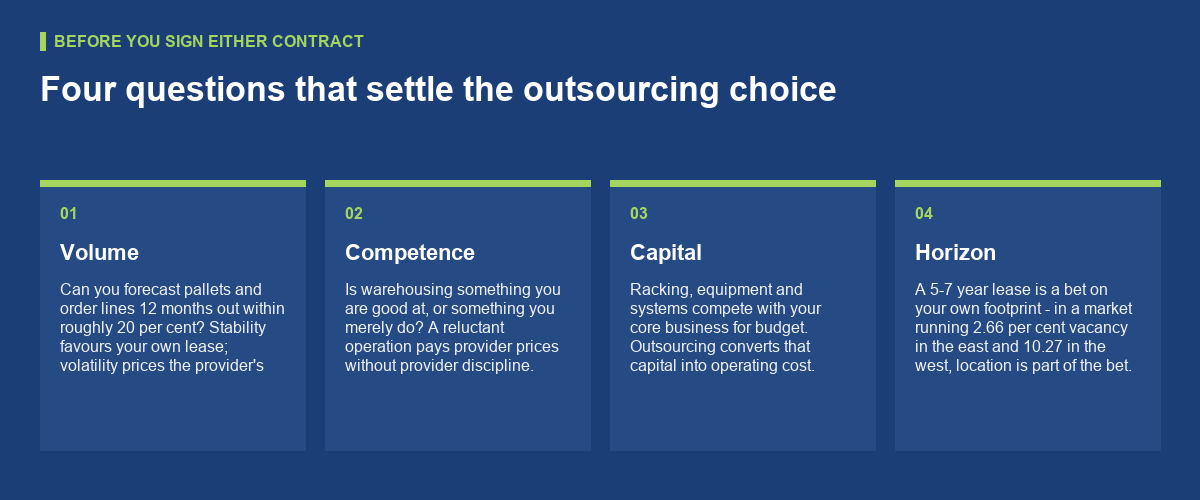
Four questions separate the cases better than any benchmark table. First, volume predictability: can you forecast pallet positions and order lines twelve months out within perhaps 20 per cent – our rule-of-thumb threshold, not a study? Stable volume amortises fixed costs and favours the own lease; volatility prices the provider’s flexibility. Second, competence: is warehousing something your company is actually good at – processes, systems, people – or merely something it does? An operation run reluctantly converges on provider pricing without the provider’s discipline. Third, capital: racking, equipment and systems compete with your core business for the same investment budget, while the outsourced route converts that capital into operating cost. Fourth, horizon: a five-to-seven year lease is a bet on your own footprint; in a market where the east runs at 2.66 per cent vacancy and the west at 10.27, the location you would commit to matters as much as the commitment itself (CBRE via Property Forum). The honest hybrid deserves a mention: many occupiers start outsourced, learn their real cost-to-serve from the provider’s invoices, and take their own space once volume stabilises – with the contract data as their business case.
Conclusion
The Slovak market will serve you either way: providers are expanding – 30 per cent of Q1 demand – and landlords are negotiating, with average rents 6 per cent softer than a year ago. The wrong move is drifting into either camp by default: outsourcing because a quote landed on the desk, or leasing because ownership feels like progress. Run the four questions, price both stacks fully – rent plus service charge plus capital plus people against the full rate card – and let the arithmetic, not the habit, sign the contract.