
Rail-connected logistics in Slovakia is a story most site searches skip. An occupier shortlisting halls along the D1 compares rents, currently around €5.30 per square metre per month for prime space, checks the motorway junction and never asks where the nearest intermodal terminal loads. Yet Slovakia moves almost a third of its inland freight by rail, one of the highest shares in the European Union, and the terminals and corridors behind that figure quietly decide which parks stay competitive. This article maps the network – the western hub, the eastern broad-gauge gateway, the TEN-T corridors – and asks the practical question: which occupiers actually benefit from paying for rail access?
Why rail-connected logistics in Slovakia still matters
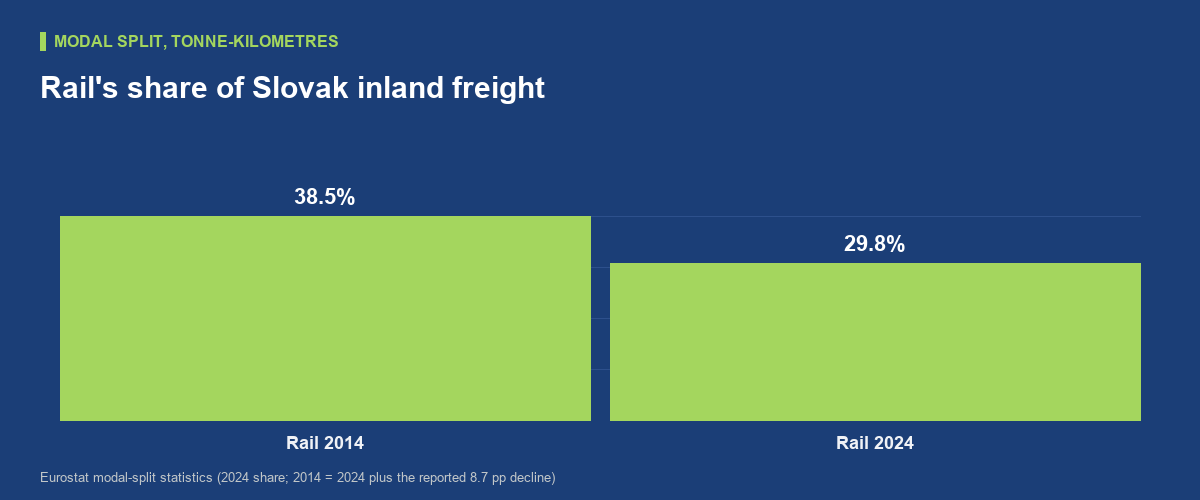
Slovakia is one of the few EU countries where rail remains a first-class freight mode rather than a rounding error. Eurostat’s modal-split statistics put rail at 29.8 per cent of Slovak inland freight tonne-kilometres in 2024 (Eurostat), a share most western European markets can only envy. The trend line, however, points the other way: between 2014 and 2024 the Slovak rail share fell by 8.7 percentage points while road’s share rose by 9.9 percentage points, so the country is drifting towards the European norm of truck-first logistics. Both facts matter to an occupier. The high share means the infrastructure, the operators and the working know-how are all in place; a company that wants to move volume by rail in Slovakia is not pioneering anything. The decline means capacity is available and terminal operators are hungry for new flows, which keeps intermodal pricing honest. It also means the occupiers who do commit to rail tend to be the ones with structural reasons – heavy inputs, fixed corridors, sustainability targets written into customer contracts – rather than opportunists chasing a subsidy. Reading the modal numbers first frames the real question: not whether rail works in Slovakia, but whether it works for a specific set of flows.
The western hub: what Dunajska Streda actually offers
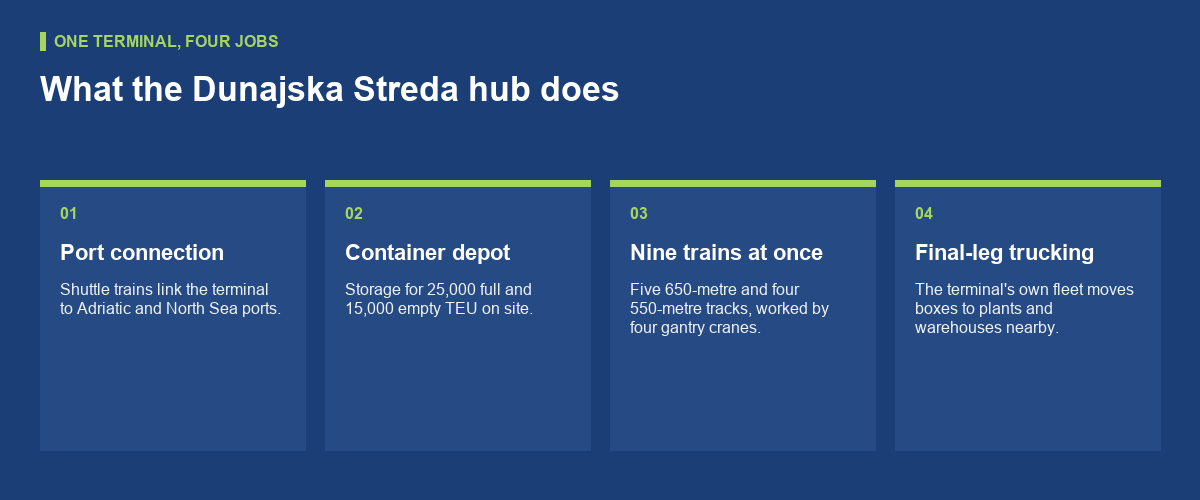
The centre of gravity of Slovak intermodal traffic sits south-east of Bratislava, in Dunajska Streda. The METRANS hub there is the largest inland container terminal in the country: a total site of 326,000 square metres with a 296,000 square metre stacking area, rail capacity for nine trains at once on five 650-metre and four 550-metre tracks, four rail-mounted gantry cranes, and a depot holding 25,000 TEU of full and 15,000 TEU of empty containers (METRANS). Rail operations run around the clock, including public holidays. In practice the hub works as Slovakia’s connection to the deep-sea ports: regular shuttle trains link it to the Adriatic and the North Sea range, and containers are trucked the final leg to plants and warehouses across western Slovakia. For an occupier this changes the geography of a site search. A hall within a short drayage of Dunajska Streda effectively has a port connection without a port, and the terminal’s own trucking fleet handles the last kilometres. Cross-docking volumes between rail and road is routine here rather than exotic, which is why container-heavy retailers and automotive suppliers cluster in the surrounding districts instead of paying Bratislava rents.
The eastern gateway: broad gauge and the Ukraine question
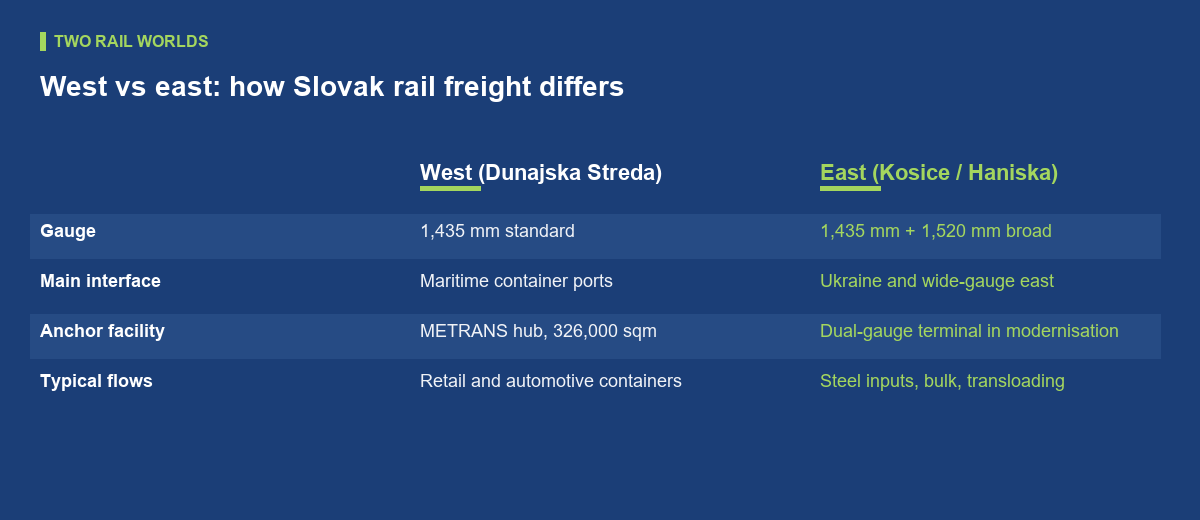
Eastern Slovakia plays a different rail game, built on a gauge break. The Uzhhorod-Kosice broad-gauge track, a single-track 1,520 mm line running from the Ukrainian border to Haniska just south of Kosice, was built to feed iron ore from the east to the steelworks near Kosice (Uzhhorod-Kosice line), and it still defines the region’s freight identity. Where western Slovakia interfaces with maritime containers, the east interfaces with the wide-gauge world: cargo arriving on Ukrainian and further-east railways can run deep into Slovak territory before it has to change systems. That break-of-gauge is friction, and friction is precisely what creates logistics work – transloading, storage, consolidation. The strategic bet on this corridor is now visible in private capital: Metrans and Interport Servis are modernising a terminal near Kosice to handle both broad and standard gauge, explicitly to ease rail freight to and from Ukraine (RailFreight.com). Whatever shape Ukraine’s reconstruction takes, the flows will need a staging ground inside the EU, and eastern Slovakia holds the shortest rail-served route. Occupiers positioning for that traffic are choosing the east now, while land near the gauge break remains cheap relative to what the corridor could carry.
The corridors that decide which parks win
Terminals are the nodes; the corridors decide how well they are fed. Slovakia sits on the crossing of two of the EU’s core TEN-T freight arteries. The Baltic Sea – Adriatic Sea corridor runs north-south through the country, entering from Poland near Zilina and leaving past Bratislava towards Vienna and the Adriatic ports (European Commission). The Rhine – Danube corridor crosses east-west, with a northern branch running via Zilina towards the Ukrainian border and a southern branch through Bratislava along the Danube (European Commission). Corridor status is not a diploma on a wall: it steers EU infrastructure co-funding, electrification and signalling upgrades, and the timetable priorities that decide whether a freight train crosses the country in hours or days. For industrial property the consequence is blunt. Parks that sit where a corridor meets a terminal – the Bratislava-Dunajska Streda pocket, the Zilina crossroads, the Kosice basin – enjoy a structural advantage that survives any single market cycle, because public money keeps flowing into the rails beneath them. A tenant’s market comes and goes; a corridor does not move.
Who benefits: matching occupier profiles to rail access
Rail access is worth real money to some occupiers and almost nothing to others, and honesty about which profile you are saves years of mispriced logistics. The clearest winners are heavy and steady flows: steel, automotive components, white goods, packaging – anything that moves in trainload rhythms on fixed lanes. Container importers with Adriatic or North Sea routings benefit through Dunajska Streda’s shuttles, particularly when sustainability clauses in customer contracts start pricing road kilometres. Businesses eyeing eastern flows – reconstruction materials, agricultural volumes, anything crossing the gauge break – gain from siting near Kosice ahead of the dual-gauge upgrade. Who does not benefit? Parcel networks and e-commerce fulfilment tuned to next-day promises, where the truck’s flexibility wins, and any operation whose volumes are too irregular to fill scheduled capacity. The warehouse lease terms an occupier signs should follow the same logic: a rail-served site commands its premium only if the siding, the terminal slots and the handling equipment are actually written into the deal. Rail access on a marketing brochure loads no trains.
Conclusion
Rail-connected logistics in Slovakia rewards the occupier who reads the map before the rent list. The country still moves almost a third of its freight by rail, the western hub at Dunajska Streda provides a genuine port connection without a coastline, and the eastern gauge break is turning into a strategic gateway as private terminals re-equip for Ukraine traffic. None of this shows up in a standard hall comparison, and that is exactly the opportunity: two buildings at the same rent can carry very different freight economics once the nearest terminal, the corridor beneath it and the shape of your own flows are priced in. The occupiers who benefit are the ones who ask early – and who make rail access a term of the lease, not a line in the brochure.