
State aid for industrial occupiers in Slovakia is one of the most under-read lines in a site-selection budget. A manufacturer comparing halls on the D1 tends to fixate on the headline rent, currently around €5.30 per square metre per month for prime space, and forgets that the Slovak state will co-fund the move itself. Regional investment aid can cover up to half of a project’s eligible costs, yet many occupiers treat it as paperwork for someone else. This article sets out what the scheme funds, where the aid map pays most, the thresholds a company must clear, and how the numbers reshape a site decision.
What state aid for industrial occupiers actually covers
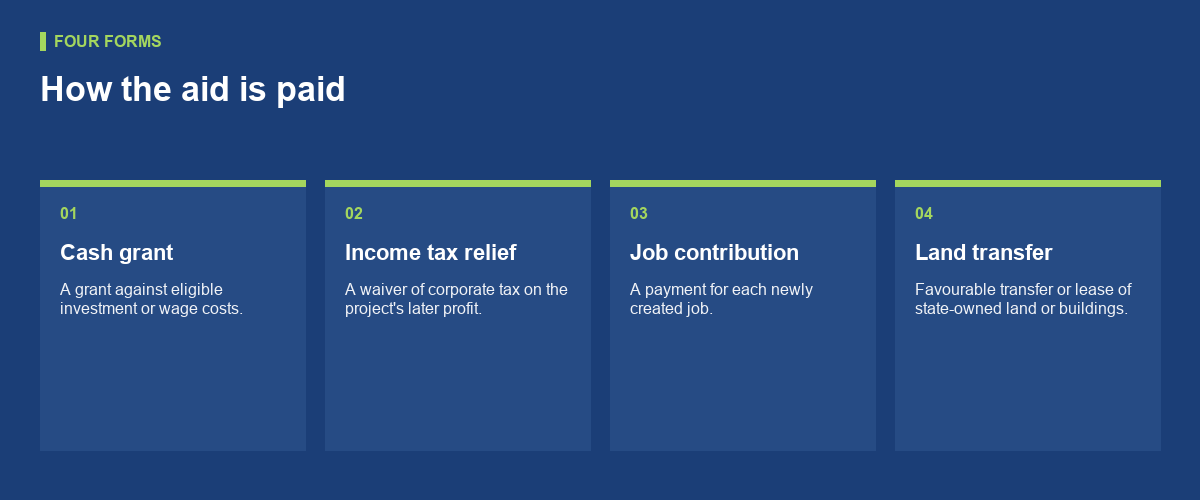
Slovakia runs a formal regional investment aid scheme under the Act on Regional Investment Aid, administered by the Ministry of Economy with the investment agency SARIO as the first point of contact (SARIO). It is open to small, medium and large companies, domestic or foreign, that invest in new capacity in industrial production, technology centres or shared-service centres. For an occupier this matters because the aid attaches to the operating company that will run the plant, not to the developer that builds the shell. The scheme pays out through four channels rather than one. The first is a cash grant against eligible investment or wage costs. The second is income tax relief, a waiver of corporate tax on the profit the project later generates. The third is a contribution for each newly created job. The fourth is a favourable transfer of state-owned land or buildings, priced at up to 100 per cent of a discount, or a favourable lease at up to 90 per cent. One project can combine several of these, and the Bratislava region is the single exclusion, so a site anywhere else in the country is in scope. The headline point is simple: the building is only half the decision, and the state funds the other half.
Where the aid map pays most across Slovakia
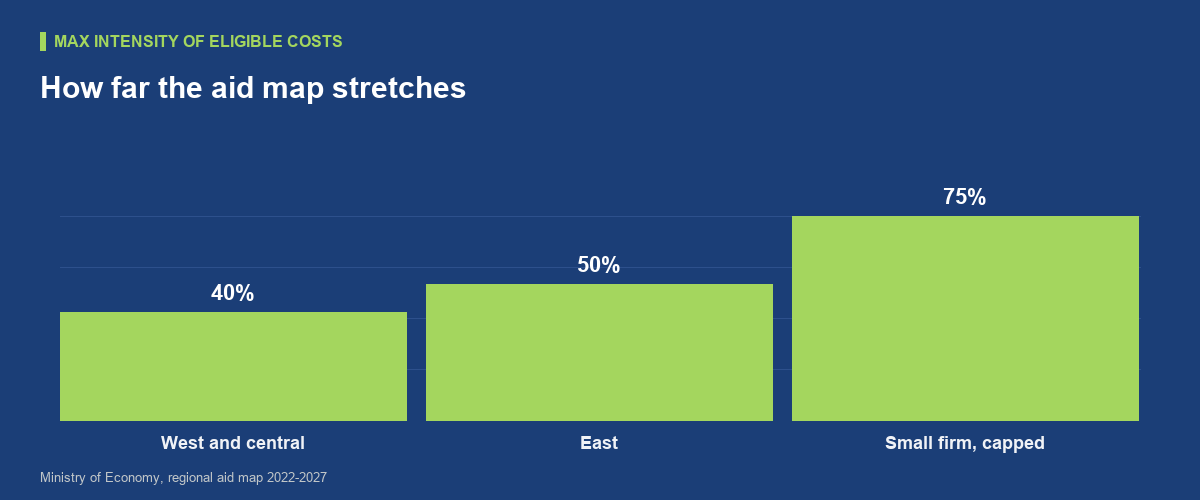
How much a project can claim depends on where it lands. Slovakia’s regional aid map, in force from 2022 to 31 December 2027, caps the intensity of aid at 40 per cent of eligible costs across most of the country and 50 per cent in the least-developed eastern districts (Ministry of Economy). From January 2024 the government lifted the ceilings in western Slovakia, raising several districts to the higher band and sharpening the incentive to build outside the saturated Bratislava hinterland (UNCTAD). Smaller companies do better still. The maximum intensity rises by 20 percentage points for micro and small enterprises and by 10 percentage points for medium-sized ones, though the combined figure can never exceed 75 per cent of total eligible costs. The map is blunt but predictable. In practice it becomes a genuine lever: an identical project that clears the same thresholds is worth materially more in Prešov or Košice than in Trnava, purely because the eastern districts carry the higher intensity. For an occupier with any freedom over location, the aid map is a reason to look east before signing in the west.
The thresholds an occupier must clear
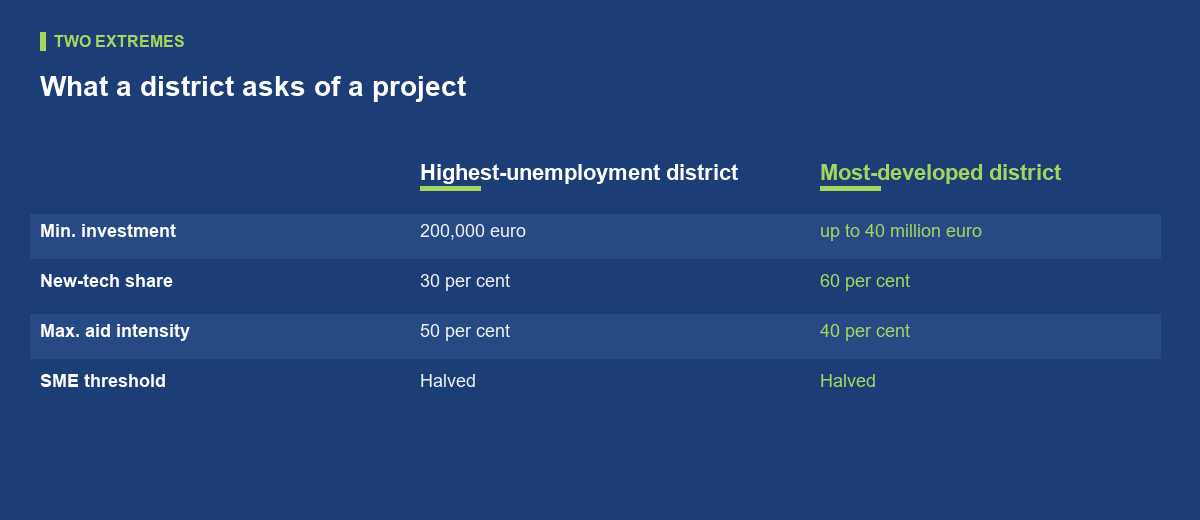
Aid is not automatic; a project has to clear minimum values that scale with how developed the district is. For industrial production the minimum qualifying investment ranges from 200,000 euro in the highest-unemployment districts to as much as 40 million euro in the most developed ones, and the thresholds are halved for small and medium-sized enterprises (Ministry of Economy). A second test governs modernity: the share of the investment spent on new technological equipment must reach between 30 per cent and 60 per cent of eligible costs, again rising with the wealth of the region. Where the aid takes the form of a job-creation contribution, the project must also create a minimum number of new posts, from around 20 in the weakest labour markets to 200 in the strongest. The logic is deliberate. Slovakia wants modern plant and real employment in the places that need them, so it asks least of a project in a struggling eastern district and most of one in a prosperous western one. An occupier reading these numbers should map its own capital plan against them early, because a site that misses a threshold by a small margin forfeits the aid entirely.
Beyond the grant: tax relief and the R&D super-deduction
The cash grant is the visible incentive, but the tax side often carries more value over the life of a plant. Income tax relief lets a beneficiary shelter the profit its new capacity generates, which is worth more the higher the tax rate. From January 2025 Slovakia charges corporate tax at 10 per cent on taxable income up to 100,000 euro, 21 per cent between 100,000 euro and 5 million euro, and 24 per cent above 5 million euro (PwC). A profitable project therefore shields income at the top band, so the relief compounds as the operation scales. The saving is real money, not a rounding error. Stacked on that is the research and development super-deduction: a company can deduct an additional 100 per cent of qualifying R&D costs from its tax base, on top of the normal expense, and carry any unused amount forward for up to five years (SARIO). For an occupier running any process engineering, testing or product development on site, that turns routine costs into a second, standing subsidy. The favourable transfer or lease of state land rounds out the package, cutting the cost of the plot beneath the building. Read together, the incentives are less a one-off cheque than a structural discount on operating in Slovakia.
How incentives should shape a site decision
The practical mistake is to treat aid as an afterthought once the building is chosen. It belongs at the front of the process, because it can reorder the site ranking outright. A hall that looks dearer on rent can be the cheaper total commitment once a 50 per cent intensity, income tax relief and a discounted plot are counted, so the comparison has to run on landed project cost rather than the rent line alone. Timing is the other trap: aid must be applied for before work on the project begins, so an occupier that breaks ground first can disqualify itself. The cleanest route is to align the incentive application with the lease or build-to-suit structure from the outset, so the developer’s delivery and the state’s aid decision move together. This is the same discipline that governs the rest of the deal, from the warehouse lease terms an occupier signs to the way rent indexation quietly compounds over the term, and it rewards the tenant that reads the whole cost, not the headline. In today’s tenant’s market, with the balance already tilted toward occupiers, incentives are the lever that decides which Slovak site actually wins.
Conclusion
Incentives are the part of a Slovak industrial decision that sits outside the lease and therefore outside most occupiers’ attention. Yet regional investment aid can fund up to half of a project’s eligible costs, income tax relief shelters the profit that follows, and the R&D super-deduction quietly discounts the work done inside the building. None of it is automatic, and all of it turns on where the project lands and how early the application starts. The occupier who prices the aid into the site decision from the beginning, rather than discovering it afterwards, is the one who signs the genuinely cheaper deal – and often in a better location than the rent line alone would have suggested.