
ESG in Slovak logistics has moved from a marketing badge to a condition of doing business. Industrial and logistics assets now draw up to 58 per cent of all commercial property investment in Slovakia, the highest sectoral share in Central and Eastern Europe. Almost every new hall is now handed over with a green certificate attached. For a tenant that raises a practical question the brochure skips: what does the BREEAM or DGNB label actually cost you, and what does it give back? This article breaks down the build cost, the running savings and the rent premium that sits behind the certificate on the wall.
ESG in Slovak logistics: how the green certificate became standard
Two forces turned certification from optional to obligatory. The first is money. Investment into Slovak industrial and logistics property jumped by around 315 per cent year on year in the first half of 2025. The sector now commands the largest share of commercial investment in the country (Cushman & Wakefield). Institutional buyers price ESG risk directly: a building without a recognised certificate is harder to finance, harder to insure and harder to sell to a fund with its own disclosure obligations. The second force is the occupier. Third-party logistics operators and manufacturers increasingly carry their own decarbonisation targets, pushed down from the retailers and brands they serve. A warehouse is one of the largest line items in a company’s reported carbon, so a certified building is no longer a nice extra but a reporting necessity. The result is visible on the ground. Across the region BREEAM has become the default specification for new warehouse stock rather than a premium option (EurobuildCEE). The recent Slovak openings tell the same story: CEVA Logistics and Jungheinrich moved into a BREEAM Excellent building at Plavecky Stvrtok near Bratislava (CEVA Logistics), on the cross-border spine we map in Cross-Border Logistics Slovakia: CEE’s Pivot Point. For a tenant the question is no longer whether to take certified space, but how to read what the certificate is worth.
BREEAM and DGNB: what the two certificates measure
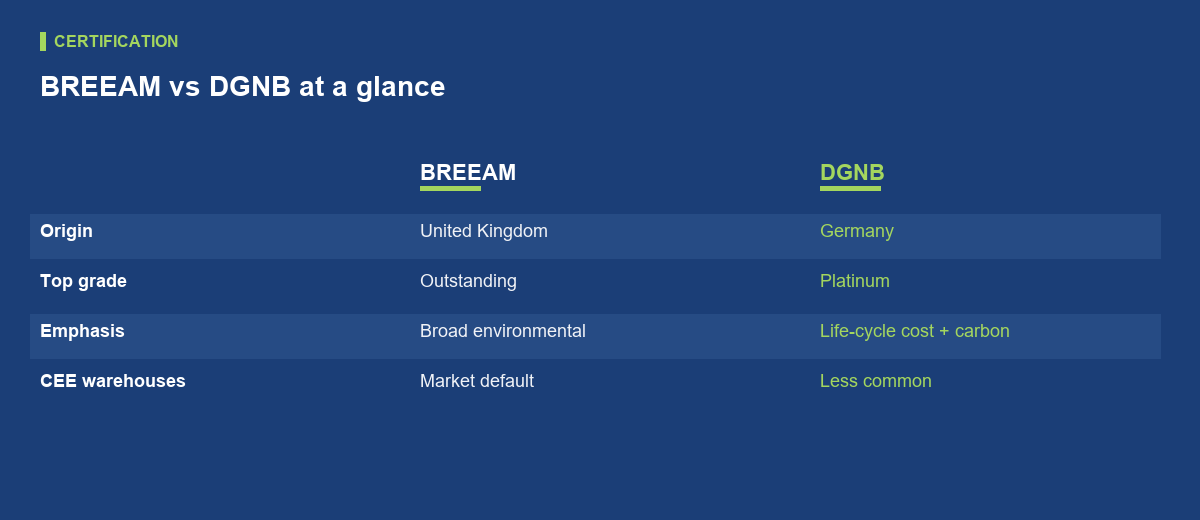
BREEAM and DGNB answer the same question with different accents. BREEAM, the British system that dominates the CEE warehouse market, scores a building across categories such as energy, water, materials, health, land use and pollution, then awards a single rating: Pass, Good, Very Good, Excellent or Outstanding (BREEAM rating guide). Most institutional-grade logistics stock now targets Very Good or Excellent, because anything lower reads as a compliance floor rather than a selling point. DGNB, the German system, works on a different logic. It scores economic, ecological and socio-cultural performance over the whole life cycle and awards Bronze, Silver, Gold or Platinum, with a heavier weighting on life-cycle cost and carbon than BREEAM applies. For a tenant the practical distinction is narrow. Both certificates confirm that the shell, the services and the site were designed to a measured environmental standard, and both feed the same corporate ESG reports. What matters is the level, not the logo: an Excellent or a Gold building carries real specification behind it, while a bare Pass or Bronze certificate may signal little more than that the developer wanted a badge. The tenant’s job is to read the scorecard, not the sticker. Ask which credits were actually achieved on energy and on-site renewables, because those are the ones that show up later in the service charge.
What certification actually costs to build
The certificate itself is not where the money goes. The assessment, modelling and administration for a BREEAM rating typically run at well under one per cent of total construction cost, and can be held close to zero when the design targets the credits from the outset rather than retrofitting them (Salvis BREEAM consulting). The real cost sits in the specification the certificate demands: a better-insulated envelope, LED lighting, water-saving fittings, a roof structure ready for solar, electric-vehicle charging bays and metering that actually reports consumption. Those items add to the developer’s build budget, and in a market where the landlord finances construction against a lease, they arrive on the tenant’s side as rent. This is the point occupiers miss. You do not pay for certification as a separate line, and you cannot decline it to save money, because in Slovakia the certified building is now the product on offer. What you can do is understand which parts of the green specification serve you and which serve the landlord’s exit. Solar-ready roofs and generous power capacity lower your running costs. A higher headline rating that adds cost without cutting your bills mainly protects the asset’s resale value. Knowing the difference is what lets a tenant argue about where the premium lands.
What the certificate saves a tenant
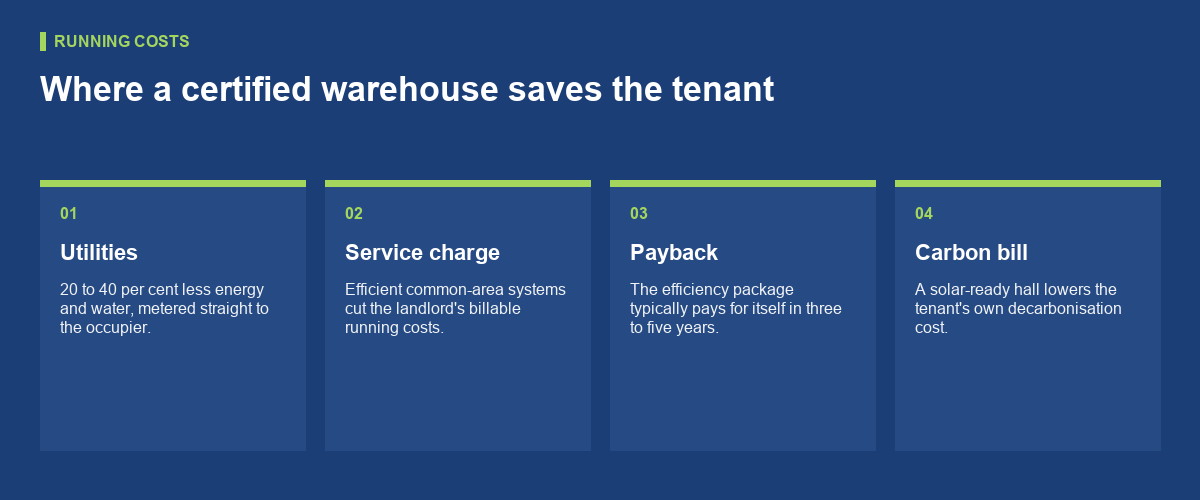
Against that cost sits a running saving that most rent comparisons ignore. A well-designed certified warehouse cuts energy and water consumption by roughly 20 to 40 per cent against an older uncertified shed, with the efficiency package typically paying for itself within three to five years of occupation (Salvis). For a tenant those savings land in two places. The first is the utility bill, which sits outside the rent and the service charge and is metered straight to the occupier, so every kilowatt the building does not waste is money kept. The second is the service charge itself: efficient lighting, heating and water systems lower the common-area running costs that the landlord bills back, the line we break down in Industrial Rent Levels in Slovakia 2026. A certified building also cuts a cost that appears on no invoice yet. Because the warehouse is a large part of a company’s reported carbon, a certified, efficient, solar-ready hall reduces the tenant’s own decarbonisation bill, the price of hitting the targets its customers now demand. That is why certified space increasingly wins the deal over a marginally cheaper uncertified unit. The saving is real, but it is not automatic. A certificate proves the building can perform; it does not guarantee the tenant runs it well. The lease should give the occupier the right to install rooftop solar and to read its own meters, or the efficiency stays on paper.
The green premium: what tenants really pay
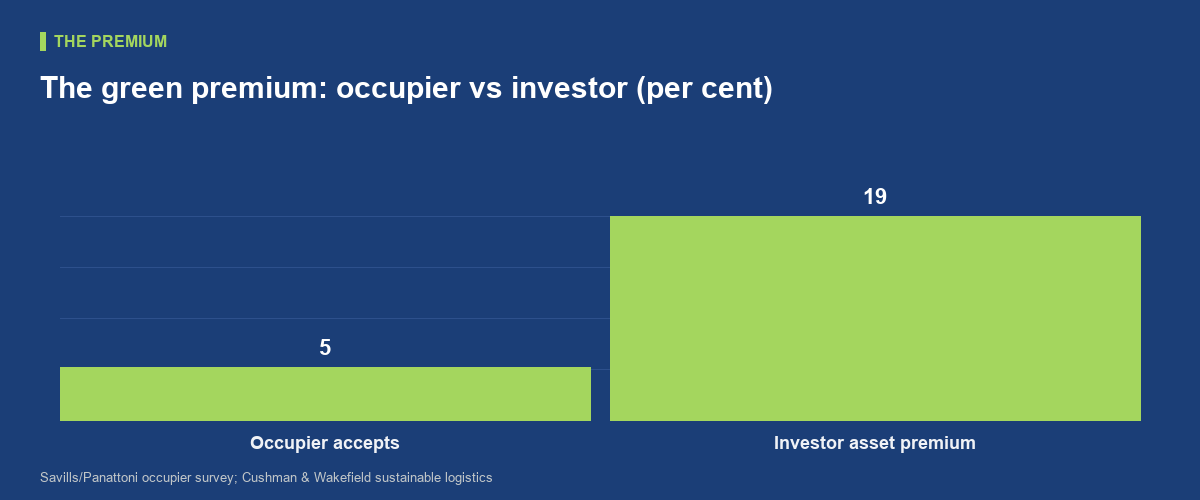
So what does the market actually charge for all this? At the investment level the premium is large. Cushman & Wakefield’s work on sustainable logistics puts the average pricing premium for assets with a high ESG rating at around 19 per cent over comparable buildings with a low rating or none (Cushman & Wakefield, via Clarion Partners). That gap reflects investor demand, not tenant rent, but it explains why developers protect their certificates so carefully. On the occupier side the willingness is real but more measured. In a survey of logistics users by Panattoni and Savills, almost 90 per cent said they would pay more for a green-certified building. Close to 70 per cent accepted a rental surplus of 5 per cent or more (Savills), and a clear majority said they were increasing their own sustainability spending. Read those numbers together and the tenant’s position is clear. The certificate is priced into the rent, and the market has agreed it is worth paying for, but the accepted premium is a single-digit percentage, not the double-digit gap investors pay each other. That is the negotiating line. Pay the green premium, but insist it buys the credits that cut your bills: on-site solar rights, real power capacity, charging infrastructure and honest metering. And trade term for it, because a longer lease that lengthens the landlord’s income is the cleanest thing to swap for a better-specified building at a controlled rent.
Conclusion
ESG in Slovak logistics is no longer a choice a tenant makes; it is the condition of the building on offer. The certificate on the wall, whether BREEAM Excellent or DGNB Gold, costs little to award but shapes the whole specification, and that specification arrives in the rent. The tenant who treats the label as marketing overpays. The tenant who reads the scorecard, counts the running savings against the premium, and negotiates for the credits that cut real bills turns a compliance cost into an operating advantage. In a market where certified space is the default, that reading is the difference between paying for a badge and buying performance.