
A greenfield plot with no listed monument can still stop a building programme. In Slovakia, the regional heritage office can order archaeological research wherever it reasonably expects finds, and the law sends the bill to the builder, even though every find belongs to the state. One public contract shows the scale: the state developer MH Invest capped the dig for the Šurany industrial park at EUR 403,640 before VAT. This post explains when a dig can be ordered, who pays, what the contract looks like, and what happens when the excavator finds something nobody expected.
Why a plot outside the register can still need a dig
Two definitions in section 2 of Act 49/2002 on the protection of the monument fund, in the text in force since 1 April 2025, set the scope. An archaeological find is a movable object that documents human life from the earliest times to 1918, usually found in the ground or under water. Weapons, ammunition and other military material found in the ground count as well if they date from before 1946. An archaeological site is land that holds such finds in their original context, uncovered or not.
Recorded sites sit in a central register kept by the Archaeological Institute of the Slovak Academy of Sciences under section 41(1). Before building on a recorded site, the owner, administrator or builder must ask the regional heritage office for its view of the plan under section 36(2). The register is not the limit, though. Section 36(3) lets the office order research on a plot that is not recorded, if it reasonably expects finds there, and it sends that decision to the building authority.
The office can act on its own initiative or at the building authority’s request under section 35(7), and research comes in two forms under section 35(4): preventive, before works start, and rescue, during them. Under section 41(4) the office sets its conditions in the procedure on the building plan. A dig decision therefore belongs in the same early timetable as land assembly, which our post on why ten hectares take years describes.
Who pays for archaeological research under section 38
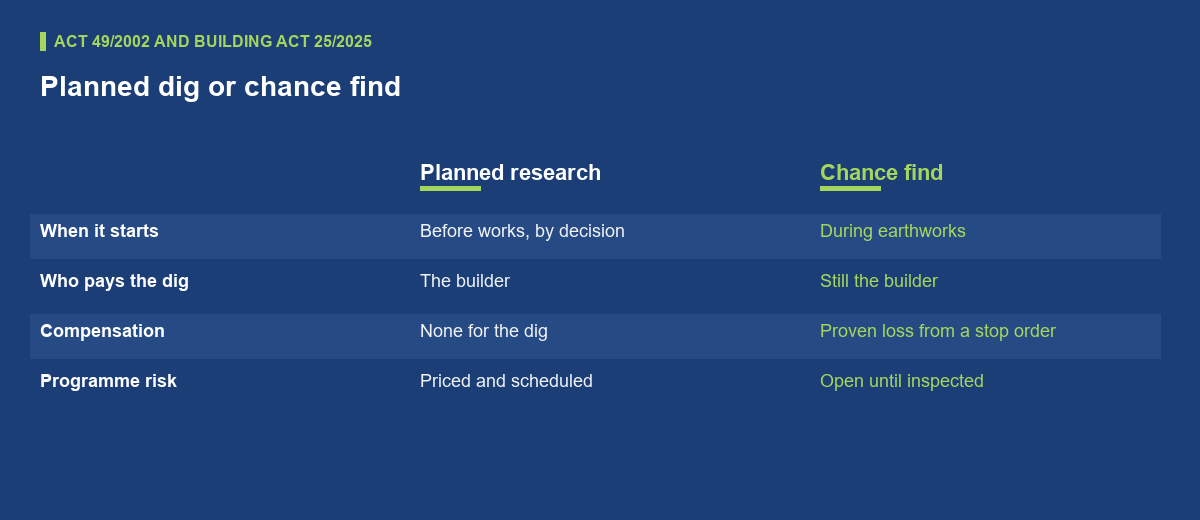
Section 38(1) is short. The costs of heritage research fall on the owner of a cultural monument, the owner of a property in a heritage zone, or the builder. On an unlisted industrial plot only the last applies, so the developer pays. Under section 40(6) the finds belong to the Slovak Republic from the moment they are found. The builder therefore funds a dig whose results it never owns.
Section 38(2) is the only exit. Where the building or activity is in the public interest, the central government body responsible for it may decide that the state budget covers all or part of the costs. The wording is permissive, and it reaches public-interest projects, not a private logistics hall. Research done purely for science is paid by whoever wants it, under section 38(3).
The builder cannot hire just anyone. Under section 36(4) only the Monuments Board, the Archaeological Institute and legal persons licensed by the Ministry of Culture may dig. The ministry’s list of 25 June 2026 names 48 entities, 21 of them private companies, the rest museums, universities and state bodies. Where the builder cannot find one for objective reasons, the ministry designates it under section 39(8). The research contract under section 39(3) is signed with the owner of the land, which matters where a trench crosses a strip the builder does not own. Rights over such a strip work differently, as our glossary entry on how rights over another’s land are created explains.
What a dig costs: the Šurany industrial park contract
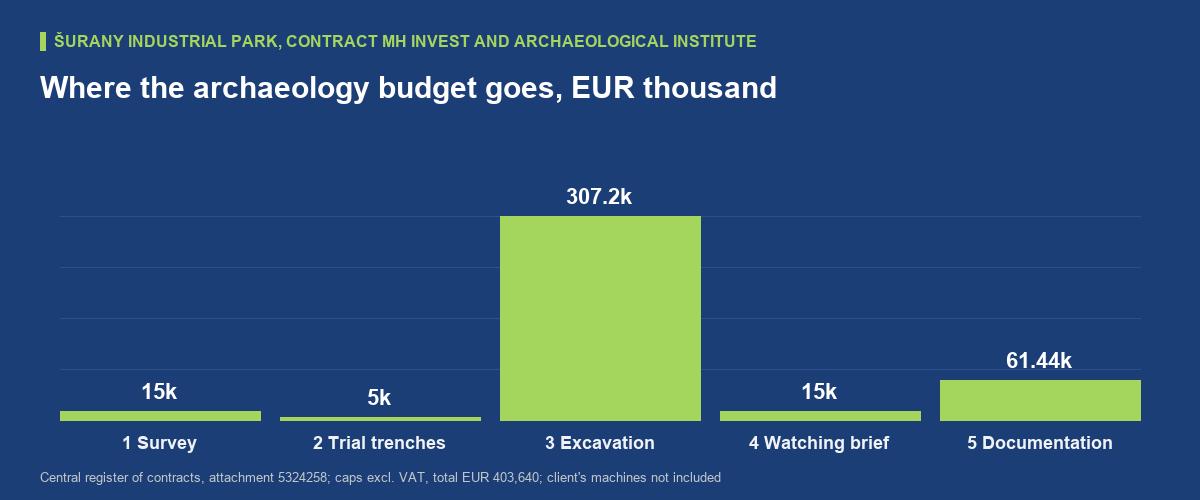
The contract between MH Invest and the Archaeological Institute, published in the central register of contracts, is a rare public price tag. The regional heritage office in Nitra ordered rescue research for the Šurany Industrial Park on 29 April 2024. The institute’s offer of 15 July 2024 became the price annex. The contract splits the work into five stages and caps the total at that EUR 403,640 before VAT.
The first two stages are fixed at EUR 15,000 and EUR 5,000, each to be finished within twenty working days. The third, the excavation of the sites found, is paid by the hour for a team of three archaeologists, six technicians and 30 labourers. It runs four months and is capped at EUR 307,200. Watching the builder’s earthworks costs EUR 15 an hour, at most EUR 15,000. The documentation earns a fifth of the third stage, at most EUR 61,440, due within 180 days of the fieldwork.
The price is not the whole bill. The client supplies three to five excavators with toothless ditching buckets in stage two, at least five in stage three, and tipper trucks for the topsoil, all at its own cost. Every day below 5°C extends each deadline by a day. Fieldwork began in March 2025 and was still running in June 2026, with eight areas of finds identified. The Monuments Board then reviews the report within 30 days under section 39(10); in 2025 it issued 516 such opinions.
What happens when the excavator finds something unexpected
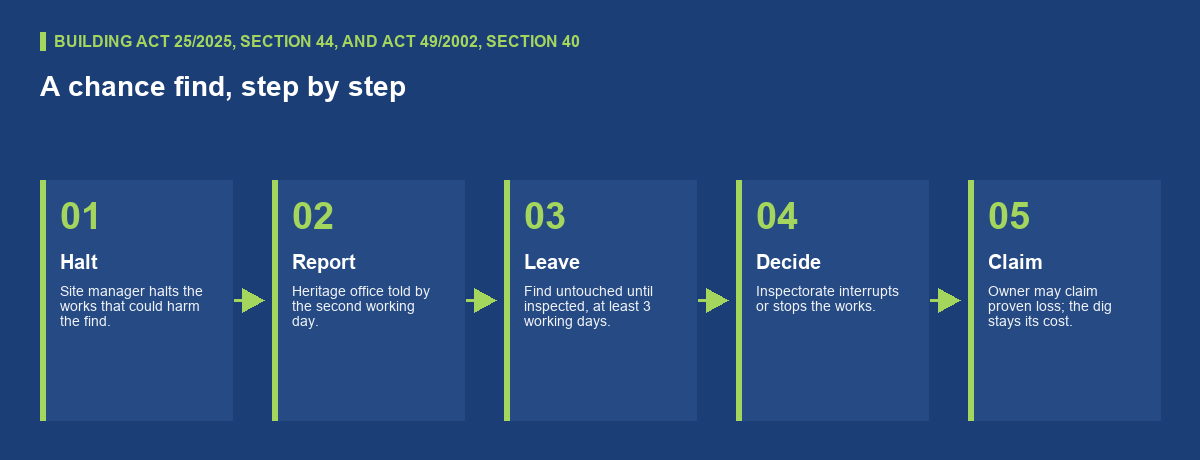
Where nobody expected a find, two acts apply side by side. Section 44(1) of the Building Act 25/2025 makes the site manager halt the works that could endanger the find without delay and report it to the regional heritage office. The site manager must also protect the find and record the time, circumstances and measures in the construction log. The building inspectorate is informed as well.
Act 49/2002 adds the clock. Section 40(2) requires the finder to report no later than the second working day after the find. Section 40(3) requires the find to stay untouched until the office or its expert has inspected it, and at least three working days from the report. Only an authorised archaeologist may lift it. Ammunition from before 1946 is for a police pyrotechnician alone, under section 40(4).
If the find needs more time, section 44(2) of the Building Act has the building inspectorate, on the heritage office’s opinion, interrupt the works for the time needed or stop them for good. Section 44(3) gives the owner of the building reasonable compensation for proven financial loss from that order. The compensation covers the stoppage, not the dig, which section 38(1) still puts on the builder. A finder outside authorised research may claim its expenses within six months under section 44(2) of Act 49/2002.
What skipping the dig costs a developer
Company fines sit in section 43(2) of Act 49/2002, in three bands. Failing to report a find falls in the lowest, EUR 100 to EUR 200,000. Ignoring the conditions set for research falls in the middle band, EUR 200 to EUR 400,000. Not carrying out research the office ordered, and digging or removing finds without authority, fall in the top band, EUR 300 to EUR 1,000,000. Fines double on World Heritage sites, and paying one does not end the duty to act.
Section 43(5) measures the damage to a destroyed archaeological site at the cost of the research that should have been done, so skipping the dig does not save its price. The office can fine within three years of learning of the breach and five years of the act itself, under section 43(4), and section 43a(2) sends serious damage to the police. Timing cuts the other way too: under section 44a a research decision lapses after three years if the work it covers has not been carried out.
For a buyer or tenant the questions resemble those for old contamination, which our post on the polluter’s legacy works through: is there a decision, who pays, and who carries the delay. Ask the seller for any heritage office opinion on the plot, check the register, and write into the purchase and construction contracts who bears the dig and the waiting time.
Conclusion
Archaeological research in Slovakia is the builder’s cost and the state’s property. A plot outside the register is not exempt, because the heritage office can order a dig where it expects finds, and a chance find halts the works with only the stoppage compensated. Ask the regional heritage office early, before the building plan is filed. Price the dig with the machines, the weather clause and the documentation period, not only the hourly rates. Then allocate the cost and the delay in the land and construction contracts, because the state budget pays only where a public-interest decision says so.