
An old factory site can come with contamination that nobody now alive caused. In Slovakia, Act 409/2011 decides who pays for an environmental burden, and its order is strict: the polluter first, then the polluter’s legal successor, then the owner of the land, and the state only when nobody else can be named. The state register counted 318 confirmed burdens and 850 suspected ones on 8 October 2026. This post explains that order, the defences an owner has to prove, the survey a seller may owe, and why public clean-up money stops at the ministries.
What counts as an environmental burden
The definition sits in section 3(t) of the Geological Act 569/2007: contamination of an area caused by human activity that poses a serious risk to human health or to rock, groundwater and soil. Environmental damage, which has its own act, is excluded. A probable burden is an area where such contamination is reasonably suspected. Act 409/2011, in the text in force since 1 January 2024, then decides who must investigate the site, clean it up and pay.
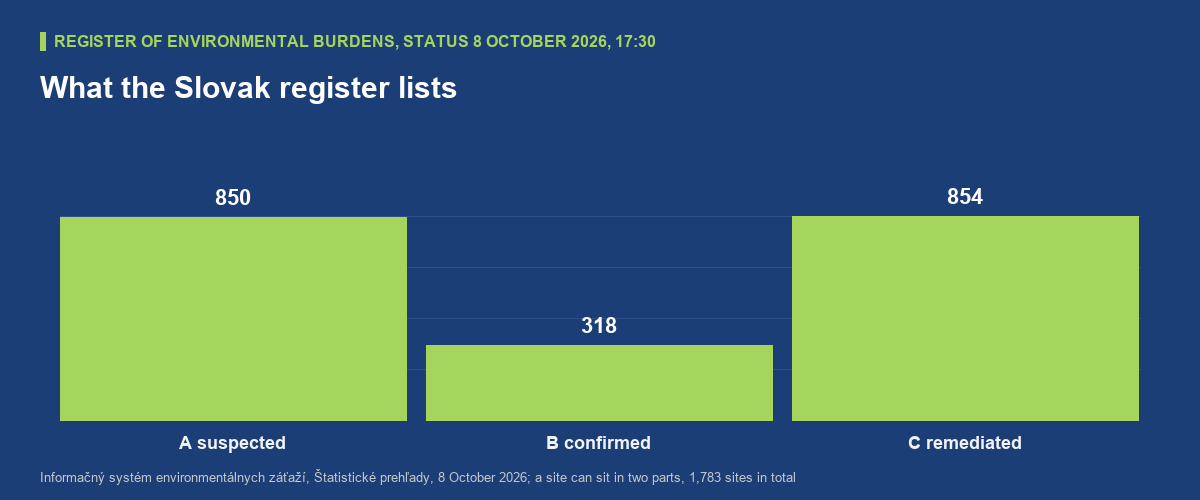
The Ministry of Environment keeps every site in a public information system. In its status report of 8 October 2026, 17:30, part A held 850 suspected sites, part B 318 confirmed burdens and part C 854 remediated or reclaimed sites. A site can sit in two parts at once, so the system counts 1,783 sites in total. Anyone may report a suspected site under section 2(3). The ministry checks it, classifies it as low, medium or high priority, and under section 11(2)(h) proposes a record in the land register.
The register is the first check, not the whole map. A site missing from it is not proven clean, and a listed site is not necessarily derelict, a gap our review of brownfield conversions describes from the other side.
Who pays first: the polluter, then the successor
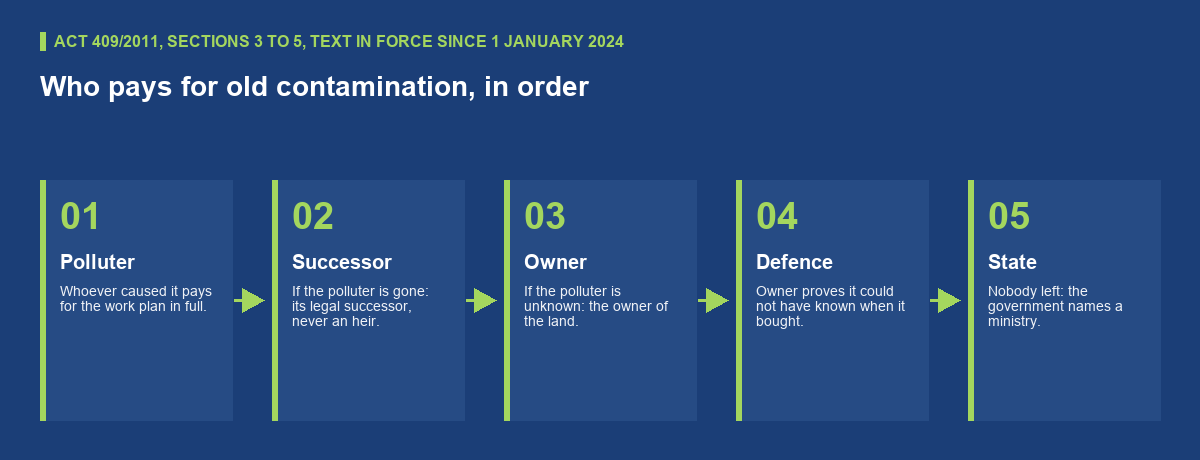
Section 3(1) puts the polluter first: anyone whose activity caused the burden. Two cases are carved out, contamination the state committed itself to clean up before the Act or by a government decision, and waste disposal that complied with a final permit. Under section 3(2) and (3) the polluter has a work plan drawn up and carried out, and pays all its costs.
If the polluter has ceased to exist or died, section 4(1) has the district office in the regional seat designate its legal successor as the obliged person, the povinná osoba. Section 4(2) excludes heirs and those who received land back under the restitution acts. Only where the polluter is unknown, or no successor can be designated, does section 4(3) turn to the owner of the property on which the contamination lies. Our glossary entry shows how the state register sorts and records a site.
Several polluters share the duty in proportion to their part in causing it, or jointly and severally if that part cannot be established, under section 6(1). Co-owners designated as obliged persons pay in line with their shares. The office can open the procedure on its own initiative, at the ministry’s request, or on a proposal from the owner, user or administrator of the property under section 5(1). A tenant, as user of the site, can therefore set it in motion too.
The defences an owner has to prove
An owner cannot be designated if it proves one of three facts listed in section 4(5). It inherited the property and did not continue the activity that caused the burden. Or it did not continue that activity after acquiring the property and, at the time of acquisition, could not have known about the contamination. Or it continued the activity without damaging rock, groundwater, soil or human health. Section 4(4) adds exemptions for privatisation buyers who spent the environmental money or met the environmental duties set in their privatisation contracts.
For a commercial buyer the second test is the one that matters, and it cuts both ways. The owner carries the burden of proof. A site listed in a public register is hard to call unknowable, so our reading is that a buyer who checks the register finds the problem, and a buyer who does not check cannot rely on ignorance either. The defence is strongest where the contamination was neither registered nor visible in any survey available at the time.
Once designated, the obliged person works to deadlines. Section 8(1) allows one year from the final designation to submit a work plan for a high-priority site and five years for medium or low priority. Section 8(7) requires an update of the plan every six years until the work is finished.
What a seller must hand over, and what it need not
Section 7 reaches into the sale itself. A polluter or obliged person that owns the contaminated property may transfer it only after an environmental geological survey of that property. The final report of the survey becomes part of the transfer contract, and the seller notifies the district office in writing and sends it the contract. Breaching section 7 falls in the same top band of company fines as failing to carry out a work plan: EUR 5,000 to EUR 33,000 under section 17(3).
The duty binds only a seller that is itself the polluter or a designated obliged person. A seller that bought the land years ago from a dissolved state enterprise owes no survey under section 7, so the buyer has to ask for one and agree in the purchase contract who bears a later designation. That is a different inheritance from the leases a buyer takes over, which our post on tenanted acquisitions covers.
A finished clean-up leaves a trace too. When the district office closes a work plan under section 9(3), its decision sets conditions for monitoring and for the further use of the property, and section 9(4) sends it on for the register and the land register. A site in part C can therefore carry use limits, and 129 sites sit in parts B and C at the same time.
When the state pays, and who gets the EU money
If no obliged person can be designated, the government decides on the ministry’s proposal which ministry takes over, under section 5(7). The State Programme for the Remediation of Environmental Burdens 2022 to 2027 lists 32 sites assigned to a ministry by resolutions from 2016 to 2019, among them a former Soviet army site in Rimavská Sobota that is now an industrial park. It also lists 20 sites where the procedure was stopped without such a resolution, seven of them former locomotive depots.
Public money follows that route. The 2023 call plan for Program Slovensko names only ministries acting as obliged persons as eligible applicants for remediation grants, with an indicative EUR 239 million. In the grant decision for phase two at Rimavská Sobota, the environment ministry is both applicant and provider, for EUR 6,117,256.04. The programme estimated EUR 636.05 million of costs up to 2027, without the former chemical works in Bratislava.
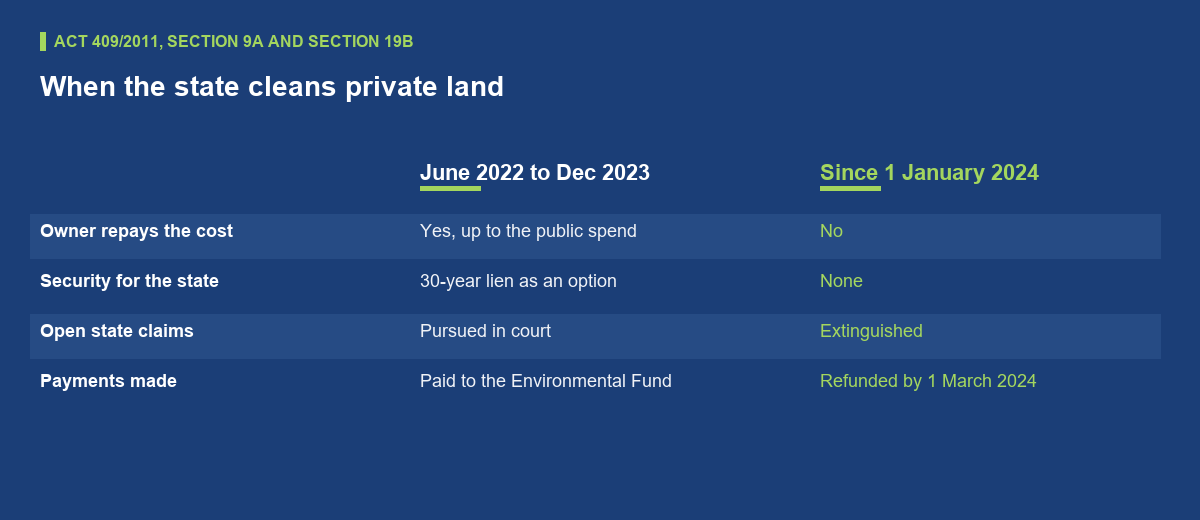
For 19 months the bill also ran the other way. Section 9a, in force from 1 June 2022, made owners of land the state had remediated repay the cost or grant a 30-year lien. Act 533/2023 repealed it from 1 January 2024, cancelled the state’s claims and made the Environmental Fund refund payments by 1 March 2024.
Conclusion
An environmental burden in Slovakia reaches a buyer only after the polluter and any successor drop out, but then it reaches whoever owns the land, unless that owner can prove it could not have known. Check the register and the land register before signing. Ask a seller that is a polluter or obliged person for the survey section 7 requires. Write into the purchase contract who carries a later designation, because public grants will not follow a private owner.