
Ask who may buy Slovak farmland and most answers still quote Act 140/2014, the law that put farmers first and made everyone else wait in a public register. That answer has been out of date since 11 February 2019, when a Constitutional Court ruling took the procedure out of the Act. What is left is a definition, a reciprocity rule and a reference to a certificate nobody issues any more. For a buyer assembling a greenfield site, the questions that decide the programme now sit elsewhere: whether the plot is in scope at all, which farmer’s lease comes with it, and what the soil levy costs since 1 June 2025.
Which land counts as Slovak farmland under the Act
The Act starts with a definition, and the definition decides more than any later rule. Section 2 of Act 140/2014, in the text in force since 11 February 2019, covers what Act 220/2004 calls agricultural soil: parcels the cadastre records as arable land, hop gardens, vineyards, orchards, gardens or permanent grassland, plus land built over for farming before 24 June 1991.
Section 2(2) then takes a long list back out. A garden is not covered, and neither is any parcel inside the built-up area of a municipality. Outside that line, a parcel falls out if the zoning documentation designates it for another use, if special laws on nature, water or energy restrict its farming use, if it measures less than 2,000 square metres, or if it adjoins a building and forms one functional whole with it.
For an industrial buyer the zoning exception is the one that counts. A plot that a zoning plan already designates for industry is outside the Act, whatever the cadastre still calls it. Section 3(1) narrows the field again: the Act only speaks to sale, exchange and gift under the Civil Code, plus the enforcement of a pledge or a security transfer. One trap sits in the footnotes. For the built-up area they still point to the Building Act of 1976, which has not been in force since 1 April 2025.
The filter that fell on 11 February 2019
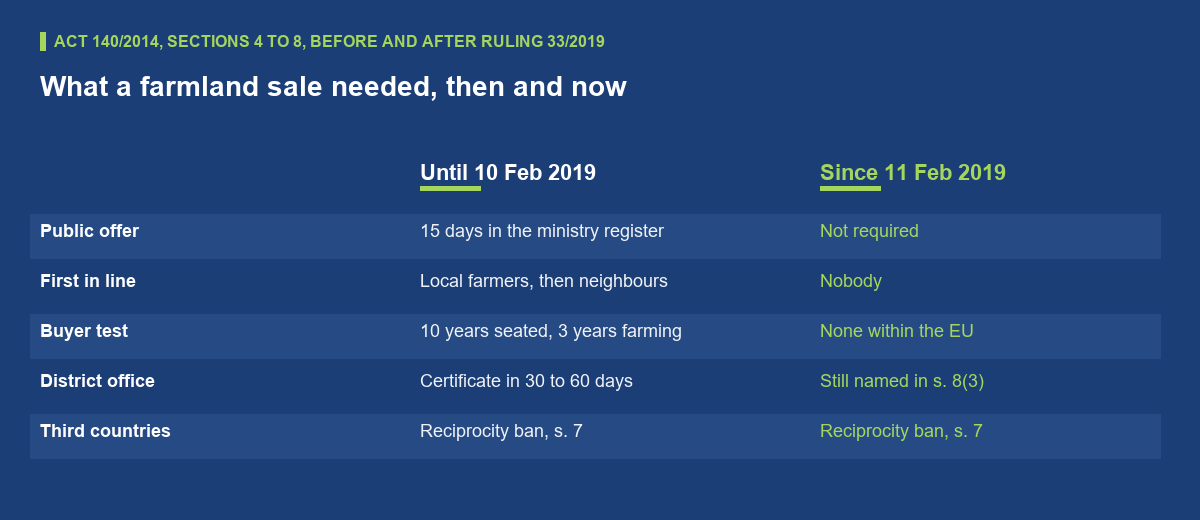
Until 2019 the Act did what its title promised. A seller who was not passing land to a co-owner, a close relative or a farmer working in the same municipality for at least three years had to publish an offer for at least 15 days in a register run by the agriculture ministry and on the municipal noticeboard. Only buyers resident or seated in Slovakia for ten years and farming for three could answer, local ones first, then neighbours, then the rest. If none came forward, any ten-year resident could buy at the published price. The district office checked the buyer and issued a certificate within 30 days, or 60 in complex cases.
On 14 November 2018 the Constitutional Court found sections 4, 5 and 6 incompatible with the Constitution and its protection of property, and its ruling, published as 33/2019, suspended them on publication. Parliament did not repair them within six months, so they lost validity. The reasoning was blunt: ownership by a Slovak resident does not, in legal terms, protect farmland at all.
The gap was never closed. In November 2020 the ministry itself said there was no regulation of the agricultural land market and proposed caps and pre-emption rights for public bodies. The consolidated history on slov-lex, read on 3 October 2026, shows no amendment since. Section 8(3) still tells the district office to issue the certificate under section 6(4), a provision that no longer exists.
Who still cannot buy: the reciprocity rule in section 7
One restriction survived the ruling. Section 7(1) bars a state, its citizens, and people resident or companies seated in a state whose own law does not let Slovak citizens, residents or companies acquire agricultural land. Inheritance is exempt. Section 7(2) lifts the bar for the European Union, the European Economic Area, Switzerland and any state for which a treaty binding Slovakia provides so, together with their citizens, residents and companies.
The foreign exchange act points the same way from the other side. Its section 19a lets a foreigner acquire real estate in Slovakia except where special laws restrict it, and its section 2 treats a company with its seat in Slovakia as domestic.
Read together, the test looks at the acquirer itself: its citizenship, its residence or its seat. A company registered in Slovakia has its seat here, so by the wording of section 7 it is not the person the rule describes, whoever holds its shares. That is our reading of the text, not a court’s, and a buyer from outside the European Union should have it confirmed for the structure it actually uses. For everyone inside the Union the question in the title has a short answer. Almost anyone may buy. The work starts after the purchase, with the people already on the land. Our post on why ten hectares take years covers the owners in the register; the next section covers the farmer in the field.
The farmer who comes with the land
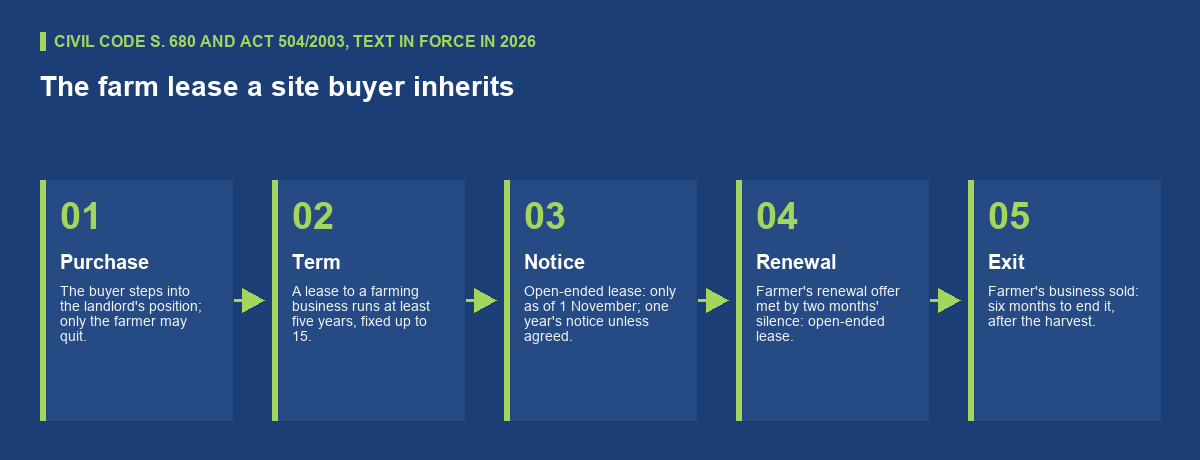
Ownership was never the main way farmland in Slovakia is worked. The Constitutional Court’s ruling recorded that roughly 93 per cent of agricultural land is leased, that leases run from five to 50 years depending on the land, and that the average lease lasts about 8.5 years. A site buyer almost always buys a lease along with the soil, and for any share whose owner cannot be traced, the lessor is the state body that administers it.
The lease does not end with the sale. Under section 680(2) of the Civil Code the acquirer steps into the landlord’s position, and under section 680(3) only the tenant may terminate because the owner changed. Act 504/2003 sets the clock. A lease to a farming business runs at least five years, and a fixed term may run up to 15. A fixed-term lease can be ended early only if the contract gives both the right and the grounds. An open-ended lease can be ended only as of 1 November, on a year’s notice unless the contract sets another period. If the tenant offers a renewal and the landlord stays silent for two months, an open-ended lease is born.
The Act names no ground for ending a farm lease because the land is to be built on. It names one that matters: if the tenant’s business, or a majority stake in it, is sold, the landlord has six months to end the lease, which ends after the harvest. Our glossary entry sets out what else changes hands when a business is sold.
What the soil levy costs since 1 June 2025
Buying the land does not make it building land. Under section 17(1) of Act 220/2004, agricultural soil may be used for anything else only on the basis of a withdrawal decision. Section 12 allows that only where necessary and to a justified extent, protects the four best quality groups, and makes whoever proposes the change weigh other locations outside the built-up area. It also charges a levy.
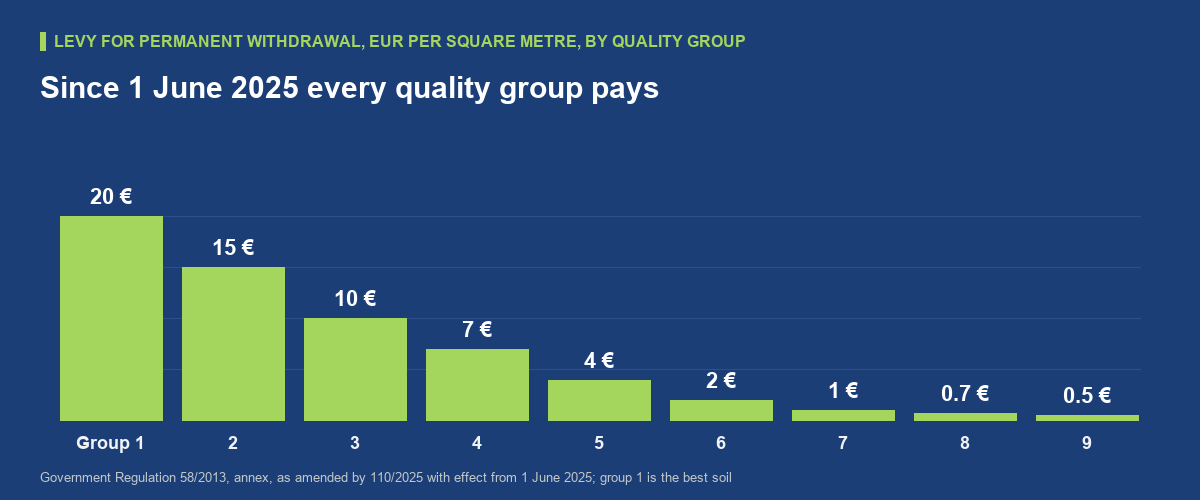
Until 31 May 2025 that levy fell only on the land listed as the most valuable in each cadastral territory. Act 82/2025 rewrote the duty, and an amending regulation deleted the list from Government Regulation 58/2013, both with effect from 1 June 2025. Since then every soil code in the regulation’s table pays, from quality group 1 to group 9. Permanent withdrawal costs EUR 20 per square metre in group 1 and EUR 0.50 in group 9, in one sum within 30 days of the decision becoming final. Irrigated land costs 50 per cent more, up from 30, and land directly next to the built-up area 30 per cent less. Non-public access roads lost their exemption the same day.
Our own arithmetic shows the scale. Ten hectares in group 3 cost EUR 1.0 million at EUR 10 per square metre, or EUR 700,000 next to the built-up area. And the decision lapses if the land is not used within three years, without a refund.
Conclusion
The question in the title has had an easy answer since 2019: almost anyone may buy, and only a narrow reciprocity rule stops some buyers from outside the Union. The questions that move money and time are three others. Is the parcel inside the Act’s definition at all, or already outside it through zoning or the built-up area? Which lease comes with it, and on which 1 November can it end? And which quality group does each parcel carry, now that every group pays the levy? Answer them parcel by parcel before the price is agreed, because none of them can be renegotiated once the cadastre has registered the sale.