
On 30 December 2026 the EUDR in Slovakia stops being a policy story and becomes a condition of despatch. The deforestation regulation has been postponed twice, most recently in December 2025, and in its whole text it never once mentions a warehouse. It does not need to. The duties attach to whoever places goods on the market or supplies them onward, and in this region almost all of that happens through a rented hall. This piece sets out what the rules change about the paper, the racking and the two contracts that govern them.
What the EUDR in Slovakia covers, and from when
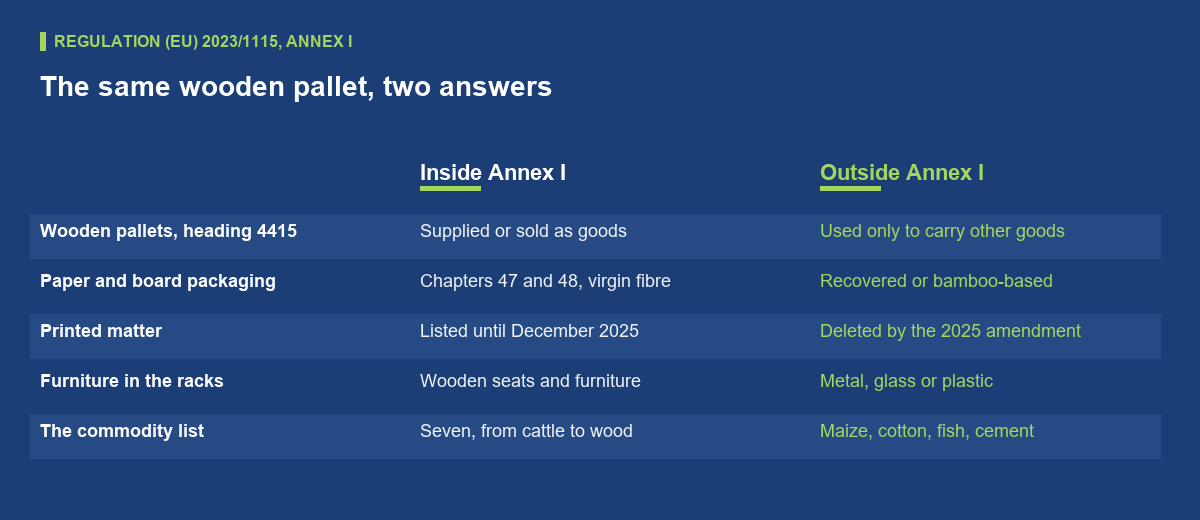
Seven commodities and a customs-code list. Regulation (EU) 2023/1115 applies to cattle, cocoa, coffee, oil palm, rubber, soya and wood, and to the products in Annex I made from them. Article 3 bars anyone from placing or making available such a product on the Union market, or exporting it, unless it is deforestation-free, was produced in accordance with the law of the country of production, and is covered by a due diligence statement or a simplified declaration.
The dates have moved twice. Regulation (EU) 2024/3234 pushed the start back by a year, and Regulation (EU) 2025/2650 pushed it back again. Article 38(2) now applies the operative articles from 30 December 2026. Article 38(3) gives natural persons and micro or small undertakings established as such by 31 December 2024 until 30 June 2027, but not for the products already covered by the old timber regulation. The same amendment struck printed matter out of Annex I.
Read that annex with a hall in mind and the scope sits closer than it looks. Heading 4415 covers wooden pallets, box pallets, load boards and pallet collars, with one carve-out: packing material used exclusively to support, protect or carry another product placed on the market. Pulp and paper of Chapters 47 and 48 are in, apart from bamboo-based and recovered products. Wooden furniture is in. The regulation reaches an ordinary distribution centre through its packaging long before it reaches anyone trading timber, which is a different question from the customs treatment of imported stock.
Storing goods is not making them available
The regulation has no view about warehouses at all. We counted the words in the consolidated text as amended: warehouse appears no times, logistics no times, batch no times. Storage appears once, in Article 20(2), on the list of costs a competent authority may reclaim from an operator after a finding of non-compliance. The single time the regulation thinks about storage, it is charging for it.
That silence is structural rather than careless. Article 2(18) defines making available on the market as any supply of a relevant product for distribution, consumption or use in the course of a commercial activity, whether in return for payment or free of charge. A warehouse keeper supplies a service, not the goods. It takes no title and sells nothing, so it is not a trader within the meaning of Article 2(17) for the stock on its racks, and Chapter 2 of the regulation passes it by. The same line already separates a storage service from a letting for tax purposes, as we set out in the piece on the VAT line that decides the invoice.
Two doors lead straight back in. Article 7 provides that where a person established outside the Union places relevant products on the market, the first person established in the Union who makes them available is deemed to be the operator, with the full diligence duty that follows. And Article 6(3) lets an operator that is a natural person or a microenterprise mandate the next downstream operator or trader as its authorised representative, who must then file on its behalf. A logistics provider that trades on its own account, or signs a mandate to be helpful, is inside the chain.
The word that decides the paperwork is mixing
Article 13 is the provision that saves work. Where an operator has ascertained that everything came from a country classified as low risk, it may skip the risk assessment in Article 10 and the mitigation in Article 11. Slovakia is named in the low-risk annex to Commission Implementing Regulation (EU) 2025/1093. But the relief is conditional, and the condition is physical: the operator must first assess the complexity of the supply chain, the risk of circumvention, and the risk of mixing with products of unknown origin or of origin in high-risk or standard-risk countries.
Mixing is a warehouse operation. It happens in a bulk location, on a consolidated pallet, at a re-pack station, at the moment two deliveries become one line of stock. Article 10(2)(j) makes it a risk criterion for the operator. Article 16(3) makes it a criterion the competent authority uses when it decides whom to check. The storage layout therefore decides which diligence regime an occupier can run and how visible it is to an inspector, which is not a sentence anyone expected to write about racking.
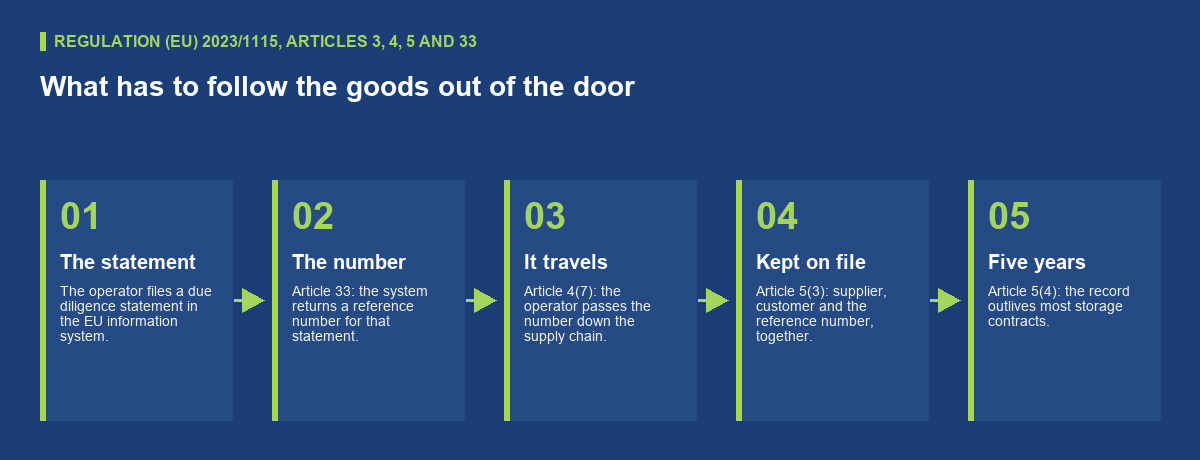
The other half of the paperwork is a number. Article 4(7) requires operators to pass the reference numbers of their due diligence statements down the supply chain. Article 5(3) requires downstream operators and traders to collect and keep those numbers together with the identity of the supplier and of the customer, and Article 5(4) requires that record to be held for at least five years. Article 3 then bars any onward supply that is not covered. A reference number that cannot be matched to a pallet is a pallet that cannot leave. What that document contains, and which party in the chain has to file it, is set out in our glossary entry on the due diligence statement.
Who enforces it in Slovakia, and what happens to the stock
Slovakia legislated early. Act 81/2025 Z. z., passed on 27 March 2025 and promulgated on 24 April 2025, carries the national machinery, and its first article takes effect on 30 December 2026, the same day as the regulation. It repeals Act 113/2018 Z. z. the old timber statute. Section 4(1) names three state bodies, and section 6(4)(a) makes the Slovak forestry and timber inspection the competent authority.
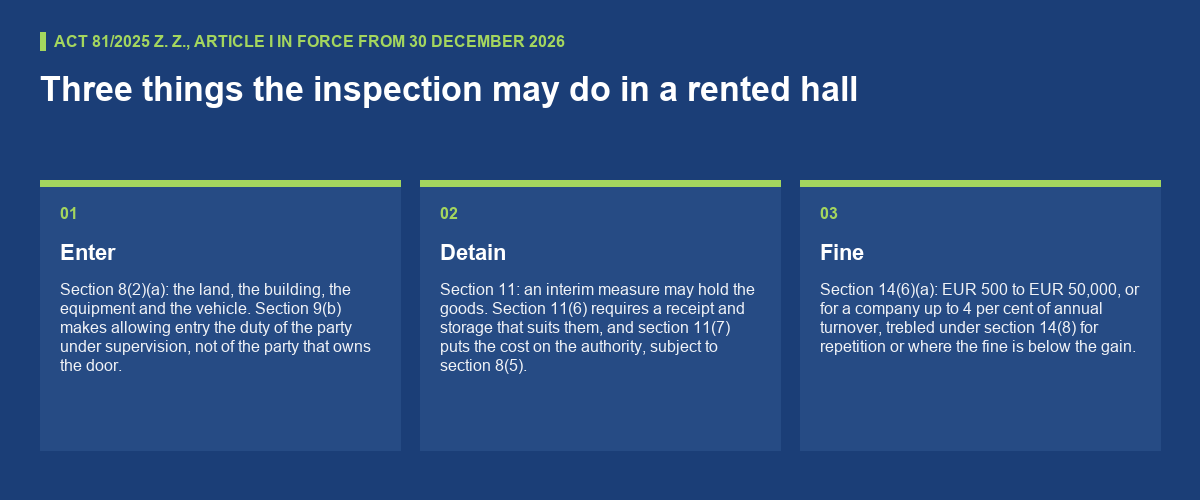
Its powers land inside the building. Section 8(2)(a) lets an authorised inspector enter the land, the building, the equipment and any vehicle used to place or make available relevant products, and section 9(b) obliges the person under supervision to allow that entry. Article 4(6) and Article 5(7) of the regulation say the same thing in Union terms: access to premises on request, as ordinary cooperation. In a leased hall the party that owes the access does not own the door.
What follows is worse for an occupier than the fine. Section 11 lets the inspection impose an interim measure and detain the goods. Section 11(6) requires it to issue a receipt and to store them in a way that suits them. Section 11(7) puts that cost on the authority, subject to section 8(5), which lets it charge the costs of supervision, detention included, back to the offender. Article 23 of the regulation is the Union version of the same power. Fines under section 14(6)(a) run from EUR 500 to EUR 50,000, or for a company up to 4 per cent of total annual turnover, and section 14(8) trebles the ceiling where the conduct repeats or the fine would be smaller than the gain.
Which clause belongs in the lease and which in the storage contract
Two contracts, two jobs. The lease governs the building. The storage or logistics contract governs the goods. Splitting the new duties along that line is most of the work, and it is cheaper to do it before the stock arrives.
The lease side is short. Give a competent authority a route in that does not depend on the landlord being reachable, and say who accompanies an inspection and who is told about it. Read the permitted-use clause against Article 24(2), which lets an authority require a non-compliant product to be withdrawn, recalled, donated or disposed of as waste, because the last of those is a waste operation carried out on the landlord site. Then decide who carries the rent on a bay that an interim measure has frozen. At the prime rent of EUR 5.30 per sq m per month that Cushman & Wakefield recorded for Slovakia in the second quarter of 2026, against a vacancy rate of 7.8 per cent and 265,800 sq m under construction, a few hundred square metres held for a quarter is a real number, and no lease drafted before this year says whose number it is.
The storage contract carries the rest. Write the segregation duty down: dedicated locations, no commingling of stock that carries different reference numbers, and a field in the warehouse management system that holds the reference number against the goods rather than against the paperwork. Say who keeps that record, because the five-year retention outlives most logistics contracts. And keep one Slovak transitional rule visible: under section 15(3) of Act 81/2025, wood produced before 29 June 2023 and placed on the market between 30 December 2026 and 30 December 2029 stays under the old act. Two regimes on one rack for three years, separated only by a record somebody has to keep, in the same way that carrier liability stops at the door while the pallet keeps moving.
Conclusion
The regulation was written for producers and importers, and it lands on the people who move pallets. Nothing in it obliges a warehouse keeper directly, and almost everything in it can stop a warehouse from despatching: a missing reference number, a bulk location that mixed two origins, an inspector at a door the tenant does not own. The date is 30 December 2026 and the Slovak enforcement act is already on the statute book. The two documents that decide who carries the cost are the lease and the storage contract, and both were drafted before any of this existed.