
Agency labour in Slovak logistics is bought as flexibility: a second shift for the peak, headcount that scales down without severance, a vacancy filled on Monday. Slovak law sells that flexibility on unusual terms. The wage is the same as your own comparable employee’s from the first hour. The assignment runs on a hard clock of 24 months and four renewals, counted against your warehouse rather than against the agency. And when the agency underpays, the difference becomes your debt. In one week of May 2026, inspectors checked 173 of the country’s 441 licensed agencies and reported suspected illegal employment at 71 of them. The framework is not paperwork. It is the shift plan.
What the borrowed worker must be paid
The first assumption to retire is that the agency worker is cheaper. Section 58(9) of the Labour Code is blunt about it. The conditions of an assigned employee, wage included, must be at least as good as those of a comparable employee of the user – the warehouse, not the agency. There is no qualifying period. The comparison runs from the first hour. Section 58(11) spells out what it covers: working time, overtime, night work, holidays, health and safety, even access to the canteen.
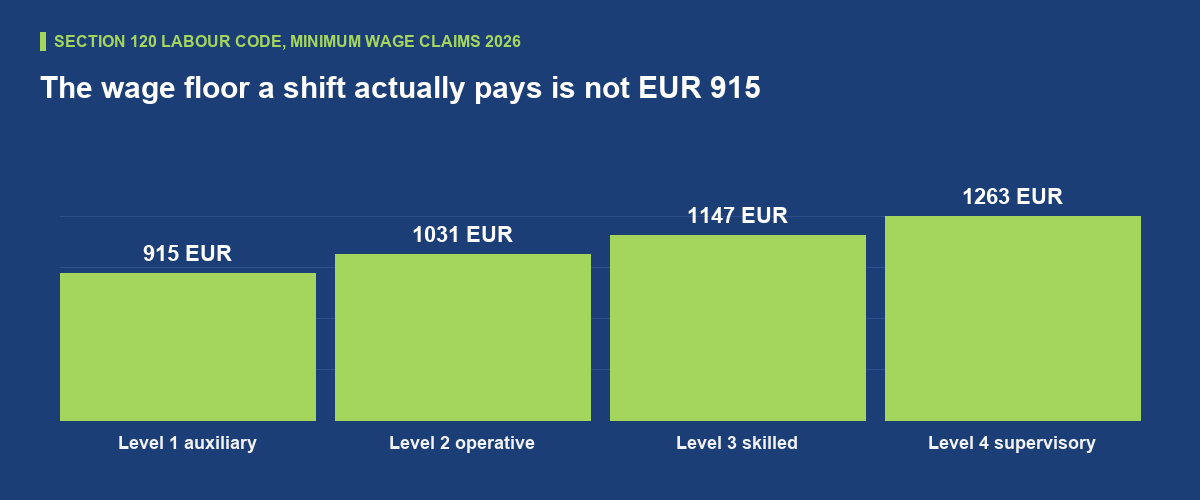
Below the comparison sits the statutory floor, and it is higher than the headline minimum wage. Slovak law grades every job into six degrees of work intensity under section 120, each with its own minimum wage claim. For 2026 the National Labour Inspectorate puts level 1 at EUR 915 a month and level 2, where a typical warehouse operative sits, at EUR 1,031; level 3 is EUR 1,147 and level 4 EUR 1,263. The base minimum rose 12.1 % on 2025, the steepest increase in years. An agency rate that undercuts your own payroll for the same picking role is therefore not a discount. It is a warning. The genuine savings sit elsewhere: in recruitment you do not run, vacancies you do not carry, and hours you can hand back – the scarcity problem we mapped in our post on labour availability as a site-selection factor.
The clock that runs against the warehouse
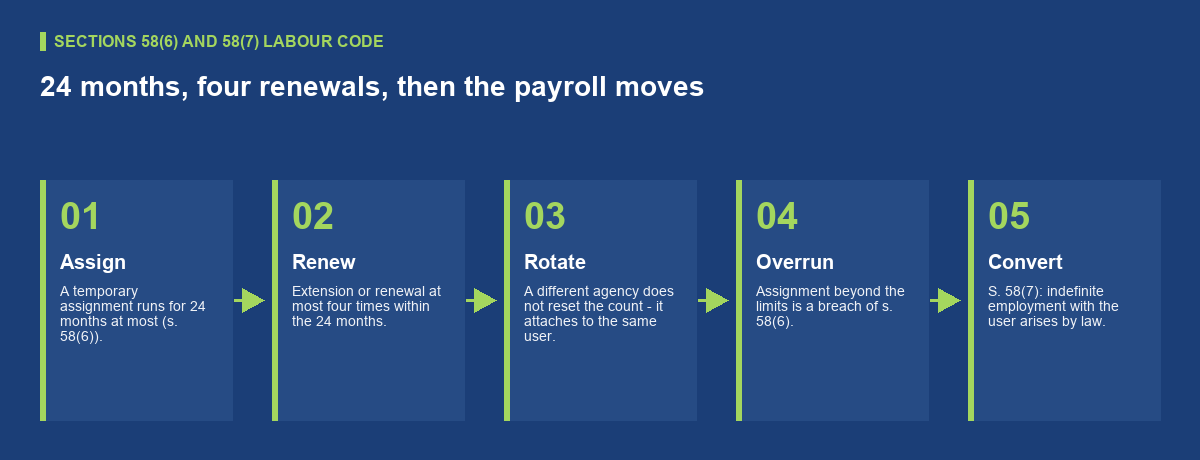
Section 58(6) sets the term: a temporary assignment may be agreed for 24 months at most, and it may be extended or renewed at most four times within those 24 months. The count attaches to the user undertaking, not to the contract. The provision says expressly that the limit applies even where a different employer or a different agency assigns the same employee to the same user. Rotating agencies does not reset the clock. A fresh assignment to the same warehouse within six months of the previous one counts as a renewal, not a new start.
The sanction is the part shift planners underestimate. Under section 58(7), an assignment in breach of those limits flips the contract. The employment with the agency ends by operation of law. In its place, an employment of indefinite duration arises between the worker and the user. Your flexible layer becomes permanent headcount automatically, and you have five working days to issue the written notice recording it. Nothing needs to be signed and nobody needs to agree. The practical consequence: the decision point on every agency worker sits around month 18, not month 24. By then the warehouse offers its own contract, returns the worker, or restructures the role. At month 24 the law decides instead.
The bill for equal pay lands on the user
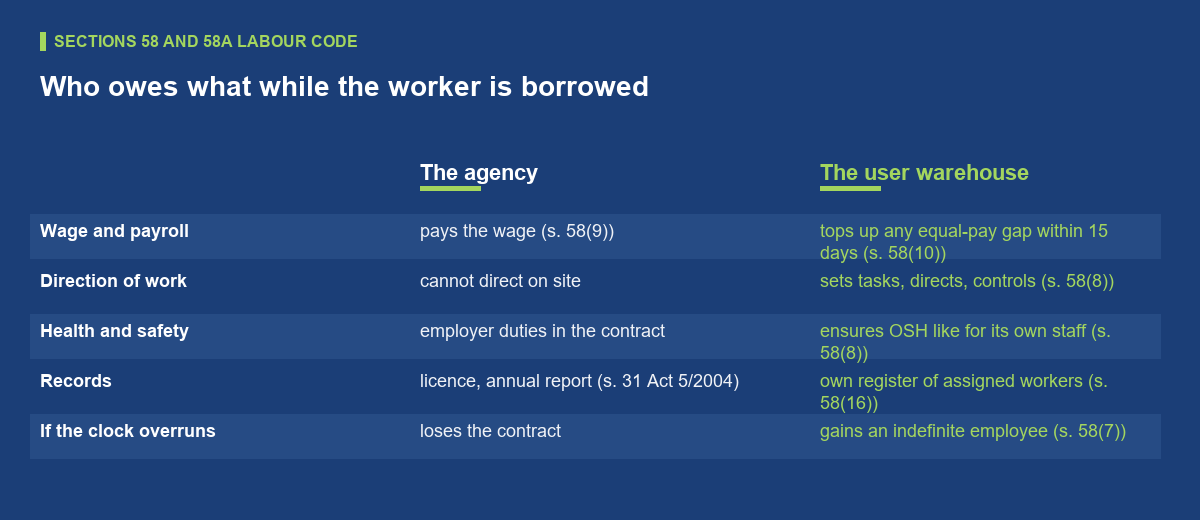
Equal pay is usually read as the agency’s promise. Section 58(10) turns it into the user’s debt. Where the agency pays the assigned worker less than the comparable employee earns, the user must pay the wage, or the difference, itself. The deadline is 15 days from the agreed pay date, with the statutory payroll deductions run as if the user were the employer. The duty applies equally where the worker is posted into Slovakia from another EU member state. A cheap agency is therefore not a transferred risk. It is a deferred invoice.
The statute also hands the user the tools to see the problem coming. Under section 58(14) the user must give the agency the conditions of the comparable employee, and under section 58a(4) the agency must hand back, on request, the data the user needs to check what was actually paid. The agreement between agency and user has mandatory contents under section 58a(2) – including, in letter (h), the number and date of the agency’s licence – and under section 58a(3) it is void unless made in writing. The practical discipline follows from the mechanics: name the comparator role in the agreement, price the assignment against your own payroll for that role, and treat any quote below it as the top-up you will later fund.
A licence list that is getting shorter
The agency side of the market runs on a permit. Under section 29 of Act 5/2004 on employment services, a temporary work agency is an employer licensed to hire people for the purpose of assigning them to user undertakings, and the central register of those licences is public. Section 29(2) draws one line worth quoting in negotiations: the agency may not charge the worker anything, neither for the assignment nor for taking a permanent job with the user afterwards; its fee comes from the user, in the agreed amount. Section 31 lists the ways a licence dies: no assignments for a year, a missing or false annual activity report, or a fine for illegal employment.
Enforcement has stopped being theoretical. In the week of 18 to 22 May 2026, 114 labour inspectors checked 173 temporary work agencies across the country and, per the ministry’s account, found suspected breaches of the ban on illegal employment at 71 entities, covering 126 people. The register itself tells the same story: 441 licensed agencies remain, down from more than 600 before the enforcement wave, and the ministry is preparing an amendment that would replace the once-a-year activity report with reporting during the year. For an occupier the checklist is short: confirm the licence in the register, confirm its number sits in the section 58a agreement, and remember that if the licence goes mid-assignment, the machinery of section 58 decides who inherits the people.
Where agency labour in Slovak logistics hits its edges
Three boundaries close the map. First, hazard: section 58(1) forbids temporary assignment to work classified in the 4th risk category, so the hardest environments in a plant cannot be staffed through an agency at all. Second, the third-country channel that much of Slovak warehousing quietly runs on: under section 21(4) of Act 5/2004, only an agency that has operated for at least three years may assign a third-country national holding a residence permit for employment, and only into occupations with a documented labour shortage in that region. Under section 21(6) the 45 % ceiling on third-country nationals in a workforce counts assigned workers at the user, not at the agency. A warehouse can hit the cap with people who are not on its payroll.
Third, the disguise. Section 58(2) presumes an assignment wherever a “service provider” has its people working mainly on your premises, mainly with your equipment, under your task-setting and supervision, in an activity your company has registered as its own business – unless the provider proves otherwise. The packing subcontractor in your hall is, on that test, usually an agency without a licence, and every rule above attaches retroactively. The structural alternatives sit outside the employment relationship altogether: hand the operation to a provider under the 3PL decision, or take the headcount out of the building – the direction of travel in warehouse automation and, at its far end, the automated high-bay warehouse.
Conclusion
Agency labour in Slovak logistics is a legitimate tool with a precise shape. Three numbers define it in any shift plan. Twenty-four months and four renewals per user undertaking, counted across agencies, with automatic conversion into your own indefinite hire at the end. One comparator: the assigned worker earns at least what your own comparable employee earns, from day one, with the top-up landing on you within 15 days when the agency falls short. And one licence number, checked against a public register that has shrunk from more than 600 entries to 441. The agency carries the payroll. The warehouse carries the consequences.