
A logistics park in Slovakia can be zoned for industry and still fail at night, because the national noise limits are measured at the nearest home, not at the park fence. Decree 549/2007, issued under the Public Health Act, sets 45 dB at night for a site’s own noise in front of the windows of homes, even beside a motorway. Inside an industrial zone, 70 dB applies. Corrections for tonal reversing alarms and for several operators shrink the real margin. This post sets out the values, the add-ons, who answers for them and what a lease for a 24/7 hall should say.
Which noise limits apply to a logistics site at night?
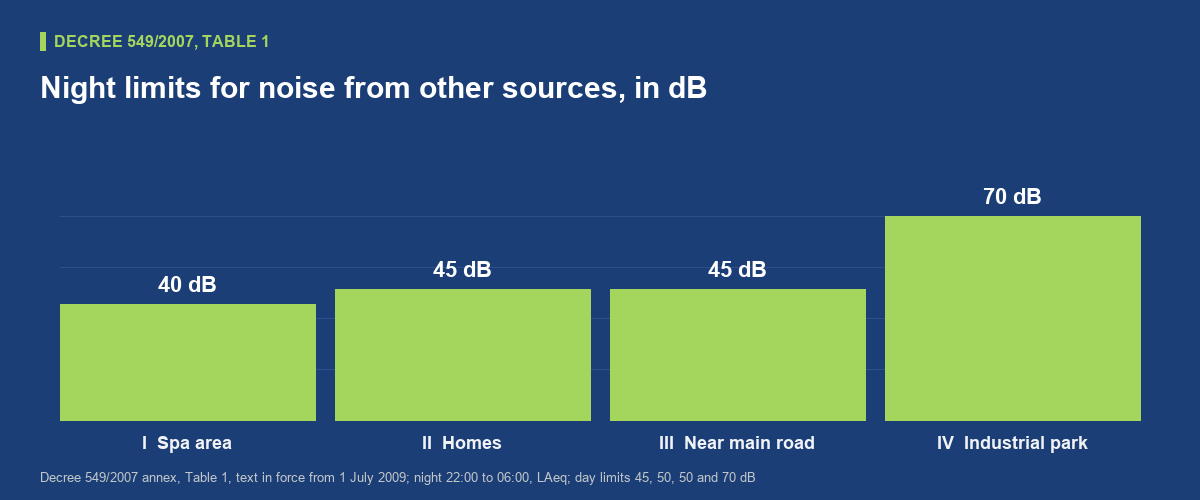
The values sit in Table 1 of the annex to Decree 549/2007 on noise, infrasound and vibration, which we read in the text in force since 1 July 2009. The only amendment so far is Decree 237/2009. The decree splits the day into three reference periods: day from 06:00 to 18:00, evening from 18:00 to 22:00 and night from 22:00 to 06:00. It sorts protected land into four categories and gives separate columns for road, rail and air traffic, and one for noise from other sources. That last column covers stationary sources and industrial activity, and it is the one that governs a hall’s own operation.
For other sources, the limits are equivalent A-weighted levels for day, evening and night. Category I, spa and treatment areas, allows 45, 45 and 40 dB. Category II, the space in front of the windows of homes, schools and hospitals and the open space of residential areas, allows 50, 50 and 45 dB. Category III is the same kind of land near motorways, main roads, railways and airports, and for other sources it stays at 50, 50 and 45 dB. The traffic columns are looser there, with 60 dB by day and 50 dB at night for roads, but a park’s own noise gets no such relief. Category IV, land without a residential function such as production zones, industrial parks and factory sites, allows 70 dB around the clock.
Why does the nearest house matter more than the park’s zoning?
The decree measures where people are, not where the noise starts. A protected space is an indoor or outdoor area where people stay permanently or repeatedly. In front of a building, noise is assessed 1.5 m from the façade and 1.5 m above the floor of the storey concerned (section 6(3)(b)); in open land, 1.5 m above the ground. A hall inside a category IV park therefore meets 70 dB at the park boundary and 45 dB at the first bedroom window beyond it, wherever that window is. The decree’s own examples of variable noise include car parks and deliveries of goods. We therefore read yard traffic, loading and refrigeration units as noise from other sources, not as road traffic.
Two more lines matter for a site plan. Offices and other workplaces that need quiet inside category IV are protected at 65 dB in front of the windows used to ventilate them (point 1.10). Noise inside the workplace itself is outside the decree under section 1(3)(a) and falls under the separate rules for employees in section 32 of the Act. The decree is therefore about the neighbours, and the night value decides whether a site can run a third shift. Where the docks, the yard and the trailer park face away from homes, that decision is taken at the drawing board, not in a dispute.
How do reversing alarms and several tenants push the number up?
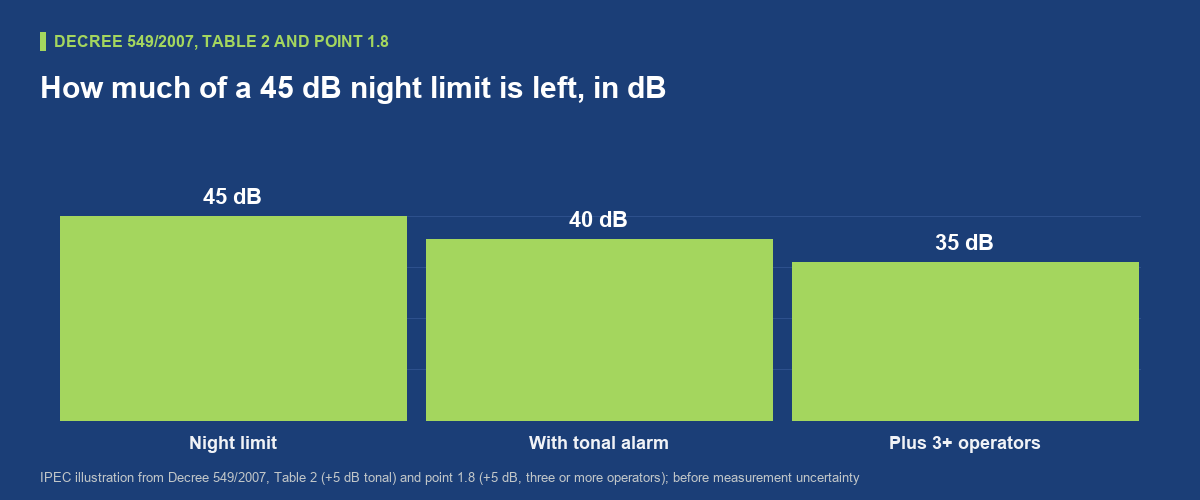
A measured level is not compared with the limit as it stands. Section 6(5) adds the expanded measurement uncertainty, and Table 2 of the annex adds corrections for specific noise: plus 5 dB for particularly disturbing or tonal noise and for ordinary impulse noise, and plus 12 dB for high-impulse noise. Only the highest correction applies in a given interval, and only for the time the specific noise lasts. The decree treats a sound as tonal when one third-octave band exceeds its neighbours by more than 5 dB and the tone is audible and disturbing. A classic beeping reversing alarm is built to do exactly that.
A multi-tenant park adds a second step. Under point 1.8, where noise from other sources exceeds the limit and comes from several operators, the assessed value of each operator is raised by 3 dB when there are two operators and by 5 dB when there are three or more. Our illustration in the chart shows what that means at night. A tenant with a tonal alarm, in a park whose combined noise already breaches the limit with two other operators, would need its own contribution near 35 dB at the window, before uncertainty. Measurement has a floor too. If the source is less than 3 dB above background noise, the decree says it cannot be determined clearly.
Who answers for the noise, and what can the authorities do?
Section 27(1) of the Public Health Act 355/2007, in the text in force since 1 August 2026, places the duty on whoever uses or operates a source of noise. Exposure of residents must be as low as possible and must not exceed the decree’s limits. In a leased hall that is normally the tenant running the trucks, the forklifts and the cooling. Section 27(3) reaches back to design. For a new or modernised source that raises the noise load, the limits must hold under the existing and the expected operating regime, and section 27(8) makes the builder prove it by measurement at the occupancy permit, done by a professionally competent person. In our reading, a file built on two shifts does not prove a third.
The regional public health authority gives binding opinions on the building intention, on trial operation and on the occupancy permit (section 13(3)), and the building office may decide only after a positive one (section 13(2)). Our glossary explains which office covers which district and what it checks. Breaching section 27(1) is an administrative offence with a fine of EUR 150 to EUR 20,000, up to double for a repeat (section 57). Proceedings must start within two years of the authority learning of the breach and within three years of the breach itself. After repeated proven breaches, a municipality may also restrict the operating hours of noise sources by ordinance (section 52(2)(a)). The permit file is the subject of our post on what a finished hall needs before it can open.
What should a lease for a 24/7 hall say?
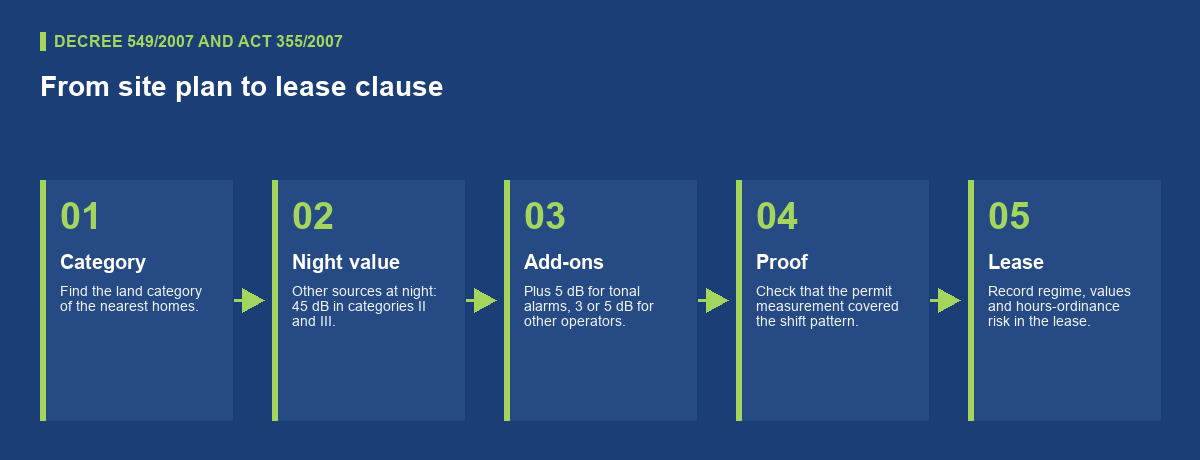
The decree does not ask who signed which contract, so the lease has to. Start with the facts: the land category of the nearest protected spaces, the operating regime that the noise study and the occupancy measurement assumed, and the measured night value with its date. If the tenant plans night shifts, say so in the heads of terms before the landlord’s file is fixed. The screening authority weighs noise as well, as our post on how the screening verdict is reached explains.
Then allocate. The tenant operates the source and carries section 27(1), so the lease should limit night activities that the permit file does not cover, require reversing alarms without a pure tone in the yard, and say who pays for a measurement the authority orders. The landlord controls the layout and the other tenants, so in a shared park it should commit to how yards and dock faces are allocated, which is where the multi-operator correction is won or lost. Finally, decide what happens if a municipal ordinance cuts operating hours: a change in law, a ground for a rent reduction, or the tenant’s risk. We would not leave that blank. The depth and orientation of the yard feed into this as well, as our post on the metres outside the dock shows.
Conclusion
Noise limits in Slovakia are set at the neighbour’s window, not at the park fence. At night, 45 dB applies to a logistics site’s own noise in front of homes, including homes beside a motorway, while 70 dB applies only inside the industrial zone. A tonal alarm and several operators can take 10 dB off the margin. Three steps keep a 24/7 operation on the right side: check the night value the permit file actually measured, plan the yard away from homes, and write the operating regime, the measurements and the risk of an hours ordinance into the lease.