
Industrial Park Solar Integration: A Comprehensive Guide to Implementation and ROI in 2026
With industrial energy costs on a steady climb, projected to rise 20-30% by 2030, facility managers and industrial park operators are under more pressure than ever to revamp their energy infrastructure. According to the latest figures from the U.S. Department of Energy, commercial and industrial solar installations hit unprecedented levels in 2024 ↗, showcasing a 13% year-over-year leap. Such growth marks a turning point in how industrial settings strategize their energy management, driven by both economic incentives and the urgency to go green.
Insight from the Solar Energy Industries Association (SEIA) underscores that commercial solar volumes thrived through 2025, with Q3 figures hitting 554 MWdc, up from 509 MWdc in 2024’s same stretch ↗. The steady climb, particularly palpable in industrial parks, signals that solar integration has shifted from a mere green initiative to an essential business strategy. Navigating the full arc of industrial solar deployment—from initial evaluation to ongoing operations—has become vital for facility managers and developers.
This guide delves into the cutting-edge happenings in industrial park solar integration, blending recent insights on costs, deployment techniques, and the technologies that are currently transforming the energy arena. We’ll show you how combined solar and storage solutions are delivering unparalleled returns while insulating industrial operations against the hike in energy costs and fluctuating regulations.
By dissecting current market trends and tech progressions, we aim to offer practical advice for property managers mulling over or preparing for solar installations heading into 2026 and beyond.
Current Market and Economic Influences
The solar sector for industries saw groundbreaking growth in 2024, with 24 states and territories generating over 5% of their power from solar, as highlighted by the U.S. Department of Energy. This widespread adoption is most vivid in industrial parks, where vast rooftops and high electricity needs create a prime setting for rolling out solar.

SEIA’s recent market assessment reveals that commercial and industrial solar installations set fresh benchmarks in 2024. This was spurred by cheaper technology costs and richer incentives. By late 2025, the cost of industrial-scale solar systems fell to $2.50-$3.50 per watt, marking a substantial economic leap over earlier years.
The federal Investment Tax Credit (ITC), promising a 30% incentive through 2032, continues to underpin project feasibility. This policy’s reliability has empowered industrial property owners to forge sweeping energy transition plans with more predictable financial outcomes.
Studies from Wood Mackenzie highlight that businesses embracing solar in industrial parks saw energy costs dip 40-60% in 2024, with some reporting even bigger savings when pairing solar with storage solutions. These tangible returns have swung the dialogue from ‘should we’ to ‘how should we’ optimize solar setups for the best payoff.
ESG criteria have emerged as another potent catalyst, with investors increasingly favoring industrial properties that demonstrate a clear dedication to sustainability through renewable energy initiatives.
Innovative System Designs for Photovoltaic Energy
The latest in technology has greatly boosted the efficiency and dependability of industrial solar setups. Data from the National Renewable Energy Laboratory (NREL) shows that commercial solar panel efficiency reached new peaks in 2024, with leading panels hitting 23-25% conversion rates in real-world situations.

SolarEdge’s unveiling of their CSS-OD system in December 2024, tailored for industrial use, underscores the industry’s shift towards specialized solutions. This system, showcasing a 102.4 kWh battery and scalable inverters up to 1 MWh, mirrors the trend towards combined solar and storage solutions that enhance self-use and manage peak demand.
Operators of industrial parks are increasingly leaning on smart energy management systems that use AI to forecast usage patterns and maximize solar production. These systems had an average performance bump of 15-20% in 2024 versus traditional fixed solar configurations.
Incorporating commercial EV charging stations has become a standard part of industrial solar projects. Studies from 2025 indicate that pairing solar arrays with EV charging can improve project ROI by 12-15% through fresh revenue streams and happier tenants.
Flexible design strategies are gaining traction, enabling industrial parks to upscale their solar power in stages while ensuring efficiency remains high. This adaptability is especially valuable for buildings housing multiple businesses with varied energy demands.
Energy Storage and Grid Connection Solutions
The component of energy storage in industrial solar installations has significantly progressed, with about 31.1 GWh of storage capacity added in the U.S. during 2024. This surge signifies a broadening awareness of storage’s vital role in maximizing solar investments.
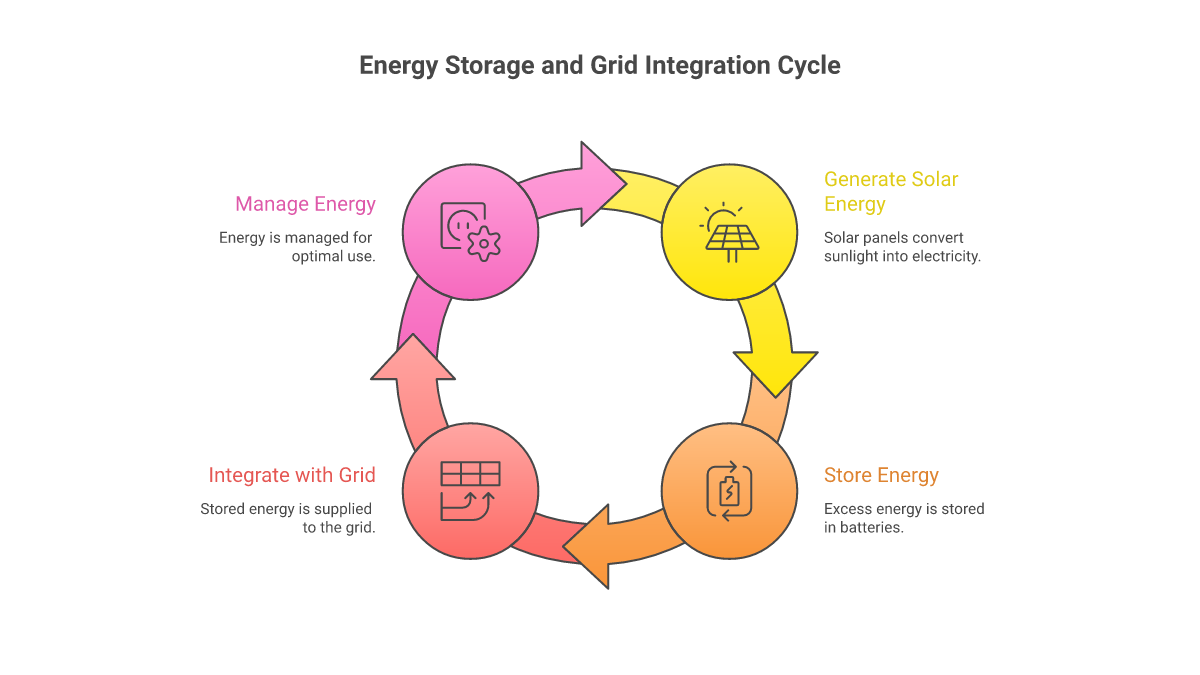
Current market data spotlights the global energy storage systems market, which hit $485.25 million in 2024 and is forecast to hit $1,835.95 million by 2030 ↗. This explosive growth is most apparent in the commercial and industrial sphere, where solar energy storage solutions foster comprehensive energy management strategies.
Advancements in battery technology have considerably strengthened the case for storage inclusion. Today’s industrial storage systems boast 85-90% round-trip efficiency, paired with operational lifespans that exceed 15 years. This durability aligns seamlessly with industrial solar installation timelines, yielding impressive combined ROI projections.
Grid connection features have made leaps forward, with cutting-edge inverters allowing industrial sites to provide grid services while ensuring a steady internal power supply. These advancements generated extra income for early adopters in 2024, with some reporting a 8-12% uptick in project economics from grid service involvement.
The push for DC-coupled storage systems is gaining traction, showing 5-8% greater system efficiency compared to AC-coupled options in industrial settings.
Implementation Tactics and Solar Investment Insights
Successful solar projects in industrial spaces start with thorough site evaluations and energy audits. Case studies from 2024-2025 show that facilities performing in-depth pre-installation analyses realized 25-30% superior performance compared to a less tailored approach.
Project phasing has surfaced as a critical success element, with data showing industrial sites implementing solar in targeted phases realized 15-20% better ROI than single-phase projects. This tactic allows for adjustments based on actual performance data and shifting facility demands.
The criteria for picking vendors have morphed to focus on long-standing partnership capabilities rather than simply initial costs. Research shows projects prioritizing vendor expertise faced 40% fewer operational hiccups in their first year.
Financial Planning and Return on Investment Analysis
Financial strategies for industrial solar endeavors have grown more refined, factoring in multiple value streams beyond just energy savings. Data from 2025 shows that well-structured projects repeatedly hit internal rates of return (IRR) between 12-18% over a 25-year horizon.
Power purchase agreements (PPAs) have become more malleable, with some industrial parks achieving rates 30-40% below utility costs while keeping operation flexibility intact. This model is especially appealing for facilities with multiple tenants looking to minimize upfront costs and boost energy savings.
The addition of battery storage to the mix has revolutionized project economics, often trimming payback periods by 2-3 years in industrial settings compared to standalone solar systems.
Operational Factors and Upkeep
Modern solar setups for industries are benefiting from advanced monitoring and predictive maintenance tools. Data from 2024-2025 indicates that AI-driven monitoring systems slashed unexpected downtimes by 60% compared to traditional models.
Operations and maintenance (O&M) expenses have dropped notably, with recent averages showing annual costs of $12-15 per kW for industrial systems. These savings stem from heightened equipment reliability and improved remote monitoring tools.
Performance guarantees have become more inclusive, with top-tier providers offering uptime guarantees over 98%, backed by cutting-edge weather normalization algorithms.
Preventive maintenance strategies now include drone checks and thermal imaging, reducing inspection costs by 40-50% while enhancing issue detection.
System upgrade possibilities have become increasingly critical, with modular designs supporting future capacity increases and tech upgrades without interrupting current operations.
Looking Ahead: Future Trends and Considerations
The industrial solar realm is racing forward, with emerging trends setting the stage for future setups. Studies suggest that bifacial solar panels, which could boost energy output by 5-15% in industrial scenarios, are expected to become commonplace by 2027.
Integration with microgrids is gaining popularity, with 35% of new solar setups in 2024 already incorporating these capabilities. This shift highlights a growing push for energy security and greater independence from the grid.
The use of AI and machine learning is poised to enhance system performance by 10-15% in the coming three years through improved forecasting and optimization features.
The merging of solar, storage, and EV charging infrastructure is speeding up, with integrated solutions anticipated to command new installations by 2027.
Regulatory landscapes are changing, with many areas introducing policies to support the participation of industrial solar setups in virtual power plants.
Wrapping Up: The Path Forward for Industrial Solar
The industrial park solar sector stands at an electrifying point, where technological strides, market development, and enticing economic conditions are propelling unprecedented adoption. The numbers are clear—well-prepared and implemented solar projects provide substantial value to industrial property owners and tenants alike.
For facility managers and developers thinking about renewable energy investments in industrial settings, the blueprint for success involves detailed planning, strategic technology choices, and careful system integration. The proven ROI metrics and operational gains offer a convincing argument for investment.
As we glance towards 2027 and beyond, the continuous advancement of technology and market mechanisms hints that early adopters will secure significant competitive advantages while laying down sustainable energy foundations for the future.